Canon PowerShot G · on sale autumn 2008
The Canon PowerShot G10: the compact with more pixels than most enthusiasts wanted
Sold under the same name in the Americas, Europe and Japan.7
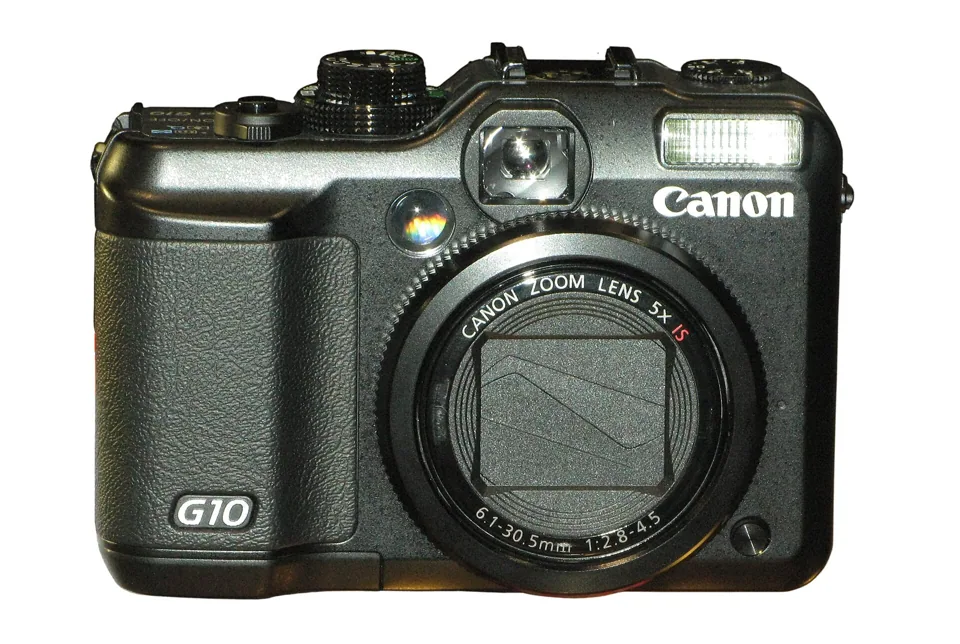
In 2008 Canon gave the G series the 28 mm wide angle enthusiasts had been requesting and, unasked, a jump to 14.7 megapixels. At base ISO DPReview found it the highest-resolving compact it had tested, then spent pages explaining why a cheaper Panasonic held up better as sensitivity rose.
- Launched
- October 2008
- Sensor
- 14.7 MP CCD
- Lens
- 28–140 mm, 5×
- Card
- SDHC, SD, MultiMediaCard
- Battery
- NB-7L
Canon PowerShot G10 specs: sensor, lens, battery, memory card and cable
Launched in October 2008 at $499.99, the Canon PowerShot G10 is a 14.7 MP CCD compact with a 28–140 mm (35 mm equivalent) 5× zoom lens. Inside: it runs on the NB-7L battery. Sources
- Sensor
- CCD, 1/1.7", 14.7 MP source
- Lens
- 28–140 mm equivalent, 5× zoom source
- Memory card
- SDHC, SD, MultiMediaCard source
- Battery
- NB-7L source
- USB / A/V cable
- IFC-400PCU, AVC-DC300 Confirmed · all Canon cables
Meet the camera
DPReview described a body that is nearly all metal, with only the battery door and port cover in plastic, and said it was one of the few compacts that feels as well built as a Canon 40D or 50D.1 It is heavy for a compact. Canon's figure for the body alone is about 350 grams, at 109.1 by 77.7 by 45.9 millimetres;7 Cameralabs gave 397 grams with the battery, and DPReview gave 402 grams, 40 more than the G9.31 PhotographyBLOG compared its build with a war photographer's Leica and said it would survive being bashed about.2
Canon announced it on 17 September 2008. The US price was an estimated $499.99 for October, and Canon UK's release gave £499.99 or €649.99 including VAT.56 PhotographyBLOG's review, written a month later, printed $499 and a UK figure whose currency sign is garbled on the page we read (449), so we do not rely on that one.2 DPReview's spec sheet, in a review dated 25 November, listed a street price of $456 in the US and £370 in the UK, and Adorama said about $460.14 Canon's museum gives October 2008 as the marketing month.7
Why this one was interesting
The wide angle arrived
The G9 started at 35 mm and reached 210 mm. The G10 starts at 28 mm and stops at 140, and the three reviewers who weighed in mostly welcomed the trade. Cameralabs said a wider lens was one of the most requested changes, and wrote that it much preferred the new range despite the loss of reach.3 PhotographyBLOG argued that gaining 7 mm at the wide end matters more than losing 60 mm at the long end, for narrow streets and crowded rooms.2 DPReview agreed it was arguably more useful, while pointing out that f/2.8 to f/4.5 is barely faster than before and that Canon's 1.4x tele converter takes the long end to a 196 mm equivalent.1 DPReview also found barrel distortion of 1.2 per cent at the wide end and none at the long end.1
More pixels, on purpose
Resolution rose from 12.1 to 14.7 megapixels. Cameralabs called it the headline enhancement and also "one which few enthusiasts asked for".3 DPReview had criticised the G9 for exactly this and wrote that Canon had not addressed it, only increased it.1 Canon UK's release promised the highest resolution of any PowerShot and "extremely low noise levels" from the new DIGIC 4 processor.6
DIGIC 4 and its small new tricks
The processor brought better face detection, with tracking of up to 35 faces and a better lock on profiles, plus a Servo AF mode that follows an approaching subject.3 Cameralabs added a Face Timer that waits for a new face to enter the frame and fires two seconds later, and i-Contrast, which lifts shadows at the price of more noise there.3 Video moved to H.264, which Cameralabs measured as roughly a third smaller than the G9's files at the same quality.3 DPReview, for its part, put the new battery at 1050 mAh against 720 mAh for the G9's, and Cameralabs said it lifted the CIPA figure from 240 shots to 400 with the screen on.13
The family around it is reviewed here: the PowerShot G9 before it, and the G11, S90 and G7 X after. Its rival of the moment has its own page: the Panasonic Lumix DMC-LX3.
What was lost
The longer lens went, and so did the old battery: Cameralabs noted that spares for the G9 no longer fit.3 Video lost its 1024 by 768 and 160 by 120 modes and the G9's time-lapse movie mode, and still had no zoom while recording.31 Cameralabs thought the biggest miss was high-definition video, which Panasonic's LX3 already offered, and noted there was no HDMI or component output either.3 Cameralabs added that Canon had held back scene recognition on every 2008 compact, where Panasonic offered it throughout.3
Burst shooting kept slipping. Canon lists about 1.3 frames a second,7 Cameralabs measured 1.4 for JPEGs and 0.8 for raw and called it getting slower with every G generation, and DPReview measured 1.53 for JPEGs with focus fixed, 0.94 with continuous focus and 0.8 for raw.31 Adorama's text, though, put the raw figure at 0.7.4
The dark: its weak point
Three of the four reviewers reached the same corner. At ISO 80 the picture is superb, they said; from ISO 200 or 400 it declines. DPReview wrote that noise reduction begins to smear detail from about ISO 200, that ISO 800 and 1600 are almost pointless and that the 3200 scene mode is a waste of time; it also noted that Auto ISO stops at 200, and that the camera offers no control over noise reduction.1 PhotographyBLOG saw noise at ISO 400 and called 800 and 1600 virtually unusable.2 Cameralabs said 200 shows noticeable softening and that 800 is as far as you would want to go, and then only for small reproduction.3


Real photographs taken with this camera. The sensitivity shown is recorded in each file's EXIF data; we cannot say what other settings or processing were used.
Adorama's lab report, built from DxOMark measurements of raw files, put numbers on this. Signal-to-noise ratio was acceptable only at ISO 80, around 20 dB at ISO 400 and 18 dB at ISO 800, and dynamic range fell from about 9.5 stops at ISO 80 to about 5 at ISO 1600, for an overall score of 37.8 out of 100 that Adorama still called good for a compact.4 A caption in the same article said ISO 800 was still fine for a decent 8 by 10 print.4
The reviewers disagreed on how the G10 compared with its own predecessor. DPReview found noise slightly better than the G9's from ISO 200 up despite the extra pixels, and Adorama said high-ISO performance was noticeably better.14 Cameralabs called noise roughly similar to the G9's at 100 per cent, and PhotographyBLOG called it on a par.32
The verdict that stuck came from DPReview, which set the G10 against Panasonic's LX3 and found the LX3 kept more detail from ISO 400 up, with fewer pixels.1 Cameralabs agreed the LX3 had lower noise throughout at 100 per cent, though without the G10's detail at the lowest sensitivities.3 DPReview's real-world shots complicated that: even at ISO 80 it saw more noise in the G10's sky and less fine detail in flat-colour areas and foliage than from the LX3, and it found the LX3 noticeably better on chromatic aberration.1 Our LX3 review has the other side.
Like that look? See recent eBay sold listings for this camera ↗
On eBay right now
Live listings for this camera, supplied by eBay and updated automatically. We earn a commission if you buy through them.
The little wins
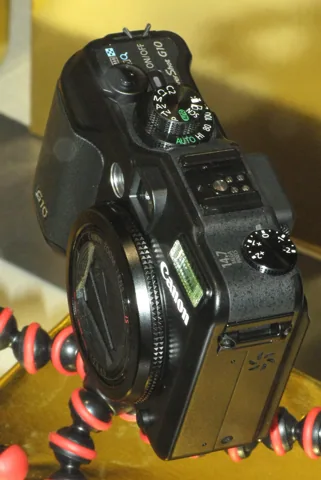 The top of the G10 with its mode, ISO and exposure-compensation dials. · Rama · CC BY-SA 2.0 fr · Commons
The exposure dial
A dial for exposure compensation now sat on the top left, with the ISO dial moved to the right under the mode dial. PhotographyBLOG said it encourages fine-tuning and beats the systems on almost every other compact.2 Cameralabs found the two-tier dials easy to turn independently even in gloves, and stiff enough not to move in a pocket.3
A built-in ND filter
A three-stop neutral-density filter, switched on from the Function menu, lets you use long exposures or wide apertures in bright light without a screw-on filter.31
Macro to a centimetre
Canon, PhotographyBLOG and DPReview all give 1 cm at wide angle. DPReview found the wide macro distorted with soft corners, and said the G10 at 140 mm gave better magnification than the G9 had at 210 mm.721
Raw that was usable
DPReview called raw surprisingly fast, with about 3 seconds to write a raw file to a card and no penalty for raw plus JPEG; Cameralabs found a raw file converted with Canon's software visibly less “cooked” than the camera's JPEG.13 DPReview added that highlights recover only a little, while shadows recover well.1
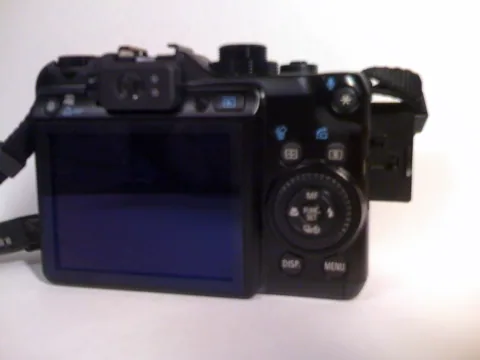 The back of the G10, showing the 3-inch screen, thumb wheel and buttons. · ESSch · CC BY 3.0 · Commons
A screen that doubled
Still 3 inches, but now about 461,000 dots against 230,000 on the G9. Cameralabs called the viewing angle impressive, and in its verdict one of the best screens it had seen on a compact; PhotographyBLOG and DPReview both said it collects fingerprints.321
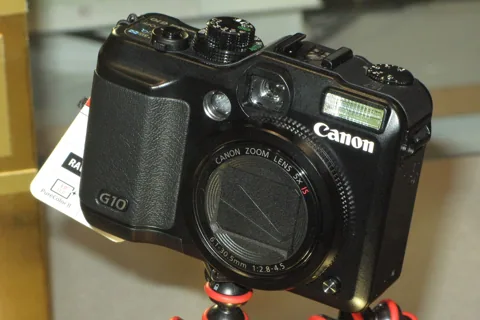 The G10 from the front with its hot shoe empty. · Rama · CC BY-SA 2.0 fr · Commons
A real hot shoe
Canon recommends the 220EX, 430EX II and 580EX II.7 Cameralabs said the 430EX II and 580EX II get the same built-in control as on Canon's SLRs, though the larger guns are awkward on a small grip; DPReview called the big flashes almost impractical.31
How it drew the picture
At base sensitivity the numbers are striking. DPReview's chart test gave 2450 horizontal and 2500 vertical lines per picture height, which it called the highest-resolving compact it had tested at base ISO, ahead of the LX3 and the Nikon P6000.1 Cameralabs measured 2450 from JPEGs and 2600 from raw, about 10 per cent over the G9, but saw the figure fall to 2000 at f/8 because of diffraction, so its best results came with the aperture wide open.3 Cameralabs also found more detail than a Canon EOS 450D with its kit lens at the lowest sensitivities, with a fine texture of noise even at ISO 80.3
The reviewers disagreed on the files themselves. PhotographyBLOG found the 14.7-megapixel JPEGs a little soft at default sharpening, where Cameralabs and DPReview both said the camera sharpens heavily.231 PhotographyBLOG found chromatic aberration excellently controlled; DPReview called it quite bad towards the corners of the frame at the wide end.21 DPReview added a warning about highlight clipping in high-contrast scenes, though it called it not particularly bad for such a tightly packed sensor, and PhotographyBLOG liked the colour: punchy but not inaccurate, with excellent night and macro work.12

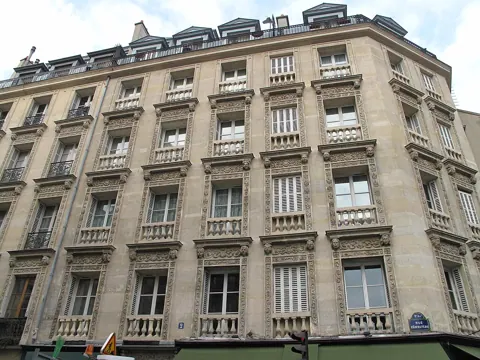
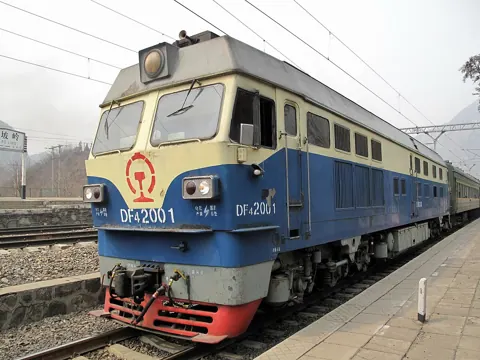














Photos taken with this camera, from Wikimedia Commons, credited under each picture.
Where it let you down
The optical viewfinder shows about 77 per cent of the frame; DPReview thought it almost unusable and PhotographyBLOG found it murky indoors, though Cameralabs valued it for bright light and for stretching battery life to about 1000 shots.7123 The battery and card door is still blocked when the camera sits on a tripod,13 DPReview found the rear wheel awkward to turn one-handed, and it said the new battery can be put in the wrong way round.1 PhotographyBLOG disliked that face detection is buried in a menu.2
Speed was a mixed story. DPReview timed about 1.0 second from off to ready, half-press focus at 0.2 to 0.4 seconds at wide angle and 0.7 to 0.9 at full zoom, and said focus can hunt in low light and in macro.1 Cameralabs said start-up took a fraction over a second and focusing felt a little quicker than the G9, while PhotographyBLOG put power-up at about 1.5 seconds.32 The shot-to-shot time was 2.0 seconds for a Superfine JPEG in DPReview's test.1
The G10 also had cheaper company. DPReview noted that for about the same money you could buy a Canon Rebel XS, a Sony A200 or a Nikon D40, and Cameralabs compared it with the SX10 IS, a 20x zoom with a flip-out screen at about 25 per cent less, though without raw.13 Cameralabs also used a Canon IXUS 870 IS in its noise comparison; our SD880 IS review covers that camera.3
What the reviewers said in 2008
| Outlet | Date | Verdict |
|---|---|---|
| PhotographyBLOG | 27 Oct 2008 | Design 5, features 5, ease of use 4.5, image quality 4.5, value 4 out of 5. "the best ever Canon G-Series camera", but it withheld a whole-hearted recommendation because of ISO 400 noise and a price close to a Rebel XS.2 |
| DPReview | 25 Nov 2008 | Recommended. Scores out of 10: build 9.5, ergonomics 9.0, features 9.5, image quality 8.0, optics 9.0, performance 8.5, value 7.0. It called the camera a "flawed gem".1 |
| Adorama | 2 Dec 2008 | No score. Called image quality awesome, better than the G9 and than other cameras of its size, and the G10 "the best in its class"; its lab report rated image quality 37.8 out of 100.4 |
| Cameralabs | 12 Oct 2009 (page date) | 90 per cent: build 19, image quality 18, handling 17, specification 18, value 18, each out of 20, relative to 2008 compacts. Preferred it to the LX3 for zoom range, controls, screen and battery life, while saying the choice is swings and roundabouts.3 |
The timeline
- 17 September 2008Canon announces the G10; Imaging Resource and PhotographyBLOG report $499.99 for the US and £499.99 / €649.99 for the UK.56
- October 2008Planned US availability, and Canon's marketing month.57
- 27 October 2008PhotographyBLOG publishes its review.2
- 25 November 2008DPReview publishes its review.1
- 2 December 2008Adorama publishes its camera test.4
- 12 October 2009Date on Cameralabs's review pages.3
Should you buy one now?
Buy one if you want a weighty CCD compact with raw files, a hot shoe and real dials, and you will mostly shoot in good light at low ISO. It was listed at about $500;5 what it sells for now is a question for the sold listings, not for us. Before you bid, check these:
- The name. Canon used the same PowerShot G10 name in all three regions, so one search covers it.7
- The battery. It uses an NB-7L, not the G9's battery;73 a fresh one is on Amazon ↗.
- The card. It takes SD, SDHC and MMC cards;7 see our memory card guide.
- Dust inside the lens. Cameralabs reported that several G9 owners complained of dust on the sensor, that Canon had reported no change to the G10's lens assembly, and so assumed the G10 could be equally susceptible; it had not seen the problem in testing.3 Look for specks in a blue-sky shot at a small aperture.
- The screen. It was a fingerprint magnet;21 check for scratches and dead pixels.
- The dials. Cameralabs found them stiff enough to stay put in a pocket,3 so loose ones are a warning sign.
- The cable. The USB port is a mini-B socket;7 see our cable guide.
- The lens. Check that it extends and retracts cleanly.
If you are wondering why cameras like this are being hunted down again, we tell that story once, in Pictures that never left the card.
See recent sold prices on eBay ↗Shop on eBay ↗NB-7L battery ↗
Sources
- DPReview, Canon PowerShot G10 review by Don Wan (25 Nov 2008; all sections read except the three side-by-side comparison pages)
- PhotographyBLOG, Canon PowerShot G10 review by Mark Goldstein (27 Oct 2008; all six pages read)
- Cameralabs, Canon PowerShot G10 review by Gordon Laing (page dated 12 Oct 2009; text written as a launch-era review; pages 1 to 7 and 10 read)
- Adorama Learning Center, Camera test: Canon PowerShot G10 by Jason Schneider (2 Dec 2008), with a lab report from DxOMark data
- Imaging Resource, Canon replaces PowerShot G9 by Mike Tomkins (17 Sep 2008), with specification table (planned price $499.99, October 2008)
- PhotographyBLOG news, Canon PowerShot G10 (17 Sep 2008), including Canon UK's press release (£499.99 / €649.99 including VAT)
- Canon Camera Museum, PowerShot G10 (marketed October 2008; specifications)
Camera photos by Rama (CC BY-SA 2.0 fr), Hiroshi UZU (CC BY 2.0) and ESSch (CC BY 3.0); other photographs are credited under each one, all via Wikimedia Commons. Links to eBay and Amazon are affiliate links.