Canon PowerShot ELPH / IXUS · 2008
The Canon PowerShot SD880 IS (Digital IXUS 870 IS): the 28 mm ELPH that waits for you to step into the frame
Sold in Europe as the Digital IXUS 870 IS and in Japan as the IXY Digital 920 IS.
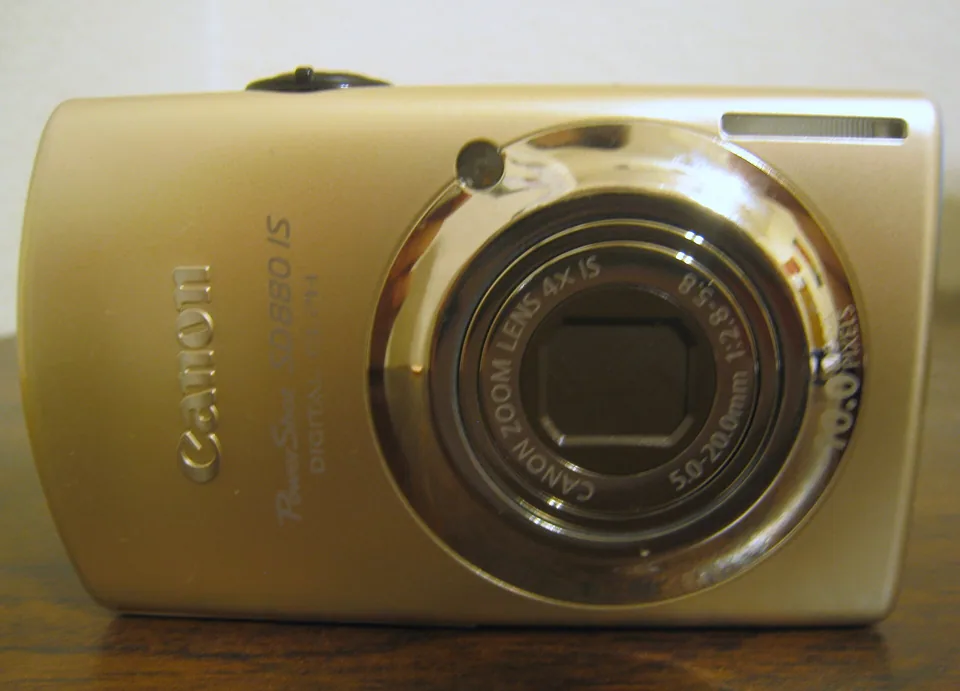

In September 2008 Canon took its stabilised 28 mm pocket camera to 10 megapixels and a 4x zoom, gave it bigger buttons and a self-timer that watches for a new face. Three reviewers liked the controls and the picture-taking; between them they listed the same gaps: no HD video, no manual exposure, no live histogram.
Canon PowerShot SD880 IS specs: sensor, lens, battery, memory card and cable
The Canon PowerShot SD880 IS (also sold as the Digital IXUS 870 IS and IXY Digital 920 IS) came out in September 2008 at $299.99 as a 10 MP CCD compact with a 28–112 mm (35 mm equivalent) 4× zoom lens. It runs on the NB-5L battery. Sources
- Sensor
- CCD, 1/2.3", 10 MP source
- Lens
- 28–112 mm equivalent, 4× zoom source
- Memory card
- SDHC, SD, MultiMediaCard source
- Battery
- NB-5L source
- Also sold as
- Digital IXUS 870 IS · IXY Digital 920 IS
- USB / A/V cable
- IFC-400PCU, AVC-DC400 Confirmed · all Canon cables
Meet the camera
It is a metal ultracompact that Canon sold in gold or silver, 23.6 millimetres deep, which the maker's museum page says is 2.3 millimetres slimmer than the model it replaced.1 PhotographyBLOG, which liked the gold front plate, called it a camera for the style-conscious and noted that it is shorter and narrower than an Apple iPhone, though thicker.2 Cameralabs was less enthusiastic about pockets: at 94 by 57 by 24 millimetres and 180 grams with battery, it thought the camera better suited to a bag or a coat than to a shirt or trouser pocket.4
It had three names. Canon lists the PowerShot SD880 IS Digital ELPH for the Americas, the Digital IXUS 870 IS for Europe, Asia and Oceania, and the IXY Digital 920 IS for Japan.1 Canon's museum page gives the date as September 2008 and shows no price;1 Imaging Resource listed US availability from October 2008 at an MSRP of $300, and PhotographyBLOG gave a recommended price of $299.99.32 It replaced the IXY Digital 910 IS, which is the PowerShot SD870 IS in our catalogue.1
- Sensor
- 10.0 MP CCD, 1/2.3" (10.3 MP total)1
- Lens
- 4x, 28–112 mm equiv., f/2.8–5.8, lens-shift stabiliser1
- Video
- 640 × 480 or 320 × 240 at 30 fps, H.264 in a MOV file, mono sound1
- Card and battery
- SD/SDHC (MMC family also listed) · NB-5L, about 310 shots per charge (CIPA)1
- Size
- 93.8 × 56.8 × 23.6 mm, about 155 g body only1
Why this one was interesting
DIGIC 4, and what it did for faces
Cameralabs called the new DIGIC 4 processor probably the most significant upgrade, and credited it with the H.264 video codec, better profile handling in face detection and a servo autofocus mode that keeps tracking while the shutter button is held half down.4 In its tests the camera held onto a face turning to profile longer than DIGIC 3 models had, and tracked an oncoming subject in servo mode.4 PhotographyBLOG described the face self-timer: press the shutter, walk into the scene, and about two seconds after the camera sees a new face it takes its shots.2 Imaging Resource described the same feature as a self-timer that will not fire until you are in the scene, and added that a Face Select function, assignable to the Print/Share button, lets you pick which face in a group the camera follows.3
Buttons that were worth the redesign
Imaging Resource went furthest: the best button layout it had seen on a PowerShot, with large asymmetrical keys that follow the curve of the short edge, its one complaint about them being how little room they leave beside the screen.3 PhotographyBLOG found the new buttons bigger and easier for a thumb to find,2 and Cameralabs welcomed a conventional turning wheel in place of the predecessor's touch-sensitive circle, which it had often found frustrating.4
A 4x lens that still started at 28 mm
The zoom grew from 3.8x to 4x, all of it at the long end.13 Cameralabs doubted that 7 millimetres of extra reach mattered in practice, but valued the 28 mm wide end, which it called a rare spec among Canon's compacts of the time.4 PhotographyBLOG judged this lens wider, better at macro and sharper off-centre than the one on the bigger IXUS 980 IS.2
That 980 IS is the PowerShot SD990 IS, which Cameralabs said you would need if you wanted manual exposure control from an IXUS or ELPH.4 Canon's museum dates the PowerShot SD940 IS to August 2009; our SD940 IS review covers it.
What was lost
Cameralabs listed two things the SD870 IS had and this did not: the time-lapse movie feature, and compatibility with the old underwater housing, because the body is slimmer; Canon offered a new WP-DC26 case good to 40 metres.4 The same reviewer found that the jump from 8 to 10 megapixels made little difference to real-life detail, and saw no perceptible gain in noise reduction over the predecessor, whatever DIGIC 4 promised.4
The dark: its weak point
All three treated about ISO 400 as the upper end of comfortable use, give or take a stop. PhotographyBLOG found base ISO suited to large prints, ISO 400 possibly good enough for a mid-sized one, a drop at 800 and worse at 1600.2 Imaging Resource's lab saw minimal noise to ISO 400 but detail traded away from about ISO 200, and printed ISO 80 at up to 16 by 20 inches, 200 and 400 at 11 by 14, 800 at 8 by 10, and 1600 at 5 by 7 (better at 4 by 6).3 Cameralabs compared it with the Panasonic FX35 and Sony T77: at ISO 400 Panasonic showed the most noise, Sony smeared with noise reduction, and Canon sat in between; 200 or below, or 400 at a push, it concluded.4
The 3200 setting is a scene mode at 2 megapixels. PhotographyBLOG would skip it unless the picture is for the web, as heavy noise reduction left it too blurry for any print, and Imaging Resource said it was not worth printing.23 The lens helps indoors: Cameralabs' ISO 800 shot of an interior at f/2.8 ran at 1/20 second, which it said the stabiliser kept steady, and its ISO 1600 shot at 1/125 second showed a significant drop in quality.4 PhotographyBLOG says the Long Shutter setting allows exposures up to 15 seconds, with a second pass of noise reduction that doubles the time.2
The sources differ on the base ISO. Canon and PhotographyBLOG list 80 as the lowest setting; Imaging Resource's overview text gives 100 as the minimum while its own spec table and test shots show ISO 80.123
Like what you read? See recent eBay sold listings for this camera ↗
On eBay right now
Live listings for this camera, supplied by eBay and updated automatically. We earn a commission if you buy through them.
The little wins
Face Self-Timer
It waits until a new face enters the frame, pauses two seconds, then takes three shots, according to Cameralabs; PhotographyBLOG says the number of shots can be set.42
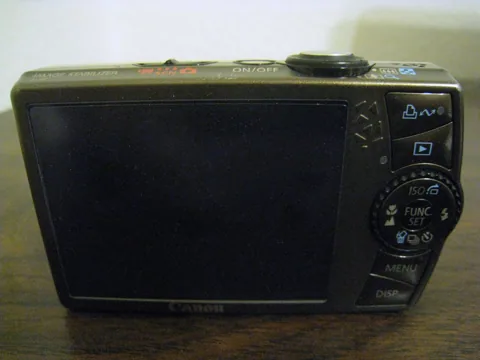 The back of an SD880 IS. Mahanga · CC BY-SA 3.0 · Commons

The new rear controls
Larger buttons shaped to the body, and a wheel that turns instead of a touch circle.34
Focus check in playback
Cameralabs liked the playback view that magnifies the active focus area, and shows the main face if face detection was used, so you can check expressions.4
How it drew the picture
PhotographyBLOG scored image quality 4 out of 5: good for a small sensor with many pixels, nice and not oversaturated colour, sharpness excellent over most of the frame, only the extreme corners blurred.2 Its main complaint was highlight clipping in contrasty light, severe enough that protecting highlights would have left the rest looking underexposed even with i-Contrast on.2 Imaging Resource found the wide end slightly soft in the corners but with less softening than most rivals, barrel distortion of about 0.4 percent at wide angle and moderate chromatic aberration, and called the colour generally good with slightly oversaturated reds.3 Cameralabs found a natural look, sitting between the softer Panasonic FX35 and the more sharpened Sony T77, and noted a little fringing only on close inspection.4




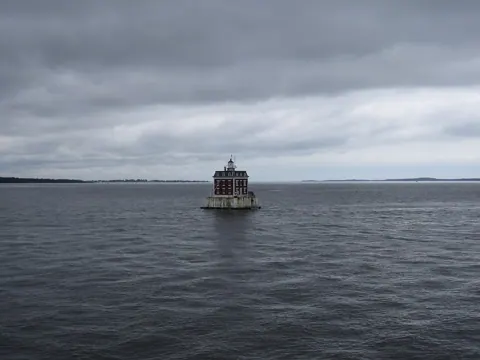













Photos taken with this camera (sold in Europe as the IXUS 870 IS); the ISO is read from each file's own EXIF data. From Wikimedia Commons, credited under each picture.
Where it let you down
There is no HD video; Cameralabs said the processor could have handled it and set the Panasonic FX35's 720p mode against it.4 The optical zoom is locked while you film, leaving only digital zoom.43 Continuous shooting is 1.4 frames per second, which Imaging Resource measured at 1.41 and Cameralabs called effectively useless for action.34 Exposure is automatic only, with no live histogram (PhotographyBLOG and Cameralabs).24 The flash got modest marks: PhotographyBLOG called it not particularly powerful, with vignetting at wide angle, and Imaging Resource measured a recycle of 6.8 seconds and found the lens blocking the flash at macro distance.23
Handling split the reviewers. PhotographyBLOG found no hand grip and said it can be uncomfortable for big hands, recommending the wrist strap;2 Imaging Resource liked the flared top that helps grip, though one companion thought it too small;3 Cameralabs said the middle finger still has to perch on the Canon logo.4 Imaging Resource found the red mode-switch legend on a dark brown panel hard to read, and PhotographyBLOG noted that the battery door sits too close to the tripod socket to open on a tripod.32 Imaging Resource measured an autofocus shutter lag of 0.43 seconds at wide angle and a prefocused lag of 0.079 seconds.3
The reviews also disagree on details. PhotographyBLOG says the lens is ready about a second after switching on, Cameralabs around 1.5 seconds; for the closest macro area they give 36 by 27 millimetres (PhotographyBLOG) and 30 by 22 millimetres (Imaging Resource).243
What the reviewers said
| Outlet | Date | Verdict |
|---|---|---|
| PhotographyBLOG | 27 Nov 2008 | Design 5, features 4, ease of use 4.5, image quality 4, value 4.5 out of 5. Probably the best-designed IXUS to date; recommended unless you want manual control or are shooting in contrasty light.2 |
| Imaging Resource | Initial test 1 Dec 2008, review 18 Jun 2009 | 4.5 out of 5 and a Dave's Pick. Fun, good-looking, and easy to handle; the lack of HD video and of manual control were its disappointments.3 |
| Cameralabs | Pages dated 24 May 2011 | 86 percent, Highly Recommended. Quick, intuitive and reliable; the Panasonic FX35 offered more features for less, so compare them in person.4 |
The timeline
- September 2007The IXY Digital 910 IS, the SD870 IS here, is launched with its 28 mm lens.1
- September 2008Canon's museum lists the IXY Digital 920 IS as marketed, and Cameralabs dates its announcement to the same month.14
- October 2008Imaging Resource lists US availability, at $300 or less.3
- 27 November 2008PhotographyBLOG publishes its review.2
- 1 December 2008Imaging Resource's initial test; the full review follows on 18 June 2009.3
Should you buy one now?
Buy one if you want a compact CCD camera with a 28 mm wide end, a large screen and quick, unfussy handling, and you can live without HD video or manual exposure. It launched at $299.99;2 what it sells for now is a question for the sold listings, not for us. Before you bid, check these:
- The name. It is the PowerShot SD880 IS in the Americas, the Digital IXUS 870 IS in Europe and the IXY Digital 920 IS in Japan, so search all three.1 The PowerShot SD870 IS is the older camera.1
- The battery. It uses an NB-5L, rated at about 310 shots, and shipped with a CB-2LX charger;13 a fresh battery is on Amazon ↗.
- The card. It takes SD and SDHC cards and has no built-in memory; the original bundle held only a 32 MB card;234 see our memory card guide.
- The cables. One side port serves both USB and AV, and the box held an IFC-400PCU USB cable and an AVC-DC400 AV cable.23
- The screen. Canon claims an anti-scratch coating, but the panel is flush and large, so look for scratches.2
- The lens. Check that it extends and retracts cleanly and that pictures are sharp at both ends.
If you are wondering why cameras like this are being hunted down again, we tell that story once, in Pictures that never left the card.
See recent sold prices on eBay ↗Shop on eBay ↗NB-5L battery ↗
Sources
- Canon Camera Museum: IXY DIGITAL 920 IS / PowerShot SD880 IS DIGITAL ELPH / Digital IXUS 870 IS (names, marketed September 2008, outline, specifications)
- PhotographyBLOG, Canon Digital IXUS 870 IS review by Zoltan Arva-Toth (27 November 2008; six pages, $299.99 recommended price)
- Imaging Resource, Canon SD880 IS review by Mike Pasini (initial test 12/01/08, review 06/18/09; MSRP $300, availability 10/2008)
- Cameralabs, Canon Digital IXUS 870IS / PowerShot SD 880IS review by Gordon Laing (five pages, dated 24 May 2011 as printed)
Camera photos by Mahanga (CC BY-SA 3.0); other photographs are credited under each one, all via Wikimedia Commons. Links to eBay and Amazon are affiliate links.