Sony Cyber-shot T · announced March 2005
The Sony Cyber-shot DSC-T7: the 15-millimetre slider that split its reviewers
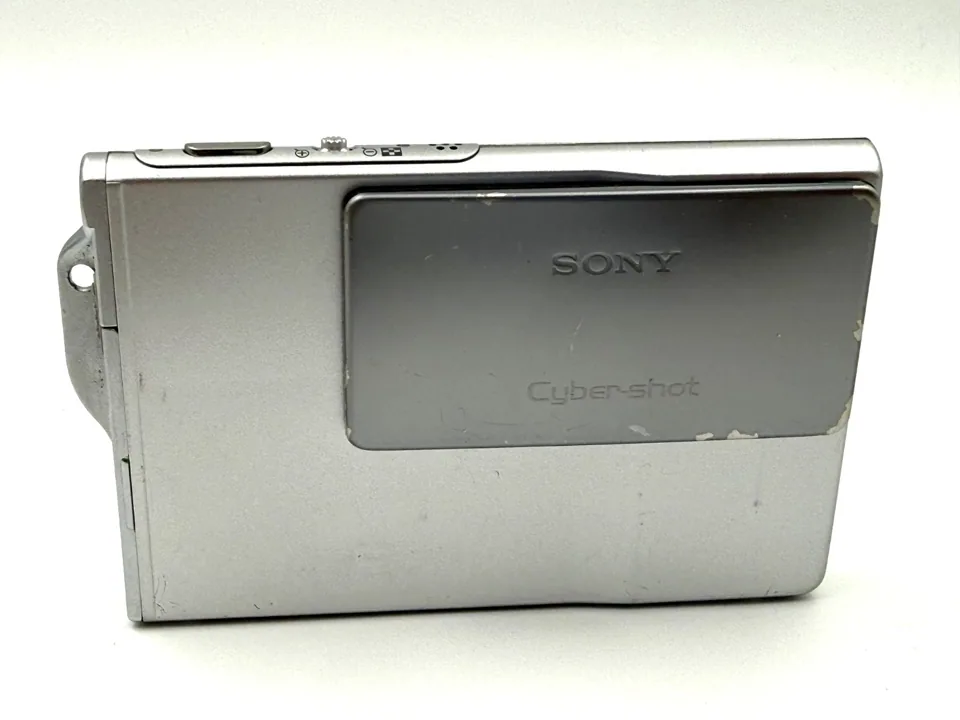
In March 2005 Sony took the T1's sliding-door idea down to about 15 millimetres and priced it at about $500. Imaging Resource made it a Dave's Pick and praised the lens, the speed and the video. Pocket-lint scored it 6 out of 10 and called it style over substance.
- Launched
- March 2005
- Sensor
- 5.1 MP CCD
- Lens
- 38–114 mm, 3×
- Card
- Memory Stick Duo, Memory Stick PRO Duo
- Battery
- NP-FE1
Sony Cyber-shot DSC-T7 specs: sensor, lens, battery, memory card and cable
The Sony Cyber-shot DSC-T7 came out in March 2005 at about $500 as a 5.1 MP CCD compact with a 38–114 mm (35 mm equivalent) 3× zoom lens. It takes Memory Stick Duo and Memory Stick PRO Duo cards and runs on the NP-FE1 battery. Sources
- Sensor
- CCD, 1/2.4", 5.1 MP source
- Lens
- 38–114 mm equivalent, 3× zoom source
- Memory card
- Memory Stick Duo, Memory Stick PRO Duo source
- Battery
- NP-FE1 source
- USB / A/V cable
- See our Sony cable page
Meet the camera
It is a brushed-metal slab with roughly the outline of a credit card, a 2.5-inch screen over most of the back and no viewfinder.354 The lens hides behind a sliding cover that spans about two thirds of the front.51 Imaging Resource's announcement, working from Sony's preliminary figures, gave 14.8 millimetres thick with the cover and only 9.8 through most of the body without it, against 21 millimetres for the T1 with its cover; it said the T7 weighed over a third less than that camera.1
Sony announced it on 8 March 2005 at about $500, for sale in May.21 Imaging Resource's later review gives a suggested price at introduction of $499.95 and availability in June 2005, and its data sheet says 31 May.57 Photo Review, an Australian site, quoted almost $850 and called it a premium price for such miniaturisation; the page does not name the currency.8 Pocket-lint's page gives £500.10 Sony's own release pitched it at "the fashion-forward crowd."2
The numbers drift by a gram or two between pages. Sony's were 91.7 by 60.0 by 14.8 millimetres and 134 grams (Photo Review's launch story says with battery and card);14 Imaging Resource's review text says 91.7 by 60.2 by 14.7 millimetres and 131 grams with battery and card,5 and Photo Review's table has 14.7 millimetres and 136 grams with the neck strap.8
Why this one was interesting
A T1 on a diet
Imaging Resource said the T7 kept the T1's sensor size and resolution. The screen gained a little resolution, movies rose from 16 to 30 frames per second, the USB port went from 1.1 to 2.0 and the battery changed from an NP-FT1 to the NP-FE1, a change Imaging Resource called probably a significant contributor to the size and weight reductions.1 Reviewed.com called it the prettier twin of the T33: the same 1/2.4-inch sensor, processor and screen, with differences it described as purely cosmetic, in a body 0.6 inches thick against the T33's 0.8.3 Our DSC-T1 review covers the camera it grew from.
A lens folded sideways
The lens stands vertically and a mirror bends the view into it, so nothing telescopes out of the front;5 Imaging Resource clocked 1.3 seconds from power-on to the first shot, where Sony claimed just under one.72 On the bench the lens did better than its size suggested: corner sharpness above average for a subcompact, low chromatic aberration, about 0.8 percent barrel distortion at wide angle and 0.5 percent pincushion at telephoto; that review called the barrel about average and the pincushion higher than average.5 The reviewer for Steve's Digicams, as quoted by PhotographyBLOG, found the lens sharp across its whole range with very little purple fringing.12
Speed
Imaging Resource measured full-autofocus shutter lag at 0.35 to 0.38 seconds depending on zoom, 12 milliseconds with pre-focus, a shot every 1.26 seconds and a nine-frame burst of large, fine files at 1.43 frames per second (the data sheet's buffer entry says 18 frames, which the review text does not match).57 Photo Review's figures were slower: 0.6 seconds of average capture lag, 0.2 with pre-focus, and burst shots 0.85 seconds apart.8 Neither page explains the gap, and we cannot reconcile the two.
A screen for sunlight
The transflective screen worked as well in full sunlight as indoors, and Imaging Resource ranked it among the best it had seen on a digital camera, usable in surprisingly dim light too.5 Sony's own pitch was an anti-reflection coating.2
What was lost
The thin body left no room for ordinary sockets: a small Interface Adapter plugs in behind the battery door and supplies USB, AV out and DC in, and Imaging Resource called it a kludgy solution and one more thing to lose.5 The camera cannot charge its battery in the body, even through that adapter: the battery goes into the supplied external charger, which Imaging Resource said takes about an hour, and the USB cradle supplies neither data nor power.5 Imaging Resource also disliked a manual split in two, which often sent readers to a separate "Read this first" poster as the only source for things like the scene modes.5 Photo Review added that a tripod needs the cradle, and that the menus were slightly reworked to suit it.8 Our DSC-T9, DSC-T10 and DSC-T100 reviews cover later T-series cameras.
The dark: its weak point
Imaging Resource called its low-light performance poor, barely capable of a good picture under average city street lighting. The longest shutter time was one second in normal modes and two in the Twilight modes, which force ISO 64.5 The reviewer also called the flash very weak.5 Sony's preliminary figures gave a flash range of 0.1 to 1.6 metres,1 while Steve's Digicams' first-look page, reproducing Sony text, gives 0.1 to 2.6 metres at wide angle and 0.5 to 2.1 at telephoto.11 In Imaging Resource's flash portrait the normal setting came out underexposed and the High flash level was better.6 The same review praised the autofocus in poor light and the bright assist lamp.5
Noise was low at ISO 64 and 100, visible at ISO 200 with some softening, and quite noticeable at ISO 400, Imaging Resource found. At 4 by 6 inches it ceased to matter, at 5 by 7 it was acceptable for most consumers, and at 8 by 10 the reviewer would not count on it.6 Photo Review also saw noise at ISO 400 whatever the shutter speed.8 Pocket-lint went further, reporting plenty of noise in both daylight and indoor shots, and flash pictures that looked over-exposed and heavy-handed.9 Three real photographs taken with the camera, two at ISO 320 and one at ISO 400 according to their own EXIF data, show night scenes and the shade of a park.






Like that look? See recent eBay sold listings for this camera ↗
On eBay right now
Live listings for this camera, supplied by eBay and updated automatically. We earn a commission if you buy through them.
The little wins
Video
Imaging Resource called the video excellent, and remarkable for such a tiny camera: VGA with sound, at 30 frames per second on a PRO Duo card. Without one the camera still recorded 640 by 480, at 16 frames per second in Imaging Resource's text and 16.6 in Reviewed.com's.53
A live histogram
Imaging Resource found a histogram available in both capture and playback.5 Pocket-lint noted it as a way to hone images on the fly, in a camera it said gave considerable manual control.9
A bright focus lamp
The AF-assist lamp on the front earned a place among Imaging Resource's likes, and low-light autofocus was good.5
A magnifying glass
The Magnifying Glass scene mode focused as close as 1 centimetre. Imaging Resource added that any zooming in that mode used digital zoom, which can cost quality.5
Sixteen frames in half a second
Multi Burst captured 16 frames at a chosen rate of 7.5, 15 or 30 per second and saved them as one file, played back as slow motion on the camera and useful, Imaging Resource said, for studying a golf or tennis swing.5 Photo Review timed it at 16 shots in half a second.8
How it drew the picture
On colour the reviewers split four ways. Imaging Resource found it accurate and bright without being overdone, with only strong reds and greens somewhat oversaturated, and measured strong detail out to at least 1,300 lines on its resolution chart.5 It also noted that the default tone curve is rather contrasty, and that the low-contrast setting caused odd saturation breaks in skin tones.56 The Steve's Digicams reviewer described outdoor frames as well exposed and richly saturated.12 Photo Review found saturation modest and contrast a little high for bright Australian sunlight, though resolution on its Imatest chart was above average and it scored image quality 8 out of 10.8 Pocket-lint went the other way: even Auto produced flat, dulled colours in sunlit shots around a vineyard in Bordeaux, although fine detail such as textiles held together.9 Imaging Resource also said prints made at 13 by 19 inches looked good, if a tad soft.5
















Photos taken with this camera, from Wikimedia Commons, credited under each picture. Where Commons names no author, the credit shows the uploader's name.
Where it let you down
Battery life was the complaint all three full reviews we could read shared. Imaging Resource measured a worst case of 74 minutes in record mode and 125 in playback.5 Pocket-lint reported being low on charge within an hour of use without using the flash, and put the screen's drain together with the missing viewfinder.9 Photo Review said it was easy to push the lens cover open by accident, which added to a drain it already blamed on the screen.8 Sony's own claim was about 180 shots per charge; Steve's Digicams' first-look page prints 240.211
Handling split the reviewers. One Imaging Resource tester kept wanting to hold it like a conventional camera and it slipped from their grip, while another held it with thumb and middle finger and liked it fairly well.5 Photo Review called the buttons small, some nearly flush with the body, the zoom rocker imprecise and the memory-card hatch a challenge for the less dexterous.8 Pocket-lint found the zoom cumbersome, got fingers in its first test shots because the lens sits in the corner (a problem it said was soon corrected and probably its own fault),9 and thought the front slide just a bit of metal bolted on for effect,10 where Imaging Resource praised the cover's feel in particular.5
What the reviewers said
| Outlet | Date | Verdict |
|---|---|---|
| Pocket-lint | 20 Apr 2005 | 6 out of 10: a disappointment; a slim body and big screen with wow factor, but poor images and short battery life.109 |
| Imaging Resource | 12 Jul 2005 | A fine little camera and a Dave's Pick, with a lens that avoids the soft corners of most subcompacts; limited in low light, short battery life.5 |
| Photo Review | Undated | Build 8.5, ease of use 8.0, image quality 8.0, value 7.5 (out of 10): well built and straightforward, good-looking stills, but a premium price.8 |
| Steves Digicams | By 19 Sep 2005 | Excerpt only (we could not read the review itself): the reviewer was pleased with the outdoor results.12 |
Reviewed.com's March 2005 launch story is not a review. It said the T7 does not offer greater picture quality than the T33.3
The timeline
- 8 March 2005Sony announces the T7 at about $500, for May.21
- 10 March 2005Photo Review reports it at 15 mm thick and 134 g, and mid-year for Australia.4
- 20 April 2005Pocket-lint publishes its review; The Register runs it on 25 April.109
- 31 May 2005Availability date on Imaging Resource's data sheet.7
- 12 July 2005Imaging Resource publishes its review.5
- 19 September 2005PhotographyBLOG notes the Steve's Digicams review.12
Should you buy one now?
Buy one if you want a very thin 2005 pocket camera that wakes quickly and reads well in sunlight, and you can live with noise at high ISO, a weak flash and short battery life. It launched at about $500;15 what it sells for now is a question for the sold listings, not for us. Before you bid, check these:
- The charger. The camera cannot charge its own battery, so make sure the external charger is included.5
- The battery. It uses an NP-FE1;1 Imaging Resource's box list and its accessories list both say NP-FT7, which looks like a typo beside its own text and Sony's NP-FE1. A fresh one is on Amazon ↗, and battery life was short even when new.5
- The adapter and cradle. The Interface Adapter provides USB, AV out and DC in; Imaging Resource said it is easy to lose.5
- The slide cover. It is the power switch, so check that it slides smoothly and does not open in a pocket.85
- The card. It takes Memory Stick Duo and PRO Duo, and 30 fps video needs a PRO Duo;2 see our Memory Stick page.
- The screen. Look for scratches: it covers about two thirds of the back.2
If you are wondering why cameras like this are being hunted down again, we tell that story once, in Pictures that never left the card.
See recent sold prices on eBay ↗Shop on eBay ↗NP-FE1 battery ↗
Sources
- Imaging Resource, Sony announces Cyber-shot DSC-T7 by Mike Tomkins (8 Mar 2005; Sony's preliminary specifications and press release)
- PhotographyBLOG, Sony Cyber-shot DSC-T7 Announced (8 Mar 2005; Sony press release: about $500, May)
- Reviewed.com, Sony Slims Down T Series by Emily Raymond (8 Mar 2005)
- Photo Review (Australia), Super-Slim Sony DSC-T7 (10 Mar 2005)
- Imaging Resource, Sony Cyber-shot DSC-T7 review by Dave Etchells (12 Jul 2005)
- Imaging Resource, Sony Cyber-shot DSC-T7 test images page (exposure, white balance and ISO notes)
- Imaging Resource, Sony Cyber-shot DSC-T7 data sheet (retail price $500, availability 31 May 2005)
- Photo Review (Australia), Sony Cyber-shot DSC-T7 review (undated page)
- The Register, Sony DSC-T7 digital camera by Stuart Miles of Pocket-lint (25 Apr 2005; 60%)
- Pocket-lint, Sony DSC-T7 digital camera review by Stuart Miles (20 Apr 2005; 6/10, price GBP 500; Wayback Machine copy)
- Steves Digicams, Sony Cyber-Shot DSC-T7 first-look and specifications page (first look posted 15 Sep 2005; reproduces Sony text; Wayback Machine copy)
- PhotographyBLOG, Sony Cyber-shot DSC-T7 Review at Steves Digicams (19 Sep 2005; quotes the outdoor-results paragraph of the review)
Sample photographs are credited under each one, all via Wikimedia Commons. Links to eBay and Amazon are affiliate links.