Sony Cyber-shot S · announced February 2005
The Sony Cyber-shot DSC-S90: the 2005 budget compact with a big screen, AA batteries and a manual mode
We found no other regional name for it: Imaging Resource's announcement table, its review and DPReview's review all call it the DSC-S90.123
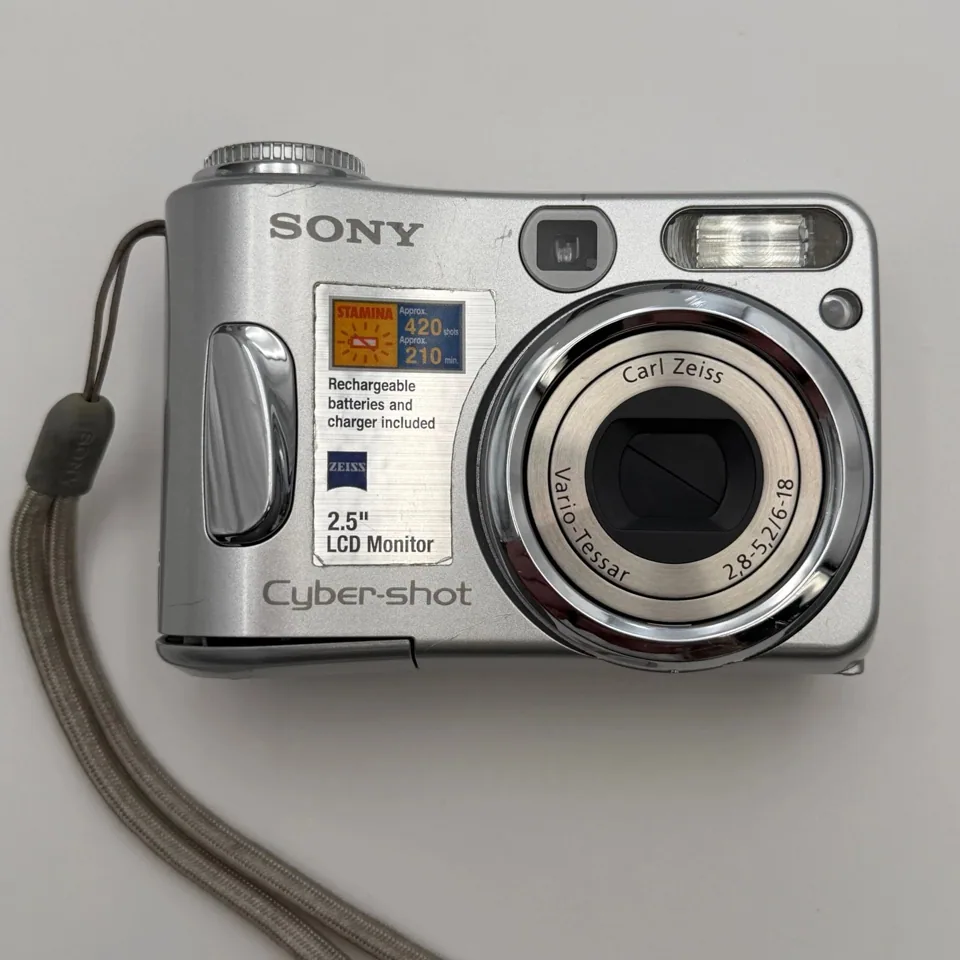
Sony's entry-level Cyber-shot of 2005 had a 4.1-megapixel sensor, a Zeiss-branded 3x zoom and, unusually for the price, a 2.5-inch screen and a manual exposure mode. Both full reviews found it fast and easy to live with; they disagreed about its noise, and DPReview was the cooler of the two on the camera as a whole.
- Launched
- February 2005
- Sensor
- 4.1 MP CCD
- Lens
- 39–117 mm, 3×
- Card
- Memory Stick, Memory Stick PRO
- Battery
- AA
Sony Cyber-shot DSC-S90 specs: sensor, lens, battery, memory card and cable
Launched in February 2005, the Sony Cyber-shot DSC-S90 is a 4.1 MP CCD compact with a 39–117 mm (35 mm equivalent) 3× zoom lens. Inside: it takes Memory Stick and Memory Stick PRO cards and runs on AA batteries. Sources
- Sensor
- CCD, 1/2.7", 4.1 MP source
- Lens
- 39–117 mm equivalent, 3× zoom source
- Memory card
- Memory Stick, Memory Stick PRO source
- Battery
- AA source
- USB / A/V cable
- See our Sony cable page
Meet the camera
Sony announced the S90 together with the S60 at the PMA trade show in Orlando in February 2005, and Imaging Resource noted that Sony had split the pair by screen size, not by pixel count: 2 inches on the S60, 2.5 on the S90, with the same screen resolution and mostly the same features.1 The S90's planned price was $299.95, with stores expected to have it from mid-March.1 Imaging Resource's review lists $299.99 at introduction and calls availability May 2005;2 DPReview put the street price at about $290 in its text and $300 in its specification table, and £190 in the UK.3
It is a boxy plastic compact with a 3x Carl Zeiss Vario-Tessar zoom, 39 to 117 millimetres in 35 mm terms, in front of a 4.1-megapixel 1/2.7-inch Super HAD CCD.13 It had a real-image optical viewfinder, a Real Imaging Processor and 32 MB of built-in memory, and it took Memory Stick and Memory Stick PRO cards, with none supplied.32 Two Sony NiMH AA cells and a charger came in the box.32
- Lens
- 3x Carl Zeiss Vario-Tessar, 39–117 mm equiv., f/2.8–5.6 at wide angle and f/5.2–10 at tele; no image stabilisation1
- Video
- 640 × 480 MPEG with sound; 16 fps in the announcement table, 16 / 30 fps in DPReview's specification table and 15 or 30 fps in its text; the top-quality setting needs a Memory Stick PRO132
- Card and power
- Memory Stick or PRO, 32 MB built in · two AA cells; NiMH cells and charger supplied, rated 420 shots by Sony32
Why this one was interesting
Two cameras, one body
The S60 is the cheaper twin and the best way to see what the S90 added. Imaging Resource's S60 review says the two differ in screen size and in the box: alkaline cells for the S60, NiMH cells and a charger for the S90, a list-price gap of roughly $70 that, it said, left the two quite close in price once you added batteries and a charger to the S60.4 The same review expected the electronics to be identical, but its S60 sample showed more noise at ISO 400 and a poorer showing under household lamps than its S90, and it recommended stepping up to the S90.4 PC Magazine, as quoted by PhotographyBLOG, measured the S60 at 1,300 average lines of resolution, the top of the 4-megapixel range in its tests, with a 2.8-second start-up and a 2.3-second recycle time, but noticeable shutter lag.5 Those are S60 figures from a different test, not S90 ones.
Fast where it counts
Imaging Resource found full-autofocus shutter lag of 0.31 to 0.41 seconds, 0.01 when prefocused, and 1.07 seconds from shot to shot at the largest size, and judged it well suited to children and sports.2 DPReview agreed on the autofocus, calling it excellent and reliable, and measured about 1.1 seconds shot to shot with the flash off; start-up took 2.5 seconds.3 Both timed a burst of four full-size frames at about 1.6 a second; DPReview noted that Sony's own figure of 0.7 a second looked like a typo, and found a pause of about 3.4 seconds after the burst.23 A Multi Burst mode packed 16 frames, taken at up to 30 a second, into one image; Imaging Resource suggested it for golf and tennis swings.23
A manual mode, with limits
Imaging Resource thought the S90 offered more manual control than most entry-level compacts, with Manual mode showing how far the exposure was from the meter reading.2 DPReview listed what was missing: no aperture or shutter priority, no custom white balance, and only two aperture choices at any zoom setting.3 For an earlier AA-powered Sony with no manual mode at all, see our DSC-P72.
A big screen for the money
Imaging Resource said composing on it was more like looking at a framed picture than at a camera display, and found it readable even in direct sun thanks to an anti-glare coating.2 DPReview agreed it was big and bright for a budget camera, with little lag, but at 115,000 dots it looked more pixellated than Sony's other screens of the time.3
What was lost
DPReview's list of cons ran to wide-end coverage that was not very wide at 39 millimetres, limited macro, and focus problems with near subjects, where it said the camera would take a picture without focus confirmed; Imaging Resource noted a different quirk, a tendency to focus on objects in front of the main subject.32 Imaging Resource also marked it down for a contrasty default tone curve that lost highlight detail in harsh light, and for very warm pictures under household bulbs unless you chose the incandescent setting.2 DPReview measured the same weakness: automatic white balance was good outdoors and poor under tungsten light.3 Power-down took 3.3 seconds, which DPReview put down to the slow, smooth zoom, and movies could not be zoomed while recording.3
The dark: good focus, mixed verdicts on noise
Both reviewers praised its low-light focus and then split on noise. Imaging Resource called low-light performance excellent: usable, well-coloured pictures down to the 1/16 foot-candle (0.67 lux) limit of its test at every ISO, autofocus working unassisted down to about a quarter of a foot-candle, and in total darkness on nearby subjects with the lamp on.2 It called the focus-assist lamp unusually bright.2 DPReview also praised focus accuracy in low light but was harder on the flash: colour was almost perfect and output was throttled well for close subjects, yet the red-eye mode's pre-flash added a delay it called unacceptable, with shot-to-shot time rising to 4.8 seconds.3 On noise, Imaging Resource found it low to moderate but with subtle detail wiped away by noise reduction, rough prints from ISO 400 shots at 5 by 7 inches and a verdict of higher-than-average noise.2 DPReview found noise very low, thought ISO 80 to 200 perfectly usable and ISO 400 fine unless you print large, but disliked the combination of heavy noise reduction and sharpening, which left halos.3 We found no high-sensitivity night photos from this model to show; the pictures below are daylight ones plus an indoor display case at ISO 320, the value recorded in its own EXIF data.
Like that look? See recent eBay sold listings for this camera ↗
On eBay right now
Live listings for this camera, supplied by eBay and updated automatically. We earn a commission if you buy through them.
The little wins
Battery life on two AAs
Sony rated it at 420 shots or 210 minutes with the supplied 2100 mAh NiMH cells, which both reviews repeated; Imaging Resource called that very good for two cells and said alkaline cells cut it to around 80 shots.23
Add-on lenses and a dock
DPReview listed 0.7x wide and 1.7x and 2.6x tele converters, a Cyber-shot Station dock and a waterproof case among the options.3
How it drew the picture
Imaging Resource thought colour was very good, with hue accuracy better than most cameras it tests and a slight warm cast. It found strong detail out to about 1,200 lines, 1.0 percent barrel distortion at wide angle, and prints that held up at 11 by 14 inches, a little soft, and looked great at 8 by 10.2 DPReview measured about 1,200 horizontal and 1,150 vertical lines, with extinction at 1,400, and called that slightly below the average of its comparison group, which included Canon's A520 and SD300; it saw the A520's lens resolve slightly more detail, while calling the S90's colour excellent and its exposure almost always reliable.3 It measured about 1.2 percent distortion at wide angle and 0.5 percent at telephoto.3






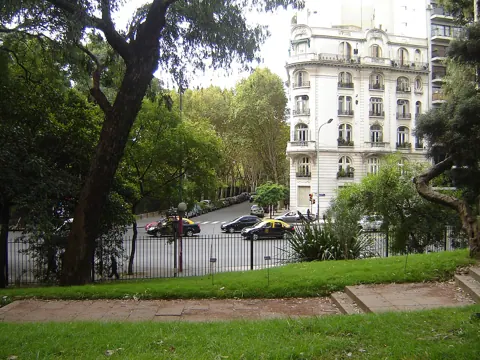









Photos taken with this camera, from Wikimedia Commons, credited under each picture. We chose them by looking, and confirmed the camera model in each file's data.
Where it let you down
The battery door was the handling complaint: Imaging Resource found the small release button awkward to press while opening the door, and noted that you cannot change batteries with the camera on a tripod.2 DPReview noted that nothing holds the cells in when the door opens, and described the optical viewfinder as small, unclear and showing only about 85 percent of the scene.3 Imaging Resource measured it at about 83 percent and aimed low, with the screen at about 99.9 percent.2 Looks divided them: Imaging Resource called it handsomely built, and DPReview called the body anonymous and the camera one that "fails to make an impression".23 The camera records only to Memory Stick, and no card is supplied;3 see our Memory Stick guide and the memory card entry in the glossary.
What the reviewers said in 2005
| Outlet | Date | Verdict |
|---|---|---|
| DPReview | 18 May 2005 | Rated Above Average: does what it promises without fuss, at an entry-level price, but, the big screen aside, offers nothing to stand out from rivals such as the Canon A520, and fell short of ticking enough boxes.3 |
| Imaging Resource | 8 Jun 2005 | An easy-to-use but very capable camera that deserves strong consideration, with a standout shutter response; its pros list includes colour, low light and battery life, its cons noise, tone curve and fussy NiMH tolerance.2 |
Imaging Resource's S60 review ends by calling the S60 “not a Dave's Pick” and ties that to the S90;4 the S90 review page itself shows no such label, so we do not claim one. We could not reach any further full contemporary review of the S90, so this page rests on two.
The timeline
- 19 February 2005Imaging Resource reports Sony's announcement of the S60 and S90 at PMA, with planned prices of $249.95 and $299.95.1
- Mid-March 2005Planned arrival in US stores.1
- 18 May 2005DPReview publishes its S90 review.3
- 8 June 2005Imaging Resource's review is dated; availability is given as May 2005.2
- 23 July 2005Imaging Resource reviews the S60.4
- 26 October 2005PhotographyBLOG quotes PC Magazine's S60 test.5
Should you buy one now?
It suits someone who wants a simple 2005 CCD compact that runs on ordinary AA cells, with a roomy screen and decent colour, and who accepts soft detail and a modest ISO ceiling. It is not for anyone who wants crisp detail at ISO 400 or a quick shutdown. Its launch price was $299.95;1 what it sells for now is a question for the sold listings, not for us. We have not tested a unit. Before you bid, check these:
- The model. The S90 has the 2.5-inch screen and shipped with NiMH cells and a charger; the S60 has a 2-inch screen and, according to Imaging Resource's S60 review, shipped with alkalines (the announcement table lists NiMH cells and a charger for the S60 too).134
- The batteries. Imaging Resource found it very fussy about NiMH brands, with some well-rated cells not powering it at all, and said Sony-branded cells were the safe choice;2 see AA cells on Amazon ↗.
- The card. Memory Stick or Memory Stick PRO; the best movie quality needed PRO.2
- The battery door and screen. Reviewers found the door awkward to open and said nothing holds the cells in when it does;23 check that it opens and closes properly, and look the screen over for scratches.
- The lens. Check that it extends and retracts cleanly.
If you are wondering why cameras like this are being hunted down again, we tell that story once, in Pictures that never left the card. For other Sony compacts, see our DSC-P200 and DSC-W55 retrospectives.
See recent sold prices on eBay ↗Shop on eBay ↗NiMH batteries ↗
Sources
- Imaging Resource news, Sony announces Cyber-shot S60, S90, by Mike Tomkins (19 Feb 2005; specification tables and planned prices)
- Imaging Resource, Sony CyberShot DSC-S90 review (review date 8 Jun 2005, unsigned; $299.99 at introduction)
- DPReview, Sony Cyber-shot S90 review by Simon Joinson (published 18 May 2005)
- Imaging Resource, Sony CyberShot DSC-S60 review, the S90's twin (review date 23 Jul 2005; $229.99 at introduction)
- PhotographyBLOG news, “Sony DSC-S60 Review at PC Magazine” (26 Oct 2005; quotes PC Magazine's test of the S60, we could not open PC Magazine's own page)
Photographs are credited under each one, all via Wikimedia Commons. Links to eBay and Amazon are affiliate links.