Sony Cyber-shot T · announced January 2005
The Sony Cyber-shot DSC-T33: the fast, slim Zeiss compact with a cradle in the box
We found no other regional name for it; Sony's US announcement and every review we read call it the DSC-T33.1245
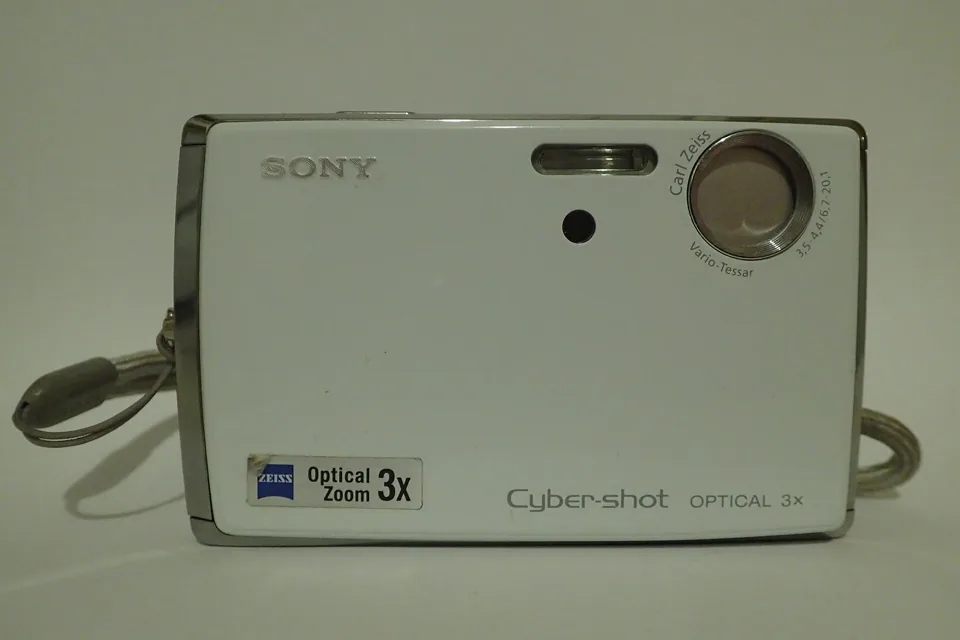

In January 2005 Sony announced a 5.1-megapixel compact 20.7 millimetres thick, with a Zeiss zoom folded sideways inside and a 2.5-inch screen, for about $450. Reviewers praised how quickly it woke and focused, then disagreed about its sharpness and its screen, and agreed about its flash.
- Launched
- January 2005
- Launch price
- About $450 in Sony's US announcement1
- Sensor
- 5.1 MP CCD
- Lens
- 38–114 mm, 3×
- Card
- Memory Stick Duo, Memory Stick Pro Duo
- Battery
- NP-FT1
Sony Cyber-shot DSC-T33 specs: sensor, lens, battery, memory card and cable
The Sony Cyber-shot DSC-T33 is a 5.1 MP CCD compact camera with a 38–114 mm (35 mm equivalent) 3× zoom lens, launched in January 2005 at about $450. It takes Memory Stick Duo and Memory Stick Pro Duo cards and runs on the NP-FT1 battery. Sources
- Sensor
- CCD, 1/2.4", 5.1 MP source
- Lens
- 38–114 mm equivalent, 3× zoom source
- Memory card
- Memory Stick Duo, Memory Stick Pro Duo source
- Battery
- NP-FT1 source
- USB / A/V cable
- See our Sony cable page
Meet the camera
The lens never sticks out. It sits in the top right corner of the front behind a small cover that opens when you press the power button, and the zoom runs inside the body like a periscope.462 A prism bends the light; Sony's table counts eleven elements in eight groups.1 The body measures 99.4 by 60.9 by 20.7 millimetres and weighs 150 grams with battery, card and strap, and Photo Review described a brushed aluminium shell with a flat front.125

Imaging Resource reported the announcement on 5 January 2005. It called the T33 an update of the DSC-T3, which Sony had announced the previous August and never sold in the United States: 21 grams lighter, slightly thicker, a little smaller in the other two dimensions.1 Sony's press release gave a March ship date and a price of about $450.1 The price is not settled: the Resource Page's review gave $450 in its opening line, but Imaging Resource's later review page lists $349.95 as the suggested price at introduction, and Engadget mentioned a $349 camera that July.428 The Resource Page saw it as the follow-up to the DSC-T1, one of the most popular cameras of 2004, with a new body and a new hybrid screen but little else changed;4 our DSC-T1 review covers the camera it followed.
Why this one was interesting
It never made you wait
Sony's press release said the camera springs to life in under a second, and Reviewed.com relayed that it would record its first shot in that time.16 Imaging Resource measured 1.3 seconds, with a full-autofocus shutter lag of 0.24 seconds at wide angle and 0.32 at telephoto, 0.011 seconds when prefocused, and a shot every 1.07 seconds;23 the Resource Page timed start-up at 1.1 seconds and called focus and shot-to-shot speed excellent.4
A screen that reviewers could not agree on
Imaging Resource ranked the transflective screen among the best it had seen on a digital camera, and the Resource Page said its outdoor visibility was second to none.24 Photo Review called it reasonably bright but next to useless in sunlit conditions.5 The split ran indoors too: the Resource Page found it very dark in low light, bordering on unusable, while Imaging Resource praised it in surprisingly dim lighting.42 We have not tested a unit, so we cannot settle it.
The cheaper sibling
Imaging Resource put the T33 beside the ultra-thin DSC-T7, which cost about $150 more, and said almost nothing separated them apart from thickness; the T33 had better battery life, quicker shutter response and a Speed Burst mode that the T7 lacked.2
What was lost
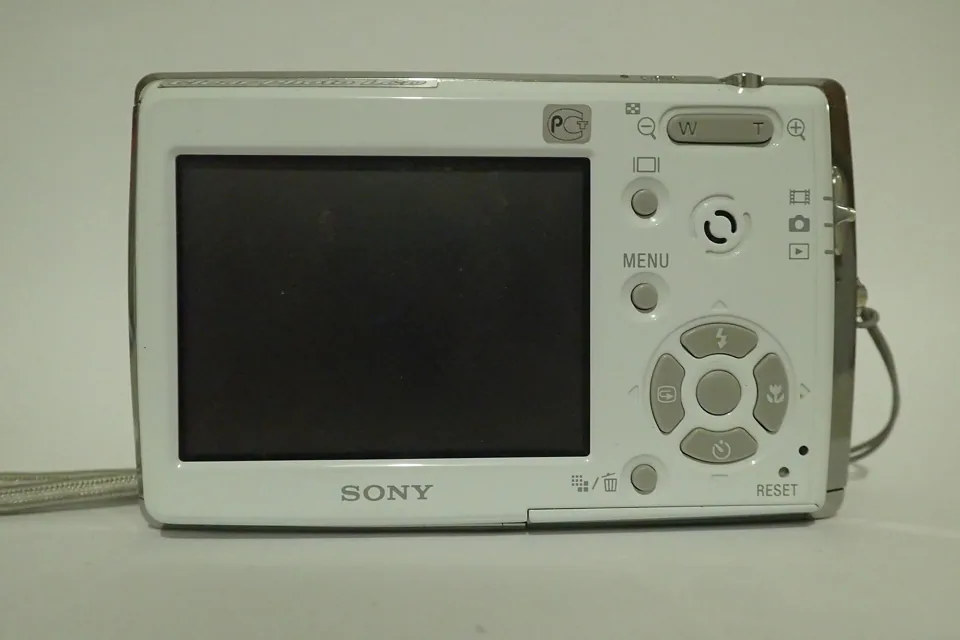
There was no optical viewfinder, which the Resource Page said would bother some buyers and not others.4 Apart from a dock connector on the base, the camera had no ports of its own: USB, video and power go through the cradle, which carries the only tripod mount, and that mount needs a separate plastic holder that Imaging Resource called odd and the Resource Page's unit did not include.24 Reviewed.com and Photo Review noted that the scene modes include Twilight Portrait but no plain portrait setting, and three reviewers noted that white balance has no manual option.654 The thin aluminium front took a small dent in Imaging Resource's testing, the Resource Page called the plastic battery door flimsy, and both it and Reviewed.com warned that fingers can cover the lens.246
The dark: its weak point
Sony's own table gives the flash a range of 0.1 to 1.6 metres, and the Resource Page listed 0.5 to 1.5 at telephoto, against 3.5 metres at wide angle for the Canon SD400.14 Imaging Resource found that at 8 feet, its closest test distance, the flash still did not light the scene properly, and that red-eye showed in nearly every informal portrait.2 The Resource Page reported red-eye too, and judged a Canon SD300's flash pictures far better.4 One early preview claimed a flash reach of 6 metres, a figure that Sony's table and both tests contradict.6124 Imaging Resource called low-light performance very poor, citing short maximum shutter times; the Resource Page's night shot came out soft but bright with little purple fringing, though it noted that such long exposures need a tripod and the cradle.24








Real photographs taken with this camera. The sensitivity shown is recorded in each file's own EXIF data; the camera's top setting was ISO 400.1
Like that look? See recent eBay sold listings for this camera ↗
On eBay right now
Live listings for this camera, supplied by eBay and updated automatically. We earn a commission if you buy through them.
The little wins
How it drew the picture
The reviewers disagreed on sharpness. The Resource Page found the pictures soft and a little fuzzy, a trait it said it had seen on other folded-lens cameras, and likened them to camcorder footage.4 Imaging Resource found them sharp but slightly over-sharpened, with halos around contrasty edges, and said aggressive noise suppression flattened fine detail such as hair.2 Photo Review also called its test pictures slightly over-sharpened and contrasty, and found them vibrant and noise-free, though its own colour chart suggested noise at higher ISO settings.5
Imaging Resource measured strong detail to about 1,350 lines and 0.8 percent barrel distortion at wide angle, and noticed a blur down the right side of the frame at near-wide zoom settings, which cost the camera a Dave's Pick.21 On colour it found reds and greens a little hot and skin slightly yellow, though it expected most buyers to like the result.2 The Resource Page said exposures were mostly accurate but highlights could blow out.4

















Photos taken with this camera, from Wikimedia Commons, credited under each picture.
Where it let you down
There was no raw or TIFF mode, and the Resource Page called it a pure point-and-shoot whose only pseudo-manual control is focus.4 Memory Stick Duo cards cost more than SD or CompactFlash, it noted, and Imaging Resource called the 32 MB card in the box the bare minimum, enough for 12 pictures at best quality.43 Sony quoted about 180 shots per charge, which the Resource Page gave as a CIPA figure and rated better than the Canon SD300 or Panasonic FX7.14
What the reviewers said in 2005
| Outlet | Date | Verdict |
|---|---|---|
| Digital Camera Resource Page | Posted 25 Feb 2005 | No score. Recommended for mostly outdoor use; weak flash, red-eye, soft pictures.4 |
| Imaging Resource | Review date 23 Jul 2005 | Picture quality Very Good; a capable, fast, affordable subcompact; the right-edge blur kept it from a Dave's Pick.21 |
| Photo Review | Undated | 8.0 for build, 8.0 for ease of use, 8.5 for image quality, 7.5 for value (out of 10); flash weak.5 |
| Reviewed.com | Undated, before the March 2005 shipping date | A strong point-and-shoot for beginners; wanted more ISO choices for the price.6 |
| Steve's Digicams | Posted 15 Sep 2005 | We could read only its first page, which repeats Sony's claims, so we list no verdict.7 |
The timeline
- 5 January 2005Sony USA announces the camera ahead of the Consumer Electronics Show; ship date March, about $450.1
- 25 February 2005The Resource Page posts its review at $450.4
- 23 July 2005Imaging Resource's review date; its page lists $349.95 at introduction.2
- 28 July 2005Engadget mentions a $349 camera.8
- 15 September 2005Steve's Digicams posts its review.7
Should you buy one now?
Buy one if you want a 2005 pocket camera that wakes and focuses without a pause and draws acceptably in daylight, and you can live with a weak flash and a proprietary card. It was announced at about $450;1 what it sells for now is a question for the sold listings, not for us. Before you bid, check these:
- The name. It is the DSC-T33; the T3 was a different camera that Sony did not sell in the United States.1
- The cradle. The camera has no ports of its own, so check that the cradle and its cables are included.24 Sources give its code as UC-TA (Sony's launch table) and UC-TD (Steve's).17 Our Sony cable guide covers the connectors.
- The battery. The reviews that name the battery all say NP-FT1, and so does the battery line of Sony's table, though its accessory list names NP-FR1;2451 a fresh one is on Amazon ↗. Our T1 and T9 take the same battery.
- The card. It takes Memory Stick Duo and PRO Duo cards, not SD; PRO Duo is needed for the 30 fps video.12 Sony's table says it was tested to 512 MB, Steve's says up to 2 GB.17 See our Memory Stick guide and the glossary.
- The panels. Check the thin aluminium front for dents and that the battery door closes.24
If you are wondering why cameras like this are being hunted down again, we tell that story once, in Pictures that never left the card.
See recent sold prices on eBay ↗Shop on eBay ↗NP-FT1 battery ↗
Sources
- Imaging Resource, Sony announces Cyber-shot DSC-T33 by Mike Tomkins (5 Jan 2005, updated 10 Jan; includes Sony's US press release and specification table)
- Imaging Resource, Sony Cyber-shot DSC-T33 review (review date 23 Jul 2005)
- Imaging Resource, Picky Details for the Sony DSC-T33 (timing, power and storage)
- Digital Camera Resource Page, Sony Cyber-shot DSC-T33 review by Jeff Keller (posted 25 Feb 2005; Wayback Machine copy of 28 Dec 2005)
- Photo Review (Australia), Sony Cyber-shot DSC-T33 review with Imatest results (undated page)
- Reviewed.com, Sony Cyber-shot DSC-T33 first impressions by Emily Raymond (undated; written before the March 2005 shipping date)
- Steve's Digicams, Sony Cyber-Shot DSC-T33 user review (posted 15 Sep 2005; first page, introduction and specifications; Wayback Machine copy of 12 Jan 2006)
- Engadget, Sony DSC-T33 reviewed by Marc Perton (28 Jul 2005; a short note on the Imaging Resource review)
Photographs are credited under each one, all via Wikimedia Commons. Links to eBay and Amazon are affiliate links.