Sony Cyber-shot T · announced September 2006
The Sony Cyber-shot DSC-T50: the slider that traded its buttons for a touch screen
We found no other regional name: every source we read calls the camera the DSC-T50.125
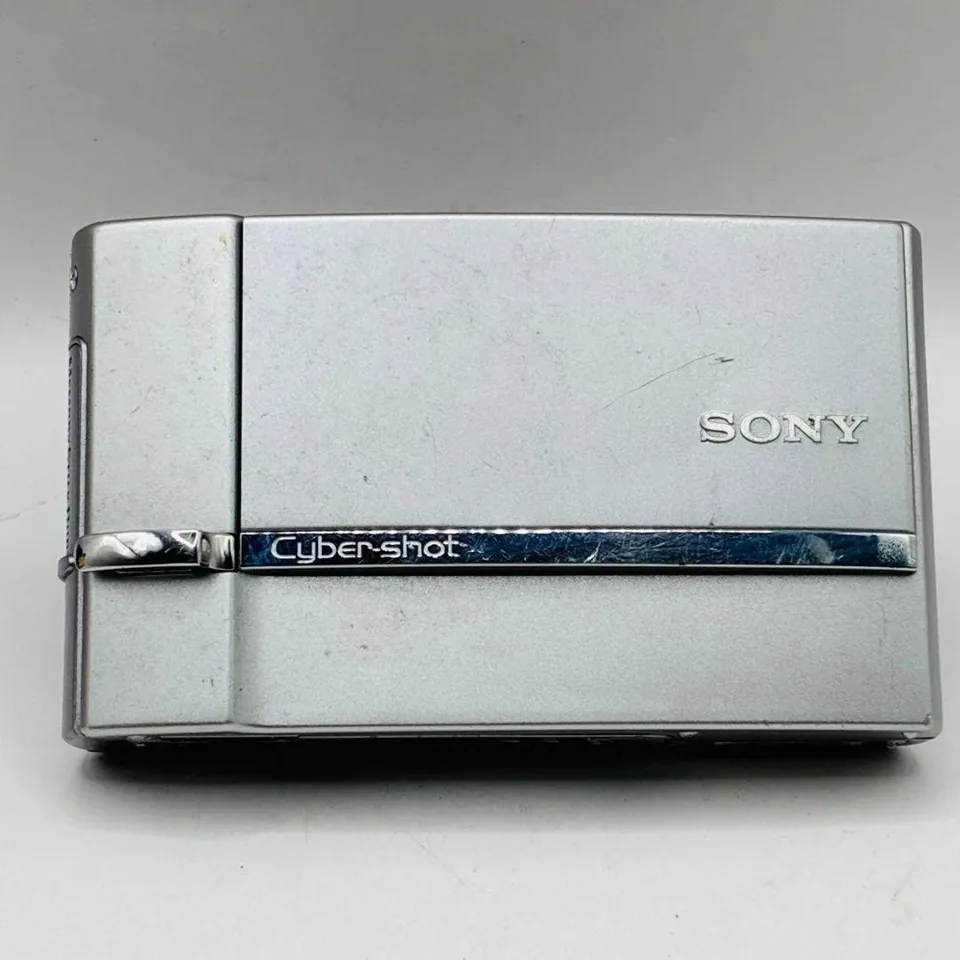
In September 2006 Sony added a touch panel to the 3-inch screen of its top T-series camera, which Reviewed.com called a first for the line, and priced it at about $500. Reviewers praised its stabiliser, its sharp lens and its battery, and could not agree whether prodding the screen was a pleasure or a chore.
- Launched
- September 2006
- Sensor
- 7.2 MP CCD
- Lens
- 38–114 mm, 3×
- Card
- Memory Stick Duo, Memory Stick Pro Duo
- Battery
- NP-FR1
Sony Cyber-shot DSC-T50 specs: sensor, lens, battery, memory card and cable
The Sony Cyber-shot DSC-T50 is a 7.2 MP CCD compact camera with a 38–114 mm (35 mm equivalent) 3× zoom lens, launched in September 2006 at about $500. It takes Memory Stick Duo and Memory Stick Pro Duo cards and runs on the NP-FR1 battery. Sources
- Sensor
- CCD, 1/2.5", 7.2 MP source
- Lens
- 38–114 mm equivalent, 3× zoom source
- Memory card
- Memory Stick Duo, Memory Stick Pro Duo source
- Battery
- NP-FR1 source
- USB / A/V cable
- See our Sony cable page
Meet the camera
Sony announced the T50 on 10 September 2006 alongside the ten-megapixel DSC-N2, and said it would ship in October for about $500.12 The selling point was the screen: a 3-inch, 230,000-dot display that doubled as the control panel, which, Sony's release said, allowed fewer physical buttons on the body.1 Reviewed.com called it the first touch screen in the T series, and noted that the camera lost the four-way controller of the T30, which had launched in April at the same price.2 The body measures about 95 by 57 by 23 millimetres and weighs 170 grams with its battery,3 and it came in red, black or silver.25 A sliding cover over the lens is also the power switch: Steve's Digicams said sliding it down turns the camera on and sliding it up turns it off,5 and PC Magazine heard a three-note jingle when it opened.6
Imaging Resource's user report is dated 28 September 2006. It came from casual use and said a final judgement would await a complete test of a production camera;3 the page we read carries no later written report, only its specification table and test-shot galleries. Steve's Digicams posted its review on 12 October,4 PC Magazine's is dated 1 November6 and TechRadar's page 26 January 2007.7
Why this one was interesting
The back of the camera is the screen
Imaging Resource said the T50 borrowed its touch system from the N2 and the N1 before it, and Steve's Digicams noted that the N1 of 2005 was the first touch-screen Sony it had reviewed.34 The reviewers counted the buttons differently: Imaging Resource found two controls on the back, one to cycle the displays and one to open the menu,3 Steve's Digicams listed menu, display and zoom,4 and PC Magazine four, counting a key that switches between playback, camera and movie.6 All agreed that most settings now lived on the glass. Steve's Digicams said you could use a fingertip or the paint-pen stylus in the box.5
A bigger body, a bigger battery
Imaging Resource said the T50 appeared to use the same sensor and lens as the T10, and listed the differences: the touch screen, a body 0.94 inch thick against 0.80, a battery rated at 400 shots against 250, a longer flash range, and slightly higher contrast and saturation.3 Sony rated the flash at 11.2 feet at wide angle with Auto ISO;35 Imaging Resource's informal studio shots suggested nearer 15 feet and it said the T50 clearly out-reached the T10.3 We cover the slimmer sibling in our DSC-T10 review.
Noise reduction retuned
Sony changed the automatic noise reduction so that it now applies only to exposures of 1/6 second or longer, where the T30 applied it from 1/25 second.13 The Candle scene mode gave way to a High Sensitivity mode, and built-in memory fell by two megabytes to 56 MB.3 PC Magazine compared the sliding-panel styling with the DSC-T9's;6 for where the T line began, see the DSC-T1.
What was lost
Compared with the T30, the four-way controller went,2 and the touch panel took the battery rating from 420 shots to 400.1 Compared with the T10 it was chunkier: Imaging Resource called it noticeably thicker, though still eminently pocketable.3 There was still no viewfinder, and two reviewers marked it down. PC Magazine thought manufacturers should not stop including a small glass one, because the screen washes out in strong sun, and TechRadar listed no optical viewfinder as its one reason to avoid the camera.67
The dark: where noise showed
Sony promised good low-light pictures without flash, and PC Magazine's reviewer found them only average.6 Steve's Digicams found noise very low at ISO 200 and below, not too bad at 400 and very noisy at 800 and 1000;4 Imaging Resource thought ISO 400 would satisfy most people at 8 by 10 inches and ISO 800 and 1000 only barely acceptable for 4 by 6 prints.3 TechRadar disagreed, saying the Super HAD sensor kept noise under relative control even at ISO 800.7 The stabiliser was the remedy the reviewers pointed to. Imaging Resource could hand-hold quarter-second exposures with care, where unstabilised shots were marginally sharp only at about 1/30 second,3 and Steve's Digicams said the stabiliser meant ISO rarely needed to rise above 400.4 PC Magazine, though, thought stabilisation less essential on a camera with only a 3x zoom.6 The flash needed care for portraits: Steve's Digicams found traces of red-eye in most people shots until red-eye reduction was switched on in the Setup menu.4







Real photographs taken with this camera. The sensitivity shown is recorded in each file's own EXIF data; the camera's top setting is ISO 1000. These were not made under test conditions and none is a very dark scene.
Like that look? See recent eBay sold listings for this camera ↗
On eBay right now
Live listings for this camera, supplied by eBay and updated automatically. We earn a commission if you buy through them.
The little wins
Quick to shoot
Steve's Digicams timed 1.5 seconds from opening the cover to the first picture, under a tenth of a second of lag when pre-focused, two-tenths with autofocus, and 1.4 seconds between frames without flash.4 Imaging Resource called its shutter response excellent and its autofocus much faster than average.3
Sharp corners
Imaging Resource warned that folded lenses often show soft corners and colour fringes, said the T10's corners had been unusually sharp and that the T50 appeared to follow suit; TechRadar praised sharpness from edge to edge.37
How it drew the picture
The reviewers' pictures did not quite match. Imaging Resource saw bright colour, a touch more contrast than the T10, oversaturated strong blues and below-average white balance under household incandescent light, and praised very nice 13 by 19 inch prints.3 Steve's Digicams found nice exposure and pleasing saturation, with moderate barrel distortion at wide angle and virtually no pincushion at the long end;4 Imaging Resource reported the opposite, above-average pincushion at telephoto,3 and PC Magazine found both pincushion and barrel distortion.6 PC Magazine's lab pictures showed excellent exposure and colour and fairly low noise, but a resolution of 1,575 lines it called a bit low for a 7.2-megapixel camera, and real-world shots with noticeable noise and fringing.6 TechRadar called the images superbly bright and punchy.7
















Photos taken with this camera, from Wikimedia Commons, credited under each picture. The sensitivity recorded in these files is ISO 125, 160 or 320.
Where it let you down
The touch screen divided the reviewers. Imaging Resource's reviewer found it tedious and awkward, needing many touches and two hands, and called it a love-it-or-hate-it feature, though it never mis-selected anything.3 PC Magazine's reviewer found the menus quite intuitive and thought seniors would like the large on-screen buttons.6 Steve's Digicams said it worked great once the layout was learned,4 and TechRadar said stabbing at it could be a pain in the fingertip even after the calibration routine.7 The screen outdoors split them too. Steve's Digicams found it excellent in direct sun and brightening in dim light, Imaging Resource called it usable in sunlight but covered in fingerprints, and PC Magazine said it washed out in very bright sun and streaked when panned in dim light.436
Other complaints were smaller. Steve's Digicams noted the lens sits at the corner, so a left index finger easily strays into the frame;4 PC Magazine's reviewer warned that the microphone beside the shutter button is easy to cover;6 and burst shooting drew mixed verdicts. Imaging Resource listed slow continuous-mode cycle times and PC Magazine called the burst mode only so-so, with three or four frames before a stall of several seconds, while Steve's Digicams recorded five frames in 3.3 seconds, about 1.5 frames per second, against Sony's rating of 1.1.3641 Start-up times used different yardsticks: 2.1 seconds to boot for PC Magazine, 1.5 to first shot for Steve's Digicams, and about a second and a half to wake for TechRadar.647 Video divided them too. Imaging Resource listed excellent video with sound, and PC Magazine found the colour and sound good but the picture jerky.36
Memory Stick Duo was the other cost. TechRadar said the 56 MB of built-in memory holds only about six full-size pictures, so a 1 GB card was needed, and that full-size Memory Sticks do not fit.7 Imaging Resource recommended at least a 256 MB PRO Duo, preferably 512 MB.3 See our Memory Stick guide and the glossary.
What the reviewers said in 2006
| Outlet | Date | Verdict |
|---|---|---|
| Imaging Resource | 28 Sep 2006 | 4 out of 5 and a Dave's Pick on a user report: a great little camera with a huge screen and good stabilisation, though the reviewer personally disliked the touch interface; a full test was still to come.3 |
| Steve's Digicams | 12 Oct 2006 | No score on the page we read: an excellent choice for a durable, stylish camera with good pictures and cool features; a bit expensive at about $499, but good value for a capable pocket camera.4 |
| PC Magazine | 1 Nov 2006 | A very good picture taker with decent performance, but low-light pictures only average, $499.95 too much, and short of rivals such as the Canon PowerShot SD550 Digital Elph.6 |
| TechRadar | 26 Jan 2007 | Not a bad camera, and a year earlier it would have been a stunning piece of kit, but the market had caught up; a camera for your mum. Its pros list says good value, while its text says a dozen other cameras match it without the Sony price tag.7 |
The timeline
- 10 September 2006Sony announces the T50 and N2; the T50 is due in October at about $500.12
- 11 September 2006Imaging Resource reports the announcement.1
- 12 September 2006Pre-orders open on Sony's own shop, according to Reviewed.com and Sony's release.21
- 28 September 2006Imaging Resource publishes its user report.3
- 12 October 2006Steve's Digicams posts its review.4
- 31 October 2006Imaging Resource's availability date.3
- 1 November 2006PC Magazine's review is dated.6
- 26 January 2007TechRadar's review appears.7
Should you buy one now?
Buy one if you want a pocketable 2006 CCD compact with a stabilised Zeiss lens, a very large screen and menus you touch instead of press, and you will mostly shoot at ISO 400 or below. It launched at about $500;16 what it sells for now is a question for the sold listings, not for us. We have not tested a unit. Before you bid, check these:
- The touch screen. Press every corner; it is the only control panel, and TechRadar mentioned a calibration routine.7 The stylus was in the box, so see whether it is still there.5
- The screen's condition. TechRadar called it scratch-resistant but advised a case to ward off scuffs.7
- The battery. It uses the NP-FR1, a larger battery than the T10's;13 an old one may not last, and a fresh one is on Amazon ↗. The charger was in the box.3
- The card. It takes Memory Stick Duo or PRO Duo only, and the PRO Duo is needed for the best video setting.3 Steve's Digicams listed support for cards up to 4 GB.5
- The cable. It shipped with a combined USB, A/V and DC-in cable.3 Imaging Resource's review calls the USB connection USB 2.0 and fast, while its announcement table says USB 1.1.31
- The lens cover. It is the power switch, so check it slides smoothly and the lens behind it is clean.5
The camera that followed it in the range is our DSC-T100 review. If you are wondering why cameras like this are being hunted down again, we tell that story once, in Pictures that never left the card.
See recent sold prices on eBay ↗Shop on eBay ↗NP-FR1 battery ↗
Sources
- Imaging Resource, “Sony: Two new Cyber-shot digicams” by Mike Tomkins (11 Sep 2006; includes Sony's release of 10 Sep 2006 and the specification table)
- Reviewed.com, “Sony Unveils Cyber-shot DSC-T50 with Touch Screen LCD” by Karen M. Cheung (10 Sep 2006)
- Imaging Resource, Sony DSC-T50 review: user report by Dave Etchells (28 Sep 2006) with specifications, pros and cons
- Steve's Digicams, Sony Cyber-shot DSC-T50, “Steve's Conclusion” page (review posted 12 Oct 2006; Internet Archive copy of 5 Dec 2006)
- Steve's Digicams, Sony Cyber-shot DSC-T50, introduction, specifications and features pages (same review; Internet Archive copy of 5 Dec 2006)
- PC Magazine, “Sony Cyber-shot DSC-T50” review by Terry Sullivan (1 Nov 2006; Internet Archive copy of 10 Dec 2007)
- TechRadar, “Sony Cyber-shot DSC-T50 review” by tech.co.uk staff (26 Jan 2007)
Of the four write-ups, Steve's Digicams and PC Magazine are full tested reviews; Imaging Resource's is a user report from casual use and TechRadar's is a short review with no measurements. Photographs are credited under each one, all via Wikimedia Commons. Steve's Digicams and PC Magazine no longer publish these pages at their old addresses, so we read Internet Archive copies. Links to eBay and Amazon are affiliate links.