Sony Cyber-shot W · on sale spring 2006
The Sony Cyber-shot DSC-W100: the top 2006 W-series compact, with a manual mode and ISO 1250
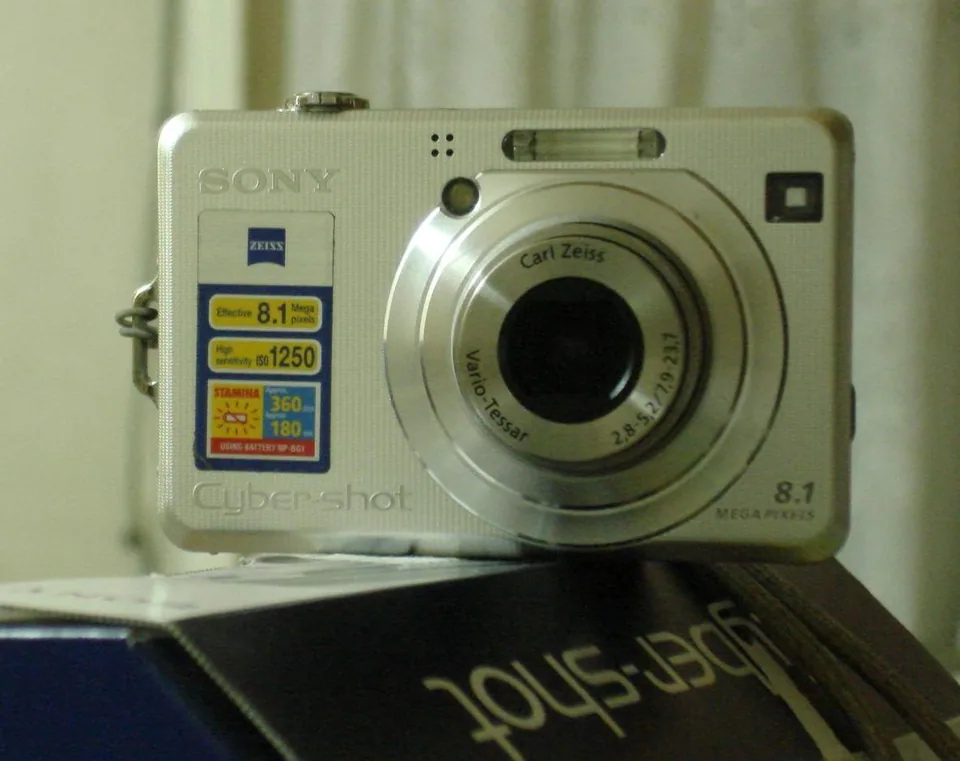

In 2006 Sony put an 8.1-megapixel sensor, ISO 1250 and a limited manual mode on top of its W line, for about $350. Reviewers liked its pictures and disagreed about several other things: how fast it was, how good its flash and low-light results were and how accurate its viewfinder was.
- Launched
- February 2006
- Sensor
- 8.1 MP CCD
- Lens
- 38–114 mm, 3×
- Card
- Memory Stick Duo, Memory Stick Pro Duo
- Battery
- NP-BG1
Sony Cyber-shot DSC-W100 specs: sensor, lens, battery, memory card and cable
The Sony Cyber-shot DSC-W100 is an 8.1 MP CCD compact camera with a 38–114 mm (35 mm equivalent) 3× zoom lens, launched in February 2006 at about $350. It takes Memory Stick Duo and Memory Stick Pro Duo cards and runs on the NP-BG1 battery. Sources
- Sensor
- CCD, 1/1.8", 8.1 MP source
- Lens
- 38–114 mm equivalent, 3× zoom source
- Memory card
- Memory Stick Duo, Memory Stick Pro Duo source
- Battery
- NP-BG1 source
- USB / A/V cable
- See our Sony cable page
Meet the camera
It is a small compact with a metal front. Imaging Resource found the build solid and the metal case attractive, with a look it called modern yet retro.3 Reviewed.com noted that only the front plate is metal, with a fishnet texture, and that the rear panel is silver plastic.4 Digital Camera Resource called it a little chunkier than the other W cameras but still easy to pocket.5 It measures 94 by 61 by 25 millimetres3 and weighs 161 grams without the battery.5
Sony announced it at the PMA show in Orlando on 25 February 2006, together with the cheaper 7.2-megapixel W70; the press release, as DPReview reproduced it, said the W100 would ship in April for about $350.1 Reviewed.com reported $349,2 and Digital Camera Resource recorded a street price of $336 when it posted its review, against $295 for the W70 and $240 for the W50.5 Our sources give the camera one name, DSC-W100, and we did not find a regional alias.
Why this one was interesting
The top of a four-camera line
Digital Camera Resource's comparison chart lists the four 2006 W models: W30, W50, W70 and W100. The W100 alone had a manual exposure mode, an ISO ceiling of 1250 against 1000, 64 MB of built-in memory against 32 or 58, and an 8.1-megapixel sensor against 6 or 7.2.5 It also gave up things the W50 and W70 had: the chart shows no conversion lens support and no camera dock, and a battery rating of 360 shots against 400 for the W30 and 390 for the W50 (the W70 is also rated at 360).5
A manual mode with two apertures
Reviewed.com and Digital Camera Resource both found the manual mode limited: shutter speeds run from 30 seconds to 1/1000, but only two apertures are offered at a time, f/2.8 or f/5.6 at wide angle and f/5.2 or f/10 at telephoto.45 Reviewed.com still welcomed it, since many compacts at the price had no manual control,4 and Digital Camera Resource said it let the W100 take a nicer night shot than the W50.5 Both missed a custom white balance setting.45
ISO 1250, and what reviewers made of it
Sony's High Sensitivity scene mode raised the ISO automatically to avoid flash, and Reviewed.com called the mode fairly new to the W series.4 In its noise tests, Imaging Resource found ISO 800 and 1250 soft enough to call them essentially unusable and ISO 400 quite good; in its print tests it found 800 reasonably good at 8 by 10 inches and 1250 acceptable only at 4 by 6.3 Digital Camera Resource's studio test gave good-sized prints through ISO 400 and a decent 4 by 6 at 800, and it advised against 1250; in its night scene nothing above ISO 200 was usable, even at 4 by 6.5 Reviewed.com measured a steady rise in noise without the big jumps typical of compacts past ISO 400, and scored manual-ISO noise 8.24 out of 10.4
Speed: three reviewers, three stopwatches
Start-up took 1.3 seconds at Digital Camera Resource,5 1.7 at Imaging Resource3 and 2.5 at Reviewed.com, which called that long.4 Shutter lag shows the widest split: 0.31 seconds at wide angle and 0.59 at telephoto with full autofocus at Imaging Resource, 0.012 prefocused;3 an average of 0.9 seconds at Reviewed.com, the longest it had tested in a while;4 not noticeable at Digital Camera Resource.5 All three agree that continuous shooting is weak, four frames at about one a second.354 A separate Multi Burst mode takes 16 frames at up to 30 a second and joins them in one 1-megapixel picture, which Reviewed.com called terrible.54
A viewfinder, still
Imaging Resource called the optical viewfinder terribly inaccurate and measured it at about 81 percent of the frame at wide angle and 83 percent at telephoto, against close to 100 percent for the screen; it did like the finder's position in the upper left corner, which keeps your nose off the screen.3 Reviewed.com thought it one of the better finders in a point-and-shoot, though small, and said that at telephoto it shows much more than the camera records, whereas Imaging Resource measured 83 percent at that end.43 Digital Camera Resource noted it has no dioptre correction.5
What was lost
Digital Camera Resource's first complaint was about missing extras: it said the W100 cannot use the extras the cheaper W models offered (conversion lenses, an underwater case and a camera dock), and it found it hard to understand why Sony left conversion lens support off the flagship.5 Our sources disagree about the lens adapter. Reviewed.com said a $30 adapter would let the camera take conversion lenses,4 and the specification list on Steve's Digicams gives a 30 mm filter diameter that needs the VAD-WB adapter;6 Digital Camera Resource said the lens is not threaded and, unlike on the cheaper models, no adapter can be attached through the tripod mount.5 Check before you pay for a conversion lens.
There is no custom white balance,54 no true manual focus, only preset distances from 0.5 metres to infinity,34 and no RAW.5 Video at 30 frames a second needs a Memory Stick PRO Duo card; without one it drops to about 16 or 17 frames a second, and the zoom does not work while recording.54 Reviewed.com added that there is no image stabilisation.4 Imaging Resource lists software for Mac and PC, while Digital Camera Resource says the supplied Cyber-shot Viewer has no Mac version;35 the specification list on Steve's Digicams also gives the supplied software as Windows only, with the camera itself listed as compatible with Mac OS.6
The dark: reviewers split
On low light the reviewers split. Imaging Resource called the capability great: its test captured bright pictures down to the darkest level it uses, although autofocus worked only down to a little above a quarter of a foot-candle.3 Reviewed.com scored low light 7.0 out of 10: pictures were lit well but not especially sharp, and colours drifted.4 Digital Camera Resource found low-light focus slow but accurate, helped by the autofocus lamp.5
The flash is where they contradict each other most. Imaging Resource found coverage uneven and slightly dim, needing the High intensity setting indoors and weak by 14 feet.3 Reviewed.com called it one of the camera's best assets, mounted above the lens, lighting subjects evenly and reaching 13 feet 8 inches on automatic ISO.4 Digital Camera Resource gave the working range as 0.2 to 6 metres at wide angle and 0.3 to 3.2 at telephoto, and found red eye frequent.5 Under household bulbs, Imaging Resource saw a strong warm cast with both automatic and incandescent white balance.3








Real photographs taken with this camera. The sensitivity shown is recorded in each file's own EXIF data; they were not made under test conditions.
Like that look? See recent eBay sold listings for this camera ↗
On eBay right now
Live listings for this camera, supplied by eBay and updated automatically. We earn a commission if you buy through them.
The little wins
High Sensitivity mode
Reviewed.com said the W100 had the widest ISO range of the W cameras;4 Digital Camera Resource said the mode suits 4 by 6 prints, because you cannot choose the ISO it picks.5
A manual night shot
Digital Camera Resource said the manual mode let the camera take in plenty of light for a sharp night scene with reasonable noise, which the W50 managed less well.5
How it drew the picture
Imaging Resource's lab found strong detail to about 1,400 lines per picture height, edge enhancement, and noise suppression that smeared subtle detail such as hair.3 Reviewed.com measured 1,856 line widths horizontally and 1,310 vertically and called that not incredibly impressive for 8.1 megapixels.4 Imaging Resource measured 0.9 percent barrel distortion at wide angle, bright colour fringing of nine pixels or more there and soft left corners, worst at telephoto;3 Digital Camera Resource called distortion fairly mild and did not find fringing a major issue.5 Colour was warm and dark at Imaging Resource, with skin tones a little orange, yet it printed ISO 80 pictures at 13 by 19 inches for wall display, with softness visible up close.3
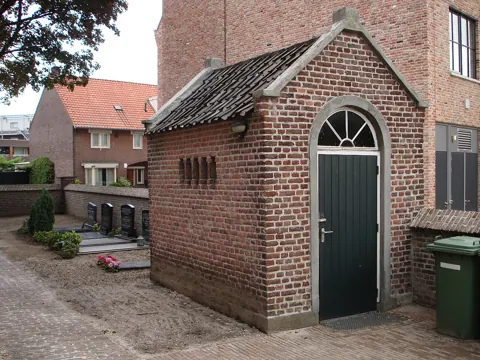







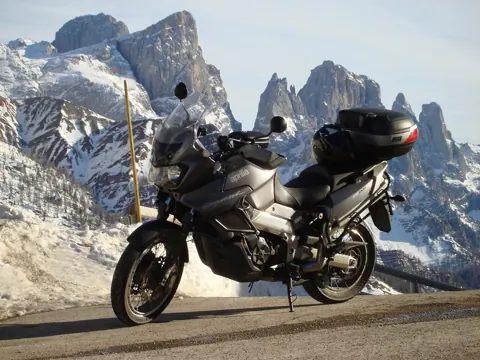








Photos taken with this camera, from Wikimedia Commons, credited under each picture.
Where it let you down
Digital Camera Resource disliked the flimsy card and battery door and the fact that you cannot open it while the camera sits on a tripod; Imaging Resource noted the tripod problem too.53 Reviewed.com found the controls cramped: a tiny zoom lever, a stiff mode dial placed too high and no finger grip, whereas Imaging Resource listed a design that fits the hand well among its pros.43 Reviewed.com and Digital Camera Resource both thought the 115,000-pixel screen unflattering on a flagship.45 The camera takes Memory Stick Duo cards rather than SD,3 so see our memory card guide.
What the reviewers said in 2006
| Outlet | Date | Verdict |
|---|---|---|
| Digital Camera Resource | 25 Apr 2006 | A very good camera that beat expectations on photo quality and high ISO, but with too little to separate it from the cheaper W models. For a regular point-and-shoot user, the reviewer would pick the W50 and spend the savings on a memory card.5 |
| Imaging Resource | 31 May 2006 | 4 out of 5 and a Dave's Pick: a versatile take-anywhere camera with good colour, high resolution and strong prints; the cons list names wide-angle fringing, soft telephoto corners and trouble under household bulbs.3 |
| Reviewed.com | Undated | Takes great pictures, with strong colour, noise results and flash, but slow start-up and burst, a long shutter delay, a low-resolution screen and a cramped body; value scored 7.25 out of 10 at $349.4 |
Steve's Digicams also posted a review in August 2006, but we read only its introduction and specification pages. PhotographyBlog's news items show that CNET (12 July 2006)8 and DigitalCameraInfo (3 July 2006)9 reviewed it too, but we did not read their pages, so we do not cover their verdicts. We found no full DPReview, Cameralabs or Photo Review review of this model.
The timeline
- 25 February 2006Sony announces the W100 and W70 at PMA.12
- April 2006The month Sony's press release said it would ship, at about $350.1
- 25 April 2006Digital Camera Resource posts its review.5
- 31 May 2006Imaging Resource posts its review.3
Should you buy one now?
Buy one if you want a metal 2006 CCD compact with a viewfinder, a manual mode and good daylight colour, and you can live with a slow burst, a coarse screen and a flash and low-light verdict that depends on whom you ask. It launched at about $350;1 what it sells for now is a question for the sold listings, not for us. Before you bid, check these:
- The model. The W100 is the 8.1-megapixel camera; the 7.2-megapixel W70 looks similar, but Reviewed.com says its viewfinder sits above the screen and Digital Camera Resource says it supports conversion lenses.45
- The battery. It uses an NP-BG1;45 a fresh one is on Amazon ↗.
- The card. It takes Memory Stick Duo or PRO Duo only.3 Sony's 2010 chart lists PRO Duo media up to 4 GB for it, with a note that movie recording stops when a file reaches about 2 GB.7 Launch-era sources differ on the ceiling: Reviewed.com and Sony's press release (via DPReview) say 4 GB,41 while the specification list on Steve's Digicams, which it labels as the manufacturer's, says tested up to 2 GB.6
- The doors. Look at the card and battery door, which Digital Camera Resource called flimsy,5 and the DC-in cover, which Reviewed.com said is attached only by a rubber thread.4
- The lens. Check that it extends and retracts cleanly.
The following year's W cameras are covered in our DSC-W80 retrospective. If you are wondering why cameras like this are being hunted down again, we tell that story once, in Pictures that never left the card.
See recent sold prices on eBay ↗Shop on eBay ↗NP-BG1 battery ↗
Sources
- DPReview, “Sony Cyber-shot DSC-W70 and DSC-W100” (launch news, 25 Feb 2006: shipping in April, about $350, preliminary specifications)
- Reviewed.com, “Sony Releases Cyber-shot W-100 and Cyber-shot W70” by Emily Raymond (25 Feb 2006: $349, available in April)
- Imaging Resource, Sony Cyber-shot DSC-W100 review by Stephanie Boozer (first posted 31 May 2006)
- Reviewed.com, Sony Cyber-shot DSC-W100 review by Emily Raymond (the page carries no date)
- Digital Camera Resource Page, Sony Cyber-shot DSC-W100 review by Jeff Keller (posted 25 April 2006, updated 17 January 2008; archived copy, the original page has gone)
- Steve's Digicams, Sony Cyber-Shot DSC-W100 review, introduction and specification pages (posted 2 Aug 2006; archived copy; we did not read the conclusion page)
- Sony, Memory Stick compatibility chart for digital still cameras (last updated 3 September 2010)
- PhotographyBlog, “Sony DSC-W100 Review at CNET” (news item, 12 July 2006; links to CNET’s review, which we did not read)
- PhotographyBlog, “Sony DSC-W100 Review at DigitalCameraInfo” (news item, 3 July 2006; links to DigitalCameraInfo’s review, which we did not read)
Photographs are credited under each one, all via Wikimedia Commons. Links to eBay and Amazon are affiliate links.