Nikon Coolpix · announced February 2004
The Nikon Coolpix 5200: the aluminium compact that fixed red-eye inside the camera
We found no other regional name for it: Nikon's Japanese release and its US announcement both say COOLPIX 5200.13 The sample photos below record the model as “E5200” in their EXIF data.
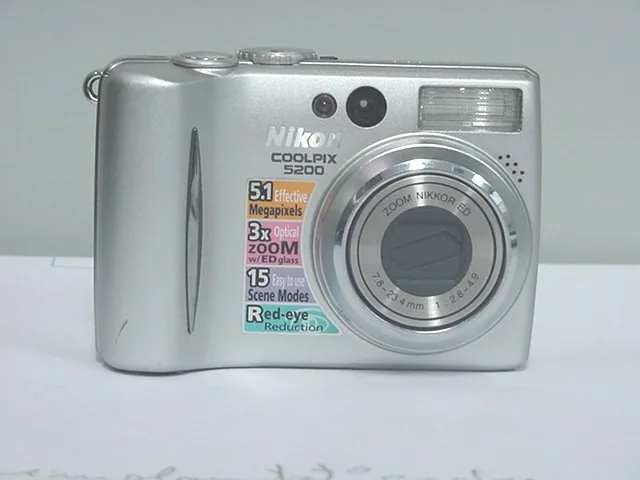
In February 2004 Nikon put a 5.1-megapixel sensor and a 3x zoom in a small aluminium body, priced it at $499.95 and made automatic red-eye correction the headline. Four reviewers liked its size and ease of use, then argued over noise, sharpness and colour.
- Launched
- February 2004
- Sensor
- 5.1 MP CCD
- Lens
- 38–114 mm, 3×
- Card
- SD, MMC
- Battery
- EN-EL5
Nikon Coolpix 5200 specs: sensor, lens, battery, memory card and cable
The Nikon Coolpix 5200 came out in February 2004 at $499.95 as a 5.1 MP CCD compact with a 38–114 mm (35 mm equivalent) 3× zoom lens. It takes SD and MMC cards and runs on the EN-EL5 battery. Sources
Meet the camera
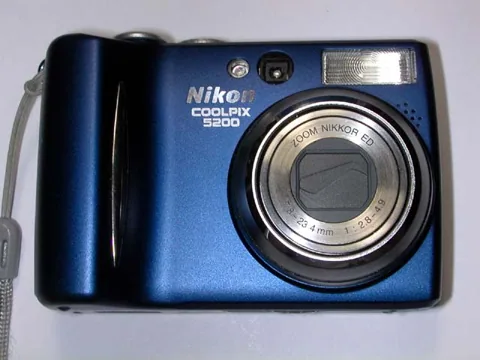
It measures 88 by 60 by 36.5 millimetres and weighs 155 grams without battery or card; Imaging Resource said it could almost hide behind a credit card, being about half an inch taller.6 The body is aluminium, which Nikon's Japanese release listed as a selling point beside two body colours, Platinum Blue and Prime Silver.1 Imaging Resource called it a “gorgeous metal skin” on a camera whose predecessor, the 3200, was plastic, and noted the weight was up a smidge from the 3200, likely thanks to the metal;6 DPReview said the metal made it a good deal smaller than the 3200 and 4200 it resembled.8 Reviewed.com thought the design sleek, but its tester worried about how the body would survive a drop.9
Nikon announced it on 12 February 2004 alongside the 4-megapixel Coolpix 4200, with a US list price of $499.95 and availability promised for spring.34 The later dates disagree: Nikon Japan set 4 June 2004 at an open price, with shops expected to ask about ¥50,000;25 Imaging Resource's specification table gives a date available of 31 May and a retail price of $499.00, while its review header says July 2004.76
- Size
- 88 × 60 × 36.5 mm, 155 g without battery and card6
Why this one was interesting
Red-eye, repaired after the shot
Nikon's release called it advanced red-eye reduction: after a flash portrait, the camera processes the image digitally and corrects red eyes on its own.1 Nikon Inc.'s US press release, reproduced by Imaging Resource, headlined “world's first” cameras to remove red-eye automatically: a pre-flash, then image analysis, switched on in the red-eye reduction flash mode and optimised for the flash's usual working distance, a limit the release admitted.3 Photo Review said it worked extremely well across a wide range of lighting,10 and DPReview said it worked virtually every time.8
Scene modes with framing guides
Nikon counted 15 scene modes: four with on-screen framing guides (portrait, landscape, sports, night portrait) and eleven others.1 Imaging Resource described the guides as outlines of people, mountains or a grid laid over the screen, and called them a nearly foolproof way to frame a shot; it listed eleven further presets in the Scene menu, which with the four guide modes matches Nikon's 15.6 Photo Review instead described four dial settings plus 15 in a separate menu, a different count.10
A month earlier Nikon had announced the 3.2-megapixel Coolpix 3200, which our page records at $299.95 and two AA batteries, and which Imaging Resource called the 5200's closest relative.6 For the swivel-bodied Coolpix of the early digicam years, see our Coolpix 995 (2001, a 1/1.8-inch CCD, listed at about $900) and Coolpix 950 (1999). Two years after the 5200, our Coolpix L3 page records a 5.1-megapixel Nikon at a planned $199.95.
What was left out
There is no manual focus and no control over shutter speed or aperture, and Reviewed.com noted that the mode dial has no manual position at all.96 DPReview counted only two aperture settings and no exposure information on the screen, a gap Imaging Resource also wanted filled in playback.86
The dark: its weak point
Noise split the reviewers. Reviewed.com was harshest: automatic ISO gave washed-out pictures in bright light and, at ISO 200 and 400, images it called extremely noisy and distorted, and it said Sony's DSC-W1 and P100, also 5-megapixel cameras, held noise down better in far dimmer light.9 Imaging Resource saw noise even at low ISO but did not find it objectionable, noting that “other reviewers have faulted it for high image noise”.6 Photo Review found noise minimal at ISO 400.10 DPReview listed clean images with only moderate noise among its pros and said in its conclusion that purists would applaud Nikon for not turning everything, sharpening included, “up to 11”, leaving a much cleaner image to start from.8
Imaging Resource's low-light test gave clear images down to about one foot-candle (11 lux) at ISO 64 and 100, and a half and a quarter of that at ISO 200 and 400; Night Landscape mode allowed two-second exposures, and autofocus held down to a sixteenth of a foot-candle, though pictures ran slightly warm and underexposed in very dim light; noise in that test was low, and only moderate even at ISO 400.6




Real photographs taken with this camera. The sensitivity shown is recorded in each file's own EXIF data.
Like that look? See recent eBay sold listings for this camera ↗
On eBay right now
Live listings for this camera, supplied by eBay and updated automatically. We earn a commission if you buy through them.
The little wins
Best Shot Selector
Hold the shutter and the camera takes a burst and keeps the sharpest frame; Imaging Resource called it one of its all-time favourite digicam features for hand-holding long exposures.86 A separate buffer mode saved the last five frames at 2.5 a second in Imaging Resource's account (DPReview measured around 2), so you could release just after the action.68
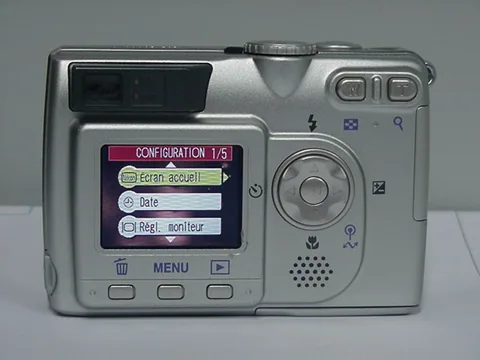 The back of the 5200: screen, four-way dial and zoom buttons. · Plbcr · CC BY-SA 3.0 · Commons
Close-ups
Focus down to 4 centimetres, and Imaging Resource measured a minimum field of 31 by 23 millimetres and called the macro typically excellent, though the lens partly blocked the flash;6 DPReview measured 36 by 27 millimetres at its closest wide setting and also rated the macro mode excellent.8


How it drew the picture
Imaging Resource measured strong detail out to about 1,300 lines per picture height and called the files soft from conservative in-camera sharpening, though they took sharpening in software well.6 DPReview agreed on softness, found muddy shadows and a still heavily compressed finest JPEG setting, and recommended unsharp masking.8 Reviewed.com's chart test found 3.7 megapixels of real resolution, 73 percent of the claimed 5.1, which it called acceptable, with oversaturated colour.9 Photo Review disagreed on both counts, reporting sharp images and natural, slightly cool colour,10 and Imaging Resource called colour very good to excellent.6 The three that commented on contrast all found it high, and Photo Review saw blocked-up highlights in bright sun.8610


















Photos taken with this camera, from Wikimedia Commons, credited under each picture.
Where it let you down
The optical viewfinder drew the loudest complaints. Imaging Resource measured it at about 72 percent of the frame at wide angle and 76 at telephoto, against 97 and 99 for the screen, and called it very poor; Reviewed.com called its size fairly laughable.69 Reviewed.com also found the 110,000-dot screen meagre, prone to solarisation off-axis, and the mode dial hard to read in the dark, where DPReview found the screen fairly clear and crisp.98 Speed was disputed. Imaging Resource measured shutter lag of 0.87 to 1.17 seconds, slower than average, or 0.124 seconds prefocused;6 Reviewed.com timed 0.91 seconds and found start-up slow;9 DPReview said the overall responsiveness made it a real pleasure to use, though it timed 3.9 seconds from off to ready to shoot, called start-up sluggish, and saw focus hunt at the long end of the zoom.8
The battery claims conflict. Nikon's launch material put the EN-EL5 at up to 320 shots,34 DPReview gave Nikon's CIPA figure as about 150, not fantastic but enough for a day,8 and Imaging Resource's worst-case run-down, screen on, lasted a bit over an hour, so it advised a spare (the same review also calls the battery life excellent in one line, which sits oddly with its own run-down test).6 Imaging Resource also said the US box held no memory card, and the built-in memory held about six full-size pictures.6
One more slip: Imaging Resource called the 3200 a 4.0-megapixel camera, but Nikon's February announcement made the 4200 the 4.0-megapixel model, and our 3200 page lists 3.2.63
What the reviewers said
| Outlet | Date | Verdict |
|---|---|---|
| Imaging Resource | 29 Jul 2004 | A nice, compact point and shoot for easy operation and good-looking pictures; held back by the viewfinder, short battery life and high contrast, with the 3200 named as a great choice for readers who like sharp, contrasty images.6 |
| DPReview | 26 Aug 2004 | A little gem and Nikon's best proper compact in years; the pictures need post-processing to shine.8 |
| Reviewed.com | 10 Sep 2004 (page metadata) | For point-and-shoot users who value size, simple menus and 30 fps video; weak on noise, colour accuracy, the small viewfinder and screen, and slow autofocus and start-up. No overall score on the page.9 |
| Photo Review | Undated | Above-average image quality and effective red-eye removal; excessive contrast, heavy JPEG compression and poor automatic white balance under incandescent light. No score.10 |
The timeline
- 12 February 2004Nikon announces the 5200 and 4200; US list $499.95.13
- 20 May 2004Nikon Japan sets 4 June as the 5200's release date.2
- 29 July 2004Imaging Resource publishes its review.6
- 26 August 2004DPReview publishes its review.8
- 10 September 2004Reviewed.com's review is dated this day in its page metadata.9
Should you buy one now?
Buy one if you want a small, simple, metal-bodied CCD compact with a good macro mode and strong measured detail,6 and you are happy to sharpen the soft files yourself. It launched at $499.95;3 what it sells for now is a question for the sold listings, not for us. Before you bid, check these:
- The name. A listing that says only “5200” can mean another Nikon; check the title and the photos for “Coolpix 5200” and its aluminium body.
- The battery. It uses an EN-EL5, supplied with an MH-61 charger.16 Reviewers disagreed about its life, so check that the pack holds a charge; a fresh one is on Amazon ↗.
- The card. It takes SD and MMC cards,78 and the US box held none.6 See our SD card guide and glossary.
- The cable. Nikon's Japanese release lists a UC-E6 USB cable in the box;1 see our UC-E6 page.
- The port cover and lens. Reviewed.com called the port cover flimsy,9 so check it closes, and that the lens extends and retracts cleanly.
If you are wondering why cameras like this are being hunted down again, we tell that story once, in Pictures that never left the card.
See recent sold prices on eBay ↗Shop on eBay ↗EN-EL5 battery ↗
Sources
- Nikon Corporation (Japan), news release on the COOLPIX 5200 and 4200, 12 Feb 2004 (archived copy; in Japanese)
- Nikon Corporation (Japan), release-date notice for the COOLPIX 5200 and 4200, 20 May 2004 (archived copy; in Japanese)
- Imaging Resource, “Nikon announces two new Coolpix digicams” by Mike Tomkins (12 Feb 2004)
- Macworld, “PMA: Nikon’s new Coolpix cameras get rid of red-eye” by Peter Cohen (11 Feb 2004)
- PC Watch (Impress), report on the Japanese release dates (20 May 2004; in Japanese)
- Imaging Resource, Nikon Coolpix 5200 review (unsigned, dated 29 Jul 2004)
- Imaging Resource, Nikon Coolpix 5200 specification table (availability 31 May 2004, retail $499.00, 1/1.8-inch CCD, SD/MMC)
- DPReview, Nikon Coolpix 5200 review by Simon Joinson (26 Aug 2004)
- Reviewed.com, Nikon Coolpix 5200 Digital Camera Review by James Murray (no date on the page; its metadata says 10 Sep 2004)
- Photo Review (Australia), Nikon Coolpix 5200 (unsigned, undated page)
Camera photos by Plbcr (CC BY-SA 3.0) and Nmaeda (public domain); other photographs are credited under each one, all via Wikimedia Commons. Links to eBay and Amazon are affiliate links.