Olympus Camedia · on sale from spring 2003
The Olympus Camedia C-740 Ultra Zoom: a 38–380 mm lens, full manual control and a $499 street price
We found no other regional name: Olympus America's release and ASCII.jp's report on the Japanese launch both call it the Camedia C-740 Ultra Zoom.48 Its picture files name the model C740UZ.
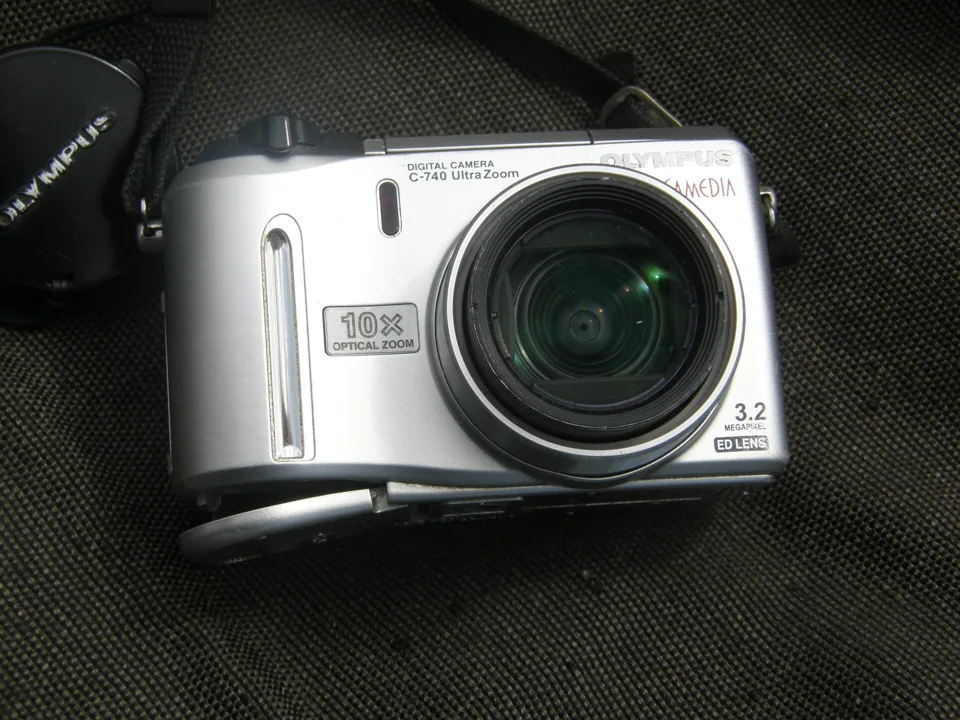

In March 2003 Olympus put a 10x zoom with an extra-low-dispersion lens into a smaller body and sold it for less than the C-750 beside it. Reviewers praised the lens and the manual controls, and counted the noise, the thin bundle and the features left out.
- Launched
- March 2003
- Sensor
- 3.2 MP CCD
- Lens
- 38–380 mm, 10×
- Card
- xD-Picture Card
- Battery
- 4 x AA, CR-V3 (x2)
Olympus Camedia C-740 Ultra Zoom specs: sensor, lens, battery, memory card and cable
The Olympus Camedia C-740 Ultra Zoom came out in March 2003 at $499 as a 3.2 MP CCD compact with a 38–380 mm (35 mm equivalent) 10× zoom lens. It uses xD-Picture Card and runs on 4 x AA or CR-V3 (x2) batteries. Sources
- Sensor
- CCD, 1/2.5", 3.2 MP source
- Lens
- 38–380 mm equivalent, 10× zoom source
- Memory card
- xD-Picture Card source
- Battery
- 4 x AA, CR-V3 (x2) source
- USB / A/V cable
- CB-USB4 Confirmed · all Olympus cables
Meet the camera
Imaging Resource measured it at 4.2 by 2.6 by 2.8 inches and 10.4 ounces (295 grams) without batteries, in a silver-and-black satin finish; the barrel grows about three-quarters of an inch more when you switch on.1 DCRP thought it too big for a pocket yet small for the size of its lens, with a grip a little too small for the reviewer's hand.2
Olympus America announced it on 2 March 2003, the same day as the C-750, with a street price of $499 and a suggested retail price of $599, shipping in April; its release pitched it at the budget-conscious family photographer.4 In Japan Olympus announced it on 22 April at ¥63,000 for a mid-May sale, and Phile-web gave 23 May as the first day.89
Why this one was interesting
A long lens at a short price
The lens ran from 6.3 to 63 mm with 11 glass elements in seven groups, opening to f/2.8 at the wide end and f/3.7 at the long end.1 ByteSector, pricing the camera at about $700 Canadian, said most cameras in that range stopped at 4x.3 Imaging Resource found the lens sharper and less distorted than most long zooms it had tested, with barrel distortion of 0.4 percent at wide angle and 0.3 percent at telephoto.51
Manual control, even here
Beside full auto and six scene modes it offered aperture priority, shutter priority and full manual with exposures up to 16 seconds, and four My Mode memories, each able to preset a list of 31 camera parameters (our count of the list).1 Imaging Resource called its multi-metering, which averages up to eight spot readings, one of the most flexible options on a digicam; DCRP wished more cameras had My Mode.12
A smaller body and a new card
DCRP said the C-740 and C-750 were smaller than the C-730 and read only the new xD-Picture Card, where the C-730 had read SmartMedia as well.2 Olympus's release said the xD slot was what let the body shrink, and that the design grew out of its C-700 Ultra Zoom line.4 For the cheaper end of the same era see our Camedia D-560 Zoom review; for the five-megapixel flagship before it, the C-5050 Zoom.
What was lost
Imaging Resource listed the differences from the C-750 as 3.2 megapixels against 4.0, no flash hot shoe and no sound recording.5 DCRP added wireless remote support and a bundle that gave the C-750 rechargeable batteries but the C-740 only two throwaway CR-V3 packs, and called the 16 MB card skimpy.2 Against the older C-730, Imaging Resource said it also lost the external flash terminal and SmartMedia.1 Panorama mode needs an Olympus-branded xD card, which Imaging Resource called one of the most ill-considered decisions Olympus had made.1
The dark: its weak point
Imaging Resource's lab got usable pictures down to its test limit of 1/16 foot-candle (0.67 lux) at all three ISO settings, with ISO 100 a little dark; noise at ISO 400 was visible but tight, and the reviewer credited the 16-second shutter and the noise reduction.1 DCRP's two night shots were well exposed and fairly sharp but noisier than it liked.2 Autofocus gave out first: Imaging Resource's unit stopped focusing at about 0.7 foot-candles, roughly 8 lux, and both reviewers missed an assist lamp, DCRP adding that low light meant longer lag and trouble locking focus.12 Imaging Resource found the viewfinder better than most in dim light, usable down to about a one-second exposure at ISO 400, while DCRP listed it among its dislikes as difficult to see in low light.12








Real photographs taken with this camera. The sensitivity shown is recorded in each file's own EXIF data.
Like that look? See recent eBay sold listings for this camera ↗
On eBay right now
Live listings for this camera, supplied by eBay and updated automatically. We earn a commission if you buy through them.
The little wins
Fast once pre-focused
With the shutter half-pressed first, Imaging Resource timed 0.093 seconds, which it called very fast; full autofocus took 1.09 seconds at both ends of the zoom, slightly slower than average but fairly good for a long zoom.1
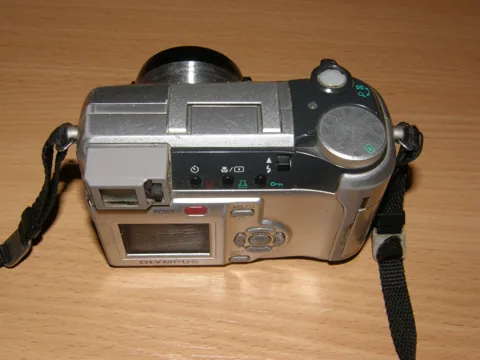 The back of the camera, with the viewfinder window at the left. Andrey Butko · CC BY-SA 3.0 · Commons

Close focus
Super macro reaches 3 centimetres; Imaging Resource measured a smallest frame of 65 by 49 millimetres and found coins and a brooch quite sharp, and DCRP had no complaints about the macro modes.12
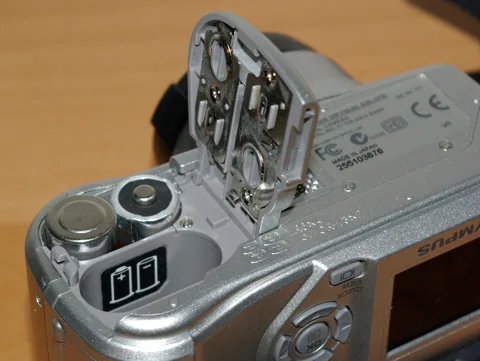 The battery compartment, which takes AA cells or CR-V3 packs. Moxfyre · Public domain · Commons

A battery that lasts, for an EVF camera
Imaging Resource estimated about 3.5 hours of capture with the screen on, on four 1,600 mAh NiMH cells, much better than average even though an EVF cannot be switched off.1
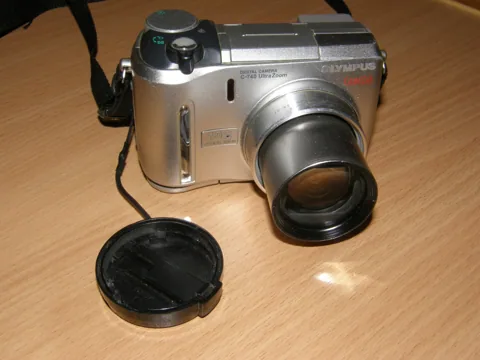 The lens extended, with the cap off. Andrey Butko · CC BY-SA 3.0 · Commons

Less purple fringing
DCRP said the ED lens noticeably reduces purple fringing, though it does not eliminate it, and called that the one standout change.2 Imaging Resource measured moderate chromatic aberration, about four to five pixels of colour either side of target lines.1
How it drew the picture
Imaging Resource rated colour very good to excellent, with accurate hues, though skin in its outdoor portrait came out very ruddy and auto white balance struggled indoors.1 DCRP found colour and exposure accurate and the pictures sharp, but with more noise than it wanted.2 ByteSector saw minimal noise in daylight and impressive sharpness, called 3.2 megapixels decent rather than the best on the market, and said prints near 12 by 18 inches would not be the sharpest.3 The lab saw strong detail out to at least 1,000 lines, with artifacts from about 600, found dynamic range quite good and the default contrast somewhat high, which the contrast setting helped considerably.1 It judged the files enough for sharp 8 by 10 prints.1

















Photos taken with this camera, from Wikimedia Commons, credited under each picture. They come from nine different photographers; every file's EXIF model reads C740UZ. Our own count, read through the Commons API on 27 October 2026: of the 12,870 files in the category, 8,408 record ISO 64 in their EXIF data, 2,057 record ISO 200, 625 record ISO 100 and 128 record ISO 400. ISO 64 is below the 100 that the sources list as the lowest setting, and we do not know why.
Where it let you down
It took 3.89 seconds from power-on to a first shot in Imaging Resource's lab, about average, and the lab did not recommend it for fast sport; its high-speed burst gave 0.54 seconds between frames but only three large, fine pictures before about 10.5 seconds of writing.1 The electronic viewfinder split the two: Imaging Resource saw blur when the subject or the camera moved and called such finders a necessary evil, while DCRP found its motion smooth, not choppy.12 DCRP also found the power button so sensitive that one push sometimes switched the camera on and straight off, and called the zoom smooth but noisy.2 Imaging Resource noted a plastic tripod socket so close to the battery door that changing cells on a tripod is awkward, and called the digital zoom very soft at full resolution.1
The sources also disagree on a few points, so treat these numbers with care:
- Price. Olympus America gave $499 as the street price and $599 as the suggested retail price; Imaging Resource's datasheet lists $499 as the retail price.46
- Screen and finder. Olympus and Steve's give about 110,000 pixels for the LCD and 180,000 for the finder; ASCII.jp says about 114,000 for the LCD; Imaging Resource's viewfinder page reverses the two figures.4781
- Burst. Olympus listed 2.6 frames a second for up to 12 shots; Steve's and DCRP gave 1.4 frames a second for up to 11, and the lab measured 1.04 seconds between the first two large, fine frames and 0.77 seconds after that, with a buffer of about seven.4721
- Sound. Imaging Resource and DCRP say the camera cannot record sound; ASCII.jp's specification summary lists WAVE audio for stills. ByteSector also says the movies are silent. We could not tell which is right.1283
What the reviewers said
| Outlet | Date | Verdict |
|---|---|---|
| Imaging Resource | Posted 2 Mar 2003; news item 2 Apr; updated 17 Jul 2003 | The long zoom to consider on a budget: great colour and tone, many features and a sharper, less distorted lens than most; the C-750 if you need a hot shoe.51 |
| DCRP | 22 May 2003, updated 29 Nov 2004 | A fine choice for most people who want a big zoom; it liked the ED lens, the manual controls and the add-on lens support, and disliked the lost remote, flash terminal and microphone, the noise and the bundle.2 |
| ByteSector | 15 Jan 2004 | Scored it 90 percent overall, with 97 for cost effectiveness and 92 for performance; praised the lens and macro; Olympus provided the camera.3 |
The timeline
- 2 March 2003Olympus America announces the C-750 and the C-740 at $499 street.4
- 2 April 2003Imaging Resource announces its full C-740 review and expects shops to stock it toward the end of April.5
- 22 April 2003Olympus Japan announces ¥63,000, on sale from mid-May.8
- 22 May 2003DCRP publishes its review.2
- 23 May 2003The C-740 goes on sale in Japan, according to Phile-web.9
- 17 July 2003Imaging Resource updates its review after testing a production camera.1
- 15 January 2004ByteSector publishes its review.3
Should you buy one now?
Buy one if you want a long lens, full manual control and CCD pictures from a compact, and can live with noise, slow full autofocus and a lens that is not stabilised.412 Olympus America's street price was $499;4 what it sells for now is a question for the sold listings, not for us. Before you bid, check these:
- The name. Search Camedia C-740 Ultra Zoom. The C-750 Ultra Zoom announced the same day has 4.0 megapixels and a hot shoe, and the older C-730 also reads SmartMedia.52
- The batteries. It shipped with two CR-V3 lithium packs; four AA cells work too, and Imaging Resource advises at least two sets of high-capacity NiMH cells and a good charger.21 A fresh set of rechargeable AAs ↗ is the first purchase; other AA-powered CCD cameras are in our guide.
- The card. It reads xD-Picture Cards only and shipped with 16 MB; Olympus listed 16, 32, 128 and 256 MB cards at launch, and Imaging Resource gave 256 MB as the current limit in 2003.14 Panorama mode needs an Olympus-branded card.12 See our xD-Picture Card page and the memory card guide.
- The lens, finder and power button. The barrel extends on start-up, so watch for a clean extend and retract; the electronic viewfinder is the only viewfinder, so check that it and the screen show a clean picture, and that the power button does not misfire.12
- The cable. USB, video-out and DC-in ports sit behind a hinged door on the left side, and a USB cable and a video cable came in the box; see our Olympus cable guide.12
If you are wondering why cameras like this are being hunted down again, we tell that story once, in Pictures that never left the card.
See recent sold prices on eBay ↗Shop on eBay ↗Rechargeable AA batteries ↗
Sources
- Imaging Resource, Olympus C-740 Ultra Zoom review (12 pages read: overview, design, viewfinder, optics, exposure and flash, timings, operation, menus, storage, video and power, test results and conclusion; first posted 2 Mar 2003, updated 17 Jul 2003 for a production camera; no author named)
- Digital Camera Resource Page (DCRP), Olympus C-740 Ultra Zoom review by Jeff Keller (originally posted 22 May 2003, last updated 29 Nov 2004; read in the Internet Archive copy captured 23 Apr 2006)
- ByteSector, Olympus C-740 Ultra Zoom Digital Camera by Asim Zaidi (15 Jan 2004; both pages read, Internet Archive copy; the page says the camera was provided by Olympus)
- Imaging Resource, Olympus: Second Ultra Zoom announcement of the day, by Michael R. Tomkins (2 Mar 2003; includes Olympus America's specification list and press release, Melville, New York, 2 Mar 2003)
- Imaging Resource, Full review updated for Olympus C-740 UltraZoom!, by Dave Etchells (2 Apr 2003)
- Imaging Resource, Olympus C-740 Ultra Zoom datasheet (retail price, availability date, size)
- Steve's Digicams, Olympus C-740 Ultra Zoom user review, introduction and specifications pages (posted 13 May 2003; Internet Archive copy)
- ASCII.jp, Olympus Optical releases the CAMEDIA C-740 Ultra Zoom (22 Apr 2003; in Japanese)
- Phile-web, Olympus printer giveaway for digicam buyers (21 May 2003; in Japanese; gives the C-740's Japanese on-sale date)
Product photographs by Andrey Butko (CC BY-SA 3.0) and Moxfyre (public domain); other photographs are credited under each one, all via Wikimedia Commons (category: Taken with Olympus C-740UZ). Links to eBay and Amazon are affiliate links.