Olympus Stylus / mju · unveiled September 2004
The Olympus Stylus Verve (mju mini Digital): a pocket camera sold on its shape
Sold in Europe and Southeast Asia as the Olympus µ-mini Digital, also written mju mini Digital.2
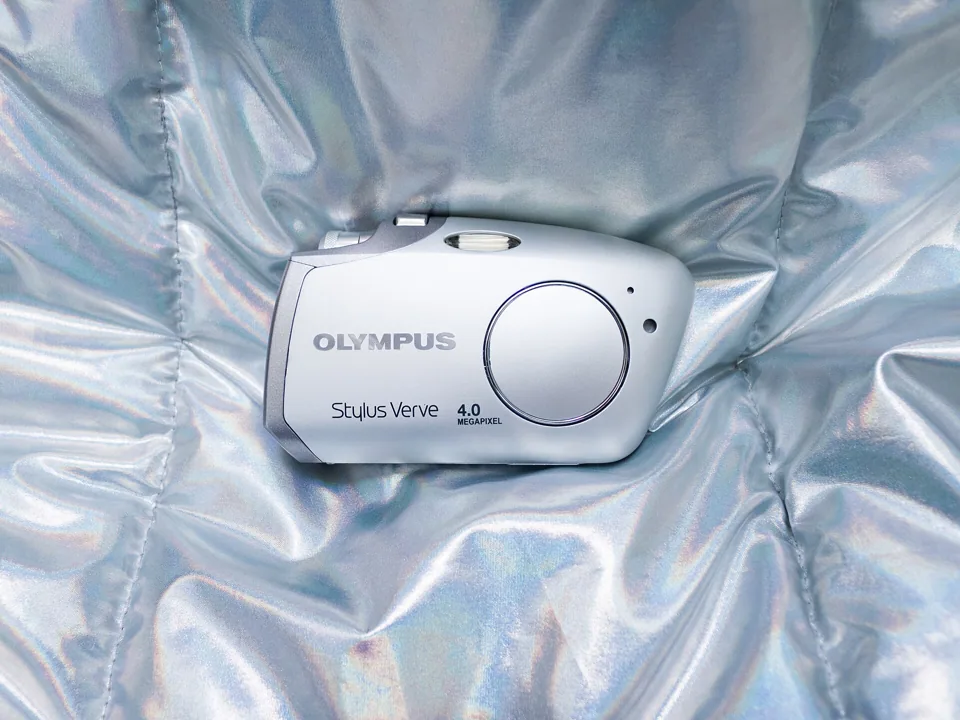
In autumn 2004 Olympus sold a 4-megapixel compact mostly on its curves: a metal body, a motorised lens cover and six colours, with a splash-proof seal under the paint. Reviewers liked the object. On nearly everything else they argued.
Olympus Stylus Verve specs: sensor, lens, battery, memory card and cable
The Olympus Stylus Verve (also sold as the mju mini Digital) came out in September 2004 at $349 as a 4 MP CCD compact with a 35–70 mm (35 mm equivalent) 2× zoom lens. It uses xD-Picture Card and runs on the LI-30B battery. Sources
Meet the camera
The Verve is built around a curve. Olympus unveiled it at Photokina in Cologne in September 2004 with an all-metal body, a cover that slides aside to let a 2x zoom lens out, a 1.8-inch screen and no viewfinder.27 The lens covers 35 to 70 millimetres in 35 mm terms at f/3.5 to f/4.9.23 The body came in six colours, which one reviewer called iPod-like and read as an attempt to follow Apple in making a style object rather than another beige box.3 Imaging Resource found it more polished than the Stylus 300 and 400 Digital that came before.1
The reviewers disagree on the basics. DPReview and PhotographyBLOG list 115 grams without the battery,23 while Macworld printed 3.7 ounces, about 105 grams, without saying what is included.4 Prices disagree too, though they do not all measure the same thing. Imaging Resource listed $349 as the suggested retail price at introduction (we have not checked this against Olympus),1 DPReview's February 2005 review lists a street price of $299 in the US and £180 in the UK,2 and PhotographyBLOG wrote "£250" in its conclusion that month.3
Why this one was interesting
Splash-proof, and it did not look like it
Olympus rated the seal as equivalent to IEC 529 IPX4, and DPReview noted that the manual is vague about what this means, saying only that the camera is not damaged by water spray from any direction.2 Imaging Resource found rubber seals and a separate plastic chassis inside the metal skin, and a large O-ring door over the battery, card and USB port, and argued that a camera that survives the beach or a ski trip is more likely to be with you when a moment arrives.1 It cannot be submerged.1
A lens that tucks itself away
Imaging Resource described the motorised cover as opening with camera-like clicks and whirrs,1 and PhotographyBLOG called the sliding cover great, though the plastic buttons and cheap-feeling battery door spoiled a front half of aluminium.3 Imaging Resource liked it for a practical reason: readers often wrote in about damaged telescoping lenses, and a cover guards against pocket knocks.1
If the weather-sealed side of this camera appeals, Olympus kept making them: see our reviews of the Stylus 710, the Stylus 720 SW and the Stylus 1030 SW.
What was lost
The zoom was only 2x, which DPReview counted as a weakness and PhotographyBLOG weighed against the money: 4 megapixels, 2x and a limited feature set for £250 did not make the grade.23 There is no exposure information in record or playback, only a green dot for focus, and no manual white balance, only four presets.2 PhotographyBLOG called the missing histogram the most important gap.3 Macworld was blunter: stylish and light, but better cameras were on sale for the price.4
The dark: its weak point
Light was the Verve's limit, and the reviewers disagree on how limiting. DPReview called the screen superb but found noise above ISO 64 fairly visible, attributed partly to weaker noise reduction and strong sharpening, and said it would avoid ISO 400.2 In DPReview's studio test against the Sony DSC-L1 the Verve measured a noise standard deviation of 2.0 (ISO 64) against 1.6 (ISO 100) for the Sony, and 3.6 against 2.5 at ISO 400.2 PhotographyBLOG judged ISO 64 and 100 very good, ISO 200 slightly noisy and ISO 400 noisy but quite usable.3 Imaging Resource found ISO 400 noise obtrusive yet not as ugly as that from a lot of competing models.1
Imaging Resource's low-light test reached down to about 2.7 lux (a quarter of a foot-candle) at ISO 200 and 400, with pink drifting into the colour as light fell, and the camera focused down to a little under an eighth of a foot-candle without an autofocus assist lamp.1
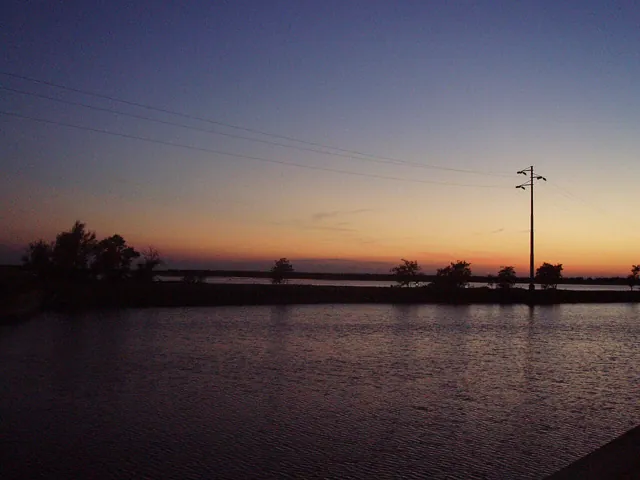

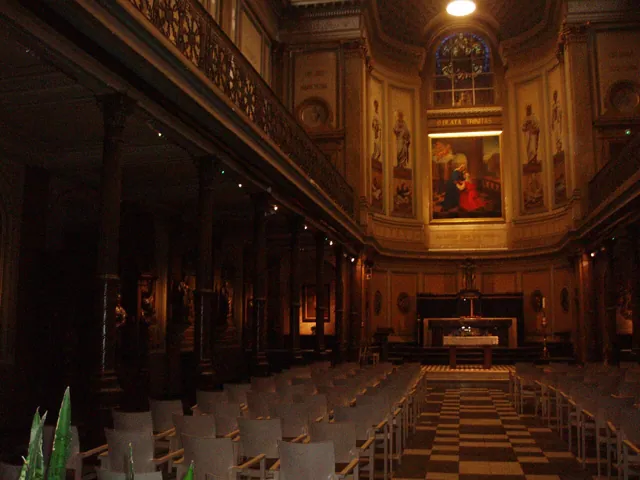

Real photographs taken with this camera (EXIF model "u-miniD,Stylus V"). The sensitivity shown is recorded in each file's own EXIF data; ISO 320 is not one of the manual steps; PhotographyBLOG's specification table lists automatic ISO up to 250, and 500 in the Indoor and Candle modes.3 Compare them with the verdicts above.
Like that look? See recent eBay sold listings for this camera ↗
On eBay right now
Live listings for this camera, supplied by eBay and updated automatically. We earn a commission if you buy through them.
The little wins
Super macro
Switch it on and it focuses from 8 centimetres at the long end of the zoom. DPReview measured a field of 39 by 29 millimetres with very little distortion, Imaging Resource 38 by 29, and the specification table PhotographyBLOG printed says 44.3 by 33.2; Macworld wrote that it focuses to 3.5 inches. Imaging Resource added that the flash is switched off in this mode.2134
Focus in the dark
No assist lamp, yet Imaging Resource saw the camera lock focus down to a little under an eighth of a foot-candle, which it called surprisingly good, and DCResource said it focused quite well in low light.16 DPReview was more guarded: focus was very reliable until light levels dropped too far.2
Little edits, saved as copies
In playback you can apply soft focus, fisheye, black and white or sepia, or shrink a picture for email, and each result is saved as a new file. DPReview called it an unusual feature.21 Imaging Resource found the fisheye more convincing on distant subjects or people off to the side; for someone in the middle, it said, the torso outgrows every other part of the picture.1
How it drew the picture
On the pictures themselves the reviewers split three ways. DPReview called the results too contrasty, over-saturated and over-sharpened, with a tendency to underexpose high-contrast scenes, and measured 1,250 lines absolute and 1,500 extinction horizontally, which it ranked about the best of four compacts for sharp detail, though with moiré before extinction.2 Imaging Resource saw pleasing, slightly warm colour, high contrast and "strong detail" to about 1,050 lines (a different yardstick from DPReview's).1 PhotographyBLOG found files on the soft side that benefited from sharpening in software,3 while Macworld said detail was good and noise modest, but that the files were slightly oversharpened, with a white halo along hard edges, and called the blues and greens a little inaccurate.4 CNET's excerpt found acceptable quality but soft detail, muted colour, yellowish skin and blown highlights with moderate purple fringing,5 while DPReview and PhotographyBLOG saw very little fringing.23











Photos taken with this camera, from Wikimedia Commons, credited under each picture.
Where it let you down
Battery life was the weak point that DPReview and Imaging Resource both named. DPReview called Olympus's CIPA figure of about 100 shots optimistic and got about 80 with moderate playback, and Imaging Resource's rundown test lasted 78 minutes with the screen on.21 Its closing paragraph calls battery life "excellent", which its own test contradicts.1 The flash is the other sore point. DPReview timed a recycle of about five seconds and called it more 1995 than 2005, and called red-eye reduction mostly ineffective, as did CNET's excerpt,25 while PhotographyBLOG found that the reduction setting removed the effect in its test shot.3 The rated range is 2.8 metres at wide and 2.0 at tele,23 and CNET's excerpt said flash pictures beyond the rated nine feet were badly underexposed and noisy.5
Speed is contested. PhotographyBLOG put start-up at about half a second and zooming at about a second;3 DPReview measured 1.9 seconds from off to record and 2.2 to zoom through the range.2 Unprimed shutter lag was about 0.8 seconds at DPReview and 0.78 to 1.22 at Imaging Resource, dropping to 0.18 and 0.11 after a half-press.21 Handling split too: DPReview found single-handed use surprisingly secure, Imaging Resource called the hold natural, PhotographyBLOG never got comfortable with it, and DCResource's excerpt found the body a little hard to hold steadily.2136 The screen was superb to DPReview, rather grainy to PhotographyBLOG and small and ghosting to Macworld.234 Macworld also wrote that there is no continuous mode, though DPReview measured one at about 1.2 frames per second and PhotographyBLOG lists 1.3, both up to seven frames at full quality.423
What the reviewers said in 2004 and 2005
| Outlet | Date | Verdict |
|---|---|---|
| CNET (excerpt) | 8 Nov 2004 | Acceptable image quality, soft detail, muted colour; flash beyond range underexposed.5 |
| DCResource (excerpt) | 18 Nov 2004 | Not their favourite ultracompact; a stylish point-and-shoot for small prints and web photos.6 |
| Imaging Resource | 2004 | Highly recommended, a Dave's Pick; the best digital Stylus yet, with a plea for a longer battery.1 |
| PhotographyBLOG | 7 Feb 2005 | Above-average pictures, uneven build; at £250, does not quite make it.3 |
| DPReview | 24 Feb 2005 | A competent splash-proof snapshot camera at a competitive price, held back by battery, flash recycling and cheaper rivals.2 |
| Macworld | 5 May 2005 | Stylish, but better cameras for the price; jury tests rated colour, detail and noise Good.4 |
The timeline
- September 2004Olympus unveils the Verve at Photokina in Cologne.2
- 3 September 2004The date printed on Imaging Resource's page as first posted; the page was updated on 16 November 2004.1
- November 2004CNET (8th) and DCResource (18th) reviews are noted by PhotographyBLOG.56
- 30 December 2004Reviewed.com writes about the holiday advertising push.7
- February 2005PhotographyBLOG (7th) and DPReview (24th) publish full reviews.32
- 5 May 2005Macworld publishes its review.4
Should you buy one now?
Buy one for the object: a small, metal, splash-proof 2004 CCD compact whose motorised cover reviewers kept coming back to. Skip it if you want zoom, a long-lasting battery or a quick flash. Imaging Resource listed it at $349 suggested retail at introduction;1 what it sells for now is a question for the sold listings, not for us. We have not tested a unit yet, and the reviewers do not agree on whether the pictures are crisp, soft or over-sharpened, so look at samples from the exact camera you plan to buy. Before you bid, check these:
- The name. Search for Stylus Verve and for mju mini Digital (or µ-mini Digital); the same camera sold under both.2
- The battery. It uses an LI-30B, a very small cell; DPReview advised budgeting for a spare, and Imaging Resource likewise.21 A replacement is on Amazon ↗.
- The card. xD-Picture Card only; the supplied card held just five full-quality shots, so expect to buy a larger card.3 See our xD card guide and the memory card glossary.
- The sealed door. The O-ring door over the battery, card and USB port is what keeps spray out, so check that it closes cleanly.1
If you are wondering why cameras like this are being hunted down again, we tell that story once, in Pictures that never left the card.
See recent sold prices on eBay ↗Shop on eBay ↗LI-30B battery ↗
Sources
- Imaging Resource, Olympus Stylus Verve review (page shows first posted 3 Sep 2004, updated 16 Nov 2004; suggested price $349 at introduction)
- DPReview, Olympus Stylus Verve (μ-mini) Digital review by Simon Joinson (24 Feb 2005)
- PhotographyBLOG, Olympus Mju Mini Digital review, pages 2 to 8 (7 Feb 2005; specification table on page 3)
- Macworld, Olympus Stylus Verve review by Robert Ellis (5 May 2005)
- PhotographyBLOG news item quoting CNET's review of the Mju Mini (8 Nov 2004; only this excerpt could be read, CNET's own page is gone)
- PhotographyBLOG news item quoting DCResource's review of the Stylus Verve (18 Nov 2004; only this excerpt could be read, DCResource's own page returns 404)
- Reviewed.com, Olympus Stylus Verve digital camera review by Alex Burack (30 Dec 2004; a two-paragraph piece on the camera and its marketing)
Camera photo by Froyo Tam (CC BY-SA 4.0); other photographs are credited under each one, all via Wikimedia Commons. Links to eBay and Amazon are affiliate links. DPReview's page needed the owner's browser to read; the CNET and DCResource originals could not be opened, so only the excerpts PhotographyBLOG quoted were used.