Olympus Camedia · announced November 2000
The Olympus Camedia C-3040 Zoom: a 3.3-megapixel compact with an f/1.8 lens, announced in November 2000
We found no other regional name: Olympus Japan's release and all three reviews we read call it the C-3040 Zoom, written C-3040ZOOM or C-3040Z.1467 Its picture files name the model C3040Z.
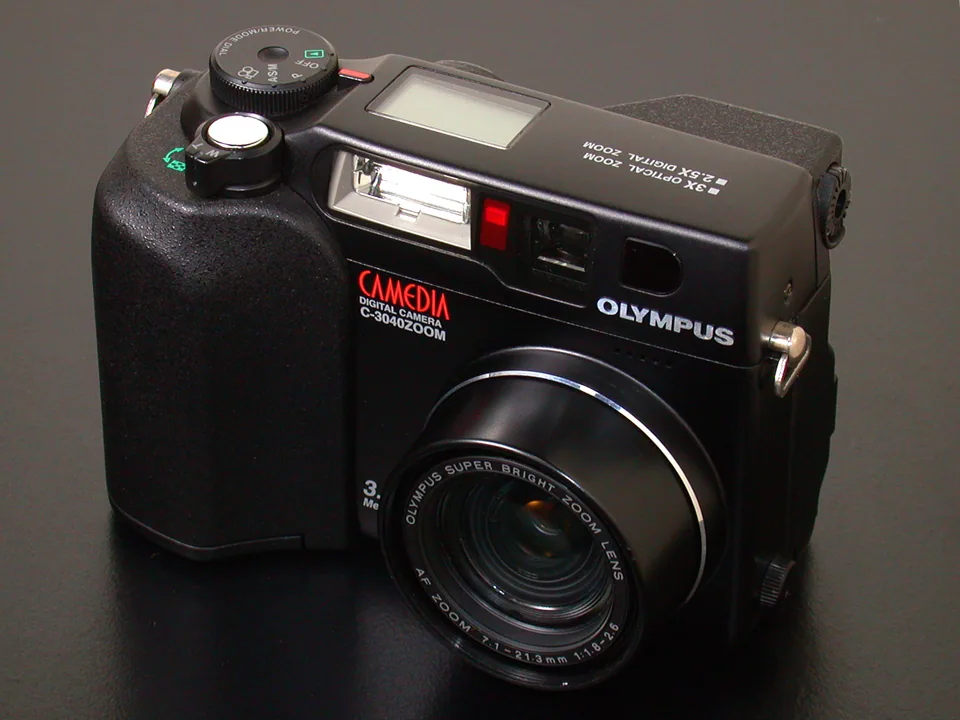

In November 2000 Olympus gave the C-3030 Zoom, which its own release calls a best seller, a new lens that opens to f/1.8. Reviewers in April and May 2001 praised the lens, the manual controls and the fixes to the C-3030 Zoom's faults; DPReview called it "hardly a new camera".
- Launched
- November 2000
- Sensor
- 3.24 MP CCD
- Lens
- 35–105 mm, 3×
- Card
- SmartMedia
- Battery
- CR-V3 (x2), 4 x AA
Olympus Camedia C-3040 Zoom specs: sensor, lens, battery, memory card and cable
The Olympus Camedia C-3040 Zoom came out in November 2000 as a 3.24 MP CCD compact with a 35–105 mm (35 mm equivalent) 3× zoom lens. It takes SmartMedia cards and runs on CR-V3 (x2) or 4 x AA batteries. Sources
- Sensor
- CCD, 1/1.8-inch, 3.24 MP source
- Lens
- 35–105 mm equivalent, 3× zoom source
- Memory card
- SmartMedia source
- Battery
- CR-V3 (x2), 4 x AA source
- USB / A/V cable
- CB-USB1 Confirmed · all Olympus cables
Meet the camera
Olympus Japan announced it on 21 November 2000 and put it on sale on 8 December at 99,800 yen before tax; the release called the f/1.8 lens a world first for a megapixel digital camera.1 DPReview was less impressed by the number: the Sony DSC-S70 and Canon G1 already opened to f/2.0 at the wide end, so f/1.8 was about a third of a stop brighter, and only at wide angle.6
The body is the C-3030 Zoom's. DPReview described a black magnesium-alloy case with a grip shaped to the fingers, and the Imaging Resource reviewer said the grip holds both the battery and the SmartMedia slots.64 Olympus gives 109.5 by 76.4 by 69.6 mm and 307 g without batteries, card or lens cap.2 In the US, DPReview quoted a $999 list price and a street price near $800.6
- Sensor
- 1/1.8" CCD, 3.34 MP total and 3.24 MP effective; 2,048 × 1,536 files2
- Lens
- 7.1–21.3 mm, 35–105 mm equiv., f/1.8–2.6, 10 elements in 7 groups; 2.5x digital zoom on top2
- Screen and finder
- 1.8" wide-angle LCD of about 114,000 pixels, plus an optical zoom finder2
- Exposure
- Program, aperture priority, shutter priority and manual; 1/800 s to 4 s, or 16 s in full manual; 3.3 frames a second for up to 5 shots (not TIFF)2
- Card and battery
- SmartMedia, 4 to 128 MB listed; two CR-V3 lithium packs or four AA2
- Size and weight
- 109.5 × 76.4 × 69.6 mm · 307 g without batteries, card or cap2
Why this one was interesting
A faster lens on the same body
Olympus said the new lens kept the camera as small as the C-3030 while holding aberration and edge darkening low from close-up to infinity.1 The Digital Camera Resource Page's Jeff Keller called the new f/1.8 lens the biggest change and said it promised better low-light shooting.7 On DPReview's chart the camera resolved 1,000 lines per picture height, against 900 for the Nikon Coolpix 990, 950 for the G1 and 1,050 for the Sony DSC-S75, with strong moiré visible on the C-3040Z's own chart at those frequencies.6 Imaging Resource saw the centre reach 800 lines easily, with detail out to 1,000.4
The C-3030's complaints, answered
DPReview's Phil Askey had asked, in their C-3030 review, for a new lens rather than C-2020 glass stretched to three megapixels, and they noted that Olympus appeared to have listened.6 Their list of fixes was a manual white balance preset, sharpness and contrast set separately, and the lens.6 The release adds spot autofocus, a multi-metering mode that averages up to eight spot readings, a contrast setting and a USB port that works as a storage drive.34 Keller found that on a modern Mac or a Windows 98 or 2000 machine no driver was needed.7
What it was not
Askey's verdict: a new lens, better image processing and several fixes, but "hardly a new camera"; in their reading Olympus was getting more life from an ageing design.6 Keller told C-3000Z and C-3030Z owners not to hurry to upgrade, and put it near the top of their list for a first or replacement 3-megapixel camera.7 On power, DPReview regretted that Olympus did not repeat the charger and NiMH cells that came with the C-2020 Zoom; DCRP listed the non-rechargeable CR-V3 packs as a miss and recommended a set of NiMH cells.67
In the dark
Imaging Resource's lab got bright, clear pictures down to 1/16 foot-candle (0.67 lux) at all three ISO settings, and called the noise moderate at ISO 100 and 200 and slightly higher at 400, with a stark pattern of bright pink and green speckles.4 Keller's night shot came out well, with colours "right on", in their words, and no noise to speak of beyond a little grain.7 Askey found normal exposures cleaner than the C-3030's and measured about 8.4 bits of dynamic range at ISO 100 against 6.8 at ISO 400.6 They got good long exposures at up to about four seconds; beyond that, stuck pixels became a distraction.6 The flash was the weak link: in their tests it consistently underexposed at the default setting, and the menu has a plus or minus 2 EV flash adjustment.6








Real photographs taken with this camera. ISO, shutter time and aperture are read from each file's own EXIF data.
Like that look? See recent eBay sold listings for this camera ↗
On eBay right now
Live listings for this camera, supplied by eBay and updated automatically. We earn a commission if you buy through them.
The little wins
Manual focus that works
The focus is smooth from 20 cm to infinity, the live view magnifies to 200 percent as you turn it and a ruler shows the distance; Askey held it up as how manual focus should be implemented on every digital camera.6
Battery life you could plan around
Askey shot for four hours, about 120 pictures, on 1,600 mAh NiMH cells with the screen off between shots.6 Imaging Resource measured about 0 mA in capture mode with the screen off against 540 mA with it on.4 Olympus claimed more than 6,000 pictures from the supplied lithium packs in a screen-off VGA test and about 400 under its standard conditions.1
How it drew the picture
Imaging Resource called colour bright, accurate and reasonably saturated, with good skin tones, and found manual white balance gave the best balance; blues drifted toward violet.4 Askey wrote that colours were accurate but not over-saturated, leaving skin a little pale, and that the indoor and outdoor presets failed under their artificial light and on a cloudy day.6 Keller found the quality excellent and noted a little purple fringing in one photo.7 Barrel distortion at the wide end measured 1.0 percent for Imaging Resource and 1.2 for DPReview, and 0.2 percent or less of pincushion at the long end.46 Imaging Resource added that corners got softer at wide angle and chromatic aberration was a little above average; DPReview said the fringing was only a little better than on the C-3030.46 Against the Nikon Coolpix 990, DPReview found the C-3040Z's lens better but its colour less saturated.6

















Photos taken with this camera, from Wikimedia Commons, credited under each picture. They come from nine different photographers, and all nine files carry the EXIF model C3040Z. Our own count, read through the Commons API on 27 October 2026: of the 1,732 files in the category, 1,730 carry that EXIF model, 433 were uploaded by one account, and 1,571 record ISO 100 in their EXIF data, against 50 at ISO 200 and 30 at ISO 400.
Where it let you down
Askey called the optical finder cramped, with parallax and distortion, showing about 84 percent of the frame; Imaging Resource measured 84.1 to 84.5 percent and a picture shifted toward the top of the frame.64 The screen showed 96.7 to 97.3 percent and DPReview found it reflective, with a stuck pixel on its unit, where Keller called it bright and fluid but hard to read in direct sun.467 Start-up was slow: 7.2 seconds from power-on to a first shot at Imaging Resource, 9.0 at DPReview, and about five seconds for the lens to extend and warm up at DCRP.467 The menu folds size and quality into 15 combinations; DPReview found SHQ files so large that only about 35 fit on a 64 MB card, and HQ too compressed, with artifacts around detail.6 Movies cannot be heard on the camera, which has no speaker.46
The sources also disagree on a few points, so treat these numbers with care:
- Price. Olympus Japan: ¥99,800 before tax. Imaging Resource's review header says MSRP $799, while its datasheet and DPReview give $999 list, with DPReview adding about $800 on the street.1456
- Pixels. Olympus and Imaging Resource's datasheet give 3.24 million effective out of 3.34 million total; DPReview lists 3.14 million effective.256
- Weight. Olympus gives 307 g without batteries, card or cap; DPReview gives 380 g with batteries; Imaging Resource's datasheet gives 407 g.265
- Movie speed. Olympus and Imaging Resource say 15 frames a second; DPReview says 12.5.346
- Zoom while filming. Olympus said the optical zoom works when sound recording is off; DCRP said only digital zoom works; DPReview's comparison table lists the movie zoom as possible.376
- Charger. DPReview's spec page lists a supplied AC-L10 adapter and charger, yet its timings page says Olympus did not ship a charger, and the box lists at Imaging Resource and DCRP show none.647
- Autofocus. Imaging Resource timed 1.08 seconds and called it a bit slower than average; DPReview's pro list says AF and shutter lag are low, yet its timings page measured 0.9 to 1.4 seconds, called that average to slow and said a 0.9 second lag is not acceptable.46
- Focal length. Imaging Resource's highlights list says 40–120 mm equivalent; its other pages and Olympus say 35–105.42
What the reviewers said
| Outlet | Date | Verdict |
|---|---|---|
| Imaging Resource | First posted 14 Apr 2001 | Improved on the already excellent C-3030 with minor interface changes and a noticeably faster lens; the lens lost some corner sharpness and added wide-angle distortion, but it judged image quality, colour and low light excellent.4 |
| DPReview | April 2001, Phil Askey | Rated it 9 out of 10 for construction, features and image quality, 8 for lens and CCD, ease of use and value, and marked it Recommended; "hardly a new camera", but fairly good value at about $800.6 |
| DCRP | 9 May 2001, updated 28 Jun 2001, Jeff Keller | Highly recommended it for a first or replacement 3-megapixel camera; owners of the C-3000Z or C-3030Z should not rush to upgrade.7 |
The timeline
- 21 November 2000Olympus Japan announces the C-3040ZOOM and C-2040ZOOM.1
- 8 December 2000The C-3040ZOOM goes on sale in Japan at ¥99,800 before tax.1
- 31 March 2001Imaging Resource's datasheet gives this as the date the camera became available.5
- 14 April 2001Imaging Resource first posts its review.4
- April 2001DPReview publishes its review; the sample gallery is dated 17 April.6
- 9 May 2001DCRP posts its review, updated 28 June.7
Should you buy one now?
Buy one if you want a fast zoom, full manual control and a body that feels like a small film SLR, and can live with a cramped finder, slow start-up and a reflective screen.647 What it sells for now is a question for the sold listings, not for us. Before you bid, check these:
- The name. Search Camedia C-3040 Zoom. The C-2040 Zoom looks almost the same, with a 2.1-megapixel sensor and a two-tone black and champagne body, and the C-3030 Zoom has a slower f/2.8 lens.46
- The batteries. It shipped with two CR-V3 lithium packs; four AA cells work too, and Imaging Resource advised high-capacity NiMH cells and a good charger over alkaline.74 A fresh set of rechargeable AAs ↗ is the first purchase; other AA-powered CCD cameras are in our guide.
- The card. It takes 3.3 volt SmartMedia, and Olympus listed 4 to 128 MB; Imaging Resource and DPReview list a 16 MB card in the box, while Olympus Japan's own spec sheet lists an 8 MB card.246 We have no SmartMedia page yet; the memory card guide covers the formats we have researched.
- Getting pictures off. USB works without a driver on Mac OS 9.1 or later and on Windows Me or 2000, and Imaging Resource clocked it at about 524 KB a second on a Mac; Olympus also sold a USB card reader and floppy and PC-card adapters.43 See our Olympus cable guide.
- The screen, lens and extras. DPReview's unit had a stuck pixel on its screen, so check for dead pixels.6 The remote came in the box.27 The optional CLA-1 adapter is needed to fit any Olympus conversion lens, and Imaging Resource warned that 43 mm filters can foul the lens unless you add a step-up ring.64
For a later Camedia see our C-5050 Zoom review, and for a long zoom from 2003 the C-740 Ultra Zoom. If you are wondering why cameras like this are being hunted down again, we tell that story once, in Pictures that never left the card.
See recent sold prices on eBay ↗Shop on eBay ↗Rechargeable AA batteries ↗
Sources
- Olympus Japan, news release on the CAMEDIA C-3040ZOOM and C-2040ZOOM (21 Nov 2000, updated 18 Dec 2000; in Japanese, our translation; the release carries the list price and on-sale date)
- Olympus Japan, C-3040ZOOM main specifications (annex to the release, updated 20 Feb 2001; in Japanese)
- Olympus Japan, C-3040ZOOM main features (annex to the release, updated 18 Dec 2000; in Japanese)
- Imaging Resource, Olympus C-3040 Zoom review (first posted 14 Apr 2001; no author named; all twelve pages read through the print version on old.imaging-resource.com, because the current site shows only the first page)
- Imaging Resource, Olympus C-3040 Zoom datasheet (retail price, date available, weight)
- DPReview, Olympus C-3040Z review by Phil Askey (April 2001; all 18 pages read in the Internet Archive copy of the original; the sample gallery is dated 17 Apr 2001)
- Digital Camera Resource Page (DCRP), Olympus C-3040Z review by Jeff Keller (posted 9 May 2001, last updated 28 Jun 2001; Internet Archive copy)
Product photograph by Hiyotada (CC0); other photographs are credited under each one, all via Wikimedia Commons (category: Taken with Olympus C-3040Z). Links to eBay and Amazon are affiliate links.