Olympus Camedia · on sale from autumn 2002
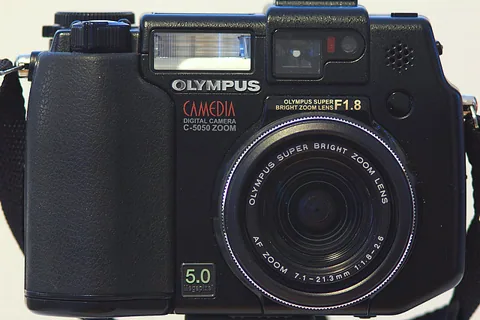
The Olympus Camedia C-5050 Zoom: the five-megapixel compact with an f/1.8 lens and a button for everything
We found no other regional name: Olympus America's release, PC Watch's Japanese report and PhotographyBLOG's UK review all call it the C-5050 Zoom.453 Its picture files name the model C5050Z.
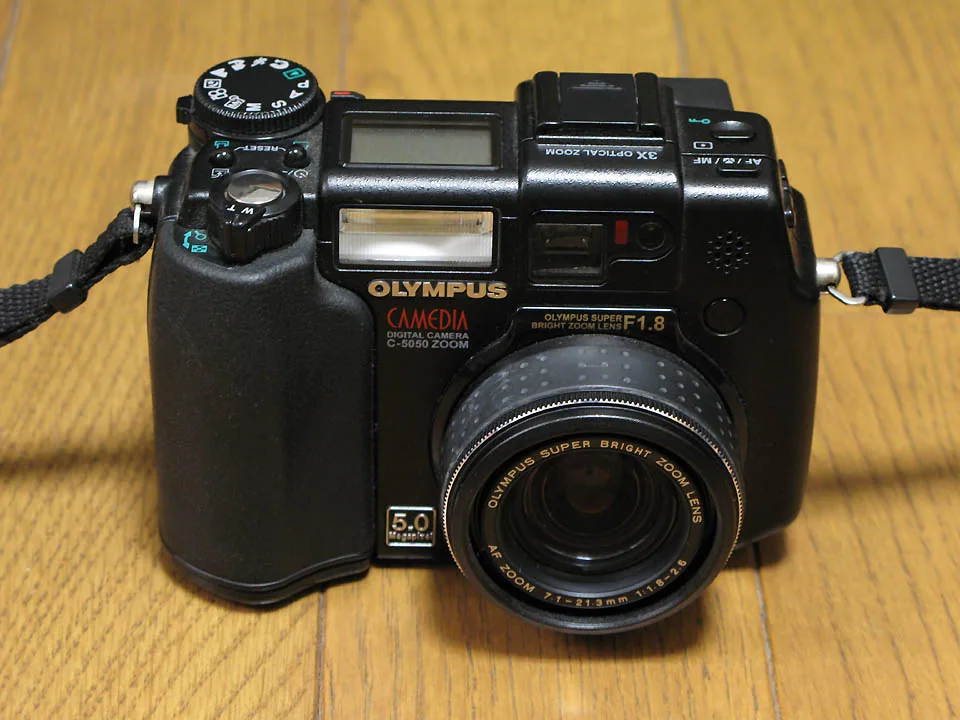
In 2002 Olympus put a bright 35–105 mm zoom, a hot shoe, a tilting screen and three kinds of memory card into one magnesium body. Reviewers praised the lens and controls and criticised its noise and purple fringing.
- Launched
- September 2002
- Sensor
- 5 MP CCD
- Lens
- 35–105 mm, 3×
- Card
- xD-Picture Card, SmartMedia, CompactFlash
- Battery
- 4 x AA (NiMH supplied), CR-V3 (x2)
Olympus Camedia C-5050 Zoom specs: sensor, lens, battery, memory card and cable
The Olympus Camedia C-5050 Zoom is a 5 MP CCD compact camera with a 35–105 mm (35 mm equivalent) 3× zoom lens, launched in September 2002 at $899. It runs on 4 x AA (NiMH supplied) or CR-V3 (x2) batteries. Sources
- Sensor
- CCD, 1/1.8-inch, 5 MP source
- Lens
- 35–105 mm equivalent, 3× zoom source
- Memory card
- xD-Picture Card, SmartMedia, CompactFlash source
- Battery
- 4 x AA (NiMH supplied), CR-V3 (x2) source
- USB / A/V cable
- CB-USB4 Confirmed · all Olympus cables
Meet the camera
Imaging Resource compared it to a small film SLR crossed with a rangefinder, 4.5 by 3.1 by 2.7 inches, 383 grams bare and 495 with four AA cells, and liked its heft.2 DPReview said the body is magnesium alloy apart from the compartment doors, the inner lens barrel and the screen frame, with soft rubber on the grip and around the lens.1
DPReview dated Olympus's announcement to 19 August, about a month before Photokina 2002 (it gives no year or place),1 and Imaging Resource's report on the US launch said the camera had been officially announced in Europe the month before.4 Olympus America followed on 24 September with a suggested price of $899, a street price of about $799 and shipping the next month,4 and the same day Olympus Japan announced ¥128,000 with sales from late November.5 By January 2003 DPReview listed street prices of $799 and £699;1 PhotographyBLOG's review in October 2003 gave a UK recommended price of £499.99 and a street price of around £400.3
- Lens
- 3x, 35–105 mm equiv., f/1.8–2.61
Why this one was interesting
A lens that stayed fast
The 1/1.8-inch sensor was smaller than the 2/3-inch size earlier five-megapixel cameras used, and DPReview noted that this let Olympus reuse the f/1.8–2.6 lens from the C-2040, C-3040 and C-4040 Zoom without a redesign.1 PhotographyBLOG said f/1.8 let you hold the camera by hand where slower cameras would need a tripod or flash,3 and in 2011 Shinya Yoshimori singled out the long end: f/2.6 at 105 mm, where he said many compacts darken to around f/5.6
A control for everything
DPReview described a top deck of buttons you hold while turning a rear dial, a programmable custom button, and eight "My Mode" memories that store almost every setting, including zoom position;1 PhotographyBLOG found the layout cluttered until a couple of hours with the manual, then one of the most accessible cameras it had used.3 DPReview called it the first of Olympus's Cx0x0-series cameras with a full hot shoe, made for the FL-40 flash.1
Three kinds of card, two slots
One slot takes CompactFlash, including the IBM Microdrive; the other takes xD-Picture Card or SmartMedia, and both can be loaded at once.12 A button switches between them and a menu copies pictures across.2 See our guides to xD-Picture Card and CompactFlash.
Yoshimori subtitled his 2011 piece with a question about whether it was the ancestor of the Olympus XZ-1, which he had borrowed that spring.6
What it asked of you
Bulk: DPReview's comparison table lists 380 grams bare against the C-4040's 320.1 And the optical viewfinder was weak: PhotographyBLOG called it small and dim and stopped using it,3 and Imaging Resource measured about 86 percent frame accuracy.2
The dark: its weak point
Noise, together with chromatic aberration, is why DPReview withheld its top rating. DPReview said noise was higher than on comparable cameras and higher than it wanted, especially at the normally clean ISO 64, that noise reduction at ISO 400 pulled it below the ISO 200 level, possibly at the cost of resolution, and that the Canon G3 was less noisy at the same effective sensitivity.1 PhotographyBLOG found very little noise at ISO 64, noise creeping in at ISO 100 and quite apparent at ISO 200 and 400 at 100 percent.3 Long exposures were another story: Imaging Resource got usable pictures down to 0.67 lux, the limit of its test, at all four settings (ISO 64 a bit dim) and found the noise reduction very effective against hot-pixel noise in long exposures;2 DPReview called its noise-reduced night exposures clean, with no obvious pit marks.1 Owner J. Andrzej Wrotniak wrote in 2003 that in his outdoor preset, Auto ISO meant practically ISO 64.8
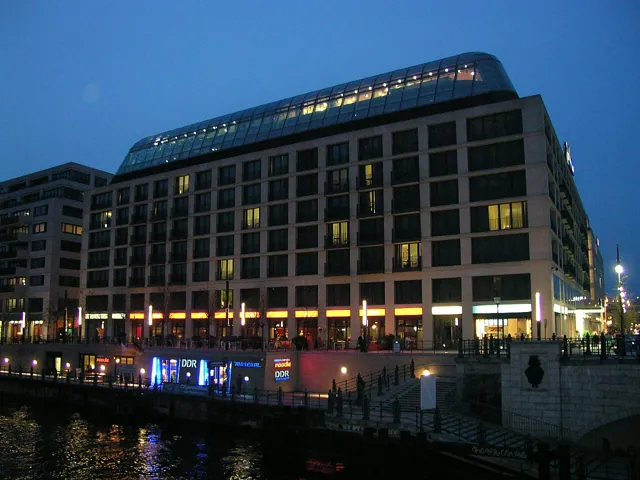
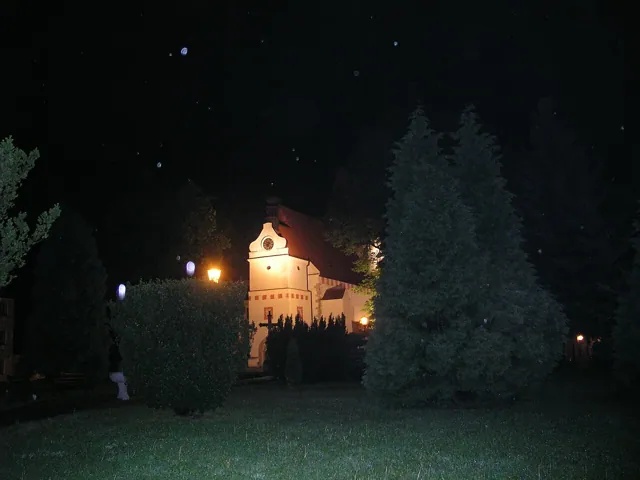


Real photographs taken with this camera. The sensitivity shown is recorded in each file's own EXIF data.
Like that look? See recent eBay sold listings for this camera ↗
On eBay right now
Live listings for this camera, supplied by eBay and updated automatically. We earn a commission if you buy through them.
The little wins


Super macro
Down to 3 centimetres, with some corner distortion and softness, DPReview said; Imaging Resource found the corners surprisingly sharp, but its flash overexposed at macro distances.12
How it drew the picture
Colour drew praise: Imaging Resource called it excellent, with skin tones just right, and PhotographyBLOG found it vibrant and saturated.23 DPReview found colour balance generally good but a little saturated, with images that were too contrasty for its taste, and saw red highlights push towards orange in direct sun in two test shots.1 Sharpness is where they split. PhotographyBLOG said files at the default setting are a little soft;3 DPReview saw jagged diagonals like those on the Canon G2 (see our G2 review);1 and Yoshimori found it very sharp, sometimes too much, with jaggies on slanting lines such as sagging wires, and said lower sharpness and contrast settings should help.6 One owner writing in 2003 ran his presets at sharpness -2, contrast -1 and saturation +1.8





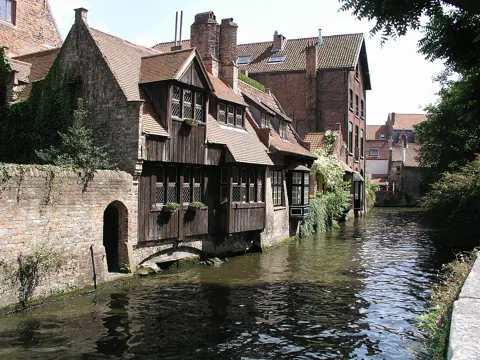







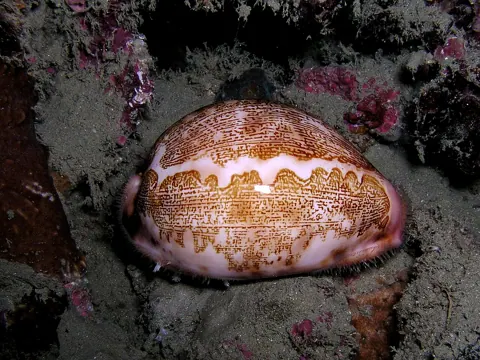



Photos taken with this camera, from Wikimedia Commons, credited under each picture. They come from nine different uploaders; every file's EXIF model reads C5050Z.
Where it let you down
It was slow to wake. The reviewers measured differently: DPReview timed 5.1 seconds from power-off to record mode with an xD card,1 Imaging Resource 4.18 seconds from power-on to a first shot,2 PhotographyBLOG estimated 3 to 4 seconds to be ready,3 and Yoshimori timed about 5 seconds from pressing the power button.6 The motorised zoom was noisy.13 Imaging Resource measured a shutter lag of 0.91 seconds at wide angle with full autofocus (0.99 at the long end) and a very fast 0.14 seconds once prefocused.2 RAW and TIFF were slow: PhotographyBLOG waited 10 seconds for a RAW file and 22 for a TIFF,3 and DPReview said the RAW option was not backed by a decent converter and gave no resolution benefit.1
Purple fringing appeared in all three reviews: strong in DPReview's everyday shots, moderate on Imaging Resource's chart, and in a few frames with the sun just outside the picture for PhotographyBLOG.123 White balance divided them: DPReview found auto white balance gave a pink or yellow cast under artificial light, while Imaging Resource found it very good under almost every light, even household incandescent.12 DPReview also disliked a rubber tripod mount that tilts the camera on quick-release plates.1
What the reviewers said
| Outlet | Date | Verdict |
|---|---|---|
| Imaging Resource | First posted 9 Jan 2003 | "Highly recommended": the best Olympus yet and a great deal; chromatic aberration and shutter lag only average.2 |
| DPReview | 16 Jan 2003 | Recommended, but not Highly Recommended because of noise and chromatic aberration; out of 10: construction 9, features 9, image quality 8, lens and CCD 8.5, ease of use 8, value 9.1 |
| PhotographyBLOG | 30 Oct 2003 | 4 out of 5 and highly recommended; the real downsides were limited ISO settings with noise at 200 and 400, and some chromatic aberration.3 |
| Digital Camera Watch | 28 Sep 2011 | A retrospective: the build and solid feel still impress, while the slow start-up and the ISO 400 ceiling show its age.6 |
The timeline
- 19 August 2002Olympus announces the C-5050 Zoom, according to DPReview, which gives no year (it places the date a month before Photokina 2002); Imaging Resource says the camera was officially announced in Europe that August.14
- 24 September 2002Olympus America announces $899 suggested, about $799 street; Olympus Japan announces ¥128,000.45
- 9 January 2003Imaging Resource posts its review.2
- 16 January 2003DPReview publishes its review.1
- 30 October 2003PhotographyBLOG publishes its review.3
- 28 September 2011Yoshimori writes up a used one he bought for ¥3,800 in a Tokyo camera shop.6
- 13 March 2022A DPReview reader comments that they had just bought a used one, in excellent condition, and found it a joy to use.1
Should you buy one now?
Buy one if you want a heavy, well-built CCD compact with a bright zoom lens, a hot shoe and a control for nearly every setting, and you can live with ISO 64 and a flash or tripod when the light fails.3 Olympus America's suggested price was $899 and the street price about $799;4 what it sells for now is a question for the sold listings, not for us. Before you bid, check these:
- The name. Search Camedia C-5050 Zoom. The C-50 Zoom announced the same day is a different, cheaper camera,7 and the C-5060 Wide Zoom that followed has a wider lens.3
- The batteries. It shipped with four 1700 mAh NiMH cells and a charger;1 a fresh set of rechargeable AAs ↗ is the first purchase.
- The clock. Yoshimori's unit lost its date and time whenever he changed the batteries,6 so see whether yours keeps its settings.
- The cards. It has one slot for xD or SmartMedia and one for CompactFlash;1 check which cards and capacities it will read in our xD and CompactFlash pages and the memory card guide.
- The screen and lens. The screen has click-stops,1 so check that it holds. DPReview thought the zoom motor sounded fragile,1 so listen for a clean extend and retract.
- The cable. The announcement lists a mini-B USB connector and a video-out port;4 see our Olympus cable guide.
If you are wondering why cameras like this are being hunted down again, we tell that story once, in Pictures that never left the card.
See recent sold prices on eBay ↗Shop on eBay ↗Rechargeable AA batteries ↗
Sources
- DPReview, Olympus C-5050 Zoom Review by Phil Askey (16 Jan 2003; 22 pages: introduction, specifications, design, controls, timings, tests, conclusion; also a reader comment dated 13 Mar 2022)
- Imaging Resource, Olympus C-5050 Zoom review (first posted 9 Jan 2003; twelve pages read: overview, design, optics, shutter lag, power, test results and conclusion; no author named)
- PhotographyBLOG, Olympus Camedia C-5050 Zoom Review (30 Oct 2003; no author named)
- Imaging Resource, Olympus America announces C-5050 Zoom (24 Sep 2002; includes Olympus America's press release)
- PC Watch (Impress), Olympus announces the C-5050 ZOOM, X-2 and X-1 (24 Sep 2002; in Japanese)
- Digital Camera Watch (Impress), 'Old digicams return: Olympus CAMEDIA C-5050 ZOOM (2002)' by Shinya Yoshimori (28 Sep 2011; in Japanese)
- MacTech, Olympus introduces new 5.0 megapixel digital cameras (24 Sep 2002)
- J. Andrzej Wrotniak, Custom Mode Settings on the Olympus C-5050Z (posted 7 Mar 2003, updated 12 Sep 2004; mirror copy)
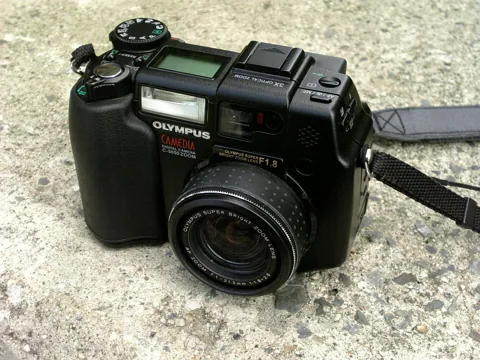
Product photographs by Kansai explorer (CC BY-SA 3.0) and Paul M from Seattle (CC BY 2.0); other photographs are credited under each one, all via Wikimedia Commons (category: Taken with Olympus C-5050Z). Links to eBay and Amazon are affiliate links.