Olympus XZ-1 · announced January 2011
The Olympus XZ-1: a pocket camera built around one very bright lens
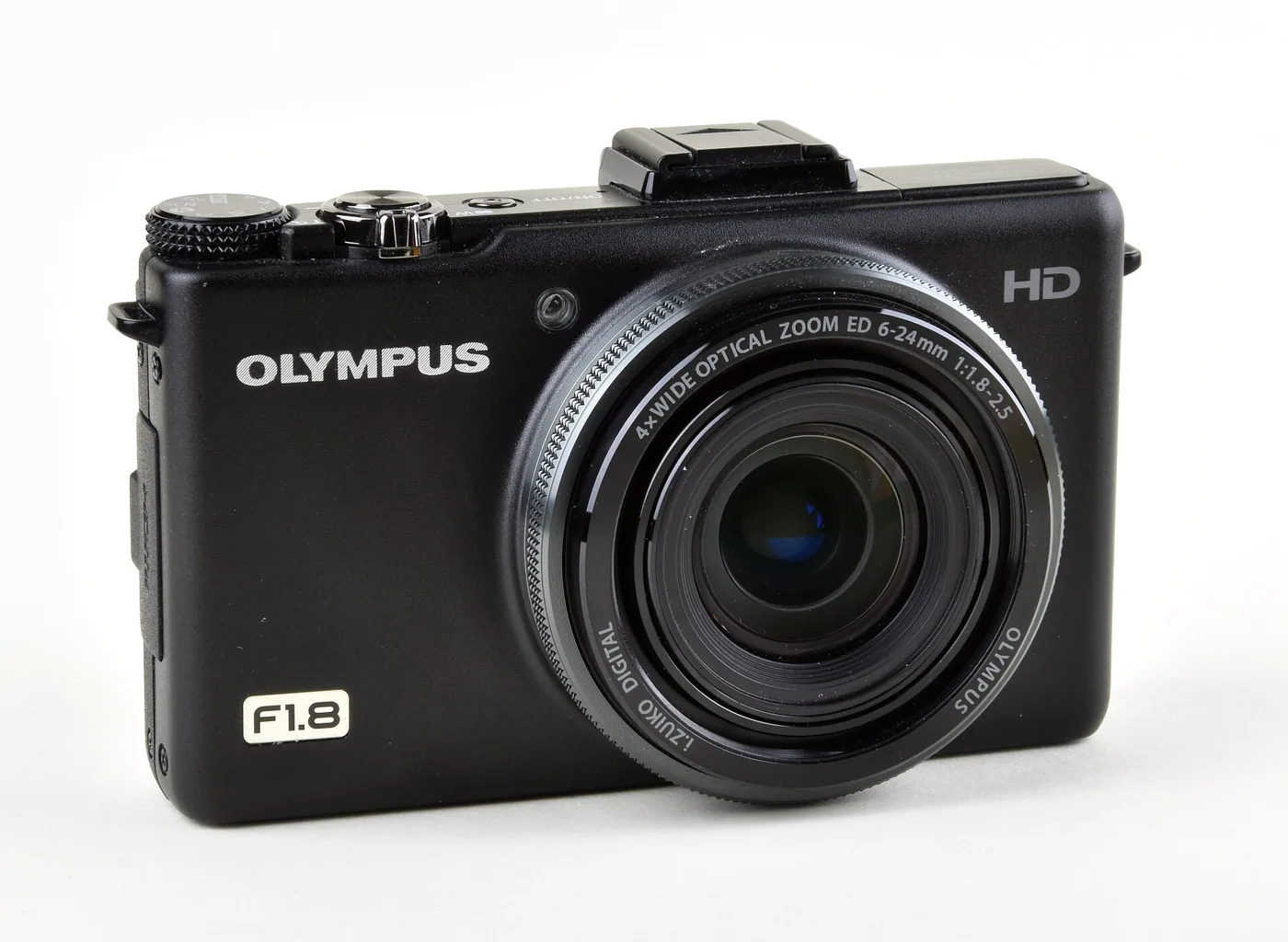

Olympus came late to the enthusiast compact in 2011 (Trusted Reviews' words were "come lately"),3 then answered the Canon S95 and Panasonic LX5 with a lens that stayed at f/2.5 even at full zoom. Reviewers loved the glass and the manual controls, and picked at the noise reduction, the missing grip and a screen that vanishes in sunshine.
- Launched
- January 2011
- Sensor
- 10 MP CCD
- Lens
- 28–112 mm, 4×
- Card
- SD, SDHC, SDXC
- Battery
- LI-50B
Olympus XZ-1 specs: sensor, lens, battery, memory card and cable
The Olympus XZ-1 came out in January 2011 at US $499.99 as a 10 MP CCD compact with a 28–112 mm (35 mm equivalent) 4× zoom lens. It takes SD, SDHC and SDXC cards and runs on the LI-50B battery. Sources
Meet the camera
It is a black (or white) body of metal and plastic with a flat, nearly bare front, a click-stop ring around the lens, a hot shoe, a mode dial and a small pop-up flash.253 There is no grip on the front, only a textured thumb rest on the back.25 PhotographyBLOG found it felt surprisingly good in the hand, while Imaging Resource's Mike Pasini never got used to it and said the front-heavy camera kept slipping.21 It measures about 110.6 by 64.8 by 42.3 millimetres; PhotographyBLOG, Trusted Reviews and Photo Review give 275 grams (Photo Review adds that this includes battery, card and cap), while Imaging Resource lists 274 grams.2351
Olympus announced it on 6 January 2011 at $499.99 in the US and £399.99 in Britain.21 Olympus presented it as the first of its compacts with a Zuiko-branded lens,145 and PhotographyBLOG noted that mock-ups had been shown at Photokina in September 2010.2 The name recalls the 1979 Olympus XA, though PhotographyBLOG pointed out that this camera is far more manual.2
Why this one was interesting
The lens was the pitch, and the other makers' numbers show why. PhotographyBLOG lined it up against the rivals: the Samsung EX1 also opens to f/1.8 but stops at 72 mm, the Panasonic LX5 reaches 90 mm, and only the Canon S95 goes as far as 105 mm, at f/4.9, two stops slower than the XZ-1's f/2.5 at 112 mm.2 Our LX5 and S95 retrospectives cover those two. Imaging Resource added that Panasonic and Canon offered f/2.0, Nikon f/2.8 and only Samsung matched f/1.8.1 TechRadar noted that at its longest setting the lens was still wider open than the Canon G12 and Nikon P7000 lenses at their widest.4
PhotographyBLOG said the extra light helps in two ways: handheld low-light pictures without very high ISO, and a subject-isolating blur that most compacts cannot manage.2 Imaging Resource's lab comparison went further, finding the lens quite a bit sharper wide open at wide angle than the S95's or LX5's.1 The two sources trace the lineage differently. PhotographyBLOG called it the first Olympus camera with an f/1.8 lens since the C-5050Z of 2002, while Imaging Resource pointed back to the C-2040 of 2001 as Olympus's first f/1.8 camera.21
A system camera in miniature
The accessory port was borrowed from the PEN line. It takes the VF-2 electronic viewfinder, the SEMA-1 microphone set or the MAL-1 macro lights, one at a time, and the hot shoe takes Olympus flashes.25 Photo Review put the VF-2 at roughly $230 extra, Imaging Resource at about $250.51
Where the dark got hard
Here the reviewers did not agree, and the scale of their disagreement is the useful part. PhotographyBLOG saw noise reduction at work from ISO 400 up, called ISO 800 and 1600 borderline for small prints and ISO 3200 and 6400 mostly there to fatten the spec sheet.2 Trusted Reviews would happily shoot up to and including ISO 1600, and thought 3200 looked felt-like and 6400 blurred.3 Imaging Resource's lab saw detail soften quite a bit by ISO 800, yet judged ISO 100 prints good up to 16 by 24 inches and advised ISO 100 to 400 for important pictures.1 TechRadar said the default noise filter gave a watercolour look at 100% on screen, with strong edges around smudgy patches, and that raw files only beat the G12 and P7000 in some conditions and only when processed in Olympus Viewer 2 with the filter switched off.4 It put safe prints at A3 for low ISOs and A4 or smaller at ISO 3200 and 6400.4
Photo Review's tests found a different weakness: picture quality fell quickly in exposures longer than two seconds, and the flash was fairly weak, leaving ISO 100 flash shots about half a stop under-exposed.5 Imaging Resource clocked the flash at about 4.3 seconds to recycle after a full-power shot, and saw uneven coverage at wide angle.1
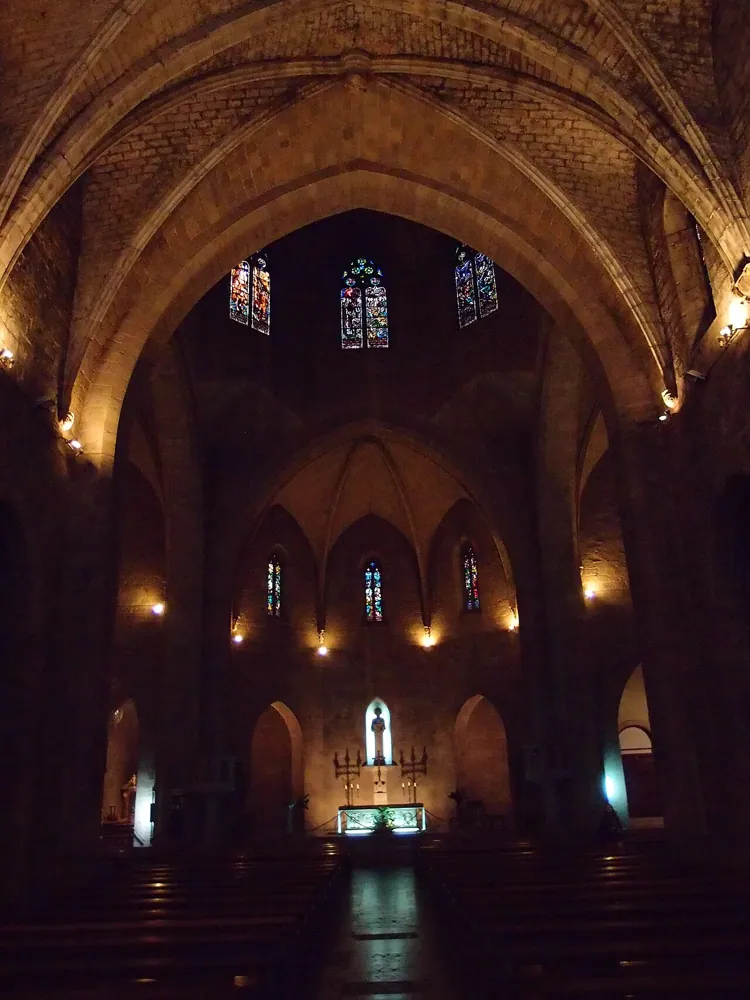




Real photographs taken with this camera; the sensitivity shown is read from each file's own EXIF data. They are indoor and evening shots at ISO 800 to 1250, since none of the free XZ-1 files we sampled were taken at the top settings.
Like that look? See what XZ-1s have recently sold for on eBay ↗
On eBay right now
Live listings for this camera, supplied by eBay and updated automatically. We earn a commission if you buy through them.
The little wins
Most of what people liked was in the handling.
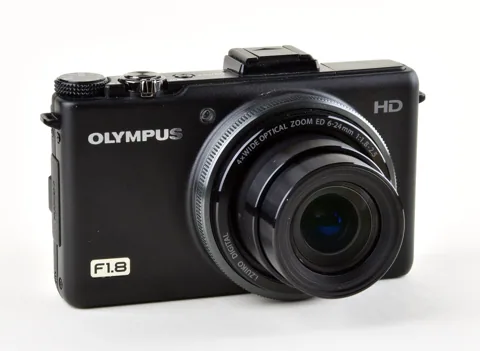 The XZ-1 with its lens extended. · SKopp · CC BY 4.0 · Commons

A ring that changes with the mode
The ring around the lens sets aperture in aperture priority and manual, shutter speed in shutter priority and ISO in program, per Imaging Resource and PhotographyBLOG.12 Trusted Reviews said the idea came from the Canon S95.3 Imaging Resource found it a little loose, and said fiddling with it when the power was off changed nothing.1
Auto Gradation
Imaging Resource said Auto Gradation opened up shadows while holding most highlights in harsh light, at the cost of slightly more shadow noise.1
A neutral density filter in the menu
A built-in filter cuts three stops of light. With a top shutter speed of 1/2000 s, PhotographyBLOG said it is sometimes necessary if you want a wide aperture in bright light without overexposing.25
Super macro to 1 cm
Super Macro focuses as close as 1 cm at wide angle and normal macro from 10 cm.25 Imaging Resource found normal macro sharp across the frame, though its closest frame, 97 by 73 mm, was larger than average.1
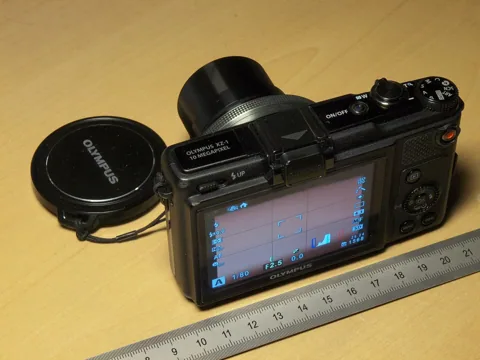 The XZ-1 seen from behind. · Kreuzschnabel · CC BY-SA 3.0 · Commons

Double exposures and a square frame
A multi-exposure scene mode overlays the first shot on the screen while you compose the second, and a 6:6 aspect ratio gives a square picture.15 Imaging Resource found it surprising how few digicams offer double exposure.1
How it drew the picture
Photo Review rated the files a cut above most digicams, clean and not over-processed, with restrained saturation and a dynamic range wider than usual for the class.5 PhotographyBLOG saw great colour and tonality at base ISO but a limited range in JPEGs, with extra headroom in raw.2 Colour opinions differed: Trusted Reviews found them natural and warm, TechRadar called the default mode punchy, and Imaging Resource saw pumped reds and pinkish skin tones.341 White balance split the reviewers too. TechRadar praised it in mixed light, while Imaging Resource found auto too warm and Photo Review said it failed to fully remove the casts of incandescent and fluorescent light.415 Distortion measured in Imaging Resource's lab at 0.5% barrel in JPEGs, rising to about 1.2% in uncorrected raw; TechRadar still saw barrel distortion at wide angle, mostly in close-ups.14















Photos taken with this camera, from Wikimedia Commons, credited under each picture.
Where it let you down
The complaints were practical. Three reviewers found the mode dial too easy to knock in a pocket.341 PhotographyBLOG, Photo Review and TechRadar all noted the lack of a dedicated ISO button.254 Opinions on the screen split. Photo Review called it impossible to read in bright outdoor light, and Imaging Resource said it flattered exposure, hiding overexposure that showed up on the computer.51 PhotographyBLOG found it eminently usable but said an eye-level finder could help in extremely bright light, and TechRadar called the view decent unless the light was very bright, if a little over-saturated.24 Photo Review added that there is no way to control or switch off noise reduction and that the manual is thin.5 Video is Motion JPEG capped at seven minutes of 720p, with little control, and Photo Review found the stereo microphones too small for good separation of the channels (TechRadar's overview page says the built-in mic records mono sound).254 Charging takes the camera plus a USB cable and AC adapter; a separate charger was an extra.21 PhotographyBLOG also disliked that the lens retracts after 15 seconds in playback.2
What the reviewers said
| Outlet | Date | Verdict |
|---|---|---|
| PhotographyBLOG | 7 Feb 2011 | Four and a half stars: a capable, serious little camera, held back on value, with high-ISO noise not a worry given the lens.2 |
| Trusted Reviews | 28 Feb 2011 | A good, solid move for Olympus; scored 9 for image quality and 8 for value; the writer said it did not quite match the LX5 for ease of use.3 |
| Imaging Resource | 18 Apr 2011 | Dave's Pick, 4.5 of 5: a lens faster and sharper than its rivals' but high-ISO performance short of hopes.1 |
| TechRadar | undated | A joy to use, responsive, with very good images at lower sensitivities; it said Olympus had made choosing a high-end compact harder.4 |
| Photo Review | undated | 8.8 out of 10: praise for its files and autofocus, with caveats for long exposures, the missing viewfinder and the controls.5 |
The timeline
- September 2010Mock-ups of an unnamed Olympus premium compact appear at Photokina.2
- 6 January 2011Olympus announces the XZ-1.25
- 15 January 2011Imaging Resource lists this as the availability date.1
- 7 February 2011PhotographyBLOG publishes its review.2
- 28 February 2011Trusted Reviews publishes its review.3
- 18 April 2011Imaging Resource publishes its lab review.1
Should you buy one now?
Buy one if you want a pocketable camera with a fast zoom, manual controls and raw files, and you will keep ISO low. It launched at $499.99;21 what it sells for now is a question for the sold listings, not for us. We have not tested a unit, and every source here dates from around the 2011 launch. Before you bid, check these:
- The lens cap. A tethered plastic cap protects the lens and there is no automatic cover, so make sure it is there.23
- The mode dial. Three reviewers knocked it by accident; make sure it clicks firmly and sits where you set it.341
- The battery. It is rated for about 320 shots,15 and a used one may deliver fewer. A replacement is on Amazon ↗.
- The charging kit. Imaging Resource lists a USB cable (CB-USB6), an AC adapter and an AV cable in the box,1 but Olympus's own USB cable compatibility table lists CB-USB8 for the XZ-1,6 so check which one the seller includes; see our CB-USB8 page.
- The card. It takes SD, SDHC and SDXC and has about 55 MB built in.12
- The viewfinder. Without a VF-2 the screen is hard to see in sun, so check whether one is included.51
The glossary on digicam terms explains sensor-shift stabilisation. For rival cameras see the LX5, S95 and Nikon P7000 retrospectives. If you wonder why cameras like this are hunted down again, we tell that story once, in Pictures that never left the card.
See recent sold prices on eBay ↗Shop on eBay ↗XZ-1 battery ↗
Sources
- Imaging Resource, Olympus XZ-1 review: lab tests, user report by Mike Pasini and specifications (18 Apr 2011; also the launch details: US$499.99, available 15 Jan 2011)
- PhotographyBLOG, Olympus XZ-1 review by Zoltan Arva-Toth (7 Feb 2011), with the Olympus specification table (launch price £399.99 / $499.99)
- Trusted Reviews, Olympus XZ-1 review by Gavin Stoker (28 Feb 2011; price about £400)
- TechRadar, Olympus XZ-1 review by Angela Nicholson (seven pages; the page shows no date, its metadata gives 29 Jul 2011)
- Photo Review (Australia), Olympus XZ-1 review (page shows no date, its metadata says 17 Feb 2012; Imatest lab tests, RRP A$699, rated 8.8 out of 10)
- OM System, USB Cable Compatibility for compact cameras (lists the XZ-1 under CB-USB8; read 2026-10-21)
Camera photos by SKopp and Kreuzschnabel as credited; other photographs are credited under each one, all via Wikimedia Commons. Links to eBay and Amazon are affiliate links.