Nikon Coolpix · announced February 2005
The Nikon Coolpix 7600: a 7-megapixel pocket camera that corrected its own pictures
We found no other regional name: Nikon's US and Tokyo announcements and both full reviews call it the Coolpix 7600.1345 The files it wrote carry the name E7600 in their own metadata.10
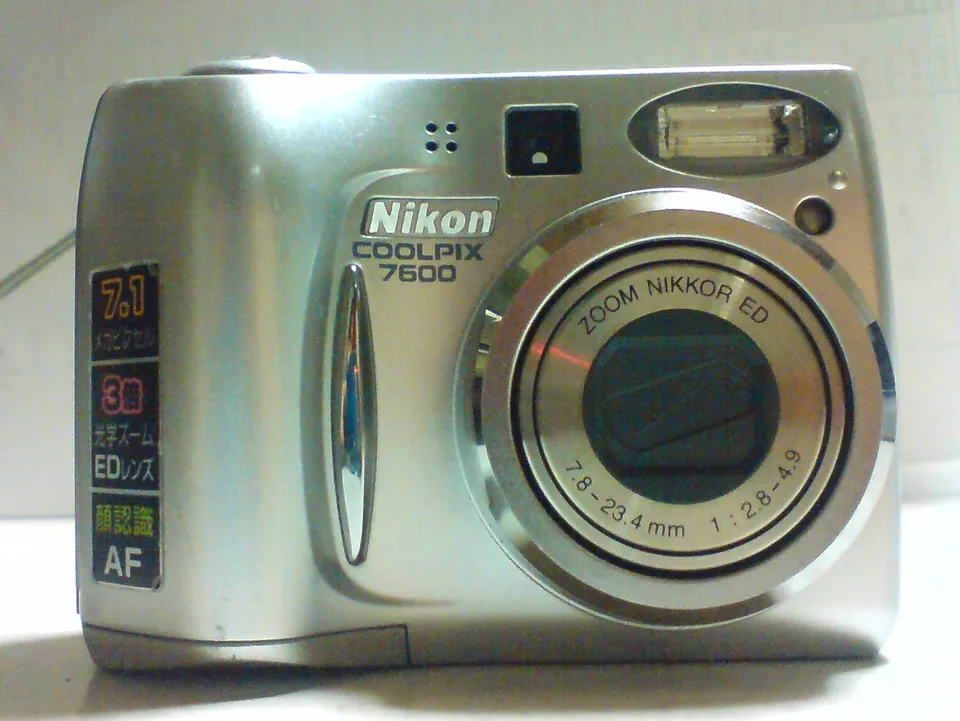

In February 2005 Nikon announced a $379.95 compact with a 7.1-megapixel CCD, two AA batteries and three fixes built in: face-priority focus, D-Lighting and red-eye correction. PhotographyBLOG found two of the three worked well and the third unreliable. Both full reviews noted the one thing the camera never let you do: choose the ISO.
- Launched
- February 2005
- Sensor
- 7.1 MP CCD
- Lens
- 38–114 mm, 3×
- Card
- SD
- Battery
- 2 x AA
Nikon Coolpix 7600 specs: sensor, lens, battery, memory card and cable
The Nikon Coolpix 7600 is a 7.1 MP CCD compact camera with a 38–114 mm (35 mm equivalent) 3× zoom lens, launched in February 2005 at $379.95. It takes SD cards and runs on 2 x AA batteries. Sources
Meet the camera
The Coolpix 7600 is a small camera in silver plastic. Nikon's figures, as PhotographyBLOG printed them, are 85 by 60 by 39 millimetres and about 145 grams without batteries or a card;4 Imaging Resource, which put a battery and a card in, weighed it at 201 grams and called it not much larger than a credit card.5 PhotographyBLOG found the casing entirely plastic with a thin grey metal band around the sides and top, and still called it well made.4 A shutter-like cover over the lens slides away when you switch on, so there is no lens cap to lose.5
Nikon USA announced it on 16 February 2005 with two siblings, the 4.0-megapixel 4600 and the 5.1-megapixel 5600, at suggested prices of $199.95, $279.95 and $379.95, all to ship that March.1 Steve's Digicams, writing in May, gave the same $379.95.7 Imaging Resource's January 2006 review says $299.95 "at time of introduction",5 which contradicts its own news item from the announcement;1 we use $379.95.
Why this one was interesting
Three fixes inside the camera
Nikon's announcement was written around what the camera did after you pressed the shutter. Red-eye was detected and corrected automatically, D-Lighting brightened shadows from the playback menu, and a Blur Warning flagged shots spoiled by shake.13 PhotographyBLOG called it one of the first Nikon cameras with Face-Priority AF, D-Lighting and advanced red-eye reduction.4 Reviewed.com said Face-priority AF, built with the company Identix, was at that point on only the 7600, 5900 and 7900.2
D-Lighting works on a copy. PhotographyBLOG described a playback command that took about 15 seconds to lighten the dark parts of a picture and leave the rest alone,4 and its spec page credits the technology to a company called Apical.4
Two AA cells, a Help button, framing outlines
Nikon USA said the new line was designed to use much less power, making it possible to take almost twice as many pictures on regular alkaline AAs.1 The Tokyo release put that at up to 100 pictures on two alkalines.3 A Help button explained whatever menu item was selected, which PhotographyBLOG judged less advanced than HP's but useful for people who had left the manual at home.14
Four mode-dial positions (Portrait, Landscape, Sports, Night Portrait) opened a Scene Assist menu. Imaging Resource described light yellow outlines on the screen that help line up a portrait, a couple or a landscape,5 and PhotographyBLOG called it a neat system that works well in practice.4
Where it sat in the range
It was the top of the three cameras announced together. Imaging Resource's announcement story said the 4600 and 5600 share a body and lens and that the 7600 has a different lens, with ED glass,1 and its review gave the reason: the 7600's sensor is a physically larger 1/1.8-inch chip, against 1/2.5-inch in the other two.5 PhotographyBLOG pointed to the more expensive Coolpix 7900 as a much more capable 7-megapixel camera, well worth the extra money.4 For other Nikons of the period see our Coolpix P2 (September 2005) and Coolpix L4 (2006, also on two AA cells).
The dark: its weak point
You could not set the ISO. PhotographyBLOG found the camera chose 50 whenever it could, citing one indoor shot of people at 1/41 second, f/4.9 and ISO 50, and the ceiling was 200;47 the slowest shutter speed is 4 seconds.4 Imaging Resource called its low-light exposure limited, though colour was good and noise moderate, and got usable pictures down to about 5.5 lux.5 The flash drew a mixed verdict. Nikon rated it to 3.4 metres at wide angle,7 and Steve's Digicams thought it controlled the flash well and saw almost no red-eye;8 but Imaging Resource said it boosted the ISO to get that range, producing noisy pictures beyond 8 feet, and measured 8 seconds to recharge after a full-power flash.56 PhotographyBLOG found it underexposed slightly.4
We read the metadata of 900 randomly chosen files from the Commons category for this camera: 899 name the E7600, 864 recorded ISO 50 and 22 recorded ISO 200. That probably says as much about what people photograph as about the camera, but it matches PhotographyBLOG's account.10
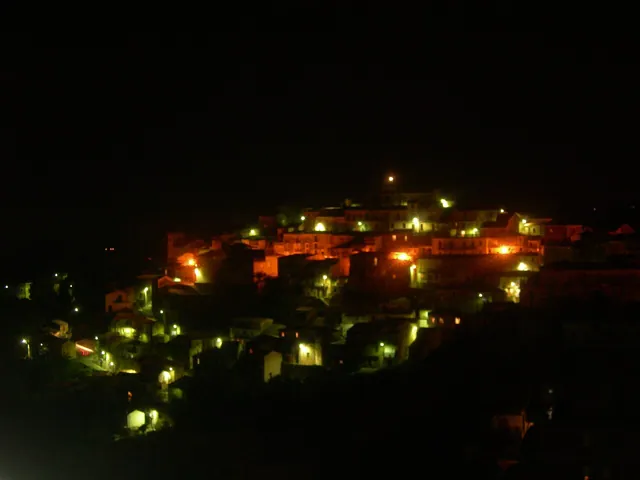

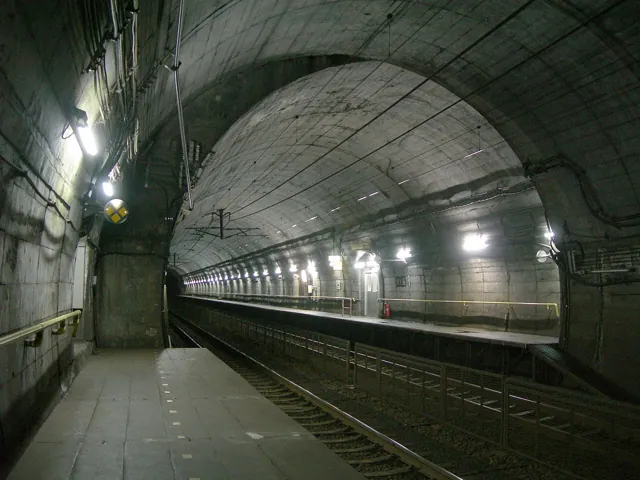

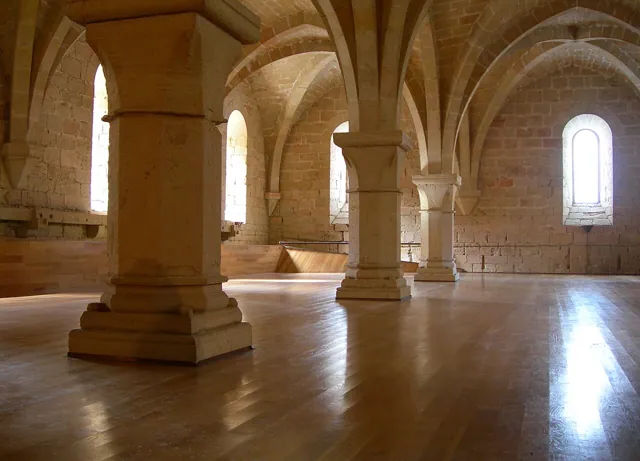



Real photographs taken with this camera. The sensitivity shown is read from each file's own metadata; the camera chose it itself.
Like that look? See recent eBay sold listings for this camera ↗
On eBay right now
Live listings for this camera, supplied by eBay and updated automatically. We earn a commission if you buy through them.
The little wins
Best Shot Selector
It took up to ten frames and kept the sharpest. Nikon's specification calls the mode effective in poor light and for telephoto and macro shots, and the Imaging Resource reviewer named it one of their all-time favourite camera features.75
A preset white balance
Imaging Resource found the manual white-balance setting handled a very wide range of light, even though auto left a cast under household bulbs.5
How it drew the picture
The two full reviews judged the pictures differently. PhotographyBLOG called the test images average: soft out of the camera, no sharpening setting to change, noise absent at ISO 50 and chromatic aberration well controlled.4 Imaging Resource rated the picture quality very good for a 7-megapixel CCD and measured strong detail out to about 1,250 lines in its test chart, with the patterns vanishing near 1,900.5 It also noted a warm cast and high saturation, a tendency to underexpose, and 0.9 percent barrel distortion at the wide end.5 Steve's Digicams, shooting at the 7M/Fine setting, found its outdoor pictures sharp and well exposed, with good saturation, very little noise and an average amount of purple fringing.8 Imaging Resource's prints were acceptable to 13 by 19 inches, though slightly soft.5
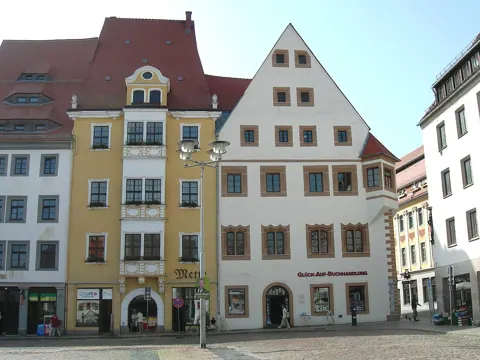







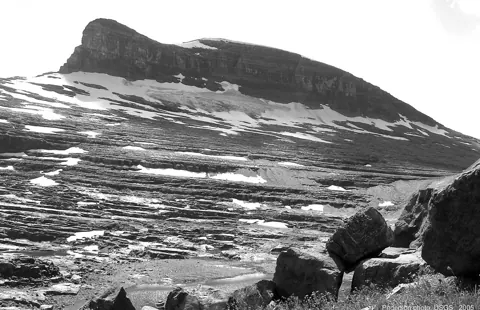







Photos taken with this camera, from Wikimedia Commons, credited under each picture. Most are daylight snapshots.

Where it let you down
Speed was disputed. PhotographyBLOG put start-up at about 1.5 seconds and shutter lag as barely noticeable;4 Imaging Resource timed 3.2 seconds from power on to first shot and a lag of 0.83 to 0.89 seconds with full autofocus, falling to 0.104 seconds when prefocused;6 Steve's Digicams measured 3.5 seconds to the first picture and about half a second of lag with autofocus, and called performance good for the class.8 Steve's also disliked that the screen went blank and the camera locked up while the flash recharged.8
PhotographyBLOG listed the rest: no histogram in playback or while shooting, a noisy and slow zoom, no continuous autofocus, and a menu that would not close when you half-pressed the shutter, so you could miss the shot.4 In its tests Face-priority AF worked when the subject looked at the camera, near the middle, and otherwise hunted for seconds before focusing somewhere else.4 Imaging Resource added that the autofocus assist lamp cannot be turned off and that automatic white balance left too much colour under incandescent lamps; its list of pros praises sharp corners while its cons list very soft corners in many shots.5 Internal memory holds about four pictures at the top setting, so a card is not optional.45
What the reviewers said
| Outlet | Date | Verdict |
|---|---|---|
| Philadelphia Daily News | March 2005 | Two sentences, hosted by Nikon, praising the red-eye removal and face-priority mode. Not a full review.9 |
| Steve's Digicams | Posted 25 May 2005 | Praised the image quality and called it good value at a street price of about $379; its one annoyance was the camera locking up while the flash recharged.8 |
| PhotographyBLOG | 26 May 2005 | 3 out of 5. Stylish and easy, but average pictures and no ISO control: best for point-and-shoot use, mostly outdoors.4 |
| Imaging Resource | 10 Jan 2006 | Picture quality "very good"; it came close to a Dave's Pick but too many traits were only average.5 |
The timeline
- 16 February 2005Nikon announces the 4600, 5600 and 7600; the 7600 is $379.95, shipping in March.123
- 25 May 2005Steve's Digicams posts its full review.7
- 26 May 2005PhotographyBLOG publishes its review.4
- 10 January 2006Imaging Resource publishes its review.5
Should you buy one now?
Buy one if you want a very small, very easy CCD camera for daylight and macro, and you can live without any control over ISO, aperture or shutter. It launched at $379.95;1 what it sells for now is a question for the sold listings, not for us. Before you bid, check these:
- The name and the lens. It is the Coolpix 7600. The 4600 and 5600 are stylistically similar but have a different lens;1 the 7600's is marked 38–114 mm equivalent, f/2.8–4.9.4
- The batteries. It runs on two AA cells. Imaging Resource's US kit came with two alkalines, while PhotographyBLOG's review kit included two EN-MH1 rechargeables and a charger, so what a used box holds will vary.54 Imaging Resource recommended NiMH rechargeables;5 AA batteries and a charger on Amazon ↗. Our guide to CCD digicams that run on AA batteries compares the cells.
- The card. It takes SD cards, and Imaging Resource also lists MMC.56 No source we read says the largest card it accepts, so check before buying a big one; the reviewers of the time suggested 64 to 256 MB cards.56 See our SD card guide. Imaging Resource said 640 by 480 video at 30 frames a second needs a fast card.5
- The lens cover and dial. The cover should open as the lens extends,5 and the mode dial, which also holds the Setup menu,4 should click through every position.
If you are wondering why cameras like this are being hunted down again, we tell that story once, in Pictures that never left the card.
See recent sold prices on eBay ↗Shop on eBay ↗AA batteries and charger ↗
Sources
- Imaging Resource, Nikon announces three new Coolpix digicams, by Mike Tomkins (16 Feb 2005; includes Nikon USA's press release: prices, March availability, battery claim)
- Reviewed.com, Nikon Announces Coolpix 4600, 5600, 7600, by Emily Raymond (16 Feb 2005)
- PhotographyBLOG, Nikon Coolpix 7600 Introduced (16 Feb 2005; reproduces Nikon Corporation's Tokyo press release)
- PhotographyBLOG, Nikon Coolpix 7600 review (26 May 2005; eight pages, 3 out of 5 stars; the pages give no author)
- Imaging Resource, Nikon Coolpix 7600 review (10 Jan 2006; written in the first person, with lab tests)
- Imaging Resource, Picky Details for the Nikon Coolpix 7600 (timings, power, storage)
- Steve's Digicams, Nikon Coolpix 7600 review, first page and specification table (full review posted 25 May 2005; Wayback Machine copy)
- Steve's Digicams, Nikon Coolpix 7600 review, Steve's Conclusion page (Wayback Machine copy of 1 June 2005; the pages carry no author name; written in the first person)
- Philadelphia Daily News, March 2005 (two-sentence excerpt hosted by Nikon USA)
- Wikimedia Commons, Category: Taken with Nikon Coolpix 7600 (8,535 files when we read it; we checked the metadata of a random 900)
Camera photo by Rsa (CC BY-SA 3.0); other photographs are credited under each one, all via Wikimedia Commons. Links to eBay and Amazon are affiliate links.