Nikon Coolpix · announced January 2004
The Nikon Coolpix 2200: the 3200's body without the lamp or the microphone
We found no other regional name for it: Nikon's manual calls it COOLPIX 2200 and types it “E2200”, the model name written into its photos' EXIF data.311 Its 3.2-megapixel twin is the Coolpix 3200.
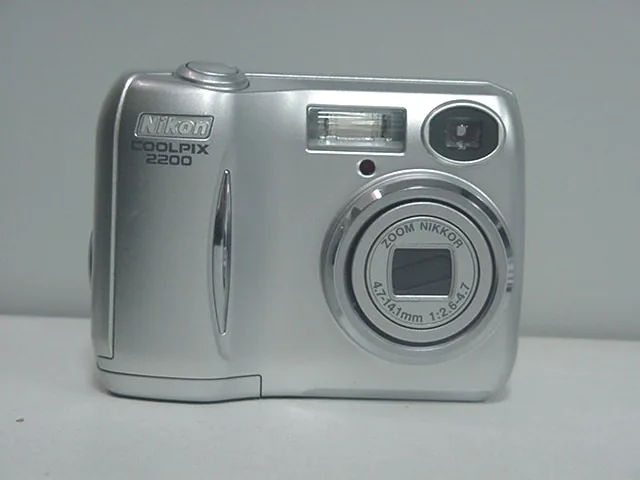
In January 2004 Nikon listed a 2-megapixel SD-card compact at $199.95, $100 under the camera it shared a body with. Reviewers praised its lens and, in one test, its battery life, but did not agree on its colour or its distortion.
- Launched
- January 2004
- Launch price
- $199.95 US list1
- Sensor
- 2 MP CCD
- Lens
- 36–108 mm, 3×
- Card
- SD
- Battery
- 2x AA, CRV3
Nikon Coolpix 2200 specs: sensor, lens, battery, memory card and cable
The Nikon Coolpix 2200 is a 2 MP CCD compact camera with a 36–108 mm (35 mm equivalent) 3× zoom lens, launched in January 2004 at $199.95. It takes SD cards and runs on 2x AA or CRV3 batteries. Sources
Meet the camera
Nikon Inc. announced the Coolpix 2200 on 8 January 2004 at a US list price of $199.95, and said it would reach shops nationwide in February; the 3200 was $299.95.1 CNET's page gives 15 March 2004 as its release date.4 The two cameras share a body, listed in Nikon's manual at 88 by 65 by 38 millimetres and 140 grams without battery or card, and the manual covers them together.13
The manual shows what the 2200 gives up. Its 1/3.2-inch CCD records 2.0 megapixels against the 3200's 3.2; the autofocus-assist illuminator is for the 3200 only; the 3200 has a built-in microphone and voice memos that the 2200 lacks; and the 2200's red-eye reduction is a pre-flash from the flash itself rather than a lamp.3 Index Digicam confirms the missing microphone, and Nikon's release says movie sound is a 3200 feature.61
- Sensor
- 2.0 MP effective CCD, 1/3.2" (2.14 MP total)3
- Lens
- 3x Zoom-Nikkor, 4.7–14.1 mm (36–108 mm equiv.), f/2.6–4.7; 4x digital zoom3
- Screen
- 1.6", 80,000 dots, about 96% coverage, plus an optical viewfinder (about 80%)3
- Card and power
- SD card (not in the box), 14.5 MB built in · two AA cells (alkalines in the box), EN-MH1 NiMH, ZR6 or FR6/L91, or one CR-V3312
- Size
- 88 × 65 × 38 mm, 140 g without battery and card3
- Launch price
- $199.95 US list1
Why this one was interesting
A 3200 with the extras left out
CNET told readers to take the full story from its 3200 review and spent its own page on the differences.4 The 2200 is that camera with a smaller sensor, no lamp and no sound. Our Coolpix 3200 retrospective covers the family in more detail.
Outlines on the screen, and many scene modes
Nikon's brochure lists 15 scene modes, four of them with Scene Assist: pick Portrait, Landscape, Sports or Night Portrait and an assist menu offers framing guides on the screen, such as one figure to the left or right, a couple, a grid for architecture, or three bands for sky, distance and foreground.2 Index Digicam counted 11 scene programmes beyond the classic five and said cameras usually offer three or four; that reviewer thought the guides in the Portrait, Night Portrait and Landscape modes help beginners arrange the subject.6
What was left out
Exposure is programmed automatic with ±2 EV of compensation, a shutter range of 4 to 1/3000 second and only two aperture steps.3 Index Digicam listed white balance, exposure compensation, flash mode and a few colour effects as everything the user can set.6 DigicamReview missed an on-screen aperture or shutter readout and any way to add sharpening, and CNET noted that the viewfinder has no diopter correction for glasses.74 Movies have no sound, and Nikon limits voice memos to the 3200.23
The dark: noise, flash and slow autofocus
Nikon's manual puts the camera at about ISO 50, with automatic gain to ISO 200; Tek.no and DigicamReview both note the user cannot choose it.357 Tek.no's reviewer saw noise handled well next to a 2-megapixel Sony and a 3-megapixel Nikon SQ, and Index Digicam found low noise in sunshine, crediting the modest gain; that reviewer could not coax anything but ISO 50 out of the camera.56 DigicamReview's ISO 200 crop was acceptable, “just”.7 Our own count, not a reviewer's: of the 2,071 files in the Commons category, 2,067 carry an ISO value, and 1,859 of those are exactly ISO 50, 75 are ISO 200 and none is higher. The longest recorded exposure is four seconds, the manual's slowest shutter speed.113
Autofocus was the weak point in low light: CNET waited 2.5 seconds for a shot in low-contrast light, against 0.7 second in contrasty light, and the camera has no assist lamp to help.43 Index Digicam found that the 3200's orange lamp lets it focus in near darkness.6
The flash is rated to 3.7 metres at wide angle and 2.0 at full zoom.3 Tek.no found red-eye a problem that the reduction mode hardly eased, with dark corners at wide angle; Index Digicam put the maximum range under 3 metres, saw red pupils beyond 2 metres and timed 6 to 8 seconds to recharge; DigicamReview found it strong enough for groups but saw red-eye on some people, and liked how it behaved in macro.567



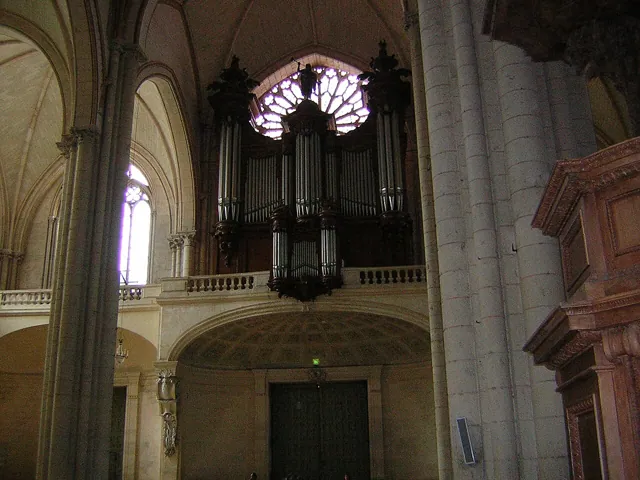
Real photographs taken with this camera. The sensitivity, shutter speed and flash state are read from each file's own EXIF data.
Like that look? See recent eBay sold listings for this camera ↗
On eBay right now
Live listings for this camera, supplied by eBay and updated automatically. We earn a commission if you buy through them.
The little wins
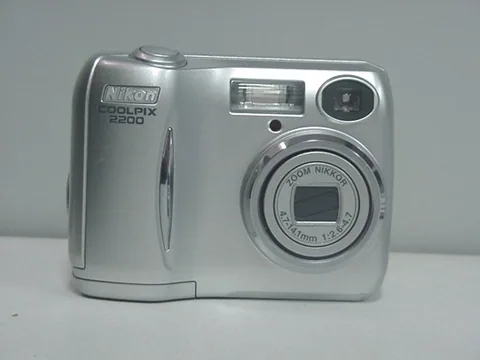 The Nikon Coolpix 2200 front, with the lens barrel engraved with its focal length and aperture range. · Plbcr · CC BY-SA 3.0 · Commons
A lens better than the megapixel count
Tek.no enlarged the 2-megapixel files to 3 megapixels for a test against the 2-megapixel Sony DSC-U40 and the 3-megapixel Minolta Dimage Z1, and found the Nikon came out best on rendering of detail, which the reviewer put down to the lens.5 PC-WELT's lab found very good sharpness at all three focal-length ranges.9
Battery life
Nikon rated 350 frames on two EN-MH1 cells, 150 on alkalines and 600 on a CR-V3, with flash on about half the shots.3 Tek.no's reviewer got 870 pictures from a set of Hähnel rechargeables, with the first low-battery message at 822, and called that above average while adding that the cells' quality decides the result.5
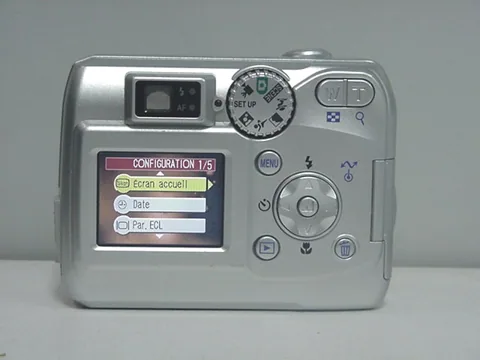 The back of the camera, with the screen, mode dial and four-way pad. · Plbcr · CC BY-SA 3.0 · Commons
Best Shot Selector
Hold the shutter button and the camera takes up to ten pictures and saves the sharpest; the flash switches off and focus and exposure come from the first frame.3 DigicamReview said it really liked it, and Index Digicam pointed to dim scenes with no flash and no tripod.76
How it drew the picture
The five reviewers did not agree about colour. CNET found rich, saturated colour and realistic skin tones, good enough for 4 by 6 prints, but pale tones that blew out into large detail-free areas, and noticeable colour fringing.4 DigicamReview saw accurate, pleasing colour, a tiny bit of softness that it would sharpen afterwards, and purple fringing in some photos.7 Tek.no called Nikon's colour neutral and placed it palest in a test against an HP 935 and a Sony U40, with the Vivid setting as the cure; Index Digicam saw lively colour in sunshine.56 PC-WELT noticed a slight red cast in daylight pictures and a good showing under artificial light.9


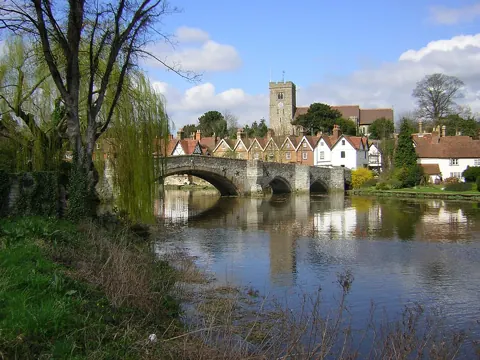

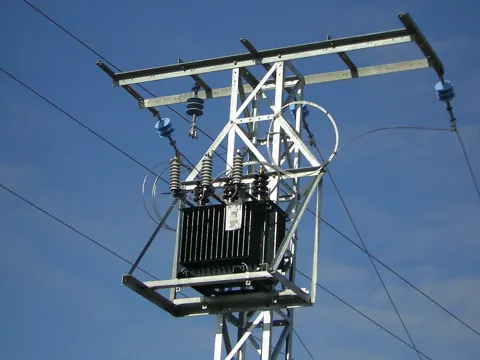
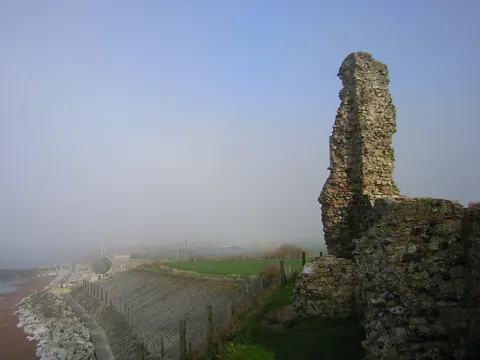








Photos taken with this camera, from Wikimedia Commons, credited under each picture.
Where it let you down
Tek.no's reviewer found the mode dial on the back easy to knock in a pocket, the flash-mode menu quick to vanish with its icons small, and no way to return to shooting from playback with a half-press of the shutter.5 CNET found the screen hard to read in full sunlight, and the viewfinder shows about 80 percent of the frame.43 Index Digicam was less taken with the plastic tripod socket, though it reckoned 98 percent of buyers would never mount the camera for night landscapes.6
Three reviewers put start-up at about four seconds: 3.88 for Tek.no, 3.82 for CNET and 4 for Index Digicam.546 Tek.no's text gives shutter lag as 0.02 second without flash and 0.22 with, though a chart in the same review lists 0.08 and 0.21 for the Nikon, and autofocus at 0.88 second at wide angle and 1.88 at full zoom.5 CNET measured shot-to-shot time at 2.8 seconds without flash and almost 6 with it, and a burst of three shots in about 1.5 seconds; Nikon says continuous mode runs at about three frames every two seconds.43
Where the sources disagree
We follow Nikon's manual for specifications and show the rest as reported. Nikon's press release covers the 2200 and the 3200 together, so where it and the manual differ, the manual wins.13
| Point | One account | Another |
|---|---|---|
| Autofocus lamp | The manual: an AF-assist illuminator on the 3200 only; Index Digicam agrees36 | Nikon's release lists an AF assist illuminator for both cameras1 |
| Red-eye lamp | The manual: a red-eye reduction lamp on the 3200, a pre-flash from the flash on the 2200; its parts list names the small lamp below the flash the self-timer lamp, shared with the 3200's red-eye lamp3 | Nikon's release (for both cameras) and brochure (for the 2200): an LED lamp for red-eye reduction; Index Digicam lists a red-eye-reduction flash mode for the 3200 only126 |
| Lens | 36–108 mm: Nikon's manual, release and brochure, and CNET3124 | 38–115 mm: Tek.no, which is the 3200's figure53 |
| Macro distance | 4 cm at wide angle: Nikon's manual, Index Digicam and Tek.no365 | 3 cm: DigicamReview7 |
| Barrel distortion at wide angle | Very restrained: Tek.no5 | Unacceptable even for a small lens: Index Digicam; −1.9 percent, which it called strongly barrel-shaped: PC-WELT69 |
| Weight | 140 g without battery and card: Nikon's manual3 | 192 g: PC-WELT, basis not stated; about 7 oz: CNET, also not stated94 |
| In the box | Two alkaline AA cells; no card, no rechargeables: Nikon and CNET124 | A charger and a rechargeable set came with the camera: Tek.no5 |
| Prices printed | $199.95 US list, January 2004: Nikon1 | $149.95: Reviewed.com (undated); $149 at Amazon and £100 in the UK: DigicamReview; about 150 euros: PC-WELT; 64,000 forints with VAT: Index Digicam10796 |
What the reviewers said
| Outlet | Date | Verdict |
|---|---|---|
| Tek.no (Danish test) | 27 Mar 2004 | Four pips on the die for image quality: it wins its 2 to 3-megapixel class on noise and lens, speed is not impressive but fine for the class, battery superb, and its size and picture quality are its best points.5 |
| Index Digicam | 7 May 2004 | An affordable, average camera that the reviewer would steer a no-name buyer towards, with plenty of scene modes and a very slow flash recharge.6 |
| PC-WELT | 8 Jul 2004 | Grades of 2.3 for quality and 2.5 for value (lower is better on German scales); sharp, slightly red in daylight, strong barrel distortion at wide angle.9 |
| CNET | 7 Oct 2004 | A good starter camera if 2 megapixels is enough; the cons list names few manual controls, slow dim-light autofocus and the extra cost of a card and rechargeables.4 |
| DigicamReview.co.uk | Undated (reported 8 Nov 2004) | Average value for money, since 3-megapixel cameras cost the same; recommended for someone who wants a compact, easy camera, especially if it is cheap.78 |
The timeline
- 8 January 2004Nikon Inc. announces the 2200 at $199.95 and the 3200 at $299.95, due in February.1
- 15 March 2004Release date on CNET's page.4
- 27 March 2004Tek.no's Danish test is published.5
- 7 May 2004Index Digicam publishes its 2200 and 3200 test.6
- 8 July 2004PC-WELT's test sheet is dated.9
- 7 October 2004CNET's review is dated.4
- 8 November 2004Photography Blog reports the DigicamReview review.8
Should you buy one now?
Buy one if you want a very small, very simple 2-megapixel SD camera with a lens that earned praise and a battery that one reviewer called superb, and you accept a flash that was slow to recharge and prone to red-eye, no manual control and slow focus in dim rooms; it launched at $199.95.1 What it sells for now is a question for the sold listings, not for us, and we have not tested a unit. Before you bid, check these:
- The model. The 3.2-megapixel Coolpix 3200 is a near twin. In our product photo the body reads COOLPIX 2200 and the lens ring 4.7–14.1 mm 1:2.6–4.7; the 3200's lens is 5.8–17.4 mm.3
- The power. Use cells from Nikon's list: EN-MH1 NiMH, ZR6, FR6/L91 or a CR-V3. Set Battery Type in the setup menu to match them: the default is alkaline, and the manual says it may revert if the clock battery is not charged enough.3 AA batteries on Amazon ↗.
- The card. It takes SD cards. Nikon's tested list stops at 512 MB (SanDisk and Toshiba to 256 MB, Panasonic to 512 MB, the 256 and 512 MB Panasonic cards in the high-speed type), and we found no Nikon statement about larger cards in this camera.3 See our SD, SDHC and SDXC guide and glossary. With no card the camera uses its 14.5 MB of internal memory.3
- The cable. The manual names the UC-E6 USB cable and, for the 2200, an EG-CP11 video cable;3 see our UC-E6 page.
- The screen and the clock. Nikon says to see a service representative if the LED-backlit monitor dims or flickers. The clock battery charges in about ten hours from the main batteries and holds for several days, so check that the date survives a battery change.3
If you are wondering why cameras like this are being hunted down again, we tell that story once, in Pictures that never left the card. For the CompactFlash Nikon one year earlier, see our Coolpix 2100 review.
See recent sold prices on eBay ↗Shop on eBay ↗Rechargeable AA batteries ↗
Sources
- Nikon Inc. press release, “Nikon Announces Next Evolution of its Incredibly Successful Compact Digital Cameras” (8 Jan 2004), as reproduced by Photography Blog
- Nikon Inc., Coolpix 2200 product brochure (PDF, printed 12/03, product number 255199; key features, scene modes and specification table)
- Nikon Corporation, COOLPIX 3200 / 2200 user's manual (English PDF; E2200 is the 2200's model string; page numbers in the text are the printed ones)
- CNET Reviews, Nikon Coolpix 2200 review (review date printed as 10/07/04, which we read as month/day/year because the same page prints its release date as 03/15/04; the page was updated 6/03/12 and prints no author; read from the Internet Archive copy of 14 June 2012)
- Jens Hansen, “Test af Nikon Coolpix 2200” (Danish; published 27 March 2004 as printed; now hosted by Tek.no, and the text refers to akamera, a Danish camera-test site)
- Nagy Gergely, “Röviden: Nikon Coolpix 2200 / 3200 (teszt)” (Hungarian; Index Digicam, 7 May 2004; read from the Internet Archive copy of 5 Dec 2004)
- DigicamReview.co.uk, Nikon Coolpix 2200 Digital Camera Review (the page prints no date; read from the Internet Archive copy of 5 Mar 2005)
- Photography Blog, “DigicamReview.co.uk Reviews Nikon Coolpix 2200” by Mark Goldstein (8 Nov 2004): the news item that dates the DigicamReview review
- PC-WELT, “Nikon Coolpix 2200 Test” by Verena Ottmann (German; 8 Jul 2004 as printed; a short lab-test sheet)
- Reviewed.com, Nikon Coolpix 3200 Digital Camera Review (page undated; it lists the 2200 as a cheaper alternative)
- Wikimedia Commons, Category: Taken with Nikon Coolpix 2200 (EXIF of all 2,071 files read through the Commons API, 29 Oct 2026)
Camera photos by Plbcr (CC BY-SA 3.0); other photographs are credited under each one, all via Wikimedia Commons. Links to eBay and Amazon are affiliate links.