Nikon Coolpix L · on sale March 2006
The Nikon Coolpix L4: the $149.95 two-AA compact with the fastest lens in its family and no say over ISO
We found no other regional name for it; Imaging Resource's launch report, Nikon Canada's archived page and Trusted Reviews' UK review all call it the Coolpix L4.186
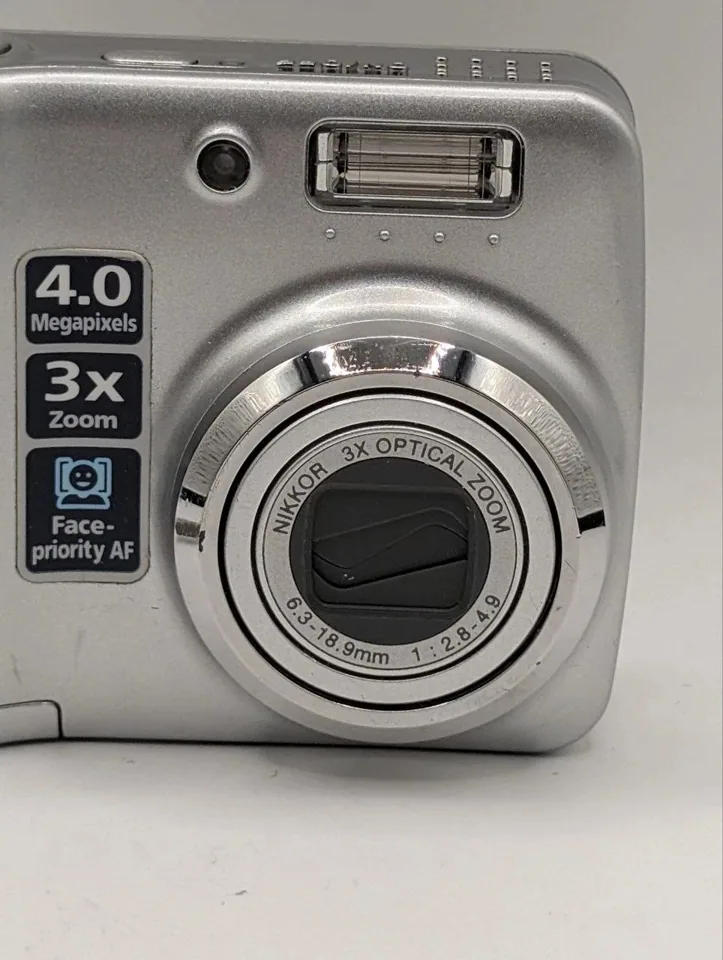
In February 2006 Nikon launched three budget cameras that ran on ordinary AA batteries. The L4 was the cheapest: four megapixels, silent video and a slow start, but a brighter lens than its dearer siblings. Reviewers liked how it looked and felt, and disagreed about the pictures.
- Launched
- March 2006
- Sensor
- 4 MP CCD
- Lens
- 38–114 mm, 3×
- Card
- SD
- Battery
- 2 x AA
Nikon Coolpix L4 specs: sensor, lens, battery, memory card and cable
The Nikon Coolpix L4 is a 4 MP CCD compact camera with a 38–114 mm (35 mm equivalent) 3× zoom lens, launched in March 2006 at $149.95. It takes SD cards and runs on 2 x AA batteries. Sources
Meet the camera
The L4 is a small, curved silver camera with a chrome band over its left side and top. Nikon's figures, as Steve's Digicams reprinted them, are 86.5 by 60.5 by 34.5 millimetres excluding projections, and 115 grams without battery and card;3 Imaging Resource gave 145 grams with batteries and card, and Trusted Reviews said about 165 grams with batteries.76 Imaging Resource thought it one of the best-looking cameras in its price range, and Trusted Reviews said the plastic body felt strong and solid.76 Unlike the L2 and L3, whose lenses sit flush when switched off, the L4's lens housing sticks out of the body, Reviewed.com and Imaging Resource noted.27
Nikon USA announced it on 21 February 2006 alongside the 6-megapixel L2 and the 5-megapixel L3, at planned prices of $249.95 and $199.95; the L4 was to follow in March at $149.95.1 Imaging Resource's table gives 31 March as its availability date.7 Trusted Reviews said the UK launch came in mid-March at £129.99, and that by August you could find it for under £80;6 Steve's said its street price was under $140 at the time of its April review.5
Sources differ on several details. Nikon's pages, Steve's and Imaging Resource's review give about 10 MB of built-in memory; Reviewed.com's hands-on gives 16 MB, as does the prose of Imaging Resource's launch report, whose own spec table says 10.0 MB.893721 Imaging Resource's launch table lists SD and MMC cards where Nikon's pages and Steve's say SD.1893 Imaging Resource's review text gives the L4's price as $199.95 in one sentence and $149.95 in the next; its launch report and Reviewed.com both say $149.95.712 Reviewed.com's hands-on describes a 50 to 400 ISO range with some ISO adjustment, which Nikon, Steve's, Imaging Resource and Trusted Reviews contradict (automatic, 50 to 200).28576 Nikon Canada's spec list heads the video line "Movie with sound" and gives a macro distance of 1 cm; Nikon's own release, Steve's and Imaging Resource say silent video and 4 cm, so those two Nikon Canada entries look like errors.8951
Why this one was interesting
A brighter lens than the dearer models
Reviewed.com compared the three: the L2 and L3 shared a 38–116 mm lens opening to f/3.2 and f/5.3, while the L4's was a 38–114 mm lens opening to f/2.8 and f/4.9, with seven elements in six groups against five in five. It called the L4's the fastest of the three and said it could not see why the lowest-priced model got it.2
Nikon's helper features on the cheapest camera
Steve's listed what the family shared: D-Lighting to brighten a dark picture in playback, Face-priority AF, an in-camera red-eye fix, a Best Shot Selector that keeps the sharpest of up to ten frames, and 15 scene modes, four with on-screen framing guides.37 Reviewed.com said the cameras looked designed to take on Canon's A-series, which won on manual control.2
Two AA cells, and a choice of what to put in them
The appeal was a battery you could buy anywhere: Trusted Reviews called AA cells a big advantage for holiday use because they are readily available throughout the world.6 What the sources say about them differs in detail, so here is each in turn:
| Source | What it says about power |
|---|---|
| Nikon Canada (archived) | Lists "two rechargeable EN-MH1 NiMH batteries" as the power source, then 250 shots on AA alkaline, 600 on AA lithium and an unlabelled 450 (approx.), to the CIPA standard. It does not say what is in the box.8 |
| Nikon Corporation, 2006 release | Same power list and 250, 600 and 450 (EN-MH1) shots as Steve's table. Its supplied-accessories list names two EN-MH1 NiMH batteries and a MH-71 charger, with a note that supplied accessories may differ by country or area.9 |
| Steve's, spec table | EN-MH1 × 2, or AA (LR6 alkaline, ZR6 oxyride or lithium) × 2, or an optional AC adapter; 250 shots alkaline, 600 lithium, 450 EN-MH1; supplied: two alkaline AA cells (its accessories note says items may differ by country or area).3 |
| Steve's, text | "Nikon includes a set of NiMH cells and a charger." A Setup option tells the camera which cell type you use. In its test two 2500 mAh NiMH cells took 120 pictures and ran the rest of the testing with no low-battery warning.45 |
| Imaging Resource, launch report | Alkaline or lithium disposable, or NiMH rechargeable; 2 × AA or 2 × EN-MH1; in the box 2 × AA alkaline.1 |
| Imaging Resource, review | Two alkaline cells come with the camera; it strongly advised rechargeables and a charger. CIPA: 250 alkaline, 450 NiMH, 600 lithium. Pros list: good battery life; table caption: moderate on alkaline, much better on NiMH or lithium. Its feature list says only "AA rechargeable batteries" for power.7 |
| Reviewed.com, hands-on | Two AA or rechargeable NiMH cells; CIPA 250 alkaline, 600 lithium, 450 EN-MH1; no time to check the claims.2 |
| Trusted Reviews | Two AA batteries, no rating or test; they cannot be changed while the camera sits on a tripod, though the SD card has its own side hatch.6 |
So the cells in the box are disputed: alkaline in three places (Steve's table and both Imaging Resource pieces), NiMH plus a charger in two (Steve's text and Nikon Corporation's release)34179. Since both Nikon's release and Steve's table say the supplied accessories may differ by country or area, the split may be a difference between markets, but no source says so. What a used L4 comes with is the seller's to say. For AA cells in a later Nikon, see our Coolpix L810 review (four of them); for this camera's 5-megapixel sibling, our Coolpix L3 review.
What was lost
The L4 was the model that gave things up. Its video has no sound and runs at 15 frames a second where the L2 and L3 record sound at up to 30,2 and it has no microphone or speaker; Imaging Resource told anyone who wanted audio to buy the L2 or L3, and Reviewed.com asked why Nikon bothered with a movie mode.72 Steve's added that the optical zoom cannot be used while recording.5 Nikon's release lists only Single and Multi-shot 16 capture modes for it (the L2 and L3 add Continuous); Trusted Reviews described Multi-shot 16, which takes 16 frames over about 12 seconds and joins them into one picture, and could not think of a use for it.96 Steve's and Nikon's release gave the L2 and L3 23 MB of built-in memory against the L4's 10 MB; Imaging Resource's launch table and Reviewed.com say 32 MB.3912
The dark: its weak point
There is no ISO setting. Imaging Resource said the camera stays at ISO 50 until the light fades and then raises it by itself to a ceiling of 200, which it called disappointing, since most entry-level cameras offered at least 400, and it found the noise too much for most low light.78 Trusted Reviews saw it the other way round: because auto never passes ISO 200, noise was generally well controlled.6 Imaging Resource's lab found bright pictures of a stationary subject on a tripod down to about an eighth of a foot-candle, which it said is about an eighth as bright as average city street lighting at night, and called that surprising given the lack of ISO and shutter controls.7 Steve's had a harder time in real rooms: with no focus-assist lamp, autofocus often failed in dim light, especially at full zoom, and the flash could not light small and mid-sized rooms.5 Imaging Resource called the flash slightly weak: its indoor test shot stayed underexposed even at +1.3 EV, with a strong pink cast, though its range chart stayed strong to about 12 feet at wide angle against Nikon's rating of about 9 feet 10 inches. Trusted Reviews, in a photo caption, called the flash very powerful for its size.786
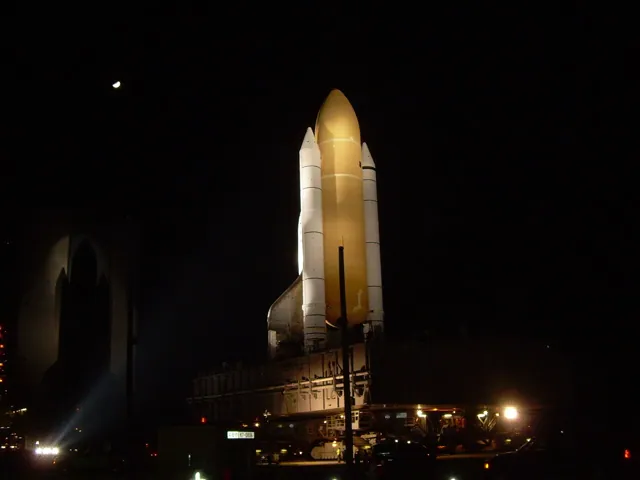
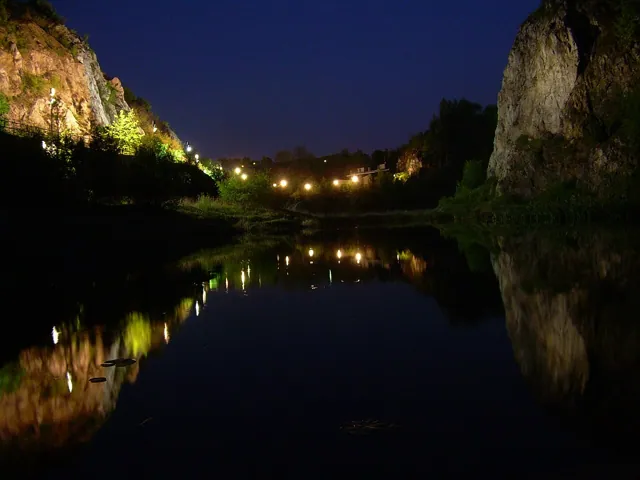
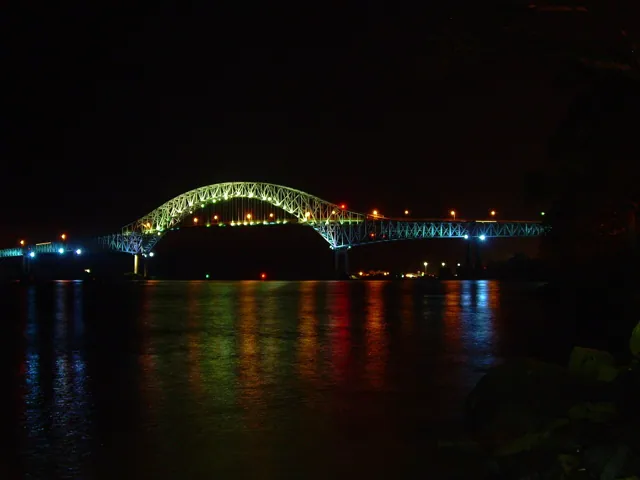
These four strips are ISO 200, the camera's top setting, read from each file's own data.8 They show what a lit night scene looks like at that ceiling, not a dim room.





On eBay right now
Live listings for this camera, supplied by eBay and updated automatically. We earn a commission if you buy through them.
The little wins
A face-finder at $150
Trusted Reviews found Face Priority AF distinctly spooky to watch as it locked on and followed a face while composing, though slower than normal focus.6 Imaging Resource called it the gem of the feature set but said it needs both eyes visible, so it cannot lock onto a profile.7 Steve's found it good for close portraits and inconsistent on screen-filling head shots.5
Close-ups
Imaging Resource measured a minimum macro area of 36 by 27 millimetres with very good detail and some corner softening, though the flash lit it unevenly.7 Trusted Reviews called the 4 cm macro range pretty good for an ultra-compact.6
A screen you could see
Steve's said the anti-reflective surface made the screen usable in the brightest conditions and that it gains up indoors to help framing;5 Trusted Reviews also found it bright despite its small size.6 Reviewed.com noted that at 115,000 dots it out-resolved the L2's and L3's 86,000, a choice it could not explain.2
How it drew the picture
The three full reviews did not agree about the pictures. Trusted Reviews called image quality generally very good, with a very high level of detail for four megapixels and a lens sharp from edge to edge.6 Steve's called its outdoor samples sharp and well exposed.5 Imaging Resource measured strong detail to about 1,000 lines per picture height, but found the corners quite soft at wide angle and still soft at telephoto, visible edge enhancement, and noise suppression it called some of the worst it had seen in a while.7










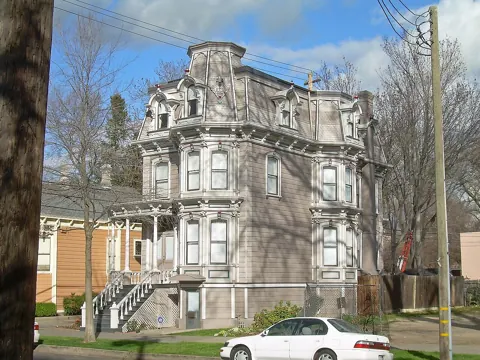





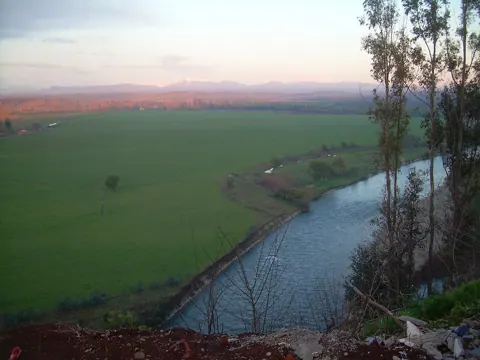

Photos taken with this camera, from Wikimedia Commons, credited under each picture. Several thousand exist; the nine on this page (counting the lead) were picked for variety, so judge sharpness and highlights yourself.
Exposure divided them too. Trusted Reviews said the CCD had a more limited dynamic range than most cameras, so contrasty scenes lost highlights or shadow detail, sometimes both;6 Imaging Resource's overview said dynamic range was good for an entry-level model, yet its harsh-sunlight test showed washed-out highlights and modest shadow detail;7 Steve's found sky detail well held but whites sometimes blown out in bright sun.5 On prints, Imaging Resource made acceptable 11 by 14 inch prints of one still life and better 8 by 10s, yet recommended only 4 by 6 because of the noise suppression;7 Trusted Reviews said a 4-megapixel file would not look too shabby at A4,6 and Steve's called 4 by 6 prints pleasing.5
All three noted barrel distortion at wide angle: Imaging Resource measured 1.15 percent and called it quite high, and Trusted Reviews called it significant.765 Fringing split them: Imaging Resource saw 7 to 8 pixels of bright colour at the edges of its chart at wide angle, while Steve's said purple fringing was very well controlled.75
Where it let you down
Speed was the common complaint, and each reviewer measured it a little differently:
| Imaging Resource | Steve's Digicams | Trusted Reviews | |
|---|---|---|---|
| Switch on to first shot | 2.7 s7 | 3 s, much of it extending the lens5 | "a whole five seconds" to start up6 |
| Shutter lag with autofocus | 0.85 s wide, 0.93 s tele7 | 0.7 s on average5 | – (called autofocus quick and accurate)6 |
| Shutter lag, prefocused | 0.219 s7 | 0.3 s, including about 0.1 s of screen delay5 | – |
| Shot to shot | 2.91 s per large fine JPEG7 | about 3 s without flash, 5 to 9 s with flash5 | – |
| Zoom | slow and noisy, a high-pitched whine7 | – | responsive, in at least eight steps6 |
Imaging Resource says its L4 review is very similar to its L2 and L3 review, and a few lines look carried over (an image-size list giving 2,592 × 1,944 pixels, which does not fit a 4-megapixel camera, and a mention of the L1), so we used only its L4-specific timings, lab results and quotes.78
The rest was handling. Imaging Resource found the buttons small and the zoom rocker narrow, and disliked a playback information overlay that is on by default and takes several menu steps to switch off.7 Steve's noted that the screen goes blank during the red-eye pre-flash, and still saw traces of red-eye with the reduction on.5
What the reviewers said in 2006
| Outlet | Date | Verdict |
|---|---|---|
| Reviewed.com | 20 Mar 2006 | A hands-on, not a full review: great value for budget buyers, but silent 15 fps video was virtually useless and manual control trailed Canon's A-series.2 |
| Steve's Digicams | 12 Apr 2006 | No score on the page. Good value under $140 if you shoot mostly outdoors in sun and do not need speed; sluggish performance and weak flash range were disappointing.5 |
| Trusted Reviews | 1 Aug 2006 | "Hard to imagine a better camera at the price" (verdict opening). Page lists Value 9 and Image Quality 6; cons were limited dynamic range, slow start-up and no manual exposure.6 |
| Imaging Resource | 7 Sep 2006 | A mixed bag with a modest recommendation, if all you expect is 4 by 6 prints, 5 by 7 at most; it called the L3 the sweet spot of the L-series.7 |
Steve's said the L2 and L3 cost $60 to $100 more and share the L4's slow performance and weak flash.5
The timeline
- 21 February 2006Nikon USA announces the L2, L3 and L4; the L4 is planned at $149.95 for March. Nikon Corporation issues its release, and Steve's Digicams posts a first look.193
- 20 March 2006Reviewed.com publishes its hands-on of the three cameras.2
- 31 March 2006Availability date in Imaging Resource's spec table.7
- 12 April 2006Steve's Digicams posts its full review.3
- 1 August 2006Trusted Reviews publishes its review.6
- 7 September 2006Imaging Resource posts its review.7
Should you buy one now?
Buy one if you want a very simple pocket camera that runs on AA cells, you shoot in daylight, you print small or share on screen, and you can live with a slow start. It launched at $149.95;1 what it sells for now is a question for the sold listings, not for us. Before you bid, check these:
- The name. Search the Coolpix L4. The L2 has 6 megapixels and the L3 has 5; the L4 is the 4-megapixel one with the brighter lens and silent video.12
- The batteries. It takes two AA cells, and Steve's and Imaging Resource both recommended NiMH rechargeables.57 Imaging Resource says the cells fall free when the battery door opens, so check that the door latches.7 Steve's says the camera's Battery Type setting (alkaline, lithium or NiMH) makes the level display correct, so set it.4 A set of rechargeables is on Amazon ↗.
- The card. Nikon lists SD cards, with about 10 MB of built-in memory; Steve's advised at least 256 MB.84 No source says whether a 2006 L4 reads high-capacity SDHC cards, so test one before relying on it; see our memory card guide and the glossary.
- The lens. It telescopes out when switched on and a shutter-like cover slides aside,7 so check that it extends and retracts cleanly and the housing is not knocked.
- The cable. Steve's and Nikon's own 2006 release list a UC-E6 USB cable and an EG-CP11 video cable (video only) among the supplied accessories, noting that these may differ by country or area; the release gives the EG-CP14 audio/video cable to the L2 and L3, not the L4.39 See our UC-E6 page.
- The tripod socket. Trusted Reviews said its thread is soft plastic, so do not overtighten it.6
If you are wondering why cameras like this are being hunted down again, we tell that story once, in Pictures that never left the card.
See recent sold prices on eBay ↗Shop on eBay ↗AA rechargeable batteries ↗
Sources
- Imaging Resource, Nikon: Three new L-series digicams, by Mike Tomkins (21 Feb 2006; Nikon USA's announcement with spec tables)
- Reviewed.com, Nikon Coolpix L2, L3 and L4 first impressions, by Dan Havlik (20 Mar 2006; a hands-on at the PMA show, not a full review)
- Steve's Digicams, Nikon Coolpix L4, introduction and specifications (first look 21 Feb 2006, full review 12 Apr 2006; archived Dec 2007)
- Steve's Digicams, Nikon Coolpix L4, Features and Controls (archived Dec 2007)
- Steve's Digicams, Nikon Coolpix L4, Steve's Conclusion (full review 12 Apr 2006; archived Aug 2007)
- Trusted Reviews, Nikon Coolpix L4 review, by Cliff Smith (1 Aug 2006)
- Imaging Resource, Nikon L4 review, by Dan Havlik (posted 7 Sep 2006 per the page's metadata; availability 31 Mar 2006 in its spec table)
- Nikon Canada, COOLPIX L4 tech specs (archived product page, undated)
- Nikon Corporation (Tokyo), news release: Digital Compact Camera COOLPIX L2/L3/L4 (21 Feb 2006; archived 2012)
Photographs are credited under each one, all via Wikimedia Commons. Links to eBay and Amazon are affiliate links. Steve's Digicams pages are read from the Internet Archive.