Canon PowerShot G · on sale June 2003
The Canon PowerShot G5: a black G3 with five megapixels
Canon's museum lists the same name, PowerShot G5, for Japan, the Americas, and Europe, Asia and Oceania.1
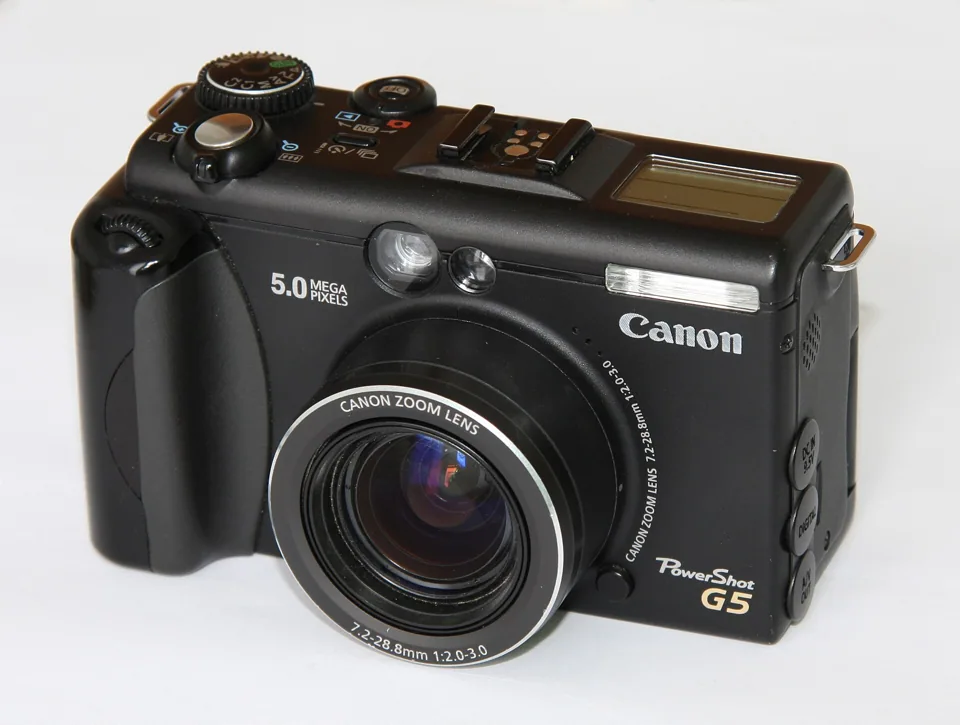

Canon's June 2003 update put a five-megapixel CCD in the G3's body and painted it black. Imaging Resource and DPReview recommended it; two of the three reviewers we read also said the cheaper G3 might be the better buy.
Canon PowerShot G5 specs: sensor, lens, battery, memory card and cable
The Canon PowerShot G5 came out in June 2003 as a 5 MP CCD compact with a 35–140 mm (35 mm equivalent) 4× zoom lens. It takes CompactFlash cards and runs on the BP-511 or BP-512 battery. Sources
- Sensor
- CCD, 1/1.8", 5 MP source
- Lens
- 35–140 mm equivalent, 4× zoom source
- Memory card
- CompactFlash source
- Battery
- BP-511, BP-512 source
- USB / A/V cable
- IFC-300PCU, AVC-DC100 Confirmed · all Canon cables
Meet the camera
Canon's museum describes the G5 as the successor to the 4-megapixel G3 of November 2002 and gives it a June 2003 market date.1 DPReview, which put the announcement at the beginning of June, called it a five-megapixel companion to the G3 rather than a direct replacement, and passed on a reason for the skipped number: the digit four sounds like the word for death in some Asian languages.2 The Digital Camera Resource Page counted just four differences from the G3: a 5.0 against 4.0 megapixel CCD, digital zoom of 4.1x against 3.6x, a screen of 118,000 pixels against about 113,600, and a black body instead of silver. It also noted that the CCD apparently came from Canon's PowerShot S50.4
The body is about 121 by 74 by 70 millimetres.31 Canon describes a lightweight aluminium cover finished in black Alumite;1 DPReview wrote that the front, the top and the back of the screen are metal alloy, while the rear, half the base and the grip are plastic.2 Weight depends on what is counted: Canon says about 410 grams for the body alone, Imaging Resource and the Digital Camera Resource Page also give 410 grams (Imaging Resource says with battery and card), and DPReview gives 481 grams with battery.1342 We cannot reconcile those, so we show all three.
Prices in 2003 depend on whom you ask. DPReview and the Digital Camera Resource Page both printed a US street price of $799, and DPReview added £679 for the UK;24 Imaging Resource's data sheet lists $899 as the retail price, with availability on 30 June 2003, in a field last updated in 2007.5 Canon's museum page gives no price.1
- Sensor
- 5.0 MP CCD (about 5.3 MP total), 1/1.8"1
- Lens
- 4x, 7.2–28.8 mm (35–140 mm equiv.), f/2.0–3.01
- ISO
- Auto, 50, 100, 200, 4001
- Screen
- 1.8" LCD that tilts, twists and swivels, 100% coverage; optical viewfinder, about 83% field of view (Canon)12
- Files
- JPEG or raw; shutter 15 s to 1/2000 s1
- Video
- 320 × 240 or 160 × 120, about 15 frames a second, about 3 minutes1
- Card and battery
- CompactFlash Type I or II · BP-511 (BP-512 optional)1
Why this one was interesting
The G3, with a bigger number on the box
Imaging Resource found the G5 nearly identical to the G3, with virtually the same controls and features, and noted the all-black body among the few other differences.3 The sensor change took the largest image from 2272 by 1704 pixels to 2592 by 1944.3 DPReview thought the G5 looked better in black, more professional and more purposeful, and, because the two are so alike, said that the first half of its review was reused from its G3 review.2
A three-way race
Three five-megapixel cameras with 4x zooms arrived at once, and DPReview compared them directly. The G5 had the fastest lens, f/2.0–3.0 against f/2.8–4.0 on Sony's DSC-V1 and f/2.8–4.6 on Nikon's Coolpix 5400, and the longest battery life of the three in DPReview's test: 4 hours 33 minutes against 2 hours 39 for the Sony and 3 hours 6 for the Nikon.2 DPReview listed street prices of $799 for the Canon and the Nikon and $699 for the Sony, which it called noticeably faster, smaller, lighter and about $100 cheaper; it said that anyone who wanted a shutterbug's camera should look at the G5 or the Nikon and everyone else should start with the Sony.2 The Digital Camera Resource Page, which had also used the Sony, still thought the Canon's pictures better in resolution, colour and noise.4
Raw, and a way to change your mind afterwards
Raw files held 12 bits of data, which DPReview listed as a strength, and Imaging Resource noted that processing inside the camera ran at 12 bits per channel throughout.23 DPReview singled out how it worked in practice: shoot a JPEG, and if the picture matters, press the FUNC button during the picture review to save it as raw instead. DPReview called that very useful, very clever.2 The Digital Camera Resource Page described the same feature and added that raw files can be saved as TIFF or JPEG after you adjust exposure and white balance on the computer.4 The price was space: DPReview's test files were about 4,900 KB for raw against about 2,100 KB for a Super-Fine JPEG, which on a 256 MB card meant 51 raw frames or 99 Super-Fine ones by the camera's own estimate.2 Imaging Resource said Canon's ZoomBrowser EX software was required to process raw files,3 and we have not checked which current converters open the camera's files.
For the G line's earlier and later chapters, see our PowerShot G2 review (2001), G9 (2007) and G11 (2009).
What was lost
The G5 was a little slower than the G3. Imaging Resource's table puts start-up at 4.82 seconds against 4.2 for the G3, full-autofocus shutter lag at 1.04 to 1.17 seconds against 0.94, and high-speed burst at 1.96 frames a second against 2.27.3 DPReview said the processor and buffer had not changed since the G3, so continuous shooting was slightly slower and fewer frames fit in a burst, and that a Super-Fine JPEG took about three quarters of a second longer to write than the G3's.2
The image quality changed too. DPReview found noise higher than on the G3 and purple fringing stronger, even at apertures where fringing normally disappears, and said the G5 handled night exposures worse: hot pixels and dark pits showed in exposures longer than about 10 seconds.2 That reviewer had wondered why Canon had not skipped the G3 and launched the G5 at the previous year's Photokina, and thought the answer was in the test results.2
The dark: its weak point
The three reviewers disagreed about noise, and the disagreement is the most useful thing in this page. DPReview measured the G5 as noisiest of the three five-megapixel cameras from ISO 100 upwards, with a clean ISO 50, and said the competition had caught and overtaken Canon.2 It also found the camera about 0.7 stops more sensitive than the same ISO setting on the Nikon and the Sony it tested, which put its ISO 50–400 range at roughly ISO 80–640 on their scale; its own spec table instead says closer to ISO 100–800.2 The Digital Camera Resource Page called exposure, colour and noise levels all excellent,4 and Imaging Resource was surprised how little noise rose as resolution did (comparing ISO 50 test shots with the G1 and G2) and called noise reasonable even at ISO 400 in its night test.3
In dim rooms the camera's focus lamp mattered more than the sensor. DPReview's test target stayed in focus in complete darkness at both ends of the zoom with the assist lamp on, and Imaging Resource said the same of its night test.23 Imaging Resource called its images clear, bright and usable down to about 1/16 foot-candle (0.67 lux) at all four ISO settings.3 The Digital Camera Resource Page liked the exposure and low noise of its night shot but saw a bunch of purple halos around bright lights.4 Exposures of 1.3 seconds or longer trigger a dark-frame noise-reduction pass, so an eight-second picture takes sixteen seconds to finish.21 DPReview said the G5 coped worse than the G3 with exposures beyond about 10 seconds, yet its list of strengths still calls the night exposures excellent.2
The free photographs below are all daylight shots, and the EXIF data in the free G5 files on Commons carries no ISO value, so there is no verified low-light strip on this page.
Like that look? See recent eBay sold listings for this camera ↗
On eBay right now
Live listings for this camera, supplied by eBay and updated automatically. We earn a commission if you buy through them.
The little wins
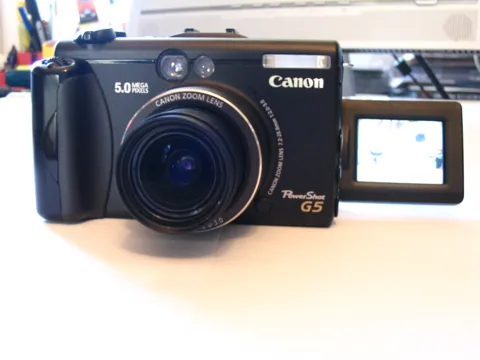 The G5 with the screen swung out sideways · Mieciu K2 · CC BY-SA 3.0 · Commons

A screen that folds away
The 1.8-inch screen pops out, twists and swings, and can be folded back into the body with the glass facing inward, which Imaging Resource liked because it keeps the screen free of fingerprints and scratches.3 DPReview added that the G5's back is moulded so the screen sits flush and that it has a good anti-reflective coating.2
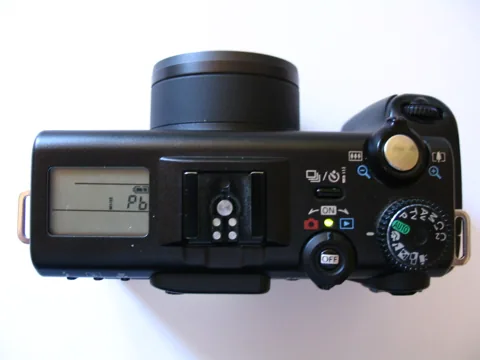 The top of the G5, with its status panel and hot shoe · Mieciu K2 · CC BY-SA 3.0 · Commons

A top panel and a remote
A status panel on top reports settings without turning on the screen; DPReview and the Digital Camera Resource Page both counted the lack of a backlight against it.24 An infrared remote came in the box, which Imaging Resource said works well with the swivelling screen when the camera sits on a tripod and you stand in front of it.3
A neutral-density filter built in
A menu option switches in a filter worth three stops of light, so you can use a wider aperture or slower shutter speed in bright light; Imaging Resource added that it makes flash practical for closer macro shots.3 DPReview counted it among the features not found on competing cameras, and the Digital Camera Resource Page said you do not see one every day on a digital camera.24
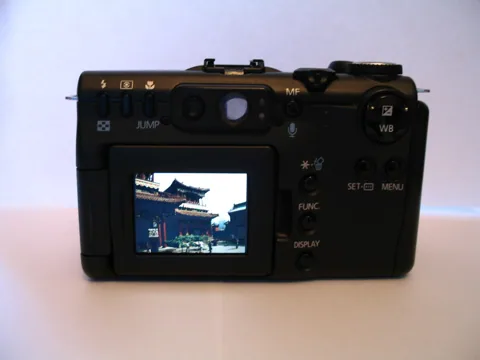 The back of the G5, showing a picture on the screen · Mieciu K2 · CC BY-SA 3.0 · Commons

Focus anywhere in the frame
Pressing SET lets you move the focus box around with the four-way pad. Imaging Resource put the range at roughly the central 60 per cent of the frame and DPReview at 345 positions on a 23 by 15 grid.32 The Digital Camera Resource Page called it the nicest system of its kind.4
A battery that went the distance
DPReview's test gave 4 hours 33 minutes and 460 shots, one minute more than the G3.2 Imaging Resource measured worst-case runtime of 162 minutes with the screen on and about 11 hours with it off,3 and the Digital Camera Resource Page's table lists 750 shots with the screen used half the time.4 DPReview called the result truly impressive and Imaging Resource excellent; the three used different tests, so the figures cannot be compared.
How it drew the picture
DPReview found good dynamic range, natural tone balance, strong but accurate colour and clean ISO 50 pictures, and in its three-way test said the G5 had the sharpest image with the most detail and the fewest sharpening halos.2 Imaging Resource found excellent colour with hue nearly always right, though skin tones ran slightly orange or pink, and said the camera's auto white balance struggled under household incandescent light.3 DPReview saw the same cast: strong orange under incandescent and fluorescent light, good auto white balance in daylight.2
The resolution tests agree in outline and differ in numbers. Imaging Resource saw artifacts from about 750 lines per picture height, strong detail to at least 1,250 and extinction near 1,600, and said Canon seemed to have used a minimal anti-aliasing filter, which gives fine detail but more jagged lines.3 DPReview measured about 1,450 lines horizontally and 1,350 vertically before aliasing, with extinction near 1,650 and 1,700, and also found jaggies at shallow angles of about ten degrees or less.2 Distortion was small: Imaging Resource measured about 0.7 per cent barrel at wide angle and 0.3 pincushion at telephoto, DPReview 0.9 and 0.4.32
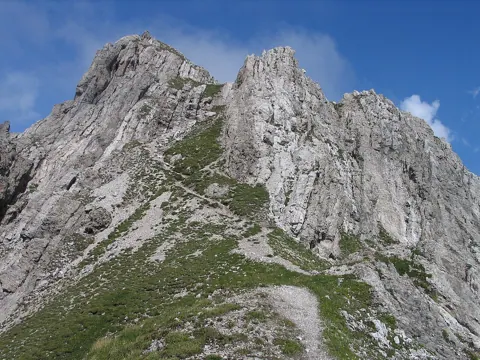

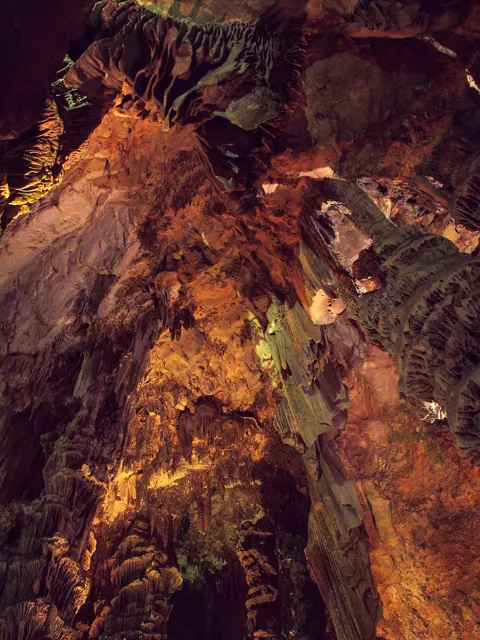





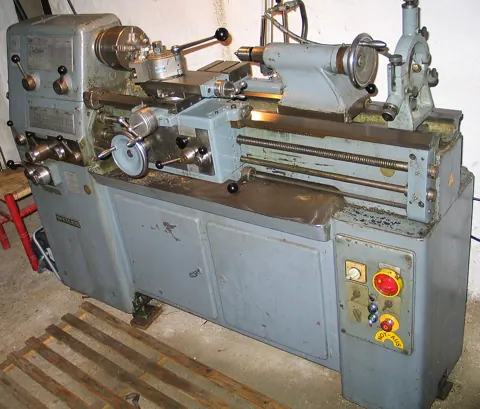









Photos taken with this camera, from Wikimedia Commons, credited under each picture.
Where it let you down
All three reviewers remarked on the viewfinder. At wide angle the lens barrel pokes into the lower-left corner of the view; DPReview called that a big negative and gave coverage as 84 per cent, Imaging Resource measured about 86 per cent at wide angle and 85 at telephoto, and the Digital Camera Resource Page quoted Canon's 83 per cent.234 DPReview and Imaging Resource both noted that the screen shows about 100 per cent of the frame.23
Speed was the second. Imaging Resource timed 4.82 seconds from power-on to first shot and called shutter lag with full autofocus slow-side-of-average at 1.04 to 1.17 seconds, though only 0.095 seconds when pre-focused; it called lag probably the weakest point of the design.3 DPReview timed 4.2 seconds to be ready and put total lag at 0.8 to 1.0 seconds at wide angle and 1.1 to 1.5 at telephoto.2 The Digital Camera Resource Page said the lens takes about four seconds to extend, but found no noticeable shutter lag and the camera generally focused in under a second.4
There were smaller things. DPReview said the new control dial "stutters" if turned quickly, found no nine-point automatic focus as on the S45 and S50, and counted only 12 zoom steps; it also listed the aperture and shutter-speed combinations the camera cannot make, such as a fastest 1/1250 second at the widest apertures.2 The Digital Camera Resource Page disliked the red-eye the light-guide flash gave even with reduction on, the small diopter knob, and pointed out a lens-barrel shadow in the lower-right corner of wide-angle flash pictures (Imaging Resource saw the same shadow in its macro flash test).43 The reviewers did not agree on the tripod mount. DPReview said it is far enough from the battery door that you can change batteries on a tripod, while Imaging Resource said the two sit so close that a quick change on a tripod would be difficult.23 The camera had USB 1.1 only, and the Digital Camera Resource Page wished for USB 2.0.24
What the reviewers said in 2003
| Outlet | Date | Verdict |
|---|---|---|
| Digital Camera Resource Page | 13 June 2003; updated 20 June | Recommends it, but not as enthusiastically as it would have liked: a very good camera held back from greatness by purple fringing, red-eye and the lens in the viewfinder. For prints larger than 8 by 10 inches, the G5; otherwise it would save a few dollars and buy the G3.4 |
| DPReview | 1 July 2003 | Recommended. Construction 8.5, features 9, image quality 8.5, lens and CCD 8.5, ease of use 9, value 8 out of 10. Higher noise and fringing than the G3 and a price $100 above the Sony DSC-V1; it said you could save money and lose only a few pixels by buying a G3.2 |
| Imaging Resource | 18 Aug 2003 | Highly recommended: all the features and performance of the G3 with an extra megapixel, and surprisingly good noise for five megapixels. It called shutter lag probably the camera's weakest point.3 |
The timeline
- November 2002Canon's museum gives this as the G3's release month.1
- Beginning of June 2003DPReview says the G5 was announced; Canon's museum gives June 2003 as the marketing date.21
- 13 June 2003The Digital Camera Resource Page posts its review and updates it on 20 June.4
- 30 June 2003Availability date on Imaging Resource's data sheet.5
- 1 July 2003The date on DPReview's review page.2
- 18 August 2003Imaging Resource first posts its review.3
- September 2004Canon markets the PowerShot G6, with a 7.1-megapixel CCD, the same lens specification and nine-point autofocus (the G5, DPReview noted, lacked it); Canon's museum calls it the first major body redesign since the G3.62
Should you buy one now?
Buy one if you want a chunky, manual-control compact with raw files, a swivelling screen and a hot shoe and you can live with a viewfinder partly blocked by the lens. Sources disagree on its price: a $799 street price in two 2003 reviews and an $899 retail field on a data sheet last updated in 2007;245 what it sells for now is a question for the sold listings, not for us. Before you bid, check these:
- The name. Canon's museum lists PowerShot G5 for Japan, the Americas, and Europe, Asia and Oceania, so one search covers it.1
- The battery. It runs on a BP-511 or BP-512; DPReview said the two have the same capacity and rated the BP-511 at 7.4 V and 1100 mAh.12 The Digital Camera Resource Page put a spare at about $50 in 2003, and the charger doubles as the AC adapter.4 Amazon ↗
- The card. It takes CompactFlash Type I and II and works with IBM's Microdrives.12 See our CompactFlash guide.
- The kit. The box held an infrared remote, an AC adapter and charger, a lens cap on a cord, and USB and video cables;24 ask whether the remote is included.
- The screen. Swing it out, twist it and fold it back to check the hinge and that the glass is clean.
- The lens. It extends about an inch when the camera is on; make sure it extends and retracts smoothly.3
- Long exposures. DPReview saw hot pixels in exposures beyond about 10 seconds; test one in the dark.2
If you are wondering why cameras like this are being hunted down again, we tell that story once, in Pictures that never left the card.
See recent sold prices on eBay ↗Shop on eBay ↗BP-511 battery ↗
Sources
- Canon Camera Museum, PowerShot G5 (marketed June 2003; specifications)
- DPReview, Canon PowerShot G5 review by Phil Askey (published 1 July 2003; first half based on the author's G3 review of December 2002)
- Imaging Resource, Canon PowerShot G5 review, print version of all twelve pages (first posted 18 Aug 2003; lab timings, resolution and low-light tests)
- Digital Camera Resource Page, PowerShot G5 review by Jeff Keller (posted 13 June 2003, updated 20 June 2003; read in a December 2003 Internet Archive copy)
- Imaging Resource data sheet, Canon PowerShot G5 (retail price field $899, availability 2003-06-30, price date 2007-02-27)
- Canon Camera Museum, PowerShot G6 (marketed September 2004; replaces the G5)
Camera photos by Yerpo and Mieciu K2 (CC BY-SA); other photographs are credited under each one, all via Wikimedia Commons. Links to eBay and Amazon are affiliate links.