Kodak EasyShare C · announced February 2005
The Kodak EasyShare C340: a 2005 beginner's camera with easy menus and a cramped screen
We found no other regional name for it; Kodak's guide and the reviews we read all call it the C340.21
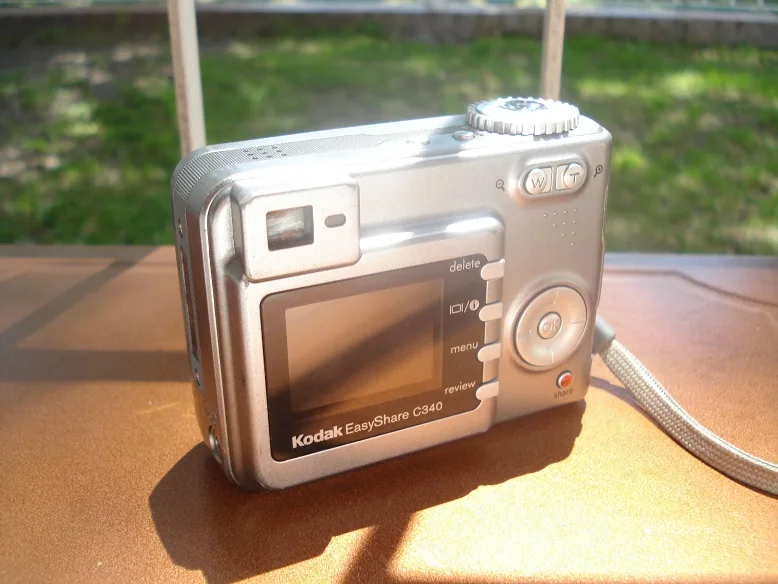

Kodak announced a 5-megapixel, 3x-zoom compact for beginners at $249.95. Reviewers liked its easy menus, and CNET found the lens surprisingly sharp for the price; they disliked the 1.6-inch screen, the viewfinder and a slow start-up.
- Launched
- February 2005
- Launch price
- $249.95, May 20051
- Sensor
- 5 MP CCD
- Lens
- 34–102 mm, 3×
- Card
- SD, MultiMediaCard
- Battery
- 2x AA, CR-V3, Kodak NiMH pack
Kodak EasyShare C340 specs: sensor, lens, battery, memory card and cable
Launched in February 2005 at $249.95, the Kodak EasyShare C340 is a 5 MP CCD compact with a 34–102 mm (35 mm equivalent) 3× zoom lens. Inside: it uses SD and MultiMediaCard and runs on 2x AA or CR-V3 or Kodak NiMH pack batteries. Sources
- Sensor
- CCD, 1/2.5", 5 MP source
- Lens
- 34–102 mm equivalent, 3× zoom source
- Memory card
- SD, MultiMediaCard source
- Battery
- 2x AA, CR-V3, Kodak NiMH pack source
- USB / A/V cable
- See our Kodak cable page
Meet the camera
Kodak introduced the C340 on 19 February 2005, the same day as its Z-series announcements; Reviewed's report called it a point-and-shoot for beginning consumers.1 It has a 1/2.5-inch CCD whose largest picture is 2576 by 1932 pixels, a 3x Kodak Retinar lens covering 34 to 102 mm in 35 mm terms, and a 1.6-inch screen of 72,000 pixels, with a small optical viewfinder above it.26 It runs on two AA cells, weighs 145 g without batteries or card, and stores pictures on SD or MultiMediaCard media or in 16 MB of internal memory.2
Dates and prices differ a little by source. Reviewed's report of Kodak's announcement priced it at $249.95 for May 2005, and CNET's archived product page gives a release date of 15 May 2005.15 Reviewed's lab review also lists $249.95 and says the street price was below $195, but elsewhere gives an "original retail price" of about $229.95; we do not know why the two differ.6 GadgetSpeak's reviewer found it at £124.80 at pixmania.co.uk when the review ran in August 2005.8
- Sensor
- 1/2.5-inch CCD, 2576 × 1932 pixels (about 5 MP)2
- Lens
- 3x Retinar, 34–102 mm equiv., f/2.7–4.6 per Kodak; digital zoom to 5x2
- ISO
- 80, 100, 200, 400; Auto stays between 80 and 1602
- Video
- VGA at 13 fps or 320×240 at 20 fps, QuickTime Motion JPEG2
- Burst
- At most 3 pictures, 3 frames per second2
- Card and battery
- SD or MMC, 16 MB internal · 2×AA (alkaline, lithium or NiMH), CR-V3 or Kodak NiMH pack2
- Launch price
- $249.95, May 20051
Its siblings: Imaging Resource reported in May 2005 that the C340 was about to gain two relatives. The C330 had a 4-megapixel sensor and a 1.5-inch screen, shot 320 by 240 video without sound and was planned at $179 for July. The C360 had a 5-megapixel sensor and a 2-inch, 110,000-pixel screen, and was planned at $279.9 We found no full review of the C330, so this page covers only the C340.
Why this one was interesting
A camera that asked for nothing
Reviewers agreed on what the C340 was for. CNET called it a solid contender but not a trailblazer, and a safe choice for a budding shutterbug or a confirmed technophobe, with menu selections so large it called them good for poor eyesight.4 Reviewed scored ease of use 8.0 out of 10 and the menu 7.5, and said anyone hoping to grow with the camera would be a little disappointed once ISO and exposure compensation were mastered in the first week.6 GadgetSpeak put it in one sentence: insert the batteries, turn the dial to Auto, frame the picture and press the shutter.8
The lens held up
The surprise was the glass. CNET noted that Kodak used a lesser Retinar lens here rather than the Schneider lenses on dearer models, but still found the pictures "surprisingly sharp" for the price.4 GadgetSpeak's reviewer was pleased with the pictures and could not easily tell the C340's from the C360's, which they said use identical lenses.8 Reviewed measured less: its resolution chart gave 3.44 megapixels' worth of detail out of 5, 69 percent and just short of its own "good" line of 70 percent, enough for 8 by 10 prints if not heavily cropped.6 CNET judged by eye and Reviewed by chart, and neither called the lens poor; Reviewed's first-impressions page expected well-defined pictures for the price.7
The Share button
The red Share button let you tag pictures for printing, e-mail or a Favorites album, and CNET said the included EasyShare software then sent them to the right place automatically.46 For Kodak's more ambitious cameras of the period, see our EasyShare Z700 review and C875 review, or the Kodak hub.
What was lost
The screen was the loudest complaint. CNET called it undersized, noted that 1.8-inch screens were common on cheaper cameras by then, and pointed out that the back had room for a bigger one; the dearer C360 had a 2-inch screen.4 Reviewed gave the LCD 2.0 out of 10 and said it is rare to find fewer than 110,000 pixels.6
The optical finder is where the sources disagree most. CNET found it noticeably out of alignment, cutting about 20 percent off the bottom of the picture and adding about 10 percent at the top.4 Reviewed's final review scored it 1.5 and called it nearly unusable, small and easily blocked by a left-hand finger.6 Its first-impressions page, with no byline shown and no date, found it fairly accurate "as far as I could tell" and said the screen came close to 100 percent accuracy.7 If you buy one, test the finder yourself.
The dark: its weak point
Low light was the weak spot in both full reviews. Reviewed scored low-light performance 3.0 out of 10: the night scene mode gave blurry pictures with less accurate colour, at about the light of two soft lamps colours looked under-saturated, and in near darkness sharpness dived.6 CNET saw obvious noise at ISO 160 and higher, and said the lack of an autofocus-assist lamp made it hard to work with in very dim places, and that the small screen and short flash range also limited it in low light.4 Reviewed rated noise at manual ISO as about average for its price, and noted that the automatic ISO range is truncated to 80 to 160.62
The flash did not help much. Kodak lists a range of 2 to 12 feet at wide angle and 2 to 7 feet at telephoto at ISO 140.2 CNET found it sometimes anemic unless the subject was close and occasionally greatly overexposing; Reviewed called the light hard, with a shadow thrown to one side because the flash sits off-centre.46 The nine sample files shown here were all shot at ISO 80 (we checked each file's metadata), so this page has no low-light strip.
On eBay right now
Live listings for this camera, supplied by eBay and updated automatically. We earn a commission if you buy through them.
The little wins
Quick to react
CNET timed shutter lag at 0.4 seconds in bright light and 0.6 in dim light, and said that beats some competing cameras; Reviewed measured 0.53 seconds and still noted “some shutter lag”.46
Cropping that keeps the original
Reviewed liked that in-camera cropping saves a new file and keeps the original, for pictures above 2.1 megapixels.6
Framing marks that work
CNET found that the on-screen preview matched the final picture closely and that autofocus was accurate when you watched the framing marks, which show where it is focusing.4
How it drew the picture
CNET found most photos had a wide contrast range with little visible compression, rich detail in dark areas and some colour blooming in light highlights; colour fringing was within acceptable limits.4 Colour was strong. CNET said hues did not shift but ran stronger than the real thing; Reviewed measured the palette over-saturated by 26.3 percent with a mean colour error of 10.6, and scored colour 6.69 out of 10.46 Reviewed called that decent but well behind Kodak's Z-series cameras.6
















Sample photos taken with this camera, from Wikimedia Commons, credited under each picture. The EXIF data of every file names the C340; the cheese picture records the flash as fired.
Where it let you down
Start-up was slow. CNET timed 5.5 seconds from switching on to the first shot and called it considerably slower than most cameras; Reviewed got 6.21 seconds at best and called it one of the slowest it had ever tested.46 After auto power-off the camera cannot be woken by a button; Reviewed says you must turn it off and on again.26
Video was the other weak area. At VGA the camera records 13 frames per second and at 320 by 240 it records 20, and both reviewers found it jerky; Reviewed scored the movie mode 3.5.246 The zoom was jerky too, with only four stopping points between the extremes, though CNET found it quick to respond.4 We found no battery-life figure in any of the reviews we read: Reviewed scored the battery 5.5 out of 10 without giving hours.6
What the reviewers said
| Outlet | Date | Verdict |
|---|---|---|
| GadgetSpeak | 18 August 2005 | A short hands-on piece: pleased with the pictures, advised buying an SD card, found the screen clear except in bright sun.8 |
| CNET | 2 November 2005 | 6.4 out of 10 (design 7, features 5, performance 6, image quality 7); good for beginners, the screen and finder are the problems.45 |
| Reviewed | Not shown | Value score 5.5 out of 10; simple and easy, but most buyers should look at cameras with bigger screens unless they want the printer dock bundle.6 |
We read two full reviews (CNET and Reviewed) and one short hands-on piece (GadgetSpeak). They agree on the small screen, the slow start-up, the jerky video and the simple controls; they differ most on the finder, between Reviewed's two pages and against CNET. Reviewed prints its scores without stating the scale; we read them as out of 10.
The timeline
- 19 February 2005Kodak introduces the C340 and C300, priced at $249.95 and $99.99.1
- 4 May 2005Imaging Resource reports a Kodak press release announcing the C330, C360 and C310 (its page is dated 5 May in the header).9
- 15 May 2005Release date listed on CNET's product page.5
- 18 August 2005GadgetSpeak publishes its hands-on review.8
- 2 November 2005CNET publishes its review.4
Should you buy one now?
Buy one if you want the plainest possible 2005 digicam: two AA cells, a big Auto dial and menus a child can read, and you will shoot in daylight. Skip it if you want a good screen or a camera that is quick to wake. It launched at $249.95;1 what it sells for now is a question for the sold listings, not for us. Before you bid, check these:
- The finder and screen. The sources disagree about the finder,467 so frame a picture with it and compare. Kodak lists the screen at 72,000 pixels.2
- The card door. CNET predicted the plastic SD/MMC cover would be the first part to break, at its hinges; Reviewed found the door has no lock and could open in a bag, though it called the hinges durable.46
- The batteries. Kodak lists alkaline, lithium or NiMH AA cells, a CR-V3 or the Kodak NiMH pack, and a 3-volt AC adapter.2 AA rechargeables on Amazon ↗
- The card. It takes SD and MMC cards; Kodak's capacity table stops at 256 MB, and states no maximum.23 The 16 MB internal memory holds seven pictures at the largest size.3 Reviewed's text says the camera has no built-in memory but a 16 MB card in the box, which contradicts Kodak and CNET.624 See our memory card guide.
- The dock. It works with Kodak's camera and printer docks, and Reviewed found the dock connector on the base.26
- The lens. The lens barrier is built into the barrel; check that it opens and closes when you switch the camera on and off.2
If you are wondering why cameras like this are being hunted down again, we tell that story once, in Pictures that never left the card.
See recent sold prices on eBay ↗Shop on eBay ↗AA rechargeable batteries ↗
Sources
- Reviewed, Kodak Announces C300, C340, by Emily Raymond (19 February 2005)
- Kodak, EasyShare C340 zoom digital camera user's guide, Camera specifications (undated)
- Kodak, EasyShare C340 user's guide, Storage capacities (undated)
- CNET, Kodak EasyShare C340 review by David English, edited by Aimee Baldridge (2 November 2005; current CNET page)
- CNET, Kodak EasyShare C340 product page, archived copy (rating 6.4; sub-ratings; "Release date: 5/15/05")
- Reviewed, Kodak EasyShare C340 Digital Camera Review, by James Murray (undated; lab tests with Imatest; the page prints scores without stating the scale)
- Reviewed, Kodak EasyShare C340 First Impressions Review (undated, no byline shown)
- GadgetSpeak, Review: Kodak Easy Share C340, by paul_smart (18 August 2005; a short hands-on review)
- Imaging Resource, Kodak: Three new EasyShare digicams, by Mike Tomkins (5 May 2005; the C330 and C360 spec tables)
Sample photographs are credited under each one, via Wikimedia Commons. Links to eBay and Amazon are affiliate links.