Kodak EasyShare M · on sale April 2008
The Kodak EasyShare M893 IS: the cheap 2008 compact with a real image stabiliser
We found no other regional name for it; the 2008 reviews and the launch coverage all call it the M893 IS.135
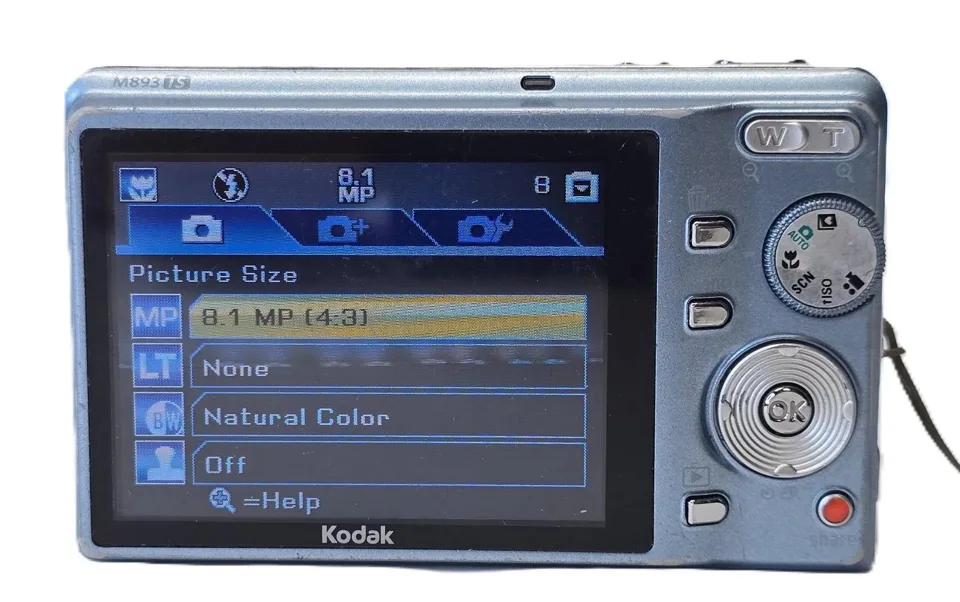
Kodak showed it at CES in January 2008 and sold it from April at $179.95. Reviewers found noise and a screen that was hard to read in sun, and split on the stabiliser, the colour and the speed.
- Launched
- April 2008
- Sensor
- 8.1 MP CCD
- Lens
- 34–102 mm, 3×
- Card
- SD, SDHC, MultiMediaCard
- Battery
- KLIC-7001
Kodak EasyShare M893 IS specs: sensor, lens, battery, memory card and cable
The Kodak EasyShare M893 IS is an 8.1 MP CCD compact camera with a 34–102 mm (35 mm equivalent) 3× zoom lens, launched in April 2008 at $179.95. It runs on the KLIC-7001 battery. Sources
- Sensor
- CCD, 1/2.5", 8.1 MP source
- Lens
- 34–102 mm equivalent, 3× zoom source
- Memory card
- SD, SDHC, MultiMediaCard source
- Battery
- KLIC-7001 source
- USB / A/V cable
- See our Kodak cable page
The Kodak page itself was not available to us; the launch facts come from Imaging Resource, which lists only a preview with no test results, and from Clubic's CES report. Where the sources disagree, we say so.
Meet the camera
Kodak showed the M893 IS at CES in January 2008 with three other M-series compacts, all priced under 200 euros; Clubic gave the M893 IS 149 euros, against 129 for the M763, 149 for the M863 and 199 for the M1033.3 Imaging Resource lists a US price of $179.95 and an availability date of 30 April 2008.12 The camera has an 8.1-megapixel 1/2.5-inch CCD, a 3x zoom covering 34 to 102 mm in 35 mm terms at f/2.9 to f/5.2, and a 2.7-inch screen of 230,000 dots with no viewfinder.1 In Britain The Register quoted about 110 pounds in May 2008, and Trusted Reviews 79.99 pounds in a review dated October 2008.56
The "IS" in the name is the point. Trusted Reviews called the system a genuine mechanical sensor-shift stabiliser, and Pocket-lint described it as CCD-shift optical stabilisation.64 One source disagrees: Imaging Resource's specification table says the camera has no optical stabilisation, although the same site's preview text calls the zoom optically stabilised.12 Clubic's launch report also calls it an optical stabiliser.3 We follow the two reviewers who handled the camera.
Why this one was interesting
A stabiliser for the price of a plain compact
Trusted Reviews opened with the arithmetic: a camera with 8.1 megapixels, a 3x zoom, a big screen, a metal body and a mechanical stabiliser would not long before have cost about 300 pounds, and here it was at 79.99 pounds.6 The reviewer estimated the stabiliser bought about two extra stops of handholding, and heard it buzzing at every shot; in its default continuous mode they compared it to a small angry wasp trapped inside.6 Pocket-lint called it the camera's ace up its sleeve, because steadier shots let you keep the ISO low.4 The Register found it helped at the long end of the zoom,5 while GadgetSpeak's reviewer called the stabilisation "not great".7
An "HD" badge that meant still pictures
Kodak's website carried an HD logo. Trusted Reviews explained that it meant the camera could play back 16:9 stills at 1920 by 1080, roughly 2.1 megapixels, and that connecting to a high-definition television needed the optional EasyShare HDTV dock, which they priced at about 60 pounds.6 Imaging Resource's preview also mentions an optional HDTV dock.2 The actual video mode stayed at VGA and 15 frames a second, which Pocket-lint called jerky.64
For other Kodak eras see our EasyShare C875 and EasyShare V570 reviews, or the Kodak page.
What was lost
The savings showed in the body and the controls. Trusted Reviews found the aluminium body thin enough to creak when squeezed, the rear buttons small and the labels pale grey on light blue, almost impossible to read; Pocket-lint called the body plasticky and the mode dial too small to use easily.64 The Register found the same dial turned too freely, and a stray jog left the reviewer shooting a set of pictures in High ISO mode without noticing; the flash button on top was easy to press by accident.5 Trusted Reviews also disliked the menu, which put ISO and metering on the second page and the date stamp on the first.6
All four reviews mention the screen in bright light. The Register called it one of the worst they had used there; Trusted Reviews found it sharp enough but slow and dim, and noticed it faded to black when the camera was held above the head.5467 The manual was thin: The Register wrote that only the first 26 pages were in English and covered the basics, with the full text a PDF on Kodak's site, and GadgetSpeak found the guide short on detail.57 GadgetSpeak found no way to shorten the six seconds the review picture stays on screen, and noted that the mixed picture shapes can leave borders on prints.7
The dark: its weak point
Noise was the loudest complaint. Trusted Reviews saw visible noise even at the lowest setting of ISO 80, in a test frame that came out under-exposed because the slowest shutter in normal shooting is an eighth of a second, and called ISO 400 virtually unusable and ISO 800 too poor for even a small print.6 Pocket-lint found large prints from pictures above ISO 400 heavily stippled with noise, with the noise processing stripping detail, and noted that Auto ISO stops at 400.4 The Register's reviewer tried the Museum mode, which switches off the flash and raises the ISO, and called the results noisy and disappointing, though the stabiliser helped at the longer focal length.5
Focus made it worse. Trusted Reviews found autofocus slow even in good light and unwilling to lock in light "you can read by", with no focus-assist lamp.6 The Register said it takes a while to settle and was temperamental in close-ups, and Pocket-lint found focusing slow even with Face AF, which did not recognise a face in profile.54 Pocket-lint also tested the macro claim of 2.3 inches and measured about 5 inches.4 GadgetSpeak called the face detection a disappointment.7
The free sample photos we found were all shot at ISO 80, according to the camera data stored in each file, so this page shows no low-light strip.
On eBay right now
Live listings for this camera, supplied by eBay and updated automatically. We earn a commission if you buy through them.
The little wins
Perfect Touch
Kodak's in-camera correction for highlights, shadows and colour. The Register's review included a before and after pair; Pocket-lint said it did not match Nikon's D-Lighting.54
Undelete
The Register noted that a deleted picture can be restored, and that the camera has an in-camera crop.5
In-camera panorama
The Register found the panorama mode worked well, stitching two or three shots, though lining them up on the screen was hard.5
How it drew the picture
Trusted Reviews found the 8.1-megapixel sensor recorded pretty good detail, with good colour in daylight and reasonably good dynamic range in high-contrast scenes, and then listed what undid it: over-compression, inconsistent auto white balance, barrel distortion at the wide end, blurred frame edges and a lot of chromatic aberration.6 Pocket-lint also found the pictures good at lower sensitivities, but thought the colours overly rich.4 The Register thought the colour was bland, and said a field of rape was much more vivid in reality than in the sample picture.5 On colour the reviewers split three ways: good, over-rich, bland. The pictures below were taken with this camera, so you can vote yourself.

С. Болашенко · CC BY-SA 3.0 · Commons


Indiana jo · CC BY-SA 4.0 · Commons


Indiana jo · CC BY-SA 4.0 · Commons


Phoenix bangalore · Public domain · Commons


Richard Arthur Norton (1958- ) · CC BY 3.0 · Commons

Alexdevil · Public domain · Commons


Grievousguy64 · CC BY-SA 3.0 · Commons


Richard Arthur Norton (1958- ) · CC BY 3.0 · Commons

Sample photos taken with this camera, from Wikimedia Commons, credited under each picture.
Where it let you down
Speed is where the reviews contradict each other. Trusted Reviews timed start-up and shot-to-shot as better than expected,6 Pocket-lint called the camera sluggish, with slow focus and flash delays, especially with red-eye reduction on,4 and The Register said only that it was not the fastest.5 Only Trusted Reviews gave timings, so the gap cannot be settled from the page.
None of the four reviews we read mentions battery life, so we cannot give a shot count. The KLIC-7001 is the battery Imaging Resource lists, with a charger in the box.1 GadgetSpeak noted that the mini USB socket carries A/V out and charging.7
What the reviewers said in 2008
| Outlet | Date | Verdict |
|---|---|---|
| Pocket-lint | 2 Apr 2008 | 3.5 out of 5. A respectable feature set in a tidy body; the stabiliser is the strength, noise above ISO 400 and slow performance the weaknesses.4 |
| The Register | 1 May 2008 | Not bad value at about 110 pounds, with caveats; "not bad" but unlikely to excite. Poor screen in daylight, slow focus, bland colour. No score in the text we read.5 |
| GadgetSpeak | 7 Jul 2008 | Aimed at novices; stabilisation "not great", face detection a disappointment. No clear verdict in the text.7 |
| Trusted Reviews | 22 Oct 2008 (as shown on the page) | The harshest: poor build, slow autofocus, poor low light, very noisy, poor lens. Value 9, Image Quality 6, Build 5; we could not see an overall score.6 |
We read four full reviews. All four mention the screen in bright light and three report noise; they disagree on the stabiliser, colour and speed. Imaging Resource covered the camera only with a preview and spec table, which we use for launch facts.
The timeline
- January 2008Kodak shows the M893 IS at CES; Clubic reports 149 euros on 11 January.3
- 2 April 2008Pocket-lint's review is dated.4
- 30 April 2008Availability date and $179.95 price in Imaging Resource's listing.1
- 1 May 2008The Register publishes its review.5
- 7 July 2008GadgetSpeak publishes its review, listing the lowest prices it found at 99.68 pounds in the UK and $152 in the US.7
- 22 October 2008The date shown on Trusted Reviews' review, which gives 79.99 pounds.6
Should you buy one now?
Buy one if you want a very small, very plain 2008 compact whose pictures are fine in daylight with the ISO left low, and you will not trust the autofocus indoors. Skip it for night or indoor work. It launched at $179.95;1 what it sells for now is a question for the sold listings, not for us. Before you bid, check these:
- The name. Search the Kodak EasyShare M893 IS. Kodak's lineup that year also had the M763, M863 and M1033, which are different cameras.3
- The battery and charger. It uses a KLIC-7001 lithium-ion battery.1 KLIC-7001 batteries on Amazon ↗
- The card. It takes SD and SDHC cards.15 See our memory card guide.
- The stabiliser. Trusted Reviews could hear it working at every shot,6 so check that yours makes that noise when you take a shot.
- The screen and dial. Reviewers found the screen hard to read in bright light and the mode dial too loose;56 check both.
- The lens. Check that it extends and retracts cleanly and the glass is free of scratches.
If you are wondering why cameras like this are being hunted down again, we tell that story once, in Pictures that never left the card.
See recent sold prices on eBay ↗Shop on eBay ↗KLIC-7001 batteries ↗
Sources
- Imaging Resource, Kodak EasyShare M893 IS specification table (price, availability date, lens, ISO, battery, card, size)
- Imaging Resource, Kodak M893 IS preview page (a preview with no test results: US$179.95, April 2008, 19 scene modes, optional HDTV dock)
- Clubic, Kodak: 4 compacts simples a moins de 200 euros, by Anne Baudry (11 Jan 2008; in French; CES 2008 announcement with euro prices)
- Pocket-lint, Kodak EasyShare M893 IS review by Doug Harman (dated 2 Apr 2008; 3.5 out of 5)
- The Register, Kodak EasyShare M893 IS compact camera, by George Cole (1 May 2008)
- Trusted Reviews, Kodak EasyShare M893 IS review by Cliff Smith (the page shows 22 October 2008; scores Value 9, Image Quality 6, Build 5)
- GadgetSpeak, Review: Kodak EasyShare M893, by paul_smart (7 Jul 2008)
Sample photographs are credited under each one, via Wikimedia Commons. Links to eBay and Amazon are affiliate links.