Fujifilm FinePix S · on sale autumn 2005
The Fujifilm FinePix S5200 (S5600): the long zoom that bet on ISO 1600 instead of a stabiliser
Sold in Europe as the FinePix S5600 Zoom.
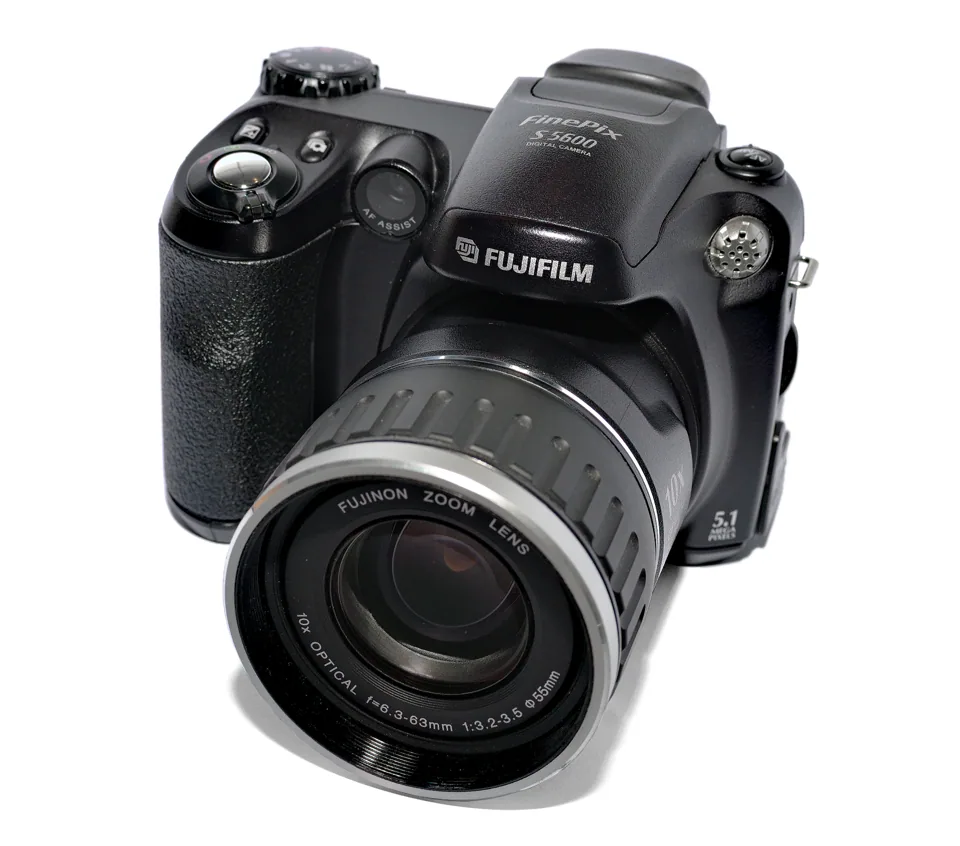

In 2005 Fujifilm priced a mini-SLR with a 10x zoom, full manual control and ISO 1600 at $399.95, and left out the image stabiliser. Reviewers praised the battery life and the handling, split on the noise, and kept noticing the purple fringes.
- Launched
- October 2005
- Launch price
- $399.95 in the US2
- Sensor
- 5.1 MP CCD
- Lens
- 38–380 mm, 10×
- Card
- xD-Picture Card
- Battery
- 4 x AA (alkaline or NiMH)
Fujifilm FinePix S5200 specs: sensor, lens, battery, memory card and cable
The Fujifilm FinePix S5200 (also sold as the FinePix S5600) came out in October 2005 at $399.95 as a 5.1 MP CCD compact with a 38–380 mm (35 mm equivalent) 10× zoom lens. It uses xD-Picture Card and runs on 4 x AA (alkaline or NiMH) batteries. Sources
- Sensor
- CCD, 1/2.5", 5.1 MP source
- Lens
- 38–380 mm equivalent, 10× zoom source
- Memory card
- xD-Picture Card source
- Battery
- 4 x AA (alkaline or NiMH) source
- Also sold as
- FinePix S5600
- USB / A/V cable
- See our Fujifilm cable page
Meet the camera
It is a small imitation of a digital SLR, in black plastic with a rubberised grip that wraps around the right side. Trusted Reviews thought it one of the most secure grips it knew, and said the body felt solid once the batteries were in.11 It is not a pocket camera: Imaging Resource said it was too big for a shirt pocket and came with a shoulder strap,8 and DigiCamReview said it needed a case.7 The weight depends on who is counting. Imaging Resource's spec table gives 371 grams, its review text 489 grams with batteries and an xD card,108 and Trusted Reviews wrote 370 grams without batteries and card.11
It had two names. Fujifilm UK announced it as the FinePix S5600 Zoom on 28 July 2005, the third generation of its mini-SLR long zooms, and the release, as PhotographyBLOG printed it, said it was known as the FinePix S5200 Zoom in the United States.1 Trusted Reviews likewise wrote that the S5600 was also known as the S5200 for the US market, and DigiCamReview titled its review with both names.117 Imaging Resource's report of the US announcement, the same day, put it on sale in October at $399.95,2 and PC Magazine gave the same list price.6 CNET listed a release date of 1 October 2005, while Imaging Resource's table says 31 October.510 The UK price was still to be announced in July, with shops due to have it in September;1 DigiCamReview found it from £206 in January 2006 and Trusted Reviews said under £200 that May.711 Photo Review gave an Australian recommended price of $549.4
Why this one was interesting
Sensitivity instead of stabilisation
Reviewed.com noted that the ISO range of 64 to 1600 stretched past the 400 or 800 that most rivals in this class reached.3 Fujifilm's answer to camera shake was the Anti-Blur mode, which raises the shutter speed by raising the sensitivity;812 its UK release called that more effective than stabilisation alone.1 The reviewers did not agree. Trusted Reviews said the camera gives good results at shutter speeds two to three stops faster than comparable cameras, which it said matches what most stabilisers offer, so it did just as well without one, though it still listed the missing stabiliser among its cons.11 Imaging Resource called the missing stabiliser the one thing it lacked against rivals, and said that at this price and resolution it could not be counted against it.8 PC Magazine found the trick merely adequate for reducing blur in its test shots.6 DigiCamReview concluded that a tripod, a lower ISO or real stabilisation would always do better, and recommended looking at stabilised rivals.7
More pixels and a quicker processor
It replaced the S5100, and Imaging Resource said its 5.1 megapixels were up from 4.0.28 TechRadar described a new fifth-generation Super CCD HR sensor, and credited the Real Photo processor with a start-up of just over a second, shorter shutter lag and better battery life, in a body slightly larger than its predecessor's.12 Trusted Reviews called the start-up a massive improvement over the S5500's;11 DigiCamReview described the new camera as an update to the "S5500 / S5100", which we take to be the same camera under its European and US names.7
Manual control and RAW
Imaging Resource listed aperture priority, shutter priority and full manual exposure,8 and Trusted Reviews found a CCD-RAW option, though hidden in the setup menu.11 PC Magazine tied the camera's Real Photo technology to the F10 and Z1,6 and DigiCamReview compared its noise with the F10's; our FinePix F10, F11 and F30 reviews cover Fujifilm's compacts of the same years. For an earlier SLR-shaped Fujifilm that also ran on four AA cells, see the FinePix S602 Zoom.
What it was up against
PC Magazine put it among cheap superzooms under $500 and judged it as good as the Panasonic Lumix DMC-FZ5, Canon PowerShot S2 IS, Nikon Coolpix S4 and Sony Cyber-shot DSC-H1, all good to very good but not great.6 The same review noted that some rivals offered 2.5-inch screens and 12x zooms.6 CNET's editors rated it 7.4 out of 10, very good.5
The dark: its weak point, or its strength
This is where the reviewers disagreed most. Trusted Reviews called the noise control among the best it had ever seen: ISO 800 better than many cameras manage at 200, and 1600 still usable, though noise reduction takes much fine detail.11 DigiCamReview saw noise at ISO 200 and 400 under strong noise reduction, found 800 and 1600 very noisy with detail largely erased, and judged the camera less capable than the Fujifilm F10 in this respect.7 Imaging Resource's conclusion mentioned decent high-ISO performance,8 but its lab pages found noise fairly low at the low settings, rising dramatically at ISO 800 and 1600, and so strong at 1600 that it greatly blurred fine detail.9 PC Magazine said the sensitivity boost brings more noise and some softening.6








Real photographs taken with this camera. The sensitivity shown is recorded in each file's own EXIF data.
Like that look? See recent eBay sold listings for this camera ↗
On eBay right now
Live listings for this camera, supplied by eBay and updated automatically. We earn a commission if you buy through them.
The little wins
Batteries you can buy anywhere
It runs on four AA cells. Imaging Resource recommended spending on rechargeable NiMH sets and a charger,8 its spec table lists 500 shots with NiMH, and DigiCamReview gave the CIPA figures as 250 shots on alkaline and 500 on 2500 mAh NiMH.107 Imaging Resource rated the battery life excellent, with 276 minutes of still shooting on the screen and 285 on the finder alone, figures it based on its power measurements and the battery's rating.9 TechRadar was impressed by the battery life in sub-zero weather,12 while Trusted Reviews could not judge it and only passed on that other users called it exceptionally good.11
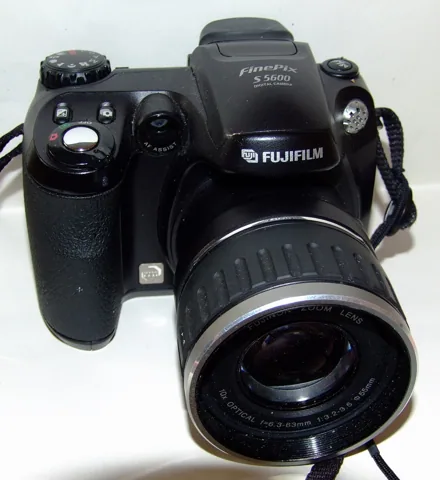 The S5600 from the front, with a neck strap attached. · Kirk · CC BY-SA 3.0 · Commons

A focus lamp that worked in the dark
Trusted Reviews called its AF illuminator one of the brightest it had seen, and said it focused in total darkness at well over the four-metre flash range; DigiCamReview also praised low-light focusing.117
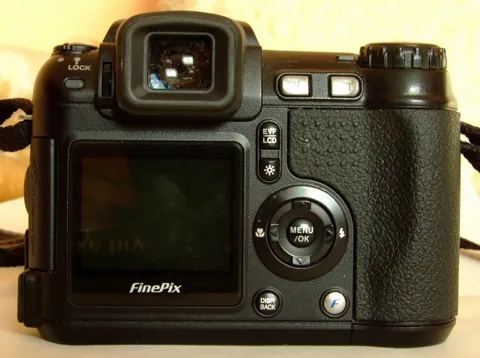 The camera back: viewfinder eyecup and 1.8-inch screen. · Kirk · CC BY-SA 3.0 · Commons

A finder with an eyepiece adjustment
DigiCamReview found the electronic viewfinder useful in bright sun, and the dioptre control let it use the viewfinder with glasses on.7
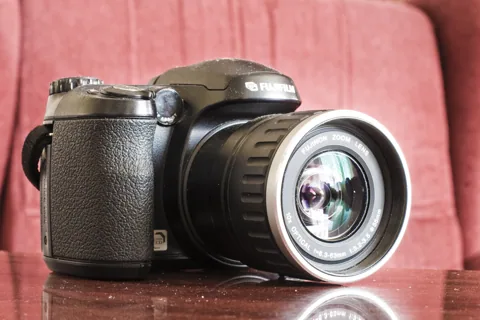 The S5600's lens barrel and grip, on a table. · Majod · Public domain · Commons

A lens that kept lines straight
Imaging Resource saw virtually no distortion at either end of the zoom (0.3% barrel at wide angle, 0.04% pincushion at full telephoto in its lab), PC Magazine called the lens nearly distortion-free, and Trusted Reviews found good corner sharpness, though Imaging Resource's lab saw slight softening in the right corners, strongest at telephoto.86119
How it drew the picture
Imaging Resource found picture quality very good, with colour more accurate than most consumer cameras but less saturated on bright hues.8 Trusted Reviews also found standard-mode colour under-saturated, added a cold automatic white balance in bright sun, and preferred the vivid mode.11 DigiCamReview, by contrast, called colour, saturation and contrast good and the pictures slightly soft,7 and PC Magazine liked the exposure, though some highlights blew out, and said colour saturation was just right.6 PC Magazine's tests gave an average resolution of 1,425 lines, above the average for a 5.1-megapixel camera in its words.6














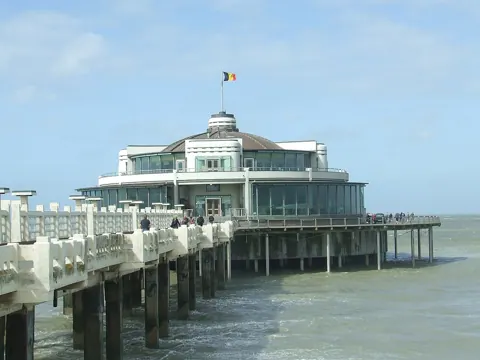



Photos taken with this camera, from Wikimedia Commons, credited under each picture. The first one was taken with a US-market S5200, which writes that name in its EXIF data instead of S5600.
Where it let you down
The fringes came up in most of the reviews. Trusted Reviews complained of massive purple fringing along the edge of bright highlights, DigiCamReview rated it higher than average and PC Magazine found strong fringing on leaves against a bright sky, though it called the fringing in its standard daylight shot "not much".1176 Imaging Resource's lab rated chromatic aberration moderately high, with 4 to 5 pixels of coloration either side of its test lines.9 Screen and finder were small: both are 115,000 pixels, Imaging Resource called the screen small, and Trusted Reviews found it reflective and hard to see in bright daylight and the finder's low resolution made focusing by hand difficult.10811 The zoom lever annoyed two reviewers: Trusted Reviews, who shoots with the left eye, had to squeeze a thumb between body and nose, and PC Magazine's thumb bumped the eye when zooming out with the viewfinder.116 They also disagreed about its feel: Trusted Reviews found the zoom jerky and counted 12 steps from end to end, where DigiCamReview counted about 19.117
The flash got mixed marks. Imaging Resource found it weak and not adjustable,8 PC Magazine liked its strength and coverage, though highlights blew out.6 PC Magazine also noted that it cannot zoom while recording video, and called xD cards a less common type; Fujifilm supplied a 16 MB one in the box, which DigiCamReview called too small.678 For the card, see our xD-Picture Card guide.
| Speed | Fujifilm | Imaging Resource table | Others |
|---|---|---|---|
| Start-up | 1.1 s1 | 1.6 s10 | DigiCamReview: just under 1 s with high-speed mode on; Trusted Reviews: just over 1 s, under 3 s if the flash must charge; PC Magazine: 2.5 s7116 |
| Shutter lag | 0.01 s1 | 0.62 s (full autofocus, wide), 0.55 s (tele), 0.015 s prefocused10 | DigiCamReview: about 0.1 s prefocused; Trusted Reviews and PC Magazine: virtually none7116 |
| Flash recycle | not stated | 6.0 s at full power10 | PC Magazine: 3.4 s, among the slowest in its class6 |
| Burst | not stated | 2.3 frames/s, 3 frames10 | DigiCamReview: roughly 2 fps, up to 3 shots at full size7 |
The table shows why the camera's speed was argued over: the 0.01 s lag is Fujifilm's claim for a prefocused shot, and Imaging Resource found full autofocus only average and prefocused shooting quick enough for fleeting action.28
What the reviewers said in 2005 and 2006
| Outlet | Date | Verdict |
|---|---|---|
| CNET | 16 Dec 2005 | 7.4 out of 10, very good: well designed and built, with very good image quality and performance; not for a pocket.5 |
| PC Magazine | 23 Dec 2005 | Light, portable, very good photos and video; held back by the small screen and the 10x zoom; as good as its superzoom rivals.6 |
| DigiCamReview | 23 Jan 2006 | Recommended: good value, quick, good battery life; purple fringing and noise reduction at ISO 800 and 1600 are the costs, and stabilised rivals deserve a look.7 |
| TechRadar | 1 Feb 2006 | A good all-rounder and terrific value under £300, though its only excellent point is the price.12 |
| Imaging Resource | 22 Mar 2006 | 4.0 out of 5 and a Dave's Pick: a benchmark for an affordable long zoom with enthusiast features; no stabilisation, weak flash.8 |
| Trusted Reviews | 16 May 2006 | Big-camera handling and excellent noise control for under £200, spoiled by purple fringes and a poorly placed zoom lever.11 |
The sources also disagree on a detail. TechRadar says Anti-Blur raises the ISO from 64 up to 1,600 and DigiCamReview says it uses high ISOs up to 1600, while Photo Review's report of the Australian launch says up to ISO 800.1274
The timeline
- 28 July 2005Fujifilm announces the camera in the UK as the S5600 Zoom and in the US as the S5200, at $399.95.12
- 23 September 2005Photo Review reports an October release in Australia at a recommended $549.4
- October 2005US availability; CNET lists 1 October and Imaging Resource's table 31 October.510
- 16 and 23 December 2005CNET and PC Magazine publish their reviews.56
- 23 January 2006DigiCamReview publishes its review.7
- 1 February 2006TechRadar publishes its review.12
- 22 March 2006Imaging Resource publishes its review.8
- 16 May 2006Trusted Reviews publishes its review.11
Should you buy one now?
Buy one if you want a big, grippy, AA-powered long zoom for daylight pictures and are happy to work around purple fringes and an old, small screen. It launched at $399.95;2 what it sells for now is a question for the sold listings, not for us. Before you bid, check these:
- The name. It is the FinePix S5200 in the US and the S5600 in Europe, so search both.1
- The batteries. It takes four AA cells; rechargeable NiMH sets are what Imaging Resource recommended,8 and Amazon ↗ has them.
- The card. It uses xD-Picture Cards,8 which PC Magazine called a less common type in 2005;6 see our xD-Picture Card guide and our memory card glossary entry.
- The finder and screen. Both are small and low in resolution,1011 so check that both work and that the screen shows an image.
- The lens. Check that it zooms smoothly through the whole range and sits straight in its barrel.
If you are wondering why cameras like this are being hunted down again, we tell that story once, in Pictures that never left the card.
See recent sold prices on eBay ↗Shop on eBay ↗Rechargeable AA batteries ↗
Sources
- PhotographyBLOG, Fujifilm FinePix S5600 Zoom announced, with the Fujifilm UK press release (28 Jul 2005)
- Imaging Resource, Fujifilm updates FinePix S5100 (S5200 announcement, by Mike Tomkins, 28 Jul 2005)
- Reviewed.com, Fujifilm Announces FinePix S5200 with 10x Zoom (28 Jul 2005)
- Photo Review (Australia), Fujifilm FinePix S5600 Out Next Month (23 Sep 2005)
- CNET, Fujifilm FinePix S5200 review by Shams Tarek (16 Dec 2005; archived copy, we read the first page only)
- PC Magazine, Fuji FinePix S5200 review by Terry Sullivan (23 Dec 2005; archived copy)
- DigiCamReview, Fujifilm FinePix S5600 / S5200 review (23 Jan 2006; archived copy)
- Imaging Resource, Fuji FinePix S5200 review by Mike Pasini (22 Mar 2006), overview and conclusion page
- Imaging Resource, Fuji FinePix S5200 review, lab pages: optics (distortion, chromatic aberration, corner sharpness), image quality (ISO and noise) and battery
- Imaging Resource, Fujifilm S5200 specification table (availability 31 Oct 2005, retail $399.95, timing results)
- Trusted Reviews, Fujifilm FinePix S5600 review by Cliff Smith (16 May 2006)
- TechRadar, FujiFilm FinePix S5600 review (published 1 Feb 2006 by tech.co.uk staff; signed Tim McCann via PhotoRadar)
Camera photos by Trio3D (CC BY-SA 4.0), Kirk (CC BY-SA 3.0) and Majod (public domain); other photographs are credited under each one, all via Wikimedia Commons. Links to eBay and Amazon are affiliate links.