Fujifilm FinePix A · announced January 2006
The Fujifilm FinePix A500: Super CCD for $179, and a screen you could not read in sunlight
Fujifilm's US release and Imaging Resource call it the FinePix A500; Fujifilm's UK press release names it the FinePix A500 Zoom.143
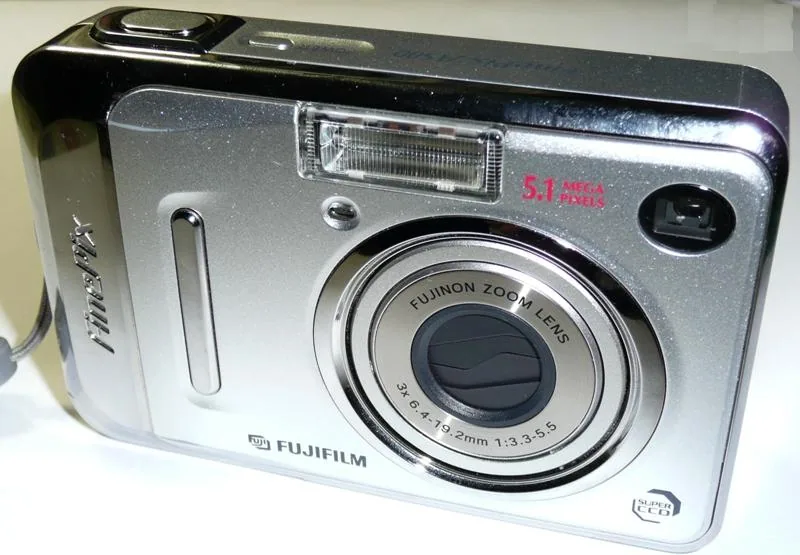
In January 2006 Fujifilm priced a 5.1-megapixel Super CCD, a 3x zoom and four scene modes at $179. Imaging Resource found rich colour, CNET found washed-out pictures, and both found it slow.
- Launched
- January 2006
- Sensor
- 5.1 MP CCD
- Lens
- 38–114 mm, 3×
- Card
- xD-Picture Card
- Battery
- 2 x AA (alkaline or NiMH)
Fujifilm FinePix A500 specs: sensor, lens, battery, memory card and cable
The Fujifilm FinePix A500 (also sold as the FinePix A500 Zoom) is a 5.1 MP CCD compact camera with a 38–114 mm (35 mm equivalent) 3× zoom lens, launched in January 2006 at $179. It uses xD-Picture Card and runs on 2 x AA (alkaline or NiMH) batteries. Sources
- Sensor
- CCD, 1/2.5", 5.1 MP source
- Lens
- 38–114 mm equivalent, 3× zoom source
- Memory card
- xD-Picture Card source
- Battery
- 2 x AA (alkaline or NiMH) source
- Also sold as
- FinePix A500 Zoom
- USB / A/V cable
- See our Fujifilm cable page
Meet the camera
Fuji Photo Film U.S.A. unveiled the A400 and A500 at the Consumer Electronics Show in Las Vegas on 4 January 2006, calling them the first of a new breed of entry-level Fujifilm cameras with Super CCD technology. It priced them at $149 and $179 and promised them for February.12 Imaging Resource's specification table gives the A500 an availability date of 1 February 2006.5 The A400 had four megapixels to the A500's five,1 and CNET called it "almost identically featured" and about AU$50 cheaper.8 Fujifilm's UK company announced the pair the same day as the A400 Zoom and A500 Zoom, due in UK shops in March.3
Imaging Resource found the body mostly polycarbonate, with a metallic-look finish that did a good job of passing for metal, and CNET called it solidly built, though Fujifilm had cut corners.48 Two of those corners were the video-out, mini-B USB and DC-in sockets, which sat open on the left side with no flap, and the plastic tripod socket, which was off-centre beside the battery-door latch, so the batteries could not be swapped on a tripod.4
- Lens
- 3x Fujinon, 38–114 mm equiv.; f/3.3 wide, f/5.5 at full zoom (aperture range listed as f/3.3 to f/8.5); 5.2x digital zoom (Imaging Resource's table says 3.6x, Fujifilm UK's figure for the A400)354
- ISO and shutter
- Auto, 100, 200 or 400. Fastest shutter 1/500 s (Imaging Resource's table) or 1/1,500 s (Fujifilm UK, its review text, CNET); slowest 2 s4583
- Video
- 320 × 240 or 160 × 120 at 10 fps, no sound4
Why this one was interesting
Super CCD, lowered
Fujifilm's own pitch was that Super CCD had until then been found only in professional and advanced amateur cameras.1 Imaging Resource's news story explains the HR version: its photodiodes sit in an octagonal array, which raises resolution in the horizontal and vertical directions, where it said the most detail in a picture usually lies.6 Fujifilm promised 8 by 10 inch prints "without a problem",1 and Imaging Resource's print test came close to bearing that out: sharp 8 by 10s from the A500, soft 11 by 14s, and ISO 400 files soft even at 8 by 10, though fine at 4 by 6.4
A viewfinder, still
The A500 kept an optical viewfinder, which Imaging Resource's news story called increasingly rare, and which let you switch the power-hungry screen off.6 In the lab review it earned its place. The reviewer, who generally prefers a screen, called this the first camera in a while that they used almost entirely by the viewfinder outdoors: the 77,000-pixel screen was slightly dark and fuzzy, and using it in sunlight was a nightmare.4 CNET also praised the finder's pair of notches that mark the safe area when you shoot close.8 The finder was tight, though: Imaging Resource measured about 80 percent frame coverage at wide angle and 82 at telephoto, against nearly 100 for the screen.4
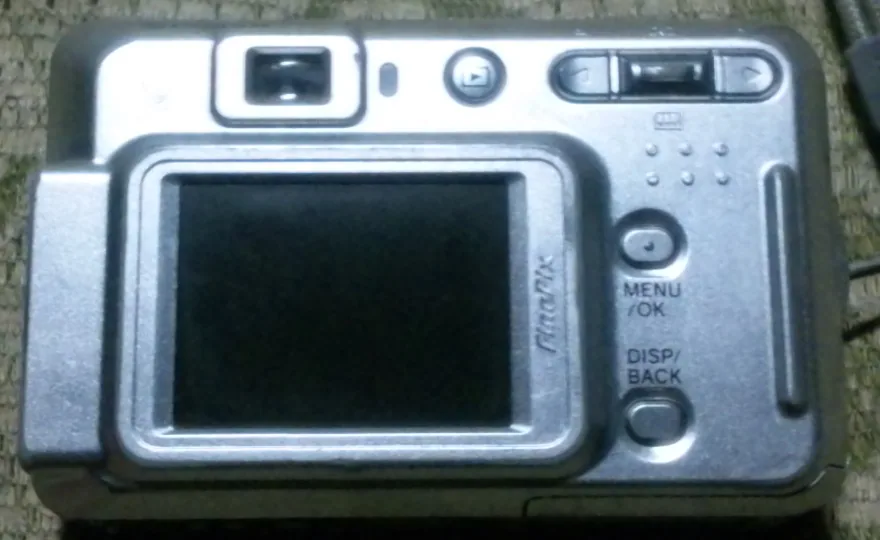
Four modes and a short menu
Besides Auto there were four scene modes: Portrait, Landscape, Sport and Night.8 Exposure stayed automatic everywhere. A "Manual" setting added exposure compensation of plus or minus 2 EV in third-of-a-stop steps and white-balance presets, but no control of aperture or shutter speed.48
What was lost
Imaging Resource found no continuous mode, and CNET said there was no burst capability beyond the 320 by 240, 10-frames-per-second silent movie.48 Showing a picture you had just taken took 4.6 seconds for a large, fine file.4 The controls were fiddly: the buttons were not touch-sensitive, so turning the camera on and off or switching to playback took firm pressure, and the zoom rocker sat between the left and right keys that switch Macro and Flash, which the reviewer kept hitting by mistake.4 There was no autofocus-assist lamp, said CNET and Imaging Resource's table.85 The clumsy menus (Imaging Resource) and the "tiny" screen (CNET) made the lists of cons too.48
How it drew the picture
Colour is where the two full reviews part company. Imaging Resource found rich, vibrant colour and balanced skin tones, a slight oversaturation of strong reds and blues, and slightly warm colour overall, with hue accuracy better than average.4 CNET called the colours accurate but unsaturated, and the results "washed-out".8 On exposure both reported bright results. Imaging Resource saw a tendency to blow out whites, particularly in skies, and in its harsh-light test the best exposure came at +0.7 EV.4 CNET found exposures "quite erratic" and frequently overbright, improved by dialling the compensation down.8
On detail, Imaging Resource's chart showed strong lines out to about 1,150 per picture height, with some oversharpening on high-contrast edges and noise reduction that flattened subtle detail in dark areas.4 CNET judged results at wide and middle focal lengths acceptable, JPEG compression artefacts a drag on sharpness, and the telephoto end "quite soft".8 Imaging Resource found the lens a little soft at wide angle but performing well overall.4 On noise, Imaging Resource found low to moderate levels at ISO 100 and 200 and more at 400, with detail blurred;4 CNET found it almost unnoticeable at 100 and "pronounced but acceptable" at 400.8



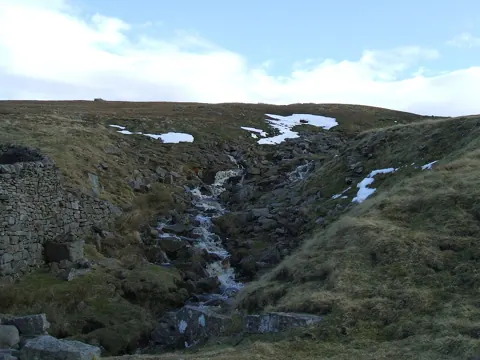
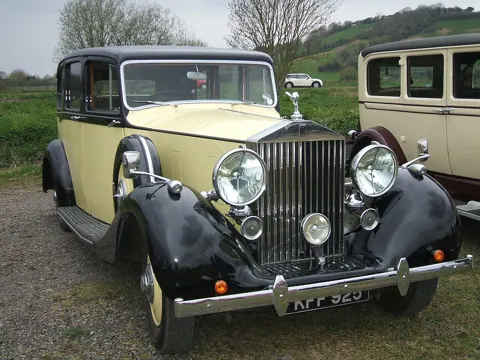


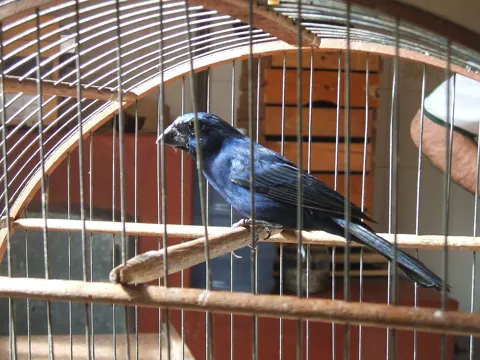

Photos taken with this camera, from Wikimedia Commons, credited under each picture. They may have been resized or edited by their authors.
The dark, and the flash
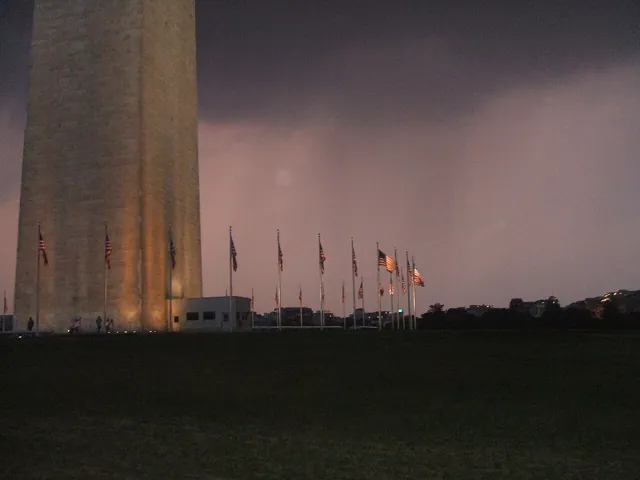
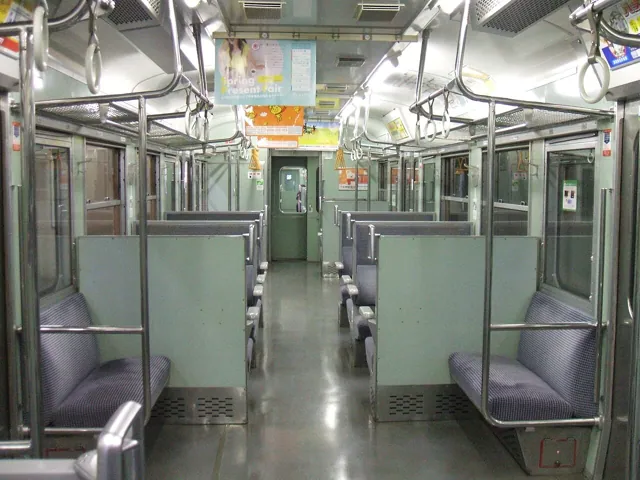
Imaging Resource's darkness test, with the camera on a tripod and a still subject, gave bright pictures down to about half a foot-candle at ISO 100 and a quarter of a foot-candle at ISO 400, the latter about a quarter as bright as average city street lighting at night. Colour was slightly reddish on automatic white balance and the shutter times ran long.4 The camera tops out at ISO 400, so these are the brightest-sensitivity pictures it could make:


Neither full review was kind to the flash. Imaging Resource's lab test found good exposures out to about 9 feet at wide angle, dim ones at telephoto even at 6 feet, no effect from exposure compensation, and slight underexposure at Fujifilm's own rated distances, though its user report still called the modest throw adequate for most low-light situations.4 CNET called the flash puny, good to only 3 metres at wide angle and 2.1 at telephoto, and found red-eye reduction had no effect on red pupils.8 The OcUK staff post, written by a seller, took a kinder view of indoor low light, calling it "very good" while saying its outdoor results were not up to a Canon IXUS or PowerShot.10
Like the look? See recent eBay sold listings for this camera ↗
Speed and battery, side by side
The two full reviews timed the camera differently, so read the columns as neighbours, not a ranking.
| Imaging Resource, 2006 | CNET, page dated Oct 2006 | |
|---|---|---|
| Power on to first shot | 2.8 s4 | just under 3 s8 |
| Shutter lag | 0.72 s at wide angle, 0.61 s at telephoto, with full autofocus; 0.012 s pre-focused. Its user report calls the wide-angle lag "slow for a camera in this class"; its performance section calls lag better than average4 | 0.8 s in high-contrast light, 0.9 s in low-contrast; "merely adequate"8 |
| Shot to shot | 2.24 s at large/fine4 | no more than once every 3 s8 |
| Battery | about 100 pictures on alkaline cells, about 400 on NiMH45 | no figure given8 |
Imaging Resource summed up the performance as ranging from pretty good to about average, and strongly recommended NiMH rechargeables and a spare set.4
On eBay right now
Live listings for this camera, supplied by eBay and updated automatically. We earn a commission if you buy through them.
The little wins


A battery discharge setting
The menu offered a Discharge command that drained rechargeable batteries fully before charging, with a warning not to use it on alkaline cells.4
ISO in every mode
Imaging Resource found ISO 100, 200 and 400 selectable in every shooting mode, Manual or not, a little creative control on a camera that offered almost none, at a time when, it noted, some rivals were taking that control away.4
What it cost
Fujifilm's US list price was $179, with the A400 at $149.1 On 19 June 2006 the company cut the A500 to $149 and the A400 to $129, drops Imaging Resource put at 17 and 13 percent.67 Imaging Resource said some online shops had it for as little as $119.4 CNET's page quotes AU$229,8 and a UK retailer's April 2007 post a one-week deal at 54.99 pounds plus VAT.10 None of that says what one costs now; sold listings do.
What the reviewers said
| Outlet | Date | Verdict |
|---|---|---|
| Imaging Resource | 25 Jul 2006 | Not a bad choice for a first-time buyer who wants good daylight pictures cheaply; anyone used to a better camera should pass. Not a Dave's Pick.4 |
| CNET (David Busch) | Page dated 11 Oct 2006 | Rated 5.6. Basic and sluggish, with mediocre pictures; the reviewer would rather you bought a Canon PowerShot A530.8 |
| OcUK staff post | 6 Apr 2007 | Great value for a simple point-and-shoot; indoors very good, outdoors behind the Canons. Written by the seller.10 |
Only Imaging Resource and CNET are full reviews, so treat the comparisons on this page as two voices, not a consensus. The CNET page is dated 11 October 2006, but DVHardware posted a blurb linking a CNET review of the A500, with the same wording about the ports and the screen, on 21 May 2006, so the review itself may be older than the date printed.98 Imaging Resource's page names no author.4
The timeline
- 4 January 2006Fujifilm unveils the A400 and A500 at CES; its UK arm announces the A400 and A500 Zoom.13
- 1 February 2006Availability date in Imaging Resource's table; Fujifilm had promised February.51
- 21 May 2006DVHardware links a CNET review.9
- 19 June 2006The A500's price falls from $179 to $149.6
- 25 July 2006Imaging Resource publishes its review.4
- 6 April 2007OcUK's staff post advertises it at 54.99 pounds plus VAT.10
Should you buy one now?
Buy one if you want a plain, light 2006 snapshot camera that runs on AA cells and gives acceptable daylight pictures by both full reviews' account, and you can live with a slow shutter and a dull screen. Skip it if you mostly shoot action or indoors with flash, where both full reviews found the camera slow and the flash weak. Before you bid, check these:
- The name. Search FinePix A500, and A500 Zoom, the name in Fujifilm's UK release. The A400 is the 4-megapixel sibling.13
- The batteries. It takes two AAs; Imaging Resource recommended NiMH.4 Rechargeables on Amazon ↗ Our AA-battery guide covers the trade-off.
- The card. xD-Picture Card only, with 12 MB inside; in 2006 Imaging Resource called 128 MB a bare minimum.4 See our xD-Picture Card page and memory card guide.
- The buttons. Imaging Resource found the buttons needed firm presses and the power button hard to get a response from, so test power and playback.4
- The open sockets. Look into the unprotected left-hand ports for lint and debris, which Imaging Resource warned about.4
For its predecessor, see our FinePix A340 review; for Fujifilm's 2005 long zoom, our FinePix S5200. And if you are wondering why cameras like this are being hunted down again, we tell that story once, in Pictures that never left the card.
See recent sold prices on eBay ↗Shop on eBay ↗AA NiMH batteries ↗
Sources
- Fuji Photo Film U.S.A., press release 'Fujifilm's A-Series digital cameras now feature Super CCD (A400 & A500)', CES, 4 Jan 2006 (reprinted by Digital Dingus)
- Fuji Photo Film U.S.A., press release 'Fujifilm announces four new FinePix digital cameras on the eve of the 2006 International Consumer Electronics Show', 4 Jan 2006 (WebWire)
- Fujifilm UK press release 'Fujifilm launches FinePix A400 Zoom and FinePix A500 Zoom', 4 Jan 2006, with the A500 Zoom specification table (reprinted by PhotographyBLOG, Mark Goldstein)
- Imaging Resource, Fujifilm FinePix A500 review (page metadata: published 25 Jul 2006; no author named; user report plus lab tests)
- Imaging Resource, Fujifilm A500 specification table (availability 1 Feb 2006, retail price $179)
- Imaging Resource news, Fuji cuts FinePix A400, A500 pricing (Mike Tomkins, 19 Jun 2006)
- Reviewed, Fujifilm reduces price of FinePix A400 and A500 (Karen M. Cheung, 20 Jun 2006)
- CNET, Fujifilm FinePix A500 review by David Busch (page dated 11 Oct 2006; rating shown 5.6)
- DVHardware, Fujifilm FinePix A500 Review (posted 21 May 2006; a blurb that links to CNET's review)
- Overclockers UK forum, 'OcUK Deal & Review - FujiFilm FinePix A500' (6 Apr 2007; a post by OcUK staff, who were selling the camera)
Photographs are credited under each one, all via Wikimedia Commons. Links to eBay and Amazon are affiliate links.