Fujifilm FinePix F · announced February 2005
The Fujifilm FinePix F10: the pocket camera that made ISO 1600 respectable
We found no other regional name for it. DPReview and the Register title their pages "F10 Zoom", which looks like a descriptive tag rather than a different model.25
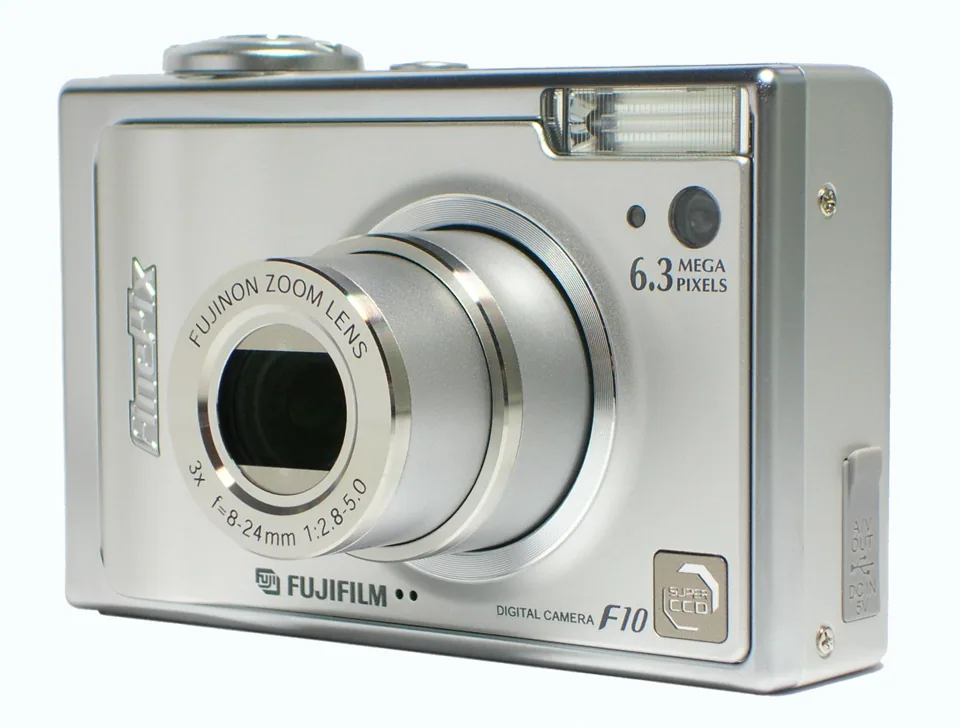

In February 2005 Fujifilm put a new Super CCD sensor and an ISO 1600 setting into a metal compact with a battery rated at 500 shots. Reviewers praised the noise, the speed and the build, then listed what it left out: manual control, a decent menu and a viewfinder.
- Launched
- February 2005
- Sensor
- 6.3 MP CCD
- Lens
- 36–108 mm, 3×
- Card
- xD-Picture Card
- Battery
- NP-120
Fujifilm FinePix F10 specs: sensor, lens, battery, memory card and cable
The Fujifilm FinePix F10 came out in February 2005 at $499 as a 6.3 MP CCD compact with a 36–108 mm (35 mm equivalent) 3× zoom lens. It uses xD-Picture Card and runs on the NP-120 battery. Sources
- Sensor
- CCD, 1/1.7", 6.3 MP source
- Lens
- 36–108 mm equivalent, 3× zoom source
- Memory card
- xD-Picture Card source
- Battery
- NP-120 source
- USB / A/V cable
- See our Fujifilm cable page
Meet the camera
Fujifilm announced the F10 in the United States on 8 February 2005, with a price of $499 and shipping planned for April.1 The announcement describes a 6.3-megapixel camera (6.63 million total pixels on the chip) with a Fujinon 3x zoom equal to 36 to 108 millimetres, ISO 80 to 1600 and a 2.5-inch screen.1 By the time DPReview published its review in May, the camera had a street price of about $325 in the US and £260 in the UK.2 The Register's review also gave £260.5
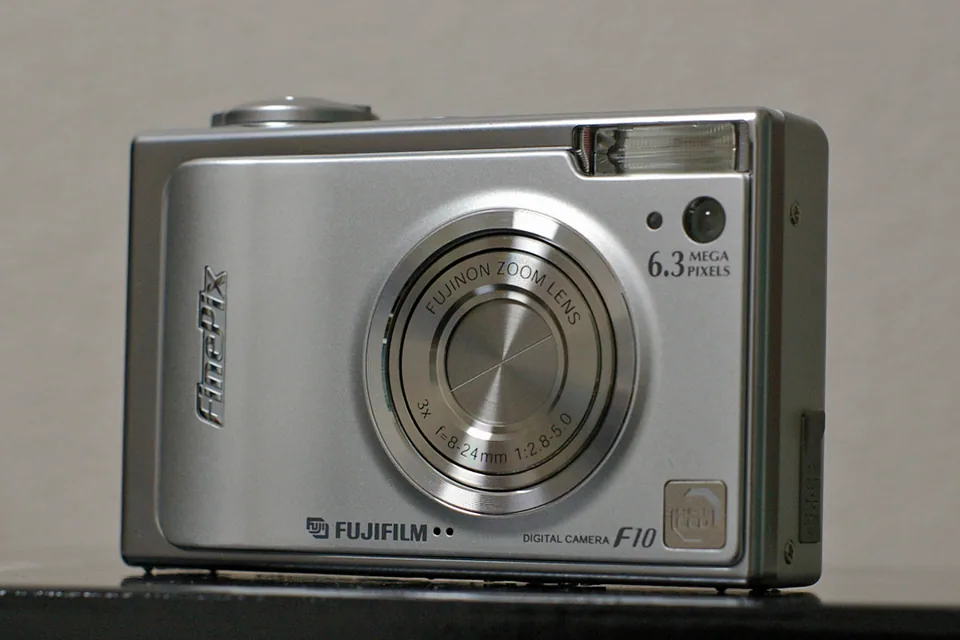
The body is metal. The sources disagree on its weight: the specification table on Imaging Resource's announcement lists 155.9 grams, while DPReview said only that it weighs around 200 grams.12 Neocamera called the case solid and comfortable to hold, with a thumb depression on the back, and the Register called it all-metal, svelte and very well made, though conservative in design.65
Why this one was interesting
A sensor that stopped faking its pixels
DPReview described the F10 as the first of a new generation of Fujifilm cameras built on the Super CCD HR sensor, with six million output pixels that, unlike earlier models, were not interpolated.2 A new Real Photo Processor made the ISO 80 to 1600 range possible.2 The review's conclusion went further, calling the camera "something of a revolution" and probably the first compact to show what Super CCD could do for resolution, sensitivity and noise.4
Low noise you could measure
DPReview's noise figures (a standard deviation, so lower is cleaner) read 2.0 at ISO 80, 2.4 at ISO 400, 2.9 at ISO 800 and 3.1 at ISO 1600. Canon's seven-megapixel SD500 measured 3.8 at ISO 400.3 The reviewer said the indicated ISO values were close to correct against a reference SLR, and that ISO 1600 gave results comparable to many five-megapixel compacts at ISO 400.3 The Register said much the same: noise at ISO 1600 was comparable to ISO 400 on other cameras.5
Quick for its day
DPReview timed it at about one second from power-off to ready to shoot, and under 0.05 seconds from half to full shutter press, against Fujifilm's quoted 0.01 seconds. Half-pressing took about 0.5 seconds at wide angle.2 The same review put the zoom travel from wide to tele at 0.8 seconds, and the Register reported up to 500 shots on a charge in its own tests.25 Fujifilm's own figures were a 1.3-second boot and about 1/100 second of lag after focus lock.1
The F10 also had a sequel, the F11, which added aperture and shutter priority;7 our F11 review covers it, and the F30, F31fd and F100fd continue the line.
What it left out
All three full reviews listed missing control. DPReview's cons were no real manual controls, limited scene modes, a fiddly menu, some common functions buried in menus, a three-shot limit in continuous mode, a screen hard to see in bright light, and a separate terminal adaptor needed to charge the battery or transfer pictures.4 The Register listed a lack of external manual controls, a menu that is fiddly at first and no optical viewfinder.5 Neocamera called the menu system the weakest point, and said exposure compensation could be selected in situations where it did nothing, without being greyed out.6 It also described a charging setup built from a chain of adapters and a cord, a battery door without a latch, and xD cards it called expensive.6
The dark: strong, and with a limit
The reviewers agreed the F10 was good in low light, then disagreed about how good. Neocamera said noise was low at every setting from ISO 80 to 1600 at full resolution, and that it held its own against some low-end SLRs.6 DPReview was more careful: noise did not rise noticeably until ISO 800, which it called still fairly sharp and detailed, while ISO 1600 was clearly noisy, with heavy noise reduction and some loss of fine detail. It suspected the test shot's F8 aperture caused some diffraction softening.3 The Register called noise "superbly controlled" at the top setting.5
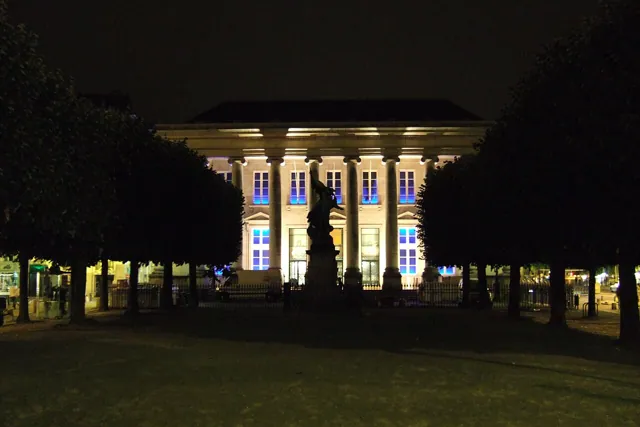



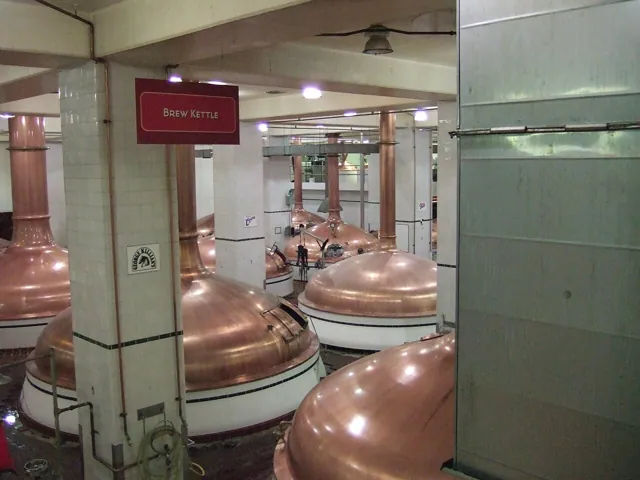

Real photographs taken with this camera. The sensitivity shown is recorded in each file's own EXIF data; the pictures may have been resized and edited by their authors.
Like that look? See recent eBay sold listings for this camera ↗
The flash was less of a strength. DPReview timed about 3.3 seconds between flash shots, found red-eye in many shots (no worse than rivals) and gave a range of about 6.5 metres at wide angle and 4 metres at tele with auto ISO up to 800.2 The Register also said the flash recycled very slowly.5
On eBay right now
Live listings for this camera, supplied by eBay and updated automatically. We earn a commission if you buy through them.
The little wins
Focus that mostly just worked
DPReview found the autofocus fast and reliable, hunting mainly in dim light at the long end, and listed an AF illuminator among the pros.24 High Speed mode sped focusing up but raised the minimum focus distance from 60 to 100 centimetres.2
A screen that sped up
Half-pressing the shutter roughly doubled the screen's frame rate, DPReview noted, which made framing smoother.2
How it drew the picture
DPReview found high default contrast, which clipped skies and shadows in some scenes, and sharpening halos around hard edges that could not be adjusted in the camera. Some outdoor pictures looked slightly washed out, and a -0.3 EV setting helped.3 Purple fringing showed mostly at the wide end and in badly overexposed areas, in only a handful of about 800 test shots.3 The Register noted slight pixel fringing at contrast edges, and Neocamera called the colour, edge-to-edge sharpness and low noise outstanding.56 DPReview's automatic white balance was excellent outdoors, average under fluorescent light and poor under incandescent bulbs: errors of 15.8 per cent in red and -19.8 per cent in blue.3








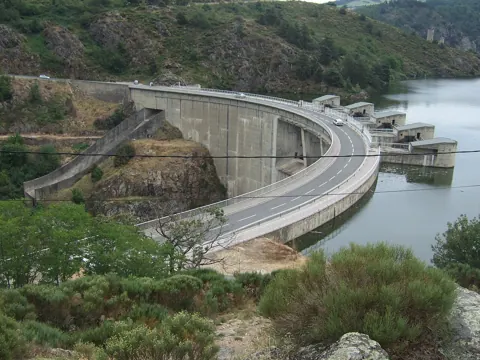







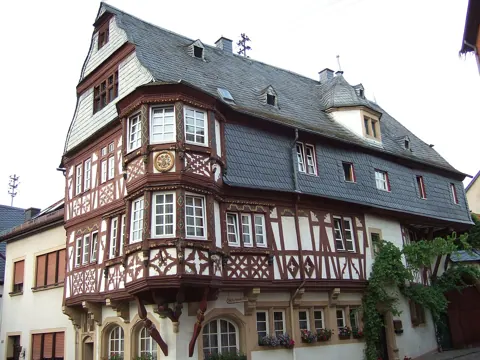

Photos taken with this camera, from Wikimedia Commons, credited under each picture.
Where it let you down
The burst mode shot three frames at about 2.5 frames per second and then made DPReview wait 4.4 to 6.5 seconds, depending on file size. The 40-frame mode ran between 0.6 and 1.1 frames per second.2 Shot to shot took 1.7 seconds with no flash and 3.3 with it.2 The macro mode focused as close as about 7.5 centimetres at wide angle, but only 30 centimetres at the tele end.2 The 2.5-inch screen, at 115,000 pixels, was less sharp than DPReview wanted, and Neocamera warned that a thumb can easily press the "F" button by accident.26 Neocamera also thought the zoom steps were too few.6
What the reviewers said
| Outlet | Date | Verdict |
|---|---|---|
| DPReview | 9 May 2005 | No score or award on the pages we read. Excellent resolution, low noise, a usable ISO 1600 and class-leading battery life; no real manual controls and a fiddly menu. It would be "highly recommended" with the F810's controls.4 |
| The Register (Pocket-lint) | 12 Jul 2005 | 90%, £260. Called it "quite simply excellent"; faulted the lack of external manual controls, the design and the missing viewfinder.5 |
| Neocamera | Page dated 3 May 2008 | No score. Calls it an excellent ultra-compact whose pictures outweigh its ergonomic flaws.6 |
We read the Neocamera page as written; it lists the burst at 2.2 frames per second in its highlights and 3 in its text. The Imaging Resource spec table says 2.2 for three frames, DPReview measured about 2.5.612
The timeline
- 8 February 2005Fujifilm announces the F10 in the US at $499, shipping planned for April.1
- 9 May 2005DPReview publishes its review, with the camera at about $325 in the US.42
- 12 July 2005The Register runs its review at £260.5
- 3 May 2008The date shown on Neocamera's review page.6
Should you buy one now?
Buy one if you want a metal, fast-starting 2005 CCD compact that takes clean pictures in dim rooms, and you do not mind choosing everything from a menu. It launched at $499;1 what it sells for now is a question for the sold listings, not for us. Before you bid, check these:
- The name. Make sure the model is the F10 and not the F11, which Imaging Resource calls closely based on the F10 but with shutter- and aperture-priority modes.7
- The charger kit. DPReview said a separate terminal adaptor is needed to charge the battery, transfer pictures and output video, so check it is included.42 The battery is an NP-120; a fresh one is on Amazon ↗.1
- The card. It takes xD-Picture Cards only;1 see our memory card guide.
- The screen. It is the only viewfinder, so check it for scratches and dead pixels.4
- The lens. Check that it extends and retracts cleanly and the glass is free of scratches.
If you are wondering why cameras like this are being hunted down again, we tell that story once, in Pictures that never left the card.
See recent sold prices on eBay ↗Shop on eBay ↗NP-120 battery ↗
Sources
- Imaging Resource, Fujifilm announces FinePix F10 (8 Feb 2005; press release and specification table, manufacturer data, not lab-tested)
- DPReview, Fujifilm FinePix F10 review by Simon Joinson (9 May 2005; introduction, design, timing, flash and macro sections)
- DPReview, F10 review, noise and image quality pages (same review)
- DPReview, F10 review, conclusion page (pros, cons and verdict; no score or award shown)
- The Register, Fuji FinePix F10 Zoom review by Doug Harman of Pocket-lint (12 Jul 2005; rated 90%, price GBP 260)
- Neocamera, Fujifilm FinePix F10 review (page dated 3 May 2008; no author named; no score, its conclusion calls the camera excellent)
- Imaging Resource, Fujifilm FinePix F11 Zoom overview (says the F11 is closely based on the F10 Zoom and adds shutter- and aperture-priority modes)
Photographs are credited under each one, all via Wikimedia Commons. Links to eBay and Amazon are affiliate links.