Canon PowerShot SX · announced August 2009
The Canon PowerShot SX120 IS: a $250 AA-powered 10x superzoom that barely changed from the year before
We found no other regional name: Canon's museum page lists PowerShot SX120 IS for Japan, the Americas and Europe, Asia and Oceania.1
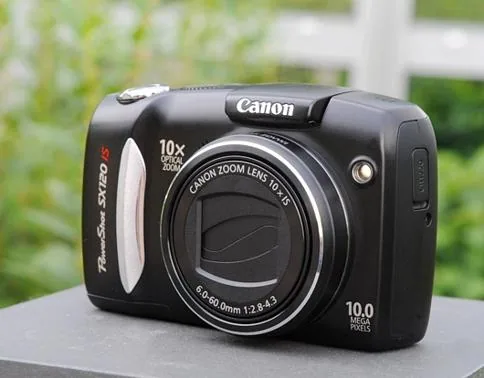

Canon's 2009 budget superzoom kept the lens and the body of the year before, added a megapixel and a new processor, and still shot only VGA video. Four reviewers called it good value, then disagreed on how fast it focused, how much its wide end bent straight lines and how long two AA cells lasted.
- Launched
- August 2009
- Launch price
- $249.99 · £229 · €2695
- Sensor
- 10 MP CCD
- Lens
- 36–360 mm, 10×
- Card
- SDHC, SD, MultiMediaCard
- Battery
- AA
Canon PowerShot SX120 IS specs: sensor, lens, battery, memory card and cable
Launched in August 2009 at $249.99, the Canon PowerShot SX120 IS is a 10 MP CCD compact with a 36–360 mm (35 mm equivalent) 10× zoom lens. Inside: it runs on AA batteries. Sources
- Sensor
- CCD, 1/2.5", 10 MP source
- Lens
- 36–360 mm equivalent, 10× zoom source
- Memory card
- SDHC, SD, MultiMediaCard source
- Battery
- AA source
- USB / A/V cable
- IFC-400PCU, AVC-DC400 Confirmed · all Canon cables
Meet the camera
PhotographyBLOG called it chunky next to the average point-and-shoot but smaller than the typical superzoom or bridge camera, and said the mainly plastic build is disguised by a matt black finish.6 Canon lists the body at 110.6 by 70.4 by 44.7 millimetres and about 245 grams, body only;1 Imaging Resource listed 302 grams with batteries and card, said it would not fit comfortably in a shirt pocket and then got it into one anyway, while Reviewed warned it could ruin the line of a good suit.79 It came in black, with two alkaline AA batteries and a 128 MB SD card in the box.67
Canon's UK press release is dated 19 August 2009 and priced it at £229 and €269; PhotographyBLOG gave the US price as $249.99.5 It was the successor to the SX110 IS of September 2008 and the third camera in a line that began with the SX100 IS in October 2007.123 Our own PowerShot SX110 IS review covers the model before it.
Why this one was interesting
A family that moved one notch a year
Photo Review described the SX120 IS as the third in a series of affordable 10x zoom cameras with full manual control that began in 2007, each update bringing a small resolution bump and minor changes to the body.8 Canon's museum pages bear that out: 8.0 megapixels and a 172,000-dot screen in the SX100 IS, 9.0 megapixels and a 230,000-dot screen in the SX110 IS, 10.0 megapixels here, then 12.1 megapixels and a 28–336 mm lens in the PowerShot SX130 IS of August 2010.3214
A new processor and a few small features
Imaging Resource said the most significant change from the SX110 IS was the processor: DIGIC 4 replaced an older generation, and the reviewer expected it to help noise, autofocus and exposure.7 PhotographyBLOG saw slightly quicker operation but thought current SX110 owners would be hard-pressed to notice it.6 The visible additions were Smart Auto, which picks from 18 scene types, a Face Detection system that PhotographyBLOG said can recognise up to 35 faces, and a Face Self-Timer that waits for a new face to enter the frame before it fires.6 Canon's release also named i-Contrast, which it said prevents highlight blowout while keeping shadow detail.5
Manual modes at the price
Imaging Resource's user report counted the manual modes among the camera's best points, since they are often neglected on PowerShots, and called the SX120 IS a great deal that does not compromise on quality.7 Photo Review thought the mix ideal for families: program, shutter, aperture and manual modes for the photographer, Easy mode and scene presets that pick the settings for everyone else.8
What stayed the same, and what went missing
PhotographyBLOG's conclusion was blunt: virtually identical to its year-old predecessor, not a worthwhile upgrade for SX110 owners, but still an affordable, well-specified superzoom.6 The lens is the same 6–60 mm f/2.8–4.3 zoom, the screen has the same 230,000 dots, and Canon gives the two cameras the same dimensions and weight.8621 The visible differences were small. The Print/Share button beside the screen went away;678 the front grip gained a larger silver accent;78 and Photo Review noted that the Superfine compression level of the SX110 IS was dropped, leaving Fine and Normal.8 There is still no viewfinder, no HD video and no stereo sound.6
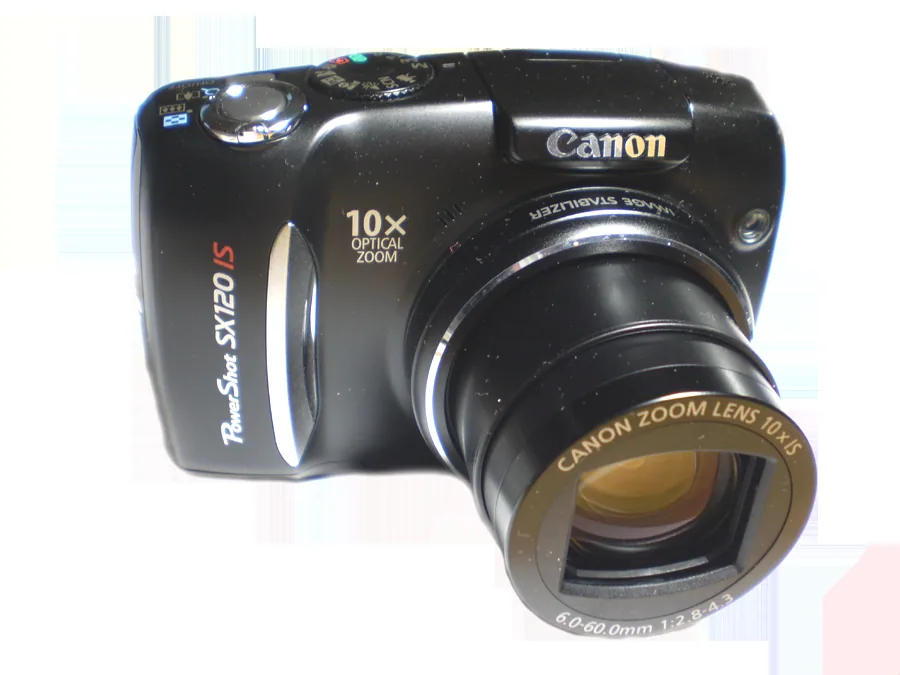
Whether the sensor itself grew smaller is something we cannot settle. Canon's museum pages list a 1/2.5-inch type sensor for the SX120 IS and a 1/2.3-inch type for the SX110 IS, both with about 10.3 million total pixels;12 Photo Review said the chip size was unchanged, and Imaging Resource called the chips identical in one paragraph and gave two different sizes in another.87
The dark: its weak point
All four found noise growing with ISO and put the limit in different places. PhotographyBLOG saw some noise, blurred detail and slight desaturation at ISO 400, getting steadily worse through ISO 800 to 1600.6 Imaging Resource's lab said colour noise was well controlled at every ISO while luminance noise began to dominate from ISO 400 up, and its ISO 800 prints were a little too soft at 8 x 10 inches and better at 5 x 7.7 Photo Review measured resolution that stayed relatively high up to ISO 400 and dropped sharply at ISO 800, with blotchy, unsharp results at ISO 1600, and listed being happy to stay below ISO 400 and use a tripod in dim light among the reasons to buy.8 Reviewed measured noise as generally low but noticeable at higher settings, and lower than the Panasonic ZS3's at high ISO.9
The stabiliser bought some slack: Photo Review shot handheld down to 1/10 second at wide and mid focal lengths in dim light, though longer settings blurred at 1/60.8 Imaging Resource found that in a dim test the ISO 3200 scene mode held detail and colour at about 1/30 second, while Program mode fell to 1/9 or 1/7 second and gave unsharp shots.7




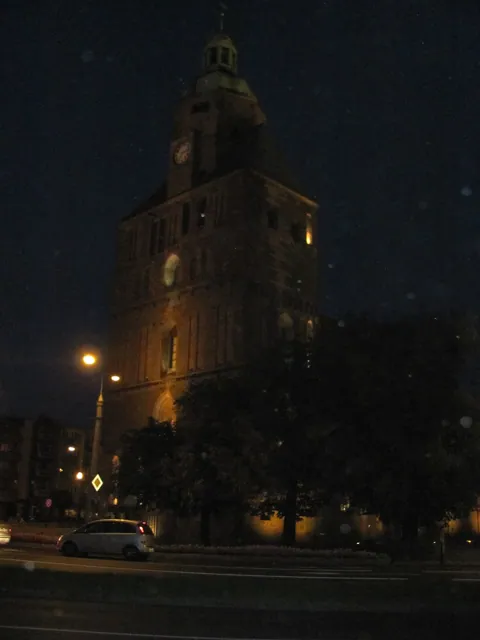



Real photographs taken with this camera. The sensitivity and exposure time shown are recorded in each file's own EXIF data, and the camera's own EXIF model name matches.
Curious what one sells for? See recent eBay sold listings for this camera ↗
On eBay right now
Live listings for this camera, supplied by eBay and updated automatically. We earn a commission if you buy through them.
The little wins
Macro at one centimetre
PhotographyBLOG called macro a stand-out highlight, focusing from 1 centimetre away, though it saw a lot of distortion and shadowing at that range.6 Imaging Resource measured a minimum coverage of 28 by 21 millimetres and found the flash made the close exposure darker because the lens blocks it.7
Colour that mostly behaves
Imaging Resource found good overall colour with moderate oversaturation in strong reds and blues, and warm skin tones;7 Photo Review also found generally good colour accuracy with slightly lifted reds and blues.8 Reviewed, with the My Colors setting off, found most colours accurate but yellows and deep reds a little muted.9
Prints bigger than you would guess
Imaging Resource judged ISO 80 and 100 pictures good at 13 by 19 inches, a touch soft up close, and ISO 1600 usable at 5 by 7.7
A camera that runs on ordinary AAs
Canon lists alkaline and NiMH cells, and rates the camera at 130 shots on alkaline and 370 on NiMH.16 Imaging Resource said single-use lithium cells give the most power and NiMH rechargeables come close, and recommended NiMH.7 See our guide to digicams that run on AA batteries.
How it drew the picture
PhotographyBLOG found images of good quality that were a little soft at the default sharpening, with limited purple fringing, and said the stabiliser worked very well handheld at the long end and in low light.6 Imaging Resource's lab was harder on the lens: moderately strong blurring in the corners at wide angle, softness overall at full telephoto, moderate chromatic aberration at the wide end and much stronger fringing at the long end.7 Reviewed found sharp images that went soft at the telephoto end and fringing at mid and long zoom.9 Photo Review said blown highlights stayed common in contrasty light and auto white balance struggled under incandescent bulbs;8 Imaging Resource found auto handled them quite well and only the Incandescent preset went very red.7


















Photos taken with this camera, from Wikimedia Commons, credited under each picture. The Commons category held about 17,800 files on 27 October 2026; in a random sample of 900 files, about one in five came from a single uploader, so we chose nine photographers.
Where it let you down
Speed is where the reviews part ways. PhotographyBLOG said the camera took a couple of seconds to start and called focus and exposure lightning fast, with no noticeable shutter delay.6 Imaging Resource measured full-autofocus shutter lag of 0.80 second at wide angle and 0.93 second at telephoto, a cycle time of 2.07 seconds, and a flash that took 12 seconds to recycle after a full-power shot, and listed the slow zoom among its cons.7 Photo Review measured 1.8 seconds to power up, about 0.9 second of capture lag, under two seconds between shots without flash and 8.1 with it, and a flash that re-primed in just over five seconds.8 Reviewed measured shot-to-shot speed at 0.76 frames a second.9
The body drew complaints too. Reviewed said the ridge your fingers wrap round is too small to hold tightly, and Photo Review called the grip not particularly secure; Imaging Resource warned the smooth plastic might feel slippery but never had it slip.987 PhotographyBLOG found the four-way pad fiddly.6 The flash must be raised by hand, and Reviewed noted it will not rise on its own even in the dark.9
Video is VGA only, at 30 frames a second with mono sound, and only the 4x digital zoom works while recording.69
What the reviewers said in 2009
| Outlet | Date | Verdict |
|---|---|---|
| Reviewed | 8 Oct 2009 | No overall score on the copy we read. It beat the Kodak EasyShare Z950 and Nikon Coolpix L100 in most still tests; against the Panasonic ZS3 stills were an even race, and Reviewed would pick the ZS3, which shoots HD video and is slimmer, if you could afford the extra.9 |
| PhotographyBLOG | 19 Oct 2009 | Design 4, features 4, ease of use 4.5, image quality 4 and value 5 out of 5. Called it cheap and more than cheerful; noisy above ISO 400, no HD video, not a worthwhile upgrade for SX110 owners.6 |
| Imaging Resource | 12/09/09 on the page | A Dave's Pick. The user report named it the one camera they would take to a desert island; cons were the slow zoom, a 36 mm wide end, VGA-only video, soft corners and strong fringing at the long end.7 |
| Photo Review | Undated page | A score of 8.5. An affordable 10x zoom with useful controls for family snapshooters; buy it if you will keep below ISO 400, avoid it if you want HD video or raw files.8 |
Where sources disagree: the reviews differ on how fast it focuses and how quickly the flash recycles (see above), and on wide-angle barrel distortion, which Imaging Resource measured at about 0.8 percent and Reviewed at about 2.7 percent.79 On batteries, PhotographyBLOG said the camera eats alkalines in a couple of afternoons, while Photo Review's supplied alkalines still had power after 145 shots, just above Canon's 130-shot rating.681 PhotographyBLOG wrote that it was available from early August 2009, whereas Imaging Resource listed 15 September 2009 and said September.57
The timeline
- September 2008Canon markets the SX110 IS.2
- 19 August 2009Canon announces the SX120 IS in the UK and Ireland.5
- 15 September 2009Date Imaging Resource lists for availability.7
- August 2010Canon markets the SX130 IS, with a 28–336 mm lens and 12.1 megapixels.4
Should you buy one now?
Buy one if you want a cheap 10x superzoom with proper manual modes, a CCD sensor and AA power, and you will shoot mostly in daylight, below ISO 400. Skip it if you want HD video or anything wider than 36 mm. It launched at $249.99;5 what it sells for now is a question for the sold listings. Before you bid, check these:
- The name. Search the Canon PowerShot SX120 IS; the museum page shows no other name.1 Do not confuse it with the 9-megapixel SX110 IS or the 12x SX130 IS.24
- The batteries and their door. It takes two AA cells, and Photo Review's unit had a stiff battery and card door, so open and close it.8 Canon's accessory list names a CBK4-300 charger kit and NB4-300 NiMH cells, and the museum calls the NiMH pack NB-3AH;61 NiMH cells are on Amazon ↗.
- The card. Canon lists SD, SDHC, MMC and MMCplus types and names no SDXC;1 Reviewed noted it has no internal memory to fall back on.9 See our memory card guide and glossary.
- The cable. Imaging Resource's box list names the IFC-400PCU interface cable and AVC-DC400 AV cable, and Canon describes a dedicated connector that is mini-B compatible;71 see our IFC-400PCU page.
- The flash. It must be raised by hand, so check that it rises and stays up.9
- The lens. Check that it extends and retracts cleanly and that the glass is free of scratches.
If you are wondering why cameras like this are being hunted down again, we tell that story once, in Pictures that never left the card. For a rival of the day, see our Panasonic Lumix DMC-ZS3 review.
See recent sold prices on eBay ↗Shop on eBay ↗AA NiMH batteries ↗
Sources
- Canon Camera Museum, PowerShot SX120 IS (marketed August 2009; the same name for Japan, the Americas and Europe, Asia and Oceania; specification page)
- Canon Camera Museum, PowerShot SX110 IS (marketed September 2008; 1/2.3-inch type sensor, 110.6 x 70.4 x 44.7 mm, about 245 g)
- Canon Camera Museum, PowerShot SX100 IS (marketed October 2007; 8.0 megapixels, 2.5-inch screen of about 172,000 dots)
- Canon Camera Museum, PowerShot SX130 IS (marketed August 2010; 12.1 megapixels, 28-336 mm equivalent, two AA batteries)
- PhotographyBLOG, Canon PowerShot SX120 IS announcement by Zoltan Arva-Toth (19 Aug 2009), with Canon UK's press release: GBP 229 / EUR 269, US price $249.99
- PhotographyBLOG, Canon PowerShot SX120 IS review by Mark Goldstein (19 Oct 2009), including Canon's specification list
- Imaging Resource, Canon SX120 IS review by Mike Pasini and Stephanie Boozer (review date printed 12/09/09; lab tests and user report)
- Photo Review (Australia), Canon PowerShot SX120 IS review (undated page; lab tests)
- Reviewed, Canon PowerShot SX120 IS Digital Camera Review by Richard Baguley (published 8 Oct 2009 per the page's own metadata; lab tests and comparisons)
Camera photos by Nikers and Kulmalukko (both CC BY-SA 3.0); other photographs are credited under each one, all via Wikimedia Commons. Links to eBay and Amazon are affiliate links.