Canon PowerShot SX · on sale September 2008
The Canon PowerShot SX110 IS: a stabilised 10x zoom on two AA cells, at a price reviewers liked
We found no other regional name for it; Canon's museum gives the same name, PowerShot SX110 IS, for Japan, the Americas and Europe, Asia and Oceania.1
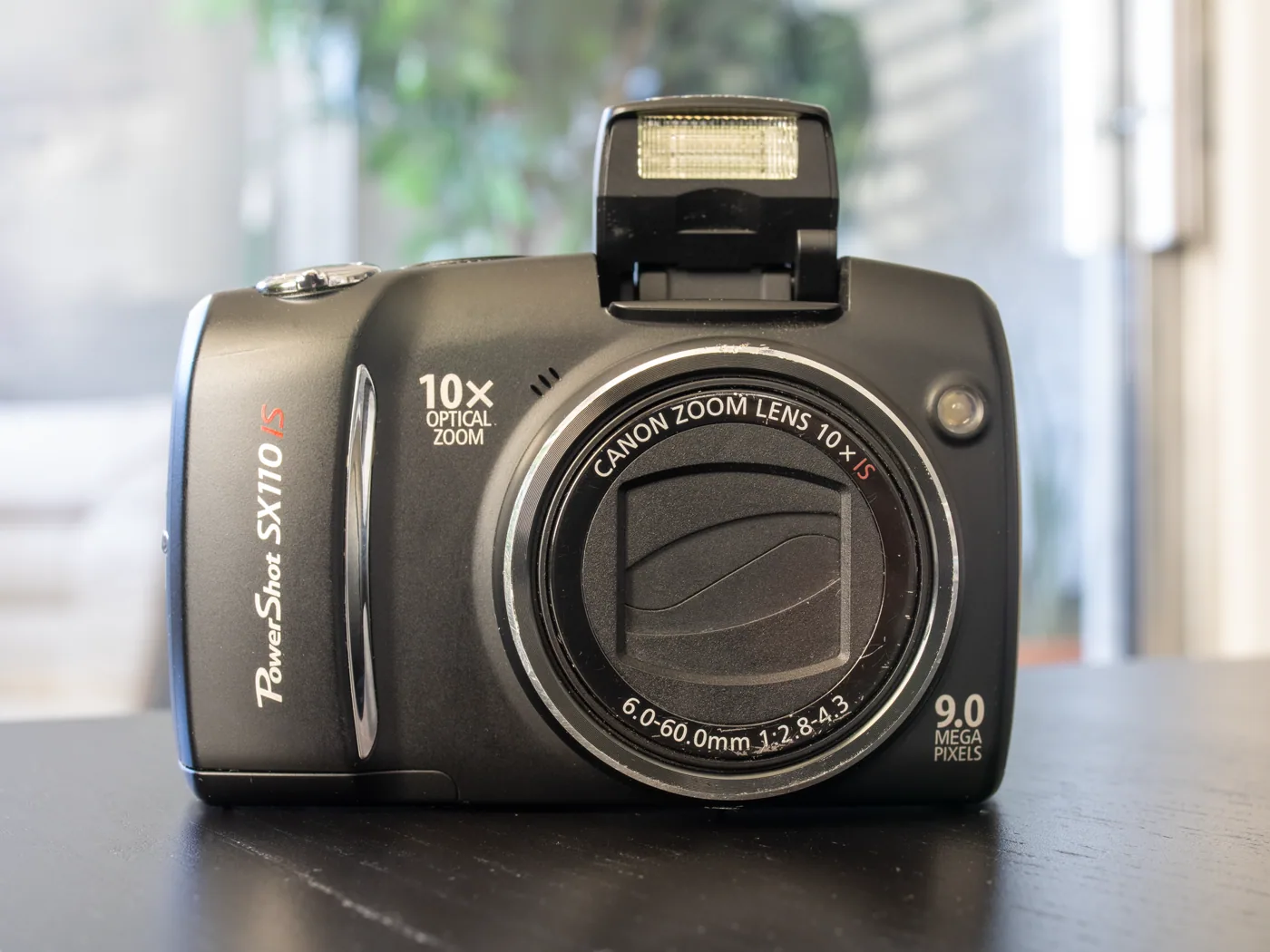

In August 2008 Canon replaced its SX100 IS with a 9-megapixel sensor, a 3-inch screen and the same 36 to 360 mm stabilised lens, and cut the UK price by £60. Reviewers praised the value, and most of them then raised the same complaints: noise in dim light, a slow flash and AA batteries that run down quickly.
- Launched
- September 2008
- Sensor
- 9 MP CCD
- Lens
- 36–360 mm, 10×
- Card
- SDHC, SD, MultiMediaCard
- Battery
- AA
Canon PowerShot SX110 IS specs: sensor, lens, battery, memory card and cable
The Canon PowerShot SX110 IS came out in September 2008 at £239 in the UK as a 9 MP CCD compact with a 36–360 mm (35 mm equivalent) 10× zoom lens. It runs on AA batteries. Sources
- Sensor
- CCD, 1/2.3", 9 MP source
- Lens
- 36–360 mm equivalent, 10× zoom source
- Memory card
- SDHC, SD, MultiMediaCard source
- Battery
- AA source
- USB / A/V cable
- IFC-400PCU, AVC-DC400 Confirmed · all Canon cables
Meet the camera
It is a plastic-bodied superzoom. Canon lists it at 110.6 by 70.4 by 44.7 millimetres and about 245 grams without batteries and card,1 and Imaging Resource's spec table gives 302 grams with batteries.6 Expert Reviews called it bulky for a compact, with a bulbous body that looks swollen, but also one of the smallest cameras to include a large zoom.7 Photo Review thought the plastic body nicely constructed and finished.8 There is no viewfinder: the screen does all the framing.58
Canon's museum lists a 9.0-megapixel, 1/2.3-inch CCD, a 6.0 to 60.0 mm f/2.8 to f/4.3 lens equal to 36 to 360 mm, a 3.0-inch screen of about 230,000 dots, ISO 80 to 1600 and two AA batteries.1 PhotographyBLOG and Photo Review name the DIGIC III processor.58 PhotographyBLOG carried Canon UK's announcement on 26 August 2008 with a price of £239 and €309, on sale from September, and gave $299.99 in its summary line.4 Imaging Resource said the US list price was $299 and that retailers were selling it for as little as $205 by November 2008.6
Why this one was interesting
A bigger screen and a bigger sensor for less money
The SX100 IS, which Canon's museum calls the debut of the SX series, appeared in October 2007 with an 8.0-megapixel, 1/2.5-inch sensor and a 2.5-inch screen of about 172,000 dots.2 The SX110 IS moved to 9.0 megapixels on a 1/2.3-inch sensor and to a 3.0-inch screen of about 230,000 dots, with the same stabilised 36 to 360 mm lens.12 Canon said the body came out slimmer and lighter despite the larger monitor;1 PhotographyBLOG counted 21 grams saved with near-identical dimensions, and Photo Review 20 grams, with a body slightly longer and slimmer.58 Imaging Resource noted that the US list price stayed at $299; PhotographyBLOG said the UK price was £60 below the SX100 IS at its launch.65 PhotographyBLOG called the new screen larger but not noticeably sharper.5
Easy mode on top of manual control
The dial still carries P, Tv, Av and M, and Canon added an Easy mode that sets everything automatically and limits playback to viewing and deleting.48 Imaging Resource called it a mode that "pretty much locks up the camera", good for handing it to a child.6 Photo Review said the SX110 IS kept a suite of manual controls that Canon had cut back on the newest A-series PowerShots, such as the A2000 IS.8 Expert Reviews found them well implemented: the control pad doubles as a wheel, the preview predicted manual exposures accurately, and manual focus enlarges the centre of the screen.7
Ordinary AA cells
Imaging Resource called the AA design a plus or a minus depending on your view: shorter life than a custom battery pack, but cells you can buy almost anywhere, and lithium AAs that keep their charge for years in a camera bag.6 Imaging Resource lists two alkaline cells in the box;6 Canon lists an optional NiMH set, the NB4-300.1 If you want a later AA-powered Canon superzoom, our PowerShot SX130 IS review covers the 12x model that came two years on.
What was lost
PhotographyBLOG listed what the redesign removed: the dedicated Stitch Assist panorama mode left the dial, and the four buttons that sat in a row under the old screen (direct print, face detection, display, menu) were squeezed out by the bigger one.5 Imaging Resource also noted the row was gone, replaced by buttons around the control pad.6 Imaging Resource's list of dislikes included a recessed power button that can be hard to reach.6
The dark: its weak point
All four reviews mention noise at high ISO, but they set the line in different places. PhotographyBLOG saw noise from ISO 400, called ISO 1600 results usable and not the worst it had seen, and said the ISO 3200 scene mode only reduces visible noise by removing finer detail.5 Imaging Resource's lab saw noise suppression from ISO 200, smudged detail at 400, worse at 800 and "much too blurry" at 1600.6 Photo Review saw no noise at ISO 200 and natural colour up to ISO 800, and said high-ISO shots would print at snapshot size but not match low-ISO quality.8 Expert Reviews said noise took a heavy toll on smoothness and detail in lower light, and that the camera fared a little worse than its direct competitors.7
Imaging Resource's print tests put numbers on it: ISO 100 and 200 made 16 by 20 inch prints, ISO 400 was about the limit for 8 by 10, ISO 800 for 5 by 7, and ISO 1600 was grainy but usable at 4 by 6.6 Imaging Resource still listed "very good low light performance" among its pros, citing a maximum exposure it gave as 16 seconds (its own spec list, Canon and the other reviews say 15) and autofocus that worked down to just above 1/8 foot-candle without the assist lamp.61 Photo Review saw noise mainly in long exposures at high ISO and less in flash pictures at ISO 800 and 1600.8 Imaging Resource's feature list gives ISO as 80 to 3200; Canon, PhotographyBLOG and Photo Review all put 3200 in the scene modes only.6158
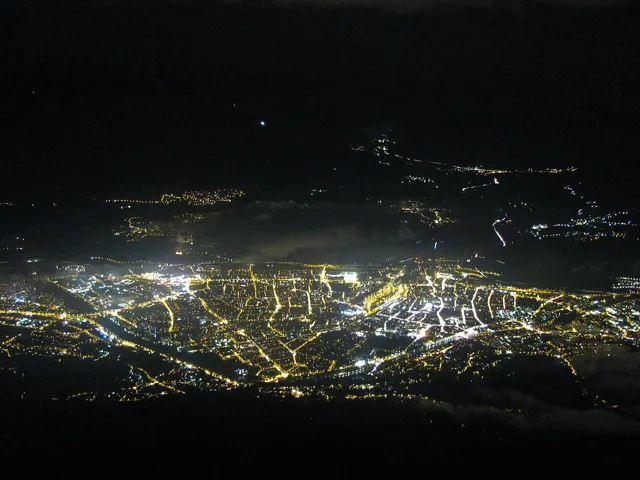






Four photographs from this camera in dim light. ISO, exposure and camera model are read from each file's own data; credited under each picture. We do not know how the cameras were held or whether any were edited.
On eBay right now
Live listings for this camera, supplied by eBay and updated automatically. We earn a commission if you buy through them.
The little wins
Stabilisation that earns its keep
Imaging Resource relayed Canon's claim of up to three stops and said it allows shutter speeds two to four times slower than you could hand-hold.6 Photo Review could shoot at shutter speeds down to 1/15 second at wide and mid focal lengths, and saw blur at 1/60 second at longer settings.8 PhotographyBLOG, with the stabiliser set to continuous, found blurred pictures were more often absent than not, even under tungsten light.5
How it drew the picture
PhotographyBLOG scored image quality 4 out of 5, found files a little soft at the default sharpening, and saw purple and cyan fringing between high-contrast areas.5 It also found the camera in fully automatic evaluative metering prone to blown highlights, unlike most rivals that underexpose, and thought Canon's default colour settings had drifted toward neutral, so it sometimes switched to the vivid setting.5 Photo Review said metering was consistently good but leaned toward exposing for shadows, losing highlight detail in contrasty scenes.8 Imaging Resource split on the same point: its gallery shots kept highlight detail well contained, which it called unusual, while its harsh-sunlight test came out high in contrast with hot highlights.6
Colour was the other split. Imaging Resource measured oversaturated reds and noted barrel distortion of 0.9 percent at wide angle and high, bright chromatic aberration.6 Photo Review called saturation close to natural, with a few shifts in cyan and in the light skin tone, and fringing from low to the low end of moderate.8 Under household bulbs, Imaging Resource's lab shot came out a hint red in automatic white balance, even though its verdict called automatic white balance excellent indoors; Photo Review also found the usual trouble with incandescent lighting and close-to-natural colour under fluorescent.68


















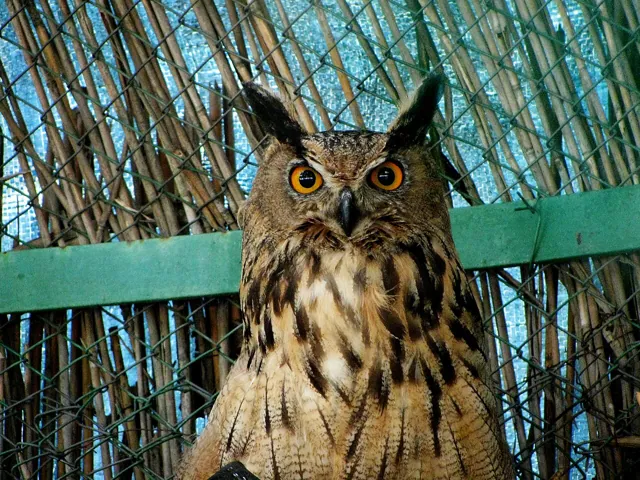
Photos taken with this camera, from Wikimedia Commons, credited under each picture. The ground-squirrel frame carries an EXIF focal length of 60 mm, the long end of the lens (360 mm equivalent per Canon's 6.0–60.0 mm = 36–360 mm); the chapel frame is recorded at 1/2 second, f/2.8, ISO 80, and we do not know whether it was handheld. These nine are a hand-picked sample, not a test.
Where it let you down
The batteries came first. Canon's rating, as Imaging Resource and Photo Review relay it, is about 140 shots on alkaline cells and about 400 on NiMH.68 Photo Review's alkalines ran low early, and a NiMH set still had plenty left after almost 300 shots.8 PhotographyBLOG said alkalines go in a couple of afternoons of shooting and that the compartment, which holds the card too, is awkward to close.5 Imaging Resource strongly recommended buying NiMH cells and a charger.6 Its user report added that the CR1220 coin cell holding the clock sits in a small drawer on the left side that is hard to pull out evenly, and pulling it loses the time.6
Speed was the second complaint, and the numbers varied. Power-on to first shot was 2.8 seconds in Imaging Resource's lab and about two seconds at Photo Review.68 Imaging Resource measured shutter lag at 0.63 second at wide angle and 0.56 at telephoto with autofocus, and 0.075 second prefocused; Photo Review measured about 0.6 and under 0.1; PhotographyBLOG noticed no delay after a half-press.685 Shot-to-shot time was about two seconds at all three of Imaging Resource, Expert Reviews and Photo Review.678 Flash cycling was the slow part: 10.8 seconds in Imaging Resource's lab, over five seconds between flash shots at Expert Reviews, and just over five to re-prime at Photo Review, where the shot-to-shot time with flash was 8.4 seconds.678
Focus in poor light was the third. Expert Reviews found autofocus quick at wide angle and a little sluggish at telephoto, especially in low light.7 Photo Review said the lack of an AF-area choice was a disadvantage, and long focal lengths in low light produced many blurred shots because the camera focused on the wrong part of the subject.8 Video was basic: VGA at 30 frames per second, mono sound, and no optical zoom while filming, according to PhotographyBLOG and Photo Review, with Imaging Resource listing the lack of a widescreen movie mode among its dislikes.1586
What the reviewers said in 2008 and 2009
| Outlet | Date | Verdict |
|---|---|---|
| PhotographyBLOG | 6 Oct 2008 | 4 out of 5 for design, features, ease of use and image quality; 5 out of 5 for value. A user-friendly jack-of-all-trades, but a small step from the SX100 IS, so not worth the upgrade for owners.5 |
| Imaging Resource | 18 Feb 2009 | 4 out of 5 and a "Dave's Pick"; its user report calls it a bargain by any standard. Dislikes: too large for a pocket, slow flash recycling, sluggish continuous mode, bright chromatic aberration.6 |
| Expert Reviews | 20 Mar 2009 | A recommended travel camera for enthusiasts thanks to bright-light image quality and manual controls, but the Panasonic TZ5 was faster, shot HD video and was the better choice for most users.7 The page text prints no score. |
| Photo Review | Undated | 9 out of 10 overall (build 9.0, ease of use 8.5, image quality 9.0). Attractive and compact, suited to travellers who like adjustable controls.8 |
Expert Reviews' page is a short, single text. If you want the camera Expert Reviews preferred, see our Lumix DMC-TZ5 review.
The timeline
- October 2007Canon's museum dates the SX100 IS, the first SX model.2
- 26 August 2008Canon UK announces the SX110 IS, £239 and €309, on sale from September.4
- September 2008The marketing date in Canon's museum entry.1
- 6 October 2008PhotographyBLOG publishes its review.5
- November 2008Imaging Resource saw retailers selling it from $205.6
- 18 February 2009Imaging Resource publishes its review.6
- 20 March 2009Expert Reviews publishes its review.7
- August 2009The SX120 IS, which Canon says succeeds it, with a 10-megapixel, 1/2.5-inch sensor.3
Should you buy one now?
Buy one if you want a stabilised 36 to 360 mm lens with real manual controls, you will shoot mostly in daylight, and you are happy to feed it NiMH cells. Skip it if you mostly shoot in dim light or want one flash picture after another. It had a US list price of $299 (Imaging Resource; PhotographyBLOG gave $299.99);64 what it sells for now is a question for the sold listings, not for us. We have not tested a unit yet. Before you bid, check these:
- The name and the year. Search the PowerShot SX110 IS. The SX100 IS before it has 8 megapixels and a 2.5-inch screen, and the SX120 IS after it lists a 1/2.5-inch sensor.23
- The batteries. Two AA cells; Canon's NiMH option is the NB4-300.1 Buy rechargeable AAs on Amazon ↗ and check that the battery door closes properly.5
- The clock. The clock cell sits in a small drawer on the left side that Imaging Resource found hard to pull out evenly, and pulling it loses the time; check the drawer is seated and the camera keeps its date.6
- The card. Canon lists SD, SDHC, MMC, MMCplus and HC MMCplus cards.1 See our memory card guide before buying a large one.
- The lens. Check that it extends and retracts smoothly through the whole zoom, and that the front glass is free of scratches.
- The screen and flash. Check the screen for scratches, and raise and lower the pop-up flash by hand to make sure it moves and fires.6
- The cable. Imaging Resource lists a USB cable (IFC-400PCU) and an AV cable (AVC-DC400) in the box; Canon calls the dedicated connector mini-B compatible.61
If you are wondering why cameras like this are being hunted down again, we tell that story once, in Pictures that never left the card.
See recent sold prices on eBay ↗Shop on eBay ↗AA rechargeable batteries ↗
Sources
- Canon Camera Museum, PowerShot SX110 IS (specification page: names, September 2008, sensor, lens, screen, battery, size, weight)
- Canon Camera Museum, PowerShot SX100 IS (October 2007, 8.0 MP, 1/2.5-inch sensor, 2.5-inch screen of about 172,000 dots)
- Canon Camera Museum, PowerShot SX120 IS (August 2009, succeeds the SX110 IS, 1/2.5-inch sensor)
- PhotographyBLOG, Canon PowerShot SX110 IS announcement by Mark Goldstein (26 Aug 2008: Canon UK press release, £239 and €309, available from September; $299.99 in the summary line)
- PhotographyBLOG, Canon PowerShot SX110 IS review by Gavin Stoker (6 Oct 2008)
- Imaging Resource, Canon PowerShot SX110 IS review by Mike Pasini and Stephanie Boozer (review date 18 Feb 2009; lab tests, user report)
- Expert Reviews, Canon PowerShot SX110 IS review by Ben Pitt (20 Mar 2009)
- Photo Review (Australia), Canon PowerShot SX110 IS review (undated page; RRP A$399, lab tests)
Photographs are credited under each one, all via Wikimedia Commons. Links to eBay and Amazon are affiliate links.