Canon PowerShot S · announced October 2001
The Canon PowerShot S30: the three-megapixel twin with the sliding lens cover
Sold under the same name in Japan, the Americas and Europe.4
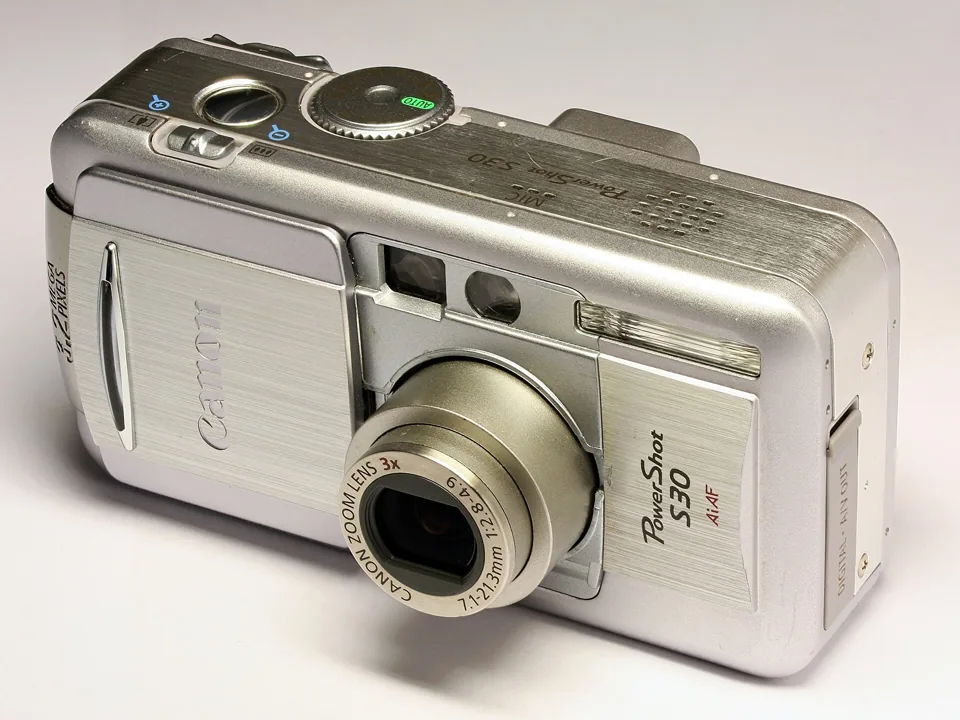

Canon's S30 was the S40's twin with a smaller sensor. The two full reviews we found praised its speed, colour and build; their complaints were a tight viewfinder, average macro and short battery life.
Canon PowerShot S30 specs: sensor, lens, battery, memory card and cable
The Canon PowerShot S30 is a 3.2 MP CCD compact camera with a 35–105 mm (35 mm equivalent) 3× zoom lens, launched in December 2001. It takes CompactFlash cards and runs on the NB-2L battery. Sources
- Sensor
- CCD, 1/1.8", 3.2 MP source
- Lens
- 35–105 mm equivalent, 3× zoom source
- Memory card
- CompactFlash source
- Battery
- NB-2L source
- USB / A/V cable
- IFC-300PCU, AVC-DC100 Confirmed · all Canon cables
Meet the camera
The lens cover is the power switch. Slide it open and the camera wakes with the lens telescoping out; Imaging Resource noted that the cover stops just short of the barrel when you close it, so it cannot be shut until the lens is back inside.1 The body is a polycarbonate shell with a reinforced aluminium exterior, which Imaging Resource described as a lavender-tinted metallic silver, and it called the camera well built the moment you pick it up.1 Steve's Digicams called it a highly durable, pocket-sized metal alloy body, and in its conclusion said the camera was fast in processing and autofocus alike.2
Canon's museum lists the S30 as marketed in December 2001 at 89,800 yen, two months after its four-megapixel sibling the S40 (October 2001, 99,800 yen).45 DPReview reported both cameras as announced on 2 October 2001, with an expected US street price of $599 for the S30.3 Other US prices in our sources do not match: Imaging Resource's review text calls $599 the list price, its data sheet gives $499 (the sheet's price-update date is 2007) and an availability date of 30 November 2001,17 and a January 2026 retrospective says a street price of around $450.8 We show all of them. Weights differ because of what is counted: Canon gives about 260 grams for the body alone,4 Imaging Resource 310.5 grams with battery and card.1
- Sensor
- 3.2 MP CCD, 1/1.8" (3.3 MP total), RGB primary-colour filter4
- Lens
- 3x, 7.1–21.3 mm (35–105 mm equiv.), f/2.8–4.94
- ISO
- Auto (picks 50 or 100), 50, 100, 200, 400, 8004
- Screen
- 1.8" LCD (Canon: 100% coverage) plus optical viewfinder (Canon: about 82%)4
- Files
- JPEG or RAW, up to 2048 × 1536; shutter 15 s to 1/1500 s4
- Flash
- Built-in; Canon lists 35 cm to 4.8 m at wide angle with ISO on Auto4
Why this one was interesting
A twin with a smaller sensor
Both full reviews treated the S30 as the S40 with fewer pixels. Imaging Resource said the two were virtually identical apart from sensor resolution and some timings, and Steve's Digicams wrote that they were physically identical and differed only in CCD resolution and finished image size.12 DPReview's launch news said both cameras appeared to be based on, and almost identical to, the PowerShot G2.3 Steve's recommended the S40 for anyone who needed more resolution.2 Canon's museum entry for the S45 says that camera superseded the S40 of October 2001; we cover it in our PowerShot S45 review.6
Quick, for a compact of its year
Speed was the surprise. On its prototype, Imaging Resource measured a shutter lag of 0.7 to 0.78 seconds with full autofocus, which it called faster than average, 0.39 seconds with manual focus, and 0.08 seconds when prefocused, which it called blazingly fast; a large/fine file cycled in 1.9 seconds and a small/basic one in 1.46.1 Start-up to first shot took 4.4 seconds, which the reviewer rated average to a bit faster.1 The reviewer called the camera surprisingly fast for a three-megapixel model, with a large buffer.1 Steve's called the S30 and S40 lean speed demons, a pleasure to use because the camera was so responsive.2
Manual control in a small body
Both reviews listed the full ladder: Auto, Program AE, shutter priority, aperture priority and manual, plus scene modes on the dial.12 Imaging Resource gave the aperture range as f/2.8 to f/8.0 and shutter times of 15 seconds to 1/1500, and called the exposure control quite extensive for a camera this size.1 Its conclusion said the feature set stopped just short of the G2's enthusiast capabilities, and named the missing external flash connector as the most prominent gap.1 Compared with the G2, Steve's thought the S30's NB-2L battery was nowhere near as powerful as the G2's BP-510; see our PowerShot G2 review for that larger sibling.2
The dark: its low-light edge
Low light was where Imaging Resource was most enthusiastic. Its prototype test camera captured bright, clear images at 1/16 foot-candle (0.67 lux) even at ISO 50, with colour still accurate, and noise was practically absent at ISO 50 and only moderately low at ISO 800, which the reviewer called exceptional.1 Canon lists exposures of up to 15 seconds, with noise reduction applied at 1.3 seconds and slower.4 For focusing in the dark, Imaging Resource described a bright white LED assist lamp on the front that lights whenever autofocus runs, and Steve's listed an AF illuminator for dim to dark scenes.12


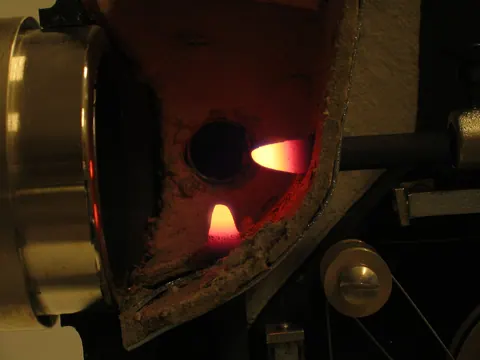

We cannot give an ISO for these two: the EXIF Commons shows for these files carries no ISO value. The shutter times and apertures in the captions are from the EXIF.
Like that look? See recent eBay sold listings for this camera ↗
On eBay right now
Live listings for this camera, supplied by eBay and updated automatically. We earn a commission if you buy through them.
The little wins
 The S30's lens and sliding cover, seen from the front. · D-Kuru · CC BY-SA 3.0 at · Commons

A cover that protects the lens from you
Imaging Resource liked that the sliding cover cannot be closed on a lens that is still out, and said the cover doubles as a finger grip when opened.1
Program Shift and a colour-effects position
Steve's wrote that Program AE gained Program Shift, so other shutter and aperture pairs can be chosen, and Imaging Resource noted that Colour Effects moved from the Record menu to the mode dial, with vivid, neutral, sepia and black-and-white previewed on the screen.21
Barks, boings and meows
The My Camera menu let you swap the start-up image and sounds, the shutter sound (options included Boing and Bark) and the button sound (including Meow), per Imaging Resource's list of settings.1
Exposure lock, borrowed from the G2
Most digicams lock focus and exposure together on a half-press. Imaging Resource explained that the S30 also lets you press the metering button afterwards to reset the exposure alone, a feature it said came from the G2, and the lock works for flash exposures too. It called that very slick.1
Highlights that blink
In playback the S30 shows a histogram, and Imaging Resource said it liked even more that blown-out highlights blink between white and black, so you see where detail has been lost.1 Steve's also noted a histogram and a visual highlight of over-exposed areas.2
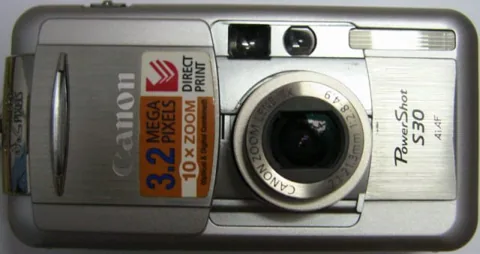 The front of the camera with its “3.2 mega pixels” and “Direct Print” stickers. · Douglas Whitaker · CC BY-SA 3.0 · Commons

Print without a computer
Canon's museum says the S30 can print directly to an optional BJ F890PD printer or the CP-10 card printer; Steve's names the S820D Bubble Jet and the CP-10.42 The brushed-metal front carries a Direct Print badge in this photo.
How it drew the picture
On its prototype, Imaging Resource said it got great colour and image quality throughout, with the Auto white balance often leaning slightly warm and the manual setting giving the best results, and with skin tones a little pink though acceptable.1 In its resolution chart test, artifacts began at about 600 lines per picture height, strong detail ran to at least 900 to 1,000 lines and the pattern vanished near 1,300; the reviewer judged this in line with a sharp three-megapixel camera and noted a bit more tendency toward jaggies than some, but saw none in real-world shots.1 It measured 0.48 per cent barrel distortion at wide angle, moderate chromatic aberration of five or six pixels, and softness only in the extreme corners.1 Steve's, whose sample page was shot at ISO 50 unless noted, thought the lens mostly excellent and sharp, with a noticeable amount of barrel distortion at wide angle, some softness around the edges and almost no chromatic aberration.2 The two reviewers therefore disagree about fringing.


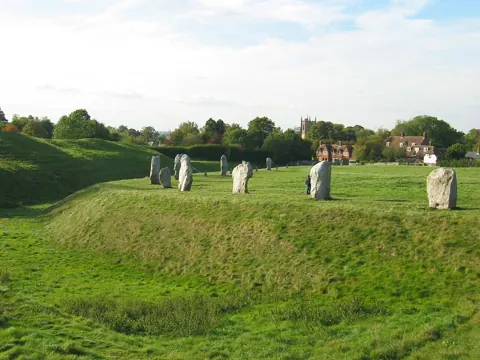

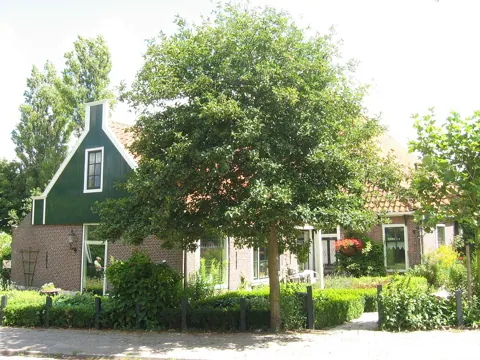



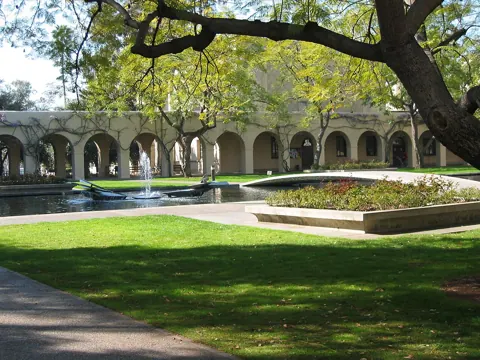









Photos taken with this camera, from Wikimedia Commons, credited under each picture.
Where it let you down
The viewfinder drew the sharpest complaint from Steve's, whose conclusion said it shows only about 75 per cent of the captured image and is not well centred, and that the LCD, at close to 100 per cent, is the safer way to frame.2 Imaging Resource, testing its prototype, measured about 81 per cent at wide angle and 83 per cent at telephoto, calling it fairly tight, against 98 and 99 per cent for the screen.1 The S30 also has no diopter adjustment, according to Steve's, and a 2026 retrospective warns glasses wearers about the same thing.28
Macro was Imaging Resource's other complaint. On its prototype it measured a minimum macro area of 4.6 by 3.45 inches (117 by 88 mm) with a fair bit of barrel distortion and very soft corners, and the flash overexposed close-ups; it did not test flash range, because its unit was a prototype.1 The Auto white balance also ran warm in macro.1 The 2026 retrospective called the flash not so great, adding that this was true of most compacts of the era.8
The controls took some getting used to. Imaging Resource found the centre Set press of the five-way Multicontroller hard to hit, because the camera kept registering an arrow direction, and said the buttons are spread out enough that adjusting settings often takes two hands.1 On battery life Imaging Resource wished for longer; it could not run its usual power tests because of the proprietary battery connection, but ran the camera continuously for about 65 minutes with the screen on.1 Steve's quoted about 170 shots with the LCD and up to 300 with only the viewfinder, and advised using the screen sparingly or carrying a spare.2 Imaging Resource added that the tripod mount sits close to the battery door, which makes quick battery changes on a tripod difficult.1
Where the sources disagree
The two reviews and Canon's pages do not always match. Steve's page two captions one of its pictures as an S40 that is identical to the S30, so we cannot say which page-two figures were checked on an S30.2 Here are the main conflicts, shown rather than resolved.
| Detail | What each source says |
|---|---|
| Continuous shooting | Canon: about 2 frames a second standard and 3 high-speed.4 Imaging Resource's overview gives standard about 3 (up to 7 frames) and high-speed 2 (up to 12), its exposure page 2.5 and 1.5, and its timings 1.2 and 2.7.1 Steve's gives standard 1.5 and high-speed 3 in its introduction, 1.5 and 2.5 in its conclusion.2 |
| Normal focus range | Canon and Imaging Resource: 80 cm to infinity.41 Steve's page-two text says 70 cm, while its own spec table says 80.2 |
| Viewfinder coverage | Canon: about 82 per cent; Imaging Resource measured 81 to 83.41 Steve's gives about 87 per cent on page two and about 75 per cent in its conclusion.2 |
| Lens construction | Imaging Resource: eight elements in seven groups; Steve's: seven elements in eight groups.12 |
| Flash range, wide angle | Canon: 35 cm to 4.8 m (ISO Auto) or 55 cm to 4.0 m (ISO 100).4 Imaging Resource quotes Canon's rating as 0.8 to 4.3 m (and did not test flash range on its prototype);1 Steve's page-two text gives 0.7 to 4.5 m at ISO 100.2 |
| 2026 retrospective | It lists a 2.0-inch screen and a body 74 mm tall, where Canon gives 1.8 inches and 58 mm, so we quote it only as its own statements and opinions.84 |
What the reviewers said
| Outlet | Date | Verdict |
|---|---|---|
| Imaging Resource | 1 Oct 2001 (prototype) | Highly recommended. It praised the low-light shooting as outstanding, plus the colour and sharpness, and wanted better macro, a more accurate Auto white balance and longer battery life.1 |
| Steve's Digicams | 29 Oct 2001 | Recommended it for novices and experienced users alike; its one real complaint was the viewfinder, and it pointed to the S40 for anyone who wanted more resolution.2 |
| Bouncing Hedgehog | 29 Jan 2026 | Still capable for fun and learning, though the interface can be clumsy and it is not for everyone.8 |
DPReview published launch news for the S30; we did not find a DPReview review of it, so only two contemporary full reviews inform this page.
The timeline
- 1 October 2001Imaging Resource first posts its S30 review, written on a prototype.1
- 2 October 2001DPReview reports the S30 and S40 announced, with expected street prices of $599 and $799.3
- October 2001Canon's museum gives this month for the S40 in Japan.5
- 29 October 2001Steve's Digicams posts its review, using a production-level camera.2
- 30 November 2001Imaging Resource's data sheet gives this as the availability date.7
- December 2001Canon's museum gives this month for the S30 in Japan.4
- October 2002The S45 appears, superseding the S40.6
Should you buy one now?
Buy one if you want a quick, metal-bodied compact with manual modes and raw files and can live with a three-megapixel sensor, a tight viewfinder and a battery that wants a spare.412 What it sells for now is a question for the sold listings, not for us. Before you bid, check these:
- The name. Canon used PowerShot S30 in Japan, the Americas and Europe, so one search covers it.4
- The battery. It uses an NB-2L, and the original kit included a charger.41 Amazon ↗
- The card. It takes CompactFlash Type I and II; Steve's lists IBM Microdrive compatibility and Imaging Resource says it should work.412 See our CompactFlash guide.
- The cover. It is the power switch, so slide it fully open and shut a few times and watch the lens go out and back.1
- The Set button. Imaging Resource found the centre press of the Multicontroller awkward;1 press the centre and each direction to be sure all five work.
- The screen and viewfinder. Look for scratches or cracks on the 1.8-inch screen and dust in the viewfinder.
If you are wondering why cameras like this are being hunted down again, we tell that story once, in Pictures that never left the card. For a camera from Canon's later pocket line, see our PowerShot SD400 review.
See recent sold prices on eBay ↗Shop on eBay ↗NB-2L battery ↗
Sources
- Imaging Resource, Canon PowerShot S30 review, twelve pages (first posted 1 Oct 2001; written on a prototype unit, with lab timings, resolution and low-light tests)
- Steve's Digicams, Canon PowerShot S30 review, six text pages (introduction and specifications, controls, record and playback screens, conclusion, two software pages) plus a sample page (posted 29 Oct 2001; its sample page says a production-level camera; read in Internet Archive copies)
- DPReview news item, “Canon announce PowerShot S30 and S40” (2 Oct 2001): expected street prices $599 (S30) and $799 (S40)
- Canon Camera Museum, PowerShot S30 (marketed December 2001, 89,800 yen; specifications)
- Canon Camera Museum, PowerShot S40 (marketed October 2001, 99,800 yen)
- Canon Camera Museum, PowerShot S45 (marketed October 2002; says it superseded the S40)
- Imaging Resource data sheet, Canon PowerShot S30 (retail price field $499, availability 2001-11-30; the sheet's price-update date reads 2007-02-27)
- Bouncing Hedgehog, “Canon PowerShot S30 Review” (29 Jan 2026): a retrospective whose spec list disagrees with Canon's in places, see the text
Camera photos by D-Kuru (CC BY-SA 3.0 at) and Douglas Whitaker (CC BY-SA 3.0); other photographs are credited under each one, all via Wikimedia Commons. Links to eBay and Amazon are affiliate links.