Canon PowerShot A · announced August 2006
The Canon PowerShot A710 IS: the budget A series gets a stabiliser and keeps its two AA cells
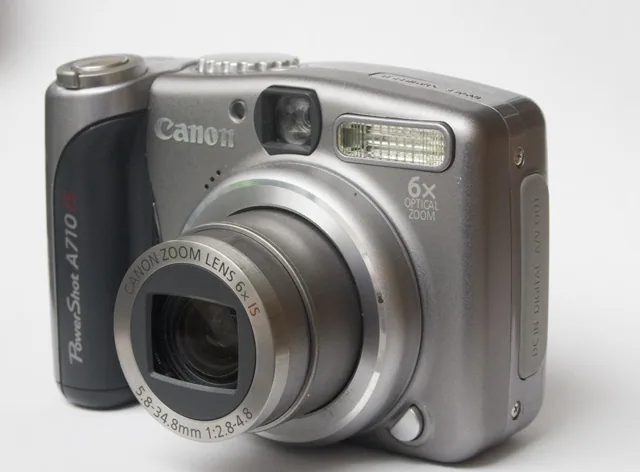

Canon's 2006 budget flagship added the first optical image stabiliser in its A series, and a seventh megapixel, to the A700's 6x zoom, viewfinder and manual controls. DPReview, PhotographyBLOG and Imaging Resource all rated it well, and all three found the flash slow to recycle.
- Launched
- August 2006
- Sensor
- 7.1 MP CCD
- Lens
- 35–210 mm, 6×
- Card
- SD, SDHC, MultiMediaCard
- Battery
- AA
Canon PowerShot A710 IS specs: sensor, lens, battery, memory card and cable
The Canon PowerShot A710 IS came out in August 2006 at US$399 as a 7.1 MP CCD compact with a 35–210 mm (35 mm equivalent) 6× zoom lens. It runs on AA batteries. Sources
- Sensor
- CCD, 1/2.5", 7.1 MP source
- Lens
- 35–210 mm equivalent, 6× zoom source
- Memory card
- SD, SDHC, MultiMediaCard source
- Battery
- AA source
- USB / A/V cable
- IFC-400PCU, AVC-DC300 Confirmed · all Canon cables
Meet the camera
Its dark-silver body bulges into a grip over the compartment for the two AA cells.56 DPReview found it slightly curvier and less boxy than the A700 and still very compact for a 6x zoom, though like the A700 it uses more plastic than other A-series models.4 PhotographyBLOG praised the finish but put it at just over 4 cm thick, better suited to a small camera bag than a trouser pocket.5
It kept one name worldwide: Canon's museum lists the PowerShot A710 IS for Japan, the Americas and Europe alike.1 Canon announced it on 24 August 2006 alongside the A640 and A630, and Reviewed.com reported a US price of $399 with shops stocking it in October.3 Canon UK promised September in Britain, price to be confirmed;2 Canon's museum gives September as the marketing month,1 and Imaging Resource's spec box lists 31 October.6 Popular Photography put the street price at $399.99,7 and DPReview's spec table lists a street price of $316 in the US and £280 in the UK.4
- Sensor
- 7.1 MP CCD, 1/2.5", DIGIC II processor1
- Lens
- 6x, 35–210 mm equiv., f/2.8–4.8, lens-shift stabiliser1
- ISO
- 80 to 800, plus Auto and High ISO Auto1
- Screen
- 2.5", about 115,000 dots, plus an optical viewfinder1
- Video
- 640 × 480 at 30 fps, up to 1 GB or 1 hour per clip1
- Card
- SD, SDHC or MMC; 16 MB card supplied1
Why this one was interesting
The first stabiliser in the A series
Canon's museum calls it the first A-series PowerShot with a lens-shift optical stabiliser,1 and Reviewed.com and DPReview said the same.34 Imaging Resource and DPReview had both complained about the A700's lack of one.64 Canon UK's release claimed it lets you shoot at shutter speeds up to three stops slower, with a chip that handles up to 4,000 signals a second.2
DPReview's test supported the claim: Simon Joinson put the gain at two to three stops over the A700, shooting by hand at 1/25 s at the long end and, nine times in ten, at 1/4 s at the short end.4 PhotographyBLOG shot handheld pairs at 0.4 s and at 1/4 s, stabiliser off and on, and found the stabilised frames much sharper,5 and Imaging Resource's 1/4 s shot in a dim garage corner showed brush strokes on a subject's eyebrows.6 Joinson tended to leave Continuous mode on when shooting at the long end because it steadies the preview, and called Shoot only gentler on the batteries.4
Everything else carried over, with small changes
DPReview's list of changes from the A700 adds a Safety Zoom function, 60 fps QVGA movies, an overexposure warning, a 3:2 framing overlay and SDHC support, and counts marginally shorter battery life, a 1.7 fps burst (2.0 before) and 10 g more weight against them.4 It judged the extra megapixel of little real advantage, because stronger noise reduction soon removed it at higher ISO.4 For the camera it replaced, see our PowerShot A700 review; for another stabilised AA-powered Canon, the PowerShot A570 IS.
Real exposure control, and a viewfinder
Imaging Resource found aperture, shutter and manual modes surprisingly absent on many digicams and was glad to see them here, with apertures from f/2.8 to f/8.0 at wide angle.6 PhotographyBLOG called the full manual control suitable for everyone from casual snapper to experienced photographer, and noted that a true optical viewfinder was something many cameras had dispensed with.5 DPReview thought the FUNC menu excellent, though it was disappointed that Canon still would not fit an ISO button.4
What was left out
The A640, announced the same day, was also priced at $399 by Reviewed.com and has 10 megapixels;3 Imaging Resource missed the variable-angle LCD that the A640 and A630 carry.6 DPReview said the slight screen lag and low resolution are what you accept below the S and G series, and counted no custom modes or shortcut buttons.4 See our PowerShot A640 review, and our glossary entry on CCD sensors.
The dark: its weak point
DPReview and PhotographyBLOG both treated ISO 800 as a last resort. DPReview found chroma noise in mid-tones from ISO 200, ISO 400 quite noisy but detailed, and ISO 800 "emergency use only" territory, usable for small prints.4 PhotographyBLOG saw no noise at ISO 80 and 100, a little at 200 and evident noise with blurred detail at 400.5 Popular Photography noticed noise past ISO 200 as a day went overcast,7 while Imaging Resource listed high-ISO capability among its pros, better than much of the competition, without a per-ISO verdict on the page we read.6
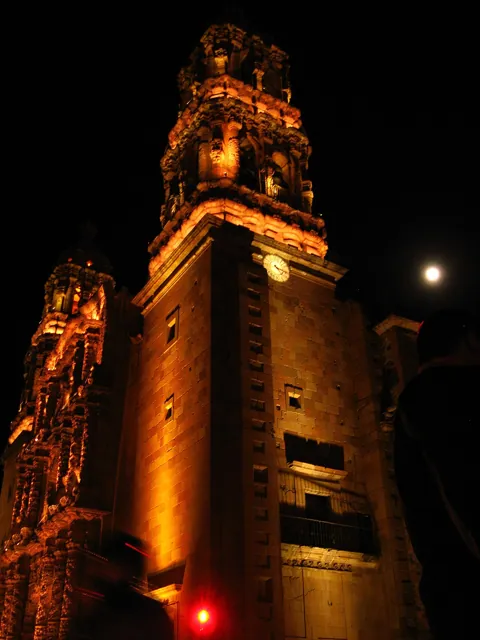
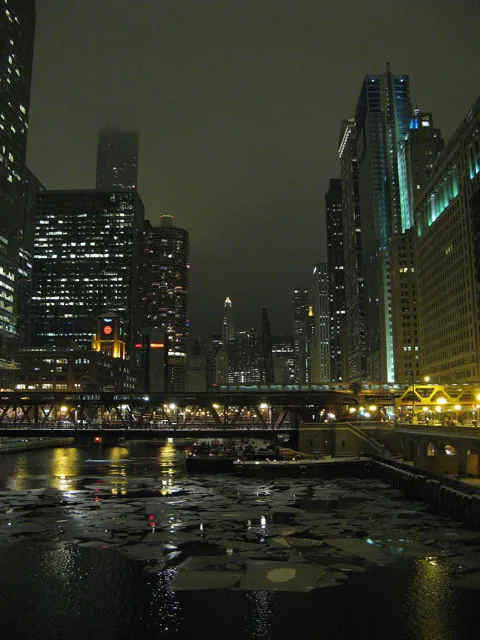
DPReview credited Canon's light noise reduction: more grain, but fine detail kept. At ISO 400 and 800 it preferred the A710 IS to the 10-megapixel Panasonic LX2, whose detail it said was smeared away;4 see also our Lumix DMC-LX2 review. Imaging Resource called its low-light capability excellent, but only in shutter-priority or manual mode.6 The photos below were shot on this camera in dim scenes; their EXIF records the exposure times shown, not whether the stabiliser was on.






On eBay right now
Live listings for this camera, supplied by eBay and updated automatically. We earn a commission if you buy through them.
The little wins
Macro
Canon lists a closest focus of 1 cm.1 DPReview measured the smallest area at about 22 mm across and called the macro mode usable only through about the first half of the zoom range;4 Imaging Resource found 21.9 by 16.4 mm, warned that the flash does not throttle down at that distance, and said macro works only at the wide end.6
The lens
Imaging Resource called its optics results a pleasant surprise: corner sharpness much better and chromatic aberration lower than average for consumer cameras, with 0.56% barrel and 0.20% pincushion distortion.6 DPReview measured 1.2% and 0.3%, and found purple fringing rare;4 PhotographyBLOG saw only slight fringing in high-contrast scenes.5
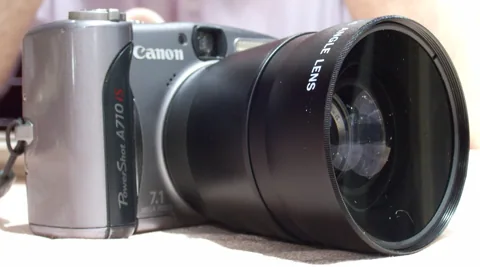 A710 IS with Canon's LA-DC58G adapter and a conversion lens fitted · Museo8bits · CC BY-SA 3.0 · Commons

Add-ons
The ring around the lens base comes off for Canon's LA-DC58G adapter, taking a 0.7x wide converter, a 1.75x tele converter or a close-up lens; there was also a High Power Flash and a waterproof case rated to 40 m.1647
Battery life
DPReview quoted about 360 shots by CIPA on NB-3AH NiMH cells with the screen on and almost 900 using only the viewfinder, and warned that the 1,600 mAh cells it tried faded too fast when it used the flash heavily one evening; it also tested 2,500 mAh cells and reported no such trouble.4 Popular Photography also quoted 360.7 PhotographyBLOG, leaving the stabiliser on all the time, got just over 100 shots from 2,000 mAh cells.5
Colour Accent and Colour Swap
These scene modes keep one colour and turn the rest black and white, or swap one colour for another. PhotographyBLOG's reviewer wrote that, as far as they knew, Canon was the only maker offering them in the camera.5 Imaging Resource called the results bizarre but fun, and the camera can keep an unedited copy.6 The sunrise below was shot in Colour Swap mode and then tone-curve edited, according to its photographer.


How it drew the picture
DPReview found natural colour, accurate white balance outdoors and a slight tendency to oversaturate bright primaries, plus highlight clipping in bright, contrasty scenes, which it said cost the camera an easy Highly Recommended.4 It measured resolution around average for 7 megapixels, with moiré at the highest frequencies, and found images slightly soft and over-sharpened.4 PhotographyBLOG also found the pictures a little soft at the default sharpening and suggested sharpening them or raising the in-camera setting.5 Imaging Resource credited vibrant colour, good skin tones and better-than-average exposure accuracy.6


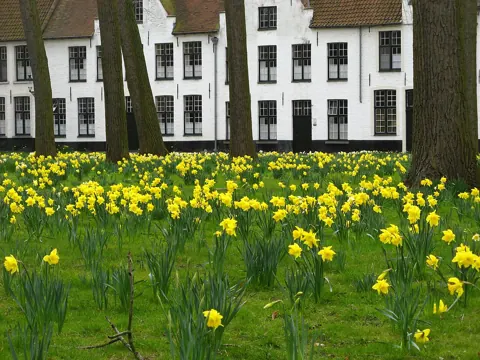







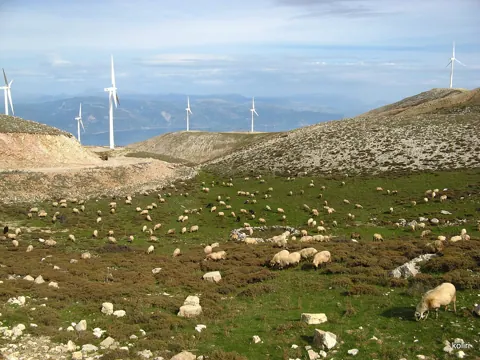

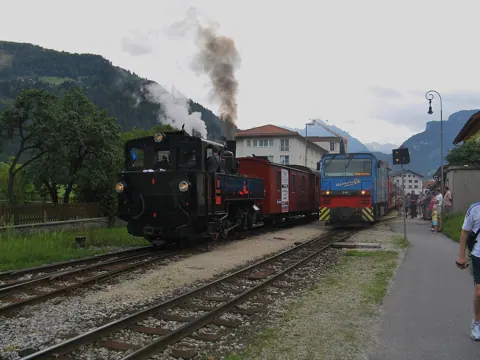



Photos taken with this camera (EXIF model checked), from Wikimedia Commons, credited under each picture.
Where it let you down
Slow flash was the shared complaint. PhotographyBLOG timed 5 s between shots;5 DPReview said recycling can stretch to 5 s or more at full power without freshly charged batteries, and shot-to-shot times with flash to as much as 8 s at long range, at the long end of the zoom or with tired batteries;4 Popular Photography noticed slowness indoors.7
The battery door drew three complaints because the card shares the compartment: DPReview found changing cards without losing the batteries fiddly, PhotographyBLOG said the AAs sometimes fall out, and Popular Photography fumbled with it.457 The tripod socket is plastic; PhotographyBLOG called it almost unusable, set in the extreme corner, while Imaging Resource liked that its position lets you change batteries and cards while on a tripod.56
The screen divided the reviewers. DPReview found it pixelated but bright, quick and surprisingly usable in direct sun;4 PhotographyBLOG found its resolution low enough to look grainy;5 Imaging Resource called it big and bright, less sharp than some.6 The viewfinder showed about 80 per cent of the frame to DPReview, which found it small and without dioptre adjustment, and about 77 per cent to Imaging Resource, whose lab photographer called it nearly useless while Pasini valued having one.46 DPReview found the zoom a bit jumpy, and Imaging Resource wanted more than 14 zoom steps and a live histogram.46 Imaging Resource called the 16 MB card supplied in the US pointlessly small; PhotographyBLOG counted five best-quality pictures on it.65
Several figures disagree between sources. PhotographyBLOG's features page says the CCD delivers 6.0 effective megapixels, while its own specification page and Canon say 7.1; we use Canon's figure.51 The weight is 210 g body only by Canon and PhotographyBLOG, 210 g including batteries in DPReview's table, 7.4 oz (210 g) in the spec table of Imaging Resource, which gives 9.45 oz (268 g) with batteries and card in its text, and 7.41 oz in Popular Photography's key specs.15467 PhotographyBLOG and Popular Photography (SDC-16MB) say the supplied card is SD, while Imaging Resource's box list names an MMC (MMC-16) although its overview says SD; Canon's museum entry gives no type for the card supplied.5761
What the reviewers said in 2006
| Outlet | Date | Verdict |
|---|---|---|
| PhotographyBLOG | 28 Oct 2006 | Ratings out of 5: design 4, features 4, ease of use 4.5, image quality 4.5, value 4.5. Well-rounded and unspectacular at first, a camera that grows on you; weak points are the tripod socket and flash recycling.5 |
| Imaging Resource | 2 Nov 2006 | A Dave's Pick. Applauded the stabiliser and the retained viewfinder; cons were slow flash, a screen less sharp than some and the small supplied card.6 |
| DPReview | 13 Dec 2006 | Highly Recommended with reservations: build 8.0, ergonomics 8.5, features 9.0, optics 7.5 among its scores. The reservations were highlight clipping and exposure foibles.4 |
| Popular Photography | October 2006, by its text (page dated 17 Dec 2008) | A short hands-on at a football warm-up. Image quality quite good for the price; hot list included the stabiliser and fast shot speed, not list included slow flash recycling and noise at higher ISO.7 |
The timeline
- 24 August 2006Canon announces the A710 IS with the A640 and A630; Reviewed.com gives $399 and an October on-sale date.3
- September 2006Canon UK's planned availability and the museum's marketing month.21
- 28 October 2006PhotographyBLOG publishes its review.5
- 31 October 2006The availability date in Imaging Resource's spec box.6
- 2 November 2006Imaging Resource's review is dated.6
- 13 December 2006DPReview publishes its concise review.4
Should you buy one now?
Buy one if you want a stabilised CCD compact with real manual control and batteries you can buy anywhere, and you mostly shoot by day. It launched at about US$399;3 what it sells for now is a question for the sold listings, not for us. We have not tested a unit yet. Before you bid, check these:
- The name. It is the PowerShot A710 IS everywhere; do not confuse it with the unstabilised A700.14
- The batteries. It takes two AA cells and Canon lists NiMH packs and a charger kit as accessories.1 DPReview advised the best cells you can get, after its 1,600 mAh cells faded too fast under heavy flash use.4 Rechargeables on Amazon ↗.
- The battery door. Open and close it; three reviewers disliked it.457
- The card. Canon lists SD, SDHC and MMC, and Canon UK said SDHC is supported for 4 GB and upwards;12 we found no tested maximum, so see our memory card guide before you buy a big card.
- The cables. Imaging Resource and Popular Photography list a USB cable (IFC-400PCU) and an AV cable (AVC-DC300) in the box; Canon lists a mini-B USB 2.0 port.671
- The lens ring. It is removable for converters; check it is present if you want one.46
If you are wondering why cameras like this are being hunted down again, we tell that story once, in Pictures that never left the card.
See recent sold prices on eBay ↗Shop on eBay ↗AA rechargeables ↗
Sources
- Canon Camera Museum: PowerShot A710 IS (outline, specifications, accessories, marketing date September 2006)
- PhotographyBLOG, Canon PowerShot A710 IS (24 Aug 2006; Canon UK press release, UK availability, price to be confirmed)
- Reviewed.com, Canon Adds Three to A-Series; New Flagship Includes Image Stabilization, by Emily Raymond (24 Aug 2006; US price and availability)
- DPReview, Canon PowerShot A710 IS Concise Review by Simon Joinson (13 Dec 2006)
- PhotographyBLOG, Canon Powershot A710 IS Review (28 Oct 2006, seven pages)
- Imaging Resource, Canon A710 IS review by Mike Pasini (review date 11/02/06; lab shots by Luke)
- Popular Photography, Camera Review: Canon PowerShot A710 IS, by Bill Schiffner (a short hands-on at a football warm-up; the page shows 17 Dec 2008, but its text places the review in October after the A700's spring launch, so we date it 2006 with that caveat)
The camera photos and samples are credited under each one, all via Wikimedia Commons. Links to eBay and Amazon are affiliate links.