Canon PowerShot A series · on sale spring 2006
The Canon PowerShot A540: a $300 six-megapixel compact with real manual controls, on two AA batteries
We found no other regional name for it: Canon's museum lists the same name for Japan, the US and Europe.1
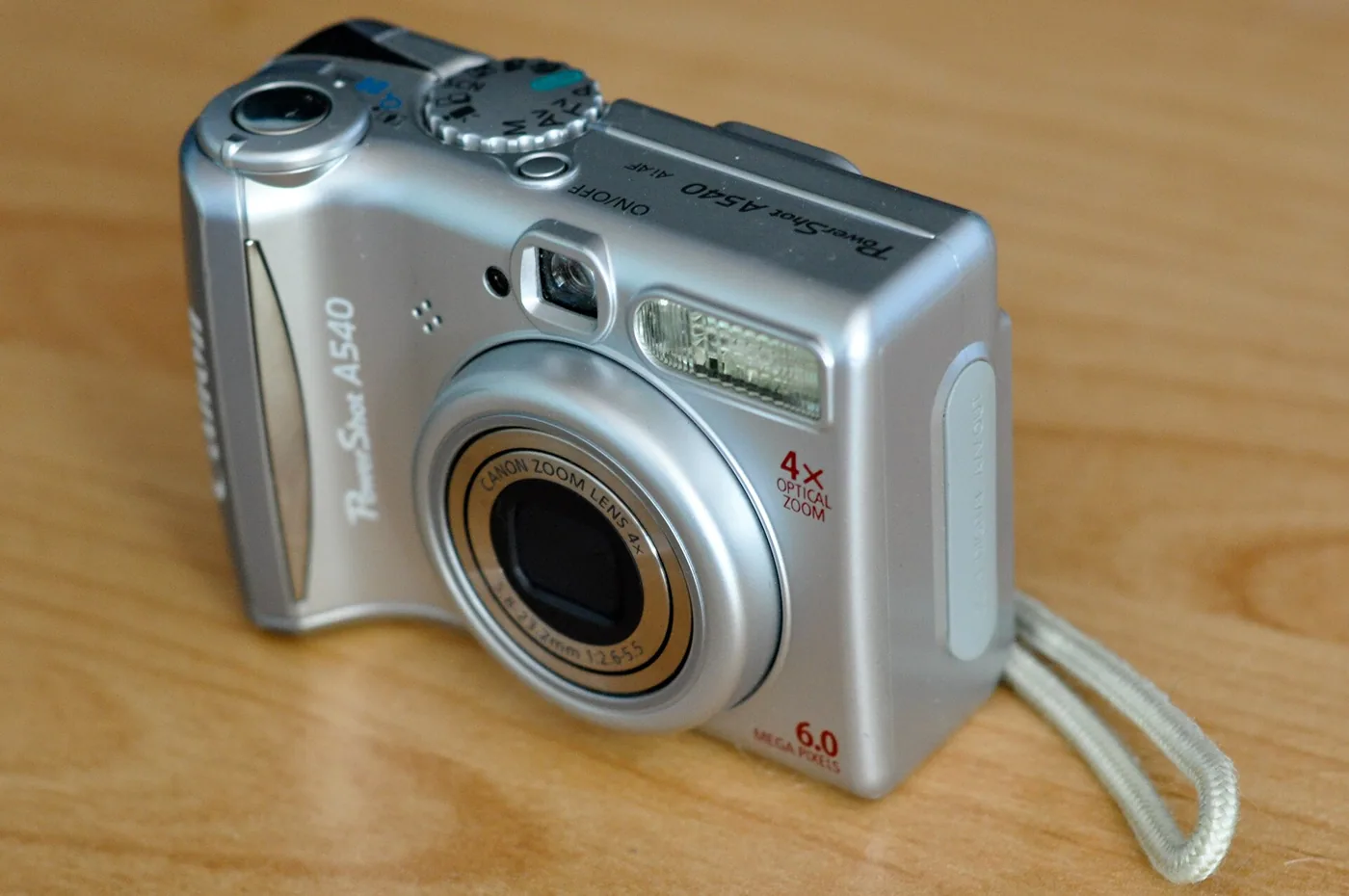

In February 2006 Canon announced a six-megapixel compact with aperture and shutter priority, an optical viewfinder, 30 frames a second of VGA video and two AA cells, for an estimated $299.99. The three full reviews we read liked the handling and the pictures, and all three marked down the noise at ISO 800.
- Launched
- March 2006
- Launch price
- Estimated $299.99 in the US2
- Sensor
- 6 MP CCD
- Lens
- 35–140 mm, 4×
- Card
- SD, MultiMediaCard
- Battery
- AA
Canon PowerShot A540 specs: sensor, lens, battery, memory card and cable
Launched in March 2006 at $299.99, the Canon PowerShot A540 is a 6 MP CCD compact with a 35–140 mm (35 mm equivalent) 4× zoom lens. Inside: it uses SD and MultiMediaCard and runs on AA batteries. Sources
- Sensor
- CCD, 1/2.5", 6 MP source
- Lens
- 35–140 mm equivalent, 4× zoom source
- Memory card
- SD, MultiMediaCard source
- Battery
- AA source
- USB / A/V cable
- IFC-400PCU, AVC-DC300 Confirmed · all Canon cables
Meet the camera
It is a chunky, square silver camera. Imaging Resource described a two-tone silver body with a retro look and a hand grip formed by the battery compartment.3 Trusted Reviews found the plastic body solid and sturdy, and thought the shape square and businesslike, built for usability more than style or size.4 Canon lists about 180 grams for the body alone; Trusted Reviews put it around 230 grams with its two AAs and Imaging Resource gave 256 grams with batteries and card.143 Trusted Reviews called it the mid-range model of five new A-series cameras.4 Imaging Resource put it just above the A530 and called it, in effect, an A700 with a 4x zoom.3 Canon's museum names the A520 and A510 of March 2005 as its predecessors;1 see our PowerShot A520 retrospective.
Canon's press release, as DPReview printed it on 21 February 2006, gave an estimated selling price of $299.99 and availability in March.2 Imaging Resource's review text says it "breaks the $300 mark" in one place and "just under $300" in another.3 In Britain Trusted Reviews quoted a recommended price of £289, which it called a little high for the class, and said Amazon was selling it for £157.4
- Sensor
- 6.0 MP CCD, 1/2.5"1
- Lens
- 4x, 35–140 mm equiv., f/2.6–5.51
- ISO
- Auto, 80 to 8001
- Screen
- 2.5", about 85,000 dots, plus optical viewfinder1
- Batteries
- 2 × AA, alkaline or NiMH; 90 shots on alkaline, 360 on NiMH (CIPA, as cited by Imaging Resource)13
- Card
- SD / MMC; Canon says it tested up to 2 GB1
- Size
- 90.4 × 64.0 × 43.2 mm, about 180 g, body only1
- Launch price
- Estimated $299.99 in the US2
Why this one was interesting
Manual exposure at the $300 mark
Imaging Resource said the Creative Zone on the mode dial, with program, shutter-priority, aperture-priority and full manual exposure, was what impressed it at this price. It confirmed that "manual" really did mean manual: shutter speeds from 15 seconds to 1/2000 and apertures from f/2.6 to f/8.0, depending on focal length.3 Trusted Reviews called the exposure modes very simple to use and liked the manual focus, which magnifies the centre of the screen and adds a range indicator.4 Pocket-lint, which said buyers get room to grow as they get better at taking pictures, noted a dedicated exposure-compensation button that works in any mode.5
A viewfinder when screens were taking over
Imaging Resource said the 2.5-inch screen would be the main way to frame pictures but that nothing beats an optical viewfinder in bright sun, and that an optical viewfinder was becoming unusual on a digicam at this price.3 Pocket-lint thought it helped tremendously and noted that switching the screen off to use it saves power.5
Accessories and the underwater angle
Imaging Resource spent part of its user report on water: an Underwater scene mode adjusts colour and exposure for Canon's optional WP-DC2 housing, which it priced at $240.3 The lens ring comes off at the press of a button to take converter lenses,3 and DPReview's list of the launch accessories includes a 0.7x wide-angle converter (WC-DC52) and a 1.75x tele converter (TC-DC52A).2 Trusted Reviews also noted the adapter-lens bayonet under the removable bezel and an optional waterproof case.4
Why not the A530, or the A700?
Canon's museum describes the A530 as a sibling with a 5.0-megapixel sensor and a 1.8-inch screen.1 Imaging Resource said the extra spend over the A530 would likely be well spent: six megapixels, 30 frames a second at 640 by 480 for video, aperture and shutter priority and the large screen.3 Against the A700 it found the A540 close to a twin apart from the zoom, but also found the A700's pictures somewhat sharper in the finest detail of its test shot.3 See our PowerShot A700 retrospective. The A540 is a CCD camera: see our glossary entry on CCD sensors.
The AA question: what each source said
All three full reviews noted that the camera runs on two AA cells. They differ on how long a set lasts, and the figures come from different kinds of test.
| Source | What it said about batteries |
|---|---|
| Canon | Lists two AA alkaline cells, or two AA NiMH cells (an NB4-300 pack is named as optional), or the ACK800 AC adapter kit. The museum page gives no shot count.1 |
| Imaging Resource | Its table, based on Canon's CIPA tests, lists 90 shots on alkaline and 360 on NiMH (it names the optional pack NB-3AH, where Canon's museum page says NB4-300). Its verdict: short life with alkalines, very good with NiMH, and "rather short" with the screen on. The reviewer recommends NiMH cells, with 1600 mAh enough and 2700 mAh available, and said they never ran out during a shoot. Two alkalines are in the box.31 |
| Trusted Reviews | Repeated Canon's 90 shots on standard alkalines, but called that conservative: with the box alkalines the reviewer took over 130 shots, many with flash. Still, it called the camera a little power-hungry next to lithium-ion compacts and suggested two sets of NiMH cells and a rapid charger for holidays.4 |
| Pocket-lint | Said the DIGIC II processor makes power use frugal, and that turning the screen off to use the viewfinder saves more.5 |
| DCResource (second-hand) | PhotographyBLOG's note on its review quotes the reviewer as saying battery life is excellent. We did not see its test method or figures.6 |
The sources agree on the shape of it: alkalines are weak (90 shots on Canon's test, and Trusted Reviews beat that figure on its own use), NiMH cells are the answer, and the viewfinder helps. Our reading, which no source states in these words, is to treat the camera as a NiMH camera and buy a second set. For comparison, our A570 IS retrospective records Canon's higher count for its successor, and our guide to AA-powered CCD digicams sets the A-series cameras side by side.
The dark, and the noise
All three full reviews agreed that the camera was fine at low ISO and rougher at the top. Imaging Resource found relatively little noise up to ISO 200, with ISO 400 and especially 800 noticeably worse, though the noise was lower than it had seen from most rivals at the price. In prints it judged ISO 400 cleaner than average at 8 by 10 inches, and ISO 800 rough at that size but fine at 5 by 7.3 Trusted Reviews found a tiny amount of speckling at ISO 200, a printable picture at ISO 400, and at ISO 800 an image it said would not make a good print.4 Pocket-lint said noise was noticeable from ISO 400 and that ISO 800 was problematic in shadows and in flat areas such as blue sky, and listed noise among the cons.5 Second-hand, Steves Digicams found very little noise at ISO 80 and 100,8 and CNET called ISO 800 performance usable.7 Imaging Resource also tested very dim light on a tripod: the camera produced bright pictures down to about one-eighth of a foot-candle at ISO 80 and 100, and its autofocus worked even with the assist lamp off.3 It added that good low-light capability held only in Night mode, and it clocked flash recycling at 9 seconds, which it called unusually slow.3
The A540 files on Commons carry no recorded ISO value in their metadata, so we cannot show a sensitivity series. Here are two after-dark pictures, with the shutter speeds the camera recorded in the files.


Like that look? See what A540s have recently sold for on eBay ↗
On eBay right now
Live listings for this camera, supplied by eBay and updated automatically. We earn a commission if you buy through them.
The little wins
Beyond the headline features, a few details made it better to use than its spec sheet suggested.
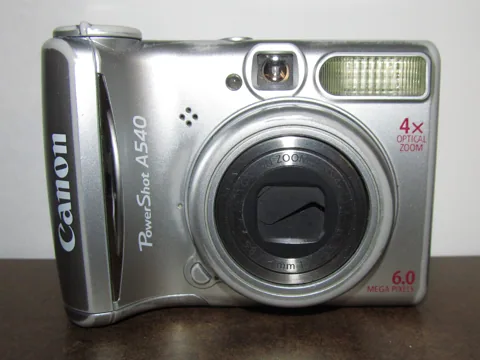 The A540 from the front. · Willis Lam · CC BY-SA 2.0 · Commons

A grip that suits both hands
Imaging Resource found the grip made the camera easy to hold in low light, said the case design fits large and small hands, and managed one-handed shooting even when changing exposure compensation.3 Pocket-lint called the handling great.5
Colour presets with a custom setting
Trusted Reviews listed vivid, neutral, sepia, positive-film and skin-tone presets, plus a custom setting with manual contrast, sharpness, saturation, colour balance and skin tone.4
A macro of 42 by 31 millimetres
Imaging Resource measured a minimum area of 1.64 by 1.23 inches (42 by 31 millimetres) with strong detail, though only at the wide end of the zoom and with a flash that does not throttle down at that range. Trusted Reviews estimated a closest focus near 5 centimetres.34
VGA video at 30 frames a second
Imaging Resource called its 640 by 480, 30-frame movie mode broadcast quality, liked that zooming while recording picked up little motor noise, and regretted that movies cannot use the 16:9 frame that stills can.3
A 16:9 mode
Imaging Resource enjoyed composing in the widescreen still mode, which records 2,816 by 1,584 pixels, and noted that the viewfinder does not show the crop.3
How it drew the picture
In daylight the reviewers were warm about the exposure and colour. Imaging Resource found exposure accuracy better than average, colour bright and slightly oversaturated (reds and dark greens most), skin tones a little pink, and detail strong to about 1,300 lines per picture height in its chart, with extinction around 1,600.3 Trusted Reviews said DIGIC II delivered natural colour and perfect exposure in most conditions.4 Pocket-lint called metering excellent and white balance good, especially on Auto, and said prints up to and beyond A4 had plenty of detail.5 Second-hand, Steves Digicams called its large, finest-quality pictures sharp, well exposed and accurate in colour.8 The lens drew mixed verdicts: Imaging Resource measured 0.71 percent barrel distortion at wide angle, slightly better than average, with soft corners at telephoto,3 while Trusted Reviews found very noticeable barrel distortion at wide angle and some corner softness at wide apertures,4 and Pocket-lint called the lens crisp except in the extreme corners.5


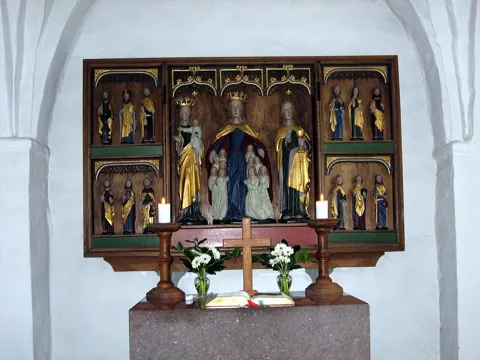











Photos taken with this camera, from Wikimedia Commons, credited under each picture. Each file's recorded camera model is the Canon PowerShot A540.
Where it let you down
Imaging Resource's list of cons was short: only average speed from shot to shot and average shutter response at wide angle, high contrast that loses highlight and shadow detail under harsh light, a short battery life with the screen on, a slow flash recycle and colour some people might find too saturated.3 Its numbers were a lab's: 2.3 seconds from power-on to first shot, an autofocus delay of 0.49 second, 0.074 second when prefocused, and a measured 1.40 frames a second in continuous mode against Canon's rating of 2.3.3 Trusted Reviews, on the other hand, found start-up under a second, focus in under half a second even in low light, and 2.3 frames a second until the card is full or the batteries run out.4 Second-hand, DCResource reported a start-up of 1.3 seconds and the same 2.3 frames a second.6 We cannot say which is right; they are not necessarily measuring the same thing. The flash reached about 9 feet and did not light the test target properly at 11.3 The viewfinder showed about 83 percent of the frame at wide angle and 79 percent at telephoto, tight and skewed slightly high, and Imaging Resource wished for a more accurate one.3 Trusted Reviews faulted the screen's 85,000 dots for making sharp focus hard to judge, and the 23-page basic guide in the box, with the full manual only on CD.4 Pocket-lint's cons were a blocky design and noise.5
Where the sources disagree
| Point | One source | Another |
|---|---|---|
| Flash power control | Trusted Reviews listed an adjustable flash level among the features the camera lacks.4 | Imaging Resource's description of the Function menu includes a flash output setting from minus 2 to plus 2 EV.3 |
| Printed manual | Trusted Reviews: only a 23-page basic guide in the box.4 | Imaging Resource's box list includes an instruction manual, software guide and registration kit.3 |
| Weight | Canon: about 180 g, body only.1 | Trusted Reviews: around 230 g with batteries; Imaging Resource: 256 g with batteries and card.43 |
| Start-up time | Imaging Resource: 2.3 seconds from power-on to first shot (a lab measurement).3 | Trusted Reviews: under a second; DCResource, second-hand: 1.3 seconds. The definitions of "start-up" may differ.46 |
| Lens distortion | Imaging Resource: 0.71 percent barrel at wide angle, a bit better than average.3 | Trusted Reviews: very noticeable barrel distortion at wide angle.4 |
What the reviewers said
| Outlet | Date | Verdict |
|---|---|---|
| Steves Digicams (second-hand) | 28 Mar 2006 | Images sharp, well exposed and accurate in colour; very little noise at ISO 80 and 100.8 |
| CNET (second-hand) | 6 Apr 2006 (news item) | Solid image quality, usable ISO 800 and a full set of manual controls; suggested for enthusiasts wanting a small second camera, and for beginners not yet ready for a superzoom or DSLR.7 |
| DCResource (second-hand) | 7 Apr 2006 (news item) | Called its performance very good and its battery life excellent.6 |
| Pocket-lint | 2 May 2006 | 4 out of 5. Worth a look: great handling and a nice viewfinder, against a blocky design and noise.5 |
| Imaging Resource | 8 Jun 2006 | An easy Dave's Pick that will meet the needs of the average consumer very well. Criticisms: viewfinder accuracy, ISO 400 and 800 noise, slow flash recycle, battery life with the screen on.3 |
| Trusted Reviews | Undated, 2006 | Very capable and good value for anyone learning photography before a DSLR; noisy at ISO 800, no adjustable flash or focus point, no printed manual in the box.4 |
The timeline
- March 2005The A520 and A510, the A540's predecessors in Canon's museum list.1
- 21 February 2006Canon announces the A540 and A700 with estimated prices of $299.99 and $349.99.2
- March 2006Canon's museum lists the camera as marketed; DPReview's press release says it will be available that month.12
- 28 March to 7 April 2006Steves Digicams, CNET and DCResource reviews are reported by PhotographyBLOG.876
- 2 May 2006Pocket-lint publishes its review.5
- 8 June 2006Imaging Resource's review date.3
- March 2007The PowerShot A570 IS arrives; Canon's museum calls it the successor to the A540.9
Should you buy one now?
Buy one if you want a handy compact with real manual exposure and a viewfinder, you will run it on NiMH rechargeables, and you can live with noisy pictures above ISO 400. It launched at an estimated $299.99;2 what it sells for now is a question for the sold listings, not for us. Before you bid, check these:
- The battery bay. The two AA wells sit beside a small slot for the CR1220 cell that keeps the clock, under a sliding door on the base.3 Check the contacts for the white crust that old alkalines leave (our advice), and expect the clock to reset if that small cell is flat.
- The batteries. Canon's CIPA figures were 90 shots on alkaline and 360 on NiMH;3 a set of NiMH rechargeables is cheap on Amazon ↗.
- The card. Canon lists SD and MultiMediaCard and says it tested cards up to 2 GB;1 the page for the A570 IS, its successor, adds SDHC,9 so do not assume a high-capacity card will work in an A540. The unit came with a 16 MB MMC card.3 See our memory card guide.
- The cables. Imaging Resource's box list names a USB cable (IFC-400PCU) and an AV cable (AVC-DC300), and Canon lists a USB 2.0 Hi-Speed mini-B port.31
- The lens. It telescopes out on power-up by about 1-1/8 inches at telephoto, and the ring around it releases with a button;3 check that the lens extends and retracts cleanly and the ring is not loose.
- The viewfinder. Do not mistake its tight, slightly skewed view for a fault: Imaging Resource measured it that way.3
If you are wondering why cameras like this are being hunted down again, we tell that story once, in Pictures that never left the card.
See recent sold prices on eBay ↗Shop on eBay ↗AA batteries ↗
Sources
- Canon Camera Museum: PowerShot A540 (specifications, power sources, card note, marketing date, A520 and A510 as predecessors, A530 as sibling)
- DPReview, Canon Powershots A700 and A540 (Canon press release of 21 Feb 2006: estimated selling prices $349.99 and $299.99, available in March; specification list)
- Imaging Resource, Canon A540 review by Mike Pasini (reviewed 06/08/2006; lab tests, user report, box contents, CIPA battery table)
- Trusted Reviews, Canon PowerShot A540 review (undated page, written in 2006; UK price, battery test, ISO test shots)
- Pocket-lint, Canon PowerShot A540 digital camera, by Doug Harman (2 May 2006; 4.0 out of 5)
- PhotographyBLOG news item, Canon PowerShot A540 Review at DCResource (7 Apr 2006; the DCResource page itself is no longer online, so this is second-hand)
- PhotographyBLOG news item, Canon PowerShot A540 Review at CNET (6 Apr 2006; second-hand: we could not open CNET's own page)
- PhotographyBLOG news item, Canon PowerShot A540 Review at Steves Digicams (28 Mar 2006; second-hand: the original page now redirects elsewhere)
- Canon Camera Museum: PowerShot A570 IS (names the A540 as its predecessor; lists SDHC cards)
Camera photos by larsjuh and Willis Lam; other photographs are credited under each one, all via Wikimedia Commons. Links to eBay and Amazon are affiliate links.