Nikon Coolpix P · on sale April 2008
The Nikon Coolpix P80: an 18x zoom in a $400 body shaped like a small DSLR
Sold under one name, the Coolpix P80, in the sources we read.
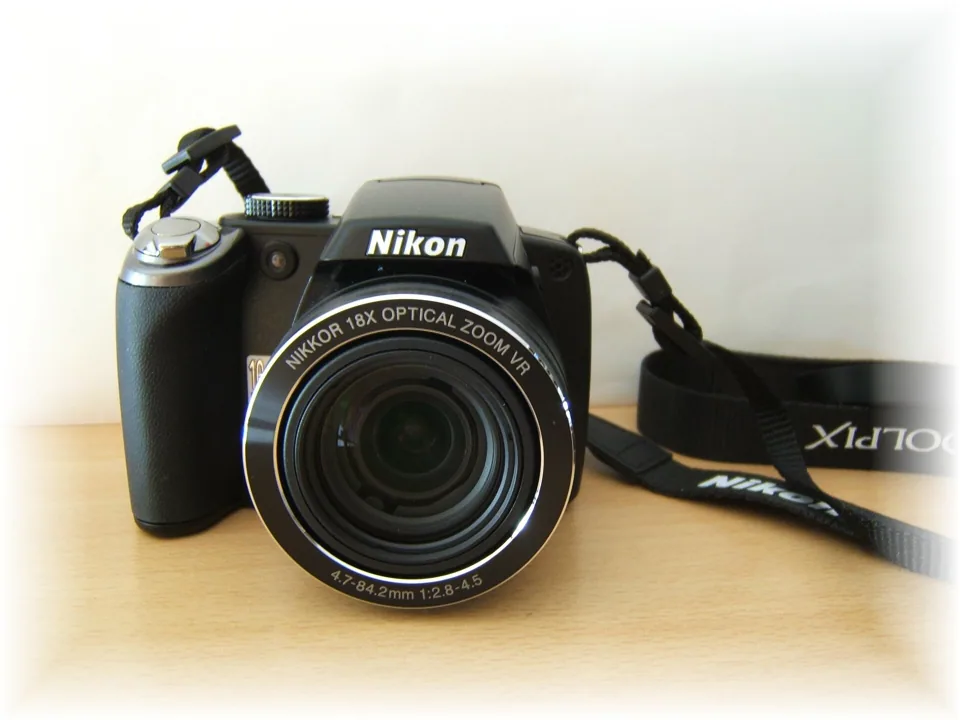

In April 2008 Nikon announced a compact with a 27 to 486 mm equivalent lens, sensor-shift stabilisation and full manual exposure for $399.95. Four full reviews praised the lens and the handling, then disagreed about its speed and its viewfinder, and all four faulted the noise.
- Launched
- April 2008
- Sensor
- 10.1 MP CCD
- Lens
- 27–486 mm, 18×
- Card
- SD, SDHC
- Battery
- EN-EL5
Nikon Coolpix P80 specs: sensor, lens, battery, memory card and cable
The Nikon Coolpix P80 came out in April 2008 at $399.95 as a 10.1 MP CCD compact with a 27–486 mm (35 mm equivalent) 18× zoom lens. It takes SD and SDHC cards and runs on the EN-EL5 battery. Sources
Meet the camera
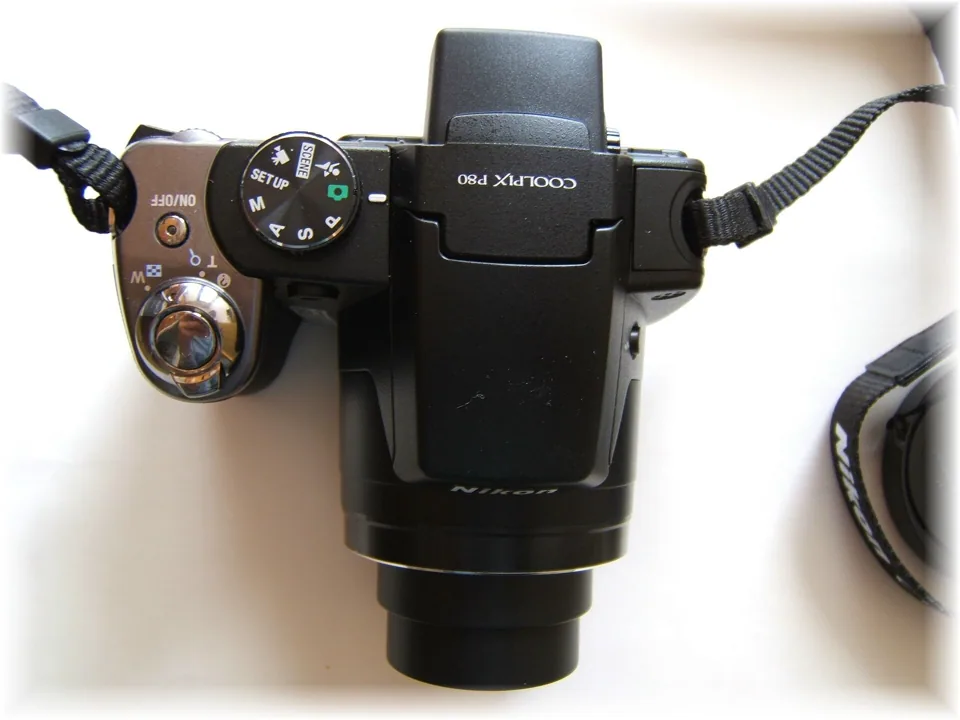
PhotographyBLOG said that beside Nikon's D60, Canon's EOS 450D and Sony's A200 the P80 would be hard to pick out as the odd one until you saw the live preview on the back or looked through the electronic viewfinder.4 It has a chunky rubberised grip and a pop-up flash,4 and Nikon gives about 110 by 79 by 78 millimetres and 365 grams without battery and card.2 Imaging Resource's specification box gives 395 grams including batteries, and its reviewer said it would not fit a jeans pocket but should fit larger coat pockets and purses.7 PhotographyBLOG called the all-plastic body a little flexible but better built than its £299 / $399 price suggested, ahead of the Olympus SP-570 UZ and Panasonic FZ18 and level with the Fujifilm S8100fd.4
Nikon Inc. announced it on 10 April 2008, for sale across the United States from April at a suggested $399.95;13 Imaging Resource's specification box lists availability from 15 April.7 Nikon's Tokyo release called it the most compact 18x optical zoom camera among competing 18x models as of 10 April, by Nikon's own research.2 PhotographyBLOG's verdict repeated Nikon's claim that it was the world's smallest 18x camera, and added that it was not the best one.4
- Sensor
- 10.1 MP CCD, 1/2.33" (10.70 MP total)2
- Lens
- 18x, 4.7 to 84.2 mm, 27 to 486 mm equiv., f/2.8 to 4.52
- ISO
- 64 to 6400 (auto 64 to 800); 3200 and 6400 at 3 MP or smaller2
- Screens
- 2.7" LCD, 230,000 dots, plus a 0.24" electronic viewfinder, about 230,000 dots2
- Shutter
- 8 s to 1/2000 s (1/4000 s in Sport Continuous mode)7
- Card and battery
- SD and SDHC, about 50 MB built in · EN-EL5 Li-ion, about 250 shots by Nikon's figure2
Why this one was interesting
A lens that starts at 27 mm and reaches 486 mm
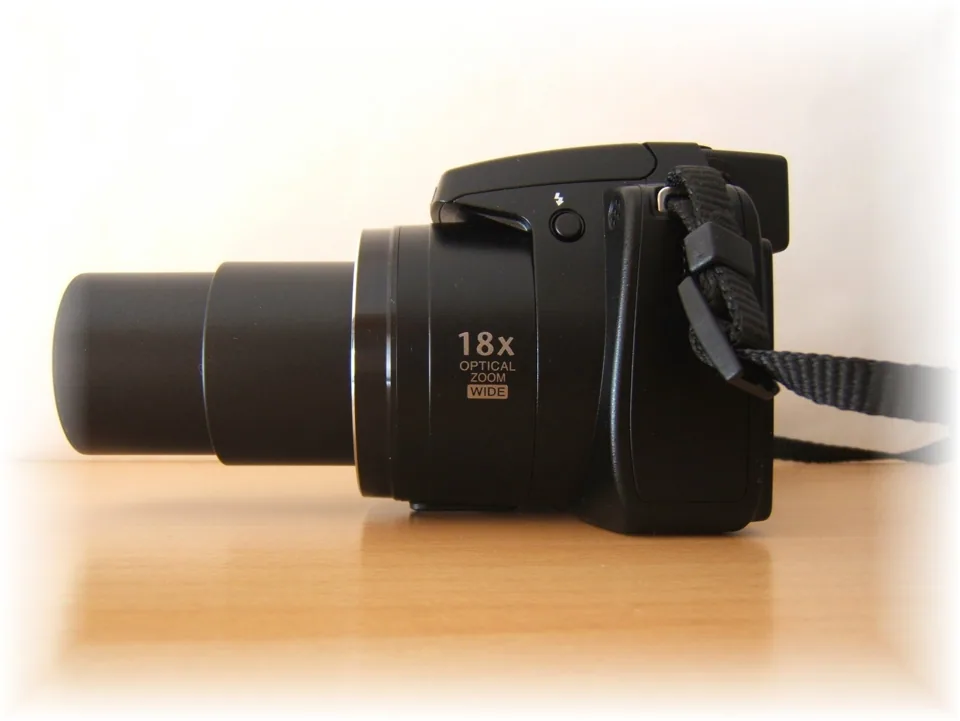
PhotographyBLOG called the lens impressively fast for its range, f/2.8 at 27 mm and f/4.5 at 486 mm, with a macro mode from 1 centimetre.4 Neocamera noted that recent Fujifilm and Olympus ultra-zooms had the same range, and that Olympus had since moved to 26 to 520 mm.6
Late to a crowded class
PhotographyBLOG called it Nikon's first super-zoom compact and noted that Olympus, Fujifilm and Panasonic had released comparable models over a year earlier.4 Neocamera counted differently: Nikon was returning to the ultra-zoom segment after four years away.6 DPReview's 2009 group test also described it as Nikon's first attempt at a DSLR-like compact since the Coolpix 8800 of 2004.9 We could not reconcile that with PhotographyBLOG's "first", and Nikon's releases make no claim either way.12 See also our Coolpix P50 (autumn 2007) and Coolpix P7000 (2010) retrospectives.11
Real exposure control
Nikon's release lists program, shutter-priority, aperture-priority and manual exposure, plus an all-new Sport Continuous mode.1 PhotographyBLOG gave the limits as an 8-second longest shutter and f/2.8 to 8, and missed a second dial on the grip.4 Trusted Reviews liked the rear dial that changes either setting in one step.5
What was lost
Trusted Reviews was disappointed that the camera shoots only JPEG, and noted that the noise reduction cannot be switched off: the choices are auto and on.5 There is no stabiliser button: PhotographyBLOG found that turning VR on or off means turning the mode dial to Setup and using the menu, which the reviewer did again and again, and ISO and white balance have no dedicated controls either.4 Imaging Resource said the 4x digital zoom looked like a watercolour.7 ISO 3200 and 6400 work only at 3 megapixels or smaller;25 Nikon's US release gives the ISO 6400 limit as 5 megapixels,1 but the Tokyo release, Trusted Reviews and Neocamera say 3, so we use 3.256
The dark: its weak point
The four reviewers drew the line at different places. PhotographyBLOG saw no discernible noise at ISO 64 and 100, noise appearing at ISO 200, obvious noise and blurring by ISO 400, and called ISO 800 an emergency setting and ISO 1600 and 2000 virtually unusable.4 Trusted Reviews found ISO 200 pretty clean and saw the noise reduction softening pictures from ISO 400.5 Neocamera found the noise reduction destructive from ISO 400 and advised against anything above it.6 Imaging Resource, which ran its standard lab scenes, saw moderate noise and significant softening even at ISO 64 and said to stick to ISO 400 and below.7
Imaging Resource's resolution chart gave strong detail to about 1,350 lines per picture height with extinction around 1,900, and said chromatic aberration and demosaicing errors made the figure hard to call.7 Its prints showed chroma noise in the shadows even at ISO 64; ISO 400 looked decent at 8 by 10 inches.7 The photographs below were taken with real P80s; the settings come from each file's EXIF data.






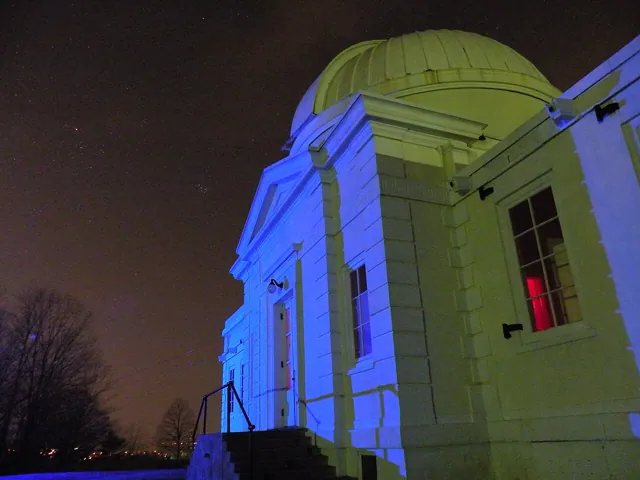

Real photographs taken with this camera, credited under each picture. The first frame is 2048 by 1536 pixels, which fits the 3-megapixel limit Nikon puts on ISO 3200; the other three were shot at ISO 800. The last one records an 8-second exposure, the camera's longest.
Like the sound of it? See recent eBay sold listings for this camera ↗
On eBay right now
Live listings for this camera, supplied by eBay and updated automatically. We earn a commission if you buy through them.
The little wins
A stabiliser you can see working
Trusted Reviews said the shaky viewfinder image snapped to stillness as you framed.5 PhotographyBLOG shot handheld pairs with it off and on, one at 1/8 s and 155 mm, and found the stabilised pictures much sharper.4 Imaging Resource got blurry frames at full telephoto in bright daylight with VR off.7
How it drew the picture
PhotographyBLOG scored image quality 3.5 out of 5 on 10-megapixel JPEGs of about 3 MB and found them a little soft at the default sharpening.4 Imaging Resource was blunter: details soft across the frame, blurred corners at close range, and a verdict that the P80 did not perform up to the standard of the average $400 long-zoom camera.7 On exposure the reviewers split. Trusted Reviews said the matrix metering mostly got it right,5 while Neocamera said it leans so hard on the frame centre that overexposure was very common when the background was brighter than the subject.6 DPReview, in its 2009 group test, called the metering some of the best in that test.9 Neocamera found the lens reasonably sharp,6 where Imaging Resource found the corners quite soft at both ends of the zoom.7
The nine daylight photographs below span the range, from 4.7 mm (27 mm equivalent) at the wide end to 84.2 mm (486 mm) at the long end; the focal length is each file's EXIF value.2 Commons held 20,486 files from this camera when we checked, and in a random draw of 200 of them 117 (58 per cent) came from a single uploader, so the pool shows a few photographers' habits more than the camera's whole range.10


















Photos taken with this camera, from Wikimedia Commons, credited under each picture.
Where it let you down
The viewfinder drew the widest spread of opinion. PhotographyBLOG called it one of the better electronic viewfinders around, with 97 per cent coverage and dioptre adjustment, though slower than an optical finder to keep up with the eye.4 Trusted Reviews found it reasonably good but small, and said the button that switches between finder and screen needs a good push.5 Neocamera called it possibly the P80's biggest problem: dark, coarse and often unusable.6 Imaging Resource measured framing accuracy of about 102 per cent at wide angle and 99 at telephoto and called it very good,7 where Neocamera gave the coverage as 97 per cent and called it poor.6
Speed is the other argument. PhotographyBLOG found start-up in under 2 seconds, about 2 seconds to store a JPEG and continuous shooting at 1 frame per second for 9 frames.4 Neocamera put start-up and shot-to-shot times near 3 seconds and counted only 4 frames at under 1 fps.6 Imaging Resource listed slow start-up among its cons, measured 2.64 seconds between large, fine JPEGs and rated the pre-focused shutter lag excellent.7 PhotographyBLOG called autofocus quick even at the long end; Neocamera found it slowing toward telephoto, to several seconds in low light,46 and DPReview's group test timed 3.3 seconds to the first shot and 2.6 seconds shot to shot and found focus at full telephoto unreliable.9 Fringing is a third disagreement: PhotographyBLOG said chromatic aberration was handled fairly well,4 Trusted Reviews saw purple and green fringes in the centre and the edges,5 and Imaging Resource found it moderate to strong across the frame.7 Battery life is about 250 shots by Nikon's figure and about 225 for PhotographyBLOG, with stabilisation left on.24
What the reviewers said
| Outlet | Date | Verdict |
|---|---|---|
| PhotographyBLOG | June 2008 | Design, features, ease of use and value 4.5 out of 5, image quality 3.5; an excellent first attempt at a super-zoom, let down by image quality worse than some of its main rivals.4 |
| Trusted Reviews | 24 Jul 2008 | Okay for a super-zoom, with reservations: pros 18x zoom, good exposure and solid build; cons fringing, high-ISO noise and not very responsive. Value 8, image quality 7, build quality 8.5 |
| Neocamera | 26 Oct 2008 | A lens that is an achievement in itself, but image quality problems that are hard to ignore next to the Panasonic FZ18 and Fujifilm S8000fd; no score on the pages we read.6 |
| Imaging Resource | 16 Dec 2008 | Enjoyable to use but its images were a disappointment, and better long-zoom cameras exist; fine to ISO 400 for prints up to 8 by 10.7 |
The timeline
- 10 April 2008Nikon announces the P80 in Tokyo and the United States; the US suggested price is $399.95.123
- 14 April 2008Nikon corrects the lens construction on its specification page from 5 groups to 11.2
- February 2009Nikon announces the P90, with a 24x, 26 to 624 mm lens, 12.1 megapixels and a 3-inch vari-angle screen.8
Should you buy one now?
Buy one if you want a stabilised lens that goes from 27 to 486 mm with full manual exposure in one body, you will shoot mostly in daylight at ISO 64 to 200 and you will print no larger than about 8 by 10 inches, the size at which Imaging Resource found ISO 400 files acceptable.7 It launched at $399.95;1 what it sells for now is a question for the sold listings. Before you bid, check these:
- The battery. It takes the EN-EL5 Li-ion, and Nikon's figure is about 250 shots.2 A fresh one is on Amazon ↗.
- The card. It takes SD and SDHC cards and has about 50 MB built in, and Imaging Resource noted that no card comes in the box;27 see our memory card guide.
- The cable. Nikon's specification list names a UC-E6 USB cable among the supplied accessories;2 see our UC-E6 cable page. Imaging Resource listed very slow download speeds among its cons.7
- The finder and screen. Check that the viewfinder is clear, that the finder-or-screen button responds, and that the glossy screen is not scratched; Imaging Resource said it shows scratches.57
- The lens. The lens extends slightly at start-up, so the cap has to come off first,5 and Neocamera found that powering on with the tethered cap in place causes a lens error.6 Check that it extends smoothly, then turn the stabiliser on in the Setup menu and watch the viewfinder at full zoom.45
If you are wondering why cameras like this are being hunted down again, we tell that story once, in Pictures that never left the card; for the vocabulary, see our glossary. For an earlier long-zoom compact, see our Fujifilm FinePix S5200 (10x, 2005).11
See recent sold prices on eBay ↗Shop on eBay ↗EN-EL5 batteries ↗
Sources
- Nikon USA press room, Nikon 'zooms' in on performance with the new Coolpix P80 (10 Apr 2008: MSRP $399.95, available from April 2008)
- Nikon Corporation, Digital Compact Camera Nikon COOLPIX P80 (news release and specification table, April 2008; lens groups corrected 14 Apr 2008)
- Imaging Resource, Nikon announces Coolpix P80 by Mike Tomkins (10 Apr 2008: US$399.95, shipping from April 2008)
- PhotographyBLOG, Nikon Coolpix P80 review by Mark Goldstein (six pages; pages dated 9 June 2008, the first page 11 June 2008)
- Trusted Reviews, Nikon Coolpix P80 review by Jamie Harrison (24 Jul 2008)
- Neocamera, Nikon Coolpix P80 review (two pages, 26 Oct 2008)
- Imaging Resource, Nikon P80 review with lab tests by Stephanie Boozer and Shawn Barnett (16 Dec 2008; specification box lists availability 15 Apr 2008)
- Nikon Corporation, Digital Compact Camera Nikon COOLPIX P90 (news release, February 2009)
- DPReview, 'Super Zoom' Camera Group Test (Q1 2009), Nikon Coolpix P80 section (read 27 Oct 2026)
- Wikimedia Commons, Category: Taken with Nikon Coolpix P80 (20,486 files when we checked on 27 Oct 2026)
- Digicam Atlas, our own Nikon Coolpix P50, Nikon Coolpix P7000 and Fujifilm FinePix S5200 retrospectives (their data files cite the reviews listed there)
The camera photographs are by Algont (CC BY-SA 3.0); sample photographs are credited under each one, all via Wikimedia Commons. Links to eBay and Amazon are affiliate links.