Nikon Coolpix L · announced February 2007
The Nikon Coolpix L12: the $199.95 two-AA compact with a stabilised lens and no say over ISO
We found no other regional name for it; Nikon's US release, Photography Blog's UK launch report and the three reviews we read all call it the Coolpix L12.12456
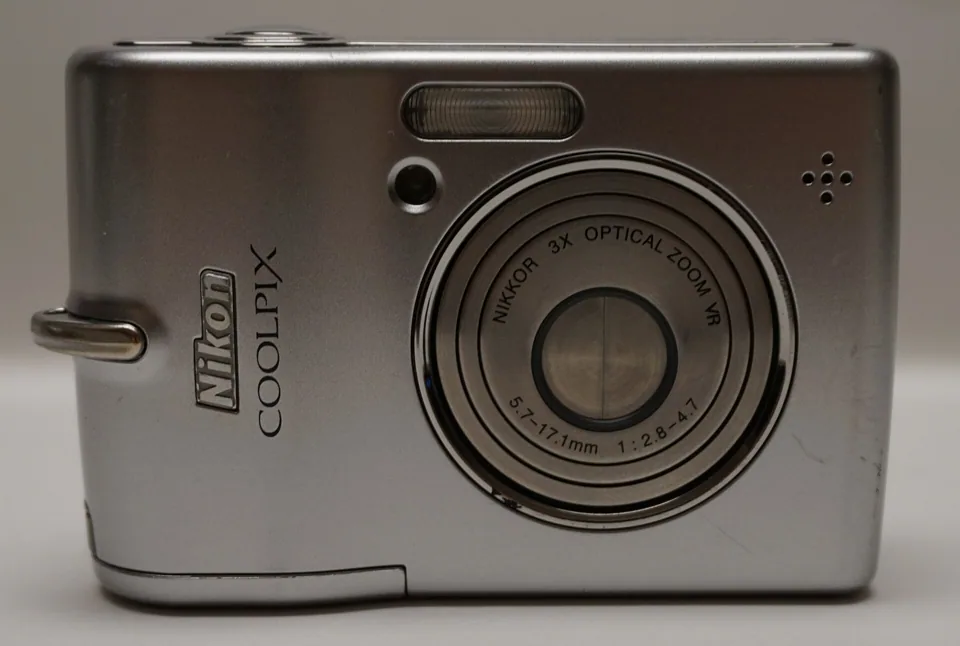

In February 2007 Nikon launched three budget cameras that ran on ordinary AA batteries. The L12 was the dearest and the only one with Vibration Reduction in its lens. Reviewers were surprised to find that feature at the price, and split over whether slow performance and automatic-only ISO cancelled it out.
- Launched
- February 2007
- Sensor
- 7.1 MP CCD
- Lens
- 35–105 mm, 3×
- Card
- SD, SDHC
- Battery
- 2 x AA
Nikon Coolpix L12 specs: sensor, lens, battery, memory card and cable
The Nikon Coolpix L12 is a 7.1 MP CCD compact camera with a 35–105 mm (35 mm equivalent) 3× zoom lens, launched in February 2007 at $199.95. It takes SD and SDHC cards and runs on 2 x AA batteries. Sources
Meet the camera
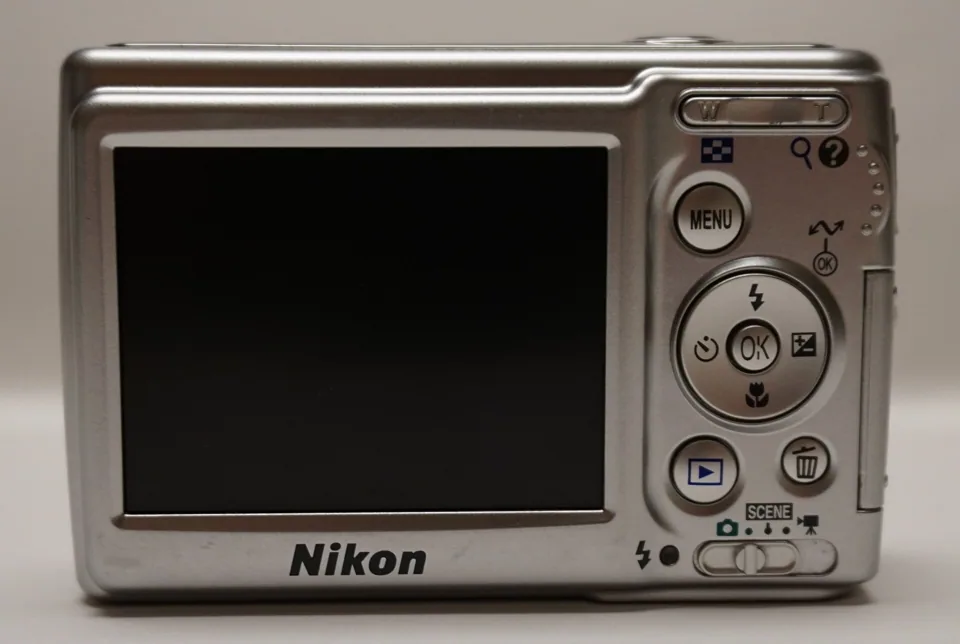
The L12 is a small silver plastic camera with a bulge on the right for its two AA cells. Nikon lists it at 91 by 61 by 26 millimetres and about 125 grams without battery and card; loaded with both, Imaging Resource's design page gives 170 grams, and CNET called it six ounces.264 The body is polycarbonate, but Imaging Resource said the silver finish felt almost metallic and not cheap, and counted it among the best-looking cameras at its price.6 Digital Camera Resource Page (DCRP) thought it well put together, down to a solid battery door, though it found little room for the right thumb and small buttons on top.5 CNET thought the joypad and buttons large enough but the mode slider and zoom rocker slightly too small.4
Nikon USA announced the L10, L11 and L12 on 19 February 2007 at $119.95, $149.95 and $199.95, from March.1 Photography Blog's PMA report a day later, which reprints Nikon UK's release and specification sheet, gave £149.99 and €219 for the L12 and expected it in shops at the beginning of April.2 Prices at review time ran lower: Imaging Resource put the street price at about $160, CNET listed $159.99, and DCRP headed its review with $179.645
- Battery
- 2 × AA (alkaline, oxyride or lithium) or two optional EN-MH1 NiMH · rated 150 shots on alkaline, 370 on EN-MH1, 600 on lithium, to CIPA2
Sources differ on several details. Weight: about 125 g without battery and card (Nikon's sheet, Imaging Resource's table, DCRP), 170 g with cells and card (Imaging Resource's design page).7526 Macro: Nikon's specification sheet and DCRP's test give a 15 cm closest focus; Imaging Resource's spec table says 5 cm, while its review text says the camera backs you off to about six inches (about 15 cm).2576 ISO: Nikon gives automatic 50 to 1600, but Imaging Resource's lab saw the automatic setting range from 50 to 1000.26 Availability: Nikon said March 2007, Photography Blog said early April, and Imaging Resource's table gives 31 March.127 The archived DCRP printer-friendly copy prints its posting year as 2006, but the camera did not exist then and the archived first page says 13 August 2007.5
Why this one was interesting
Stabilisation at the bottom of the range
The lens carries a floating element that shifts to cancel hand shake; Imaging Resource noted you can hear it rattle if you shake the camera, and Reviewed.com said the feature came over from the L5 that Nikon introduced in August.63 CNET called stabilisation and face-priority focus the kind of features usually found on dearer Nikons such as the Coolpix S500.4 DCRP called the L12 one of a very small group of entry-level cameras with stabilisation under $200, and of the ten rivals it tabulated only Canon's PowerShot A570 IS and Panasonic's Lumix DMC-LS75 had it too; see our PowerShot A570 IS review.5
Two reviewers showed the effect. Imaging Resource got a sharp macro shot at 1/9 second, far slower than the 1/30 second it said even the best can hold steady, and DCRP found that a telephoto shot at 1/30 second that blurred with stabilisation off came out clean with it on, though it warned stabilisation will not freeze a moving subject.65
A face-finder on a button
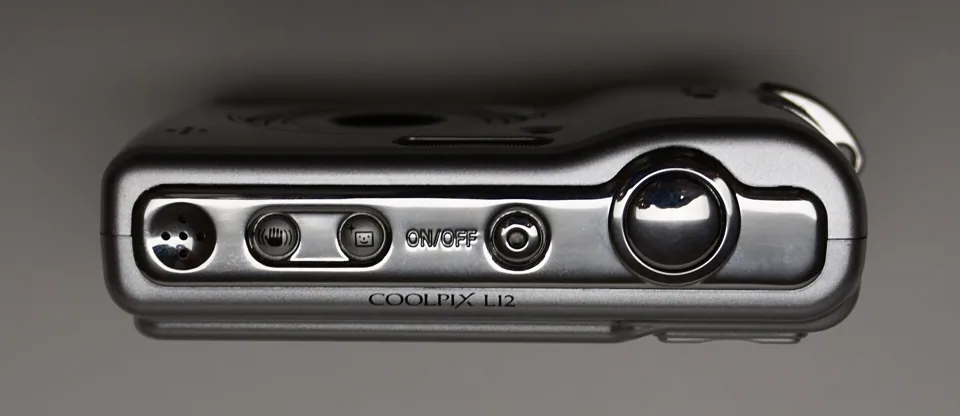
On the L10 and L11 face-priority autofocus sat in the scene menu; on the L12 a top-panel button switched straight to it, with red-eye fix and portrait mode.61 Imaging Resource found it reassuring once you stopped dancing in front of the camera to watch it draw boxes.6 DCRP was less kind: in its test the camera never found more than two of six faces, and was slower than other makers' systems.5
Two AA cells, and a choice of what to put in them
Nikon rated it at about 150 shots on alkaline cells, 370 on its EN-MH1 NiMH cells and 600 on lithium, to the CIPA method.2 Imaging Resource found it a surprise that the L12 beat the L11 on NiMH despite its extra resolution and moving lens element, and noted that lithium cells keep their charge while sitting in the camera, which could suit one used only now and then.6 DCRP noted that Nikon rated the 370 on 2000 mAh cells, and guessed that 2500 mAh cells would give about 460, which is its own extrapolation, not a Nikon figure. It also pointed out that the two alkaline cells in the box would soon be in the bin.5 For AA cells in a later Nikon, see our Coolpix L810 review (four of them); for the 2006 generation, our Coolpix L3 review.
A dock connector for Kodak printers
The base carries an ImageLink connector, and a clear plastic insert for Kodak EasyShare printer docks came in the box (Nikon's UK list names it Dock Insert PV-13); the L10 had no ImageLink connector.62 DCRP called the L12 one of a very small group of non-Kodak cameras to support it, and told buyers to fit the insert to the dock before seating the camera.5
What was lost
The L12 gave up control in exchange for simplicity. It offered almost no manual control: DCRP counted preset white balance as the only manual control (its own menu list also shows exposure compensation of plus or minus 2 EV), and even ISO could not be set.5 There was no viewfinder, no live histogram and no exposure information in playback.65 Digital zoom stepped slowly and gave poor detail.6 Imaging Resource added that the L12 recorded AVI video where the L10 and L11 recorded MOV,6 while DCRP found an audio and video sync bug that cut the sound a few seconds before the end of its sample clip, and said it had seen the same fault in other Nikons for over a year.5 It also found the tripod mount was plastic.5
The dark: its weak point
Because ISO is automatic, the camera decides how noisy a dim picture will be, and all three reviewers disliked that. CNET said it raises sensitivity to as high as 1600 on its own and that indoor and low-light shots vary wildly; in dim light, it said, noise and the noise reduction wipe out much of the detail, making the camera almost useless there.4 Imaging Resource's lab explained the mechanism: the longest exposure is one second, so the camera raises ISO instead, reaching ISO 910 at a quarter foot-candle. At one foot-candle, about street lighting at night, it still made very good 4 by 6 prints and acceptable 5 by 7s.6 DCRP tested on a tripod, where ISO 400 is the last thing you would choose, and saw the camera choose it anyway, leaving its macro shot noisy and its night shot soft and noisy.5 Its verdict: this is not a camera for low light, night or tripod work.5
The reviewers disagreed on focus in the dark. Imaging Resource said autofocus worked unassisted down to just below half a foot-candle; DCRP said low-light focusing was quite poor despite the assist lamp.65 The Anti-Shake button, which turns on stabilisation, raises ISO beyond auto and switches on Best Shot Selector, was something DCRP advised skipping for its noise.51
These four strips are ISO 800 to 1000, read from each file's own data: a lit pumpkin, a bridge tower at night and two interiors, not a pitch-black room.








On the flash, the reviewers disagreed about power. Imaging Resource called it slightly weak, with uneven coverage at wide angle; it found the camera matched Nikon's rated range of 26 feet 3 inches wide and 14 feet 9 inches at telephoto, though at full telephoto it had to raise ISO to 514, and its wide-angle shot at 26 feet came out underexposed, which it blamed on reflective studio walls.62 DCRP called the flash powerful for a compact and liked the two-stage red-eye system: pre-flashes first, then software removal if red-eye is still found.5 All three complained about recycling; the table below has their figures.
On eBay right now
Live listings for this camera, supplied by eBay and updated automatically. We earn a commission if you buy through them.
The little wins
Sharp at 1/9 second
Stabilisation was the headline, and Imaging Resource's macro shot at that slow speed came out sharp.6 DCRP's telephoto comparison at 1/30 second showed the same gain, and it noted that stabilisation also works while recording video.5
Stop-motion movies
A stop-motion mode overlays the last frame on the screen so you can line up the next, and builds up to 1,800 frames into a silent 640 by 480 film at 15 frames per second, Imaging Resource and DCRP both said.65 Imaging Resource also liked that holding Playback powers the camera on without extending the lens.6
Flash in macro
Imaging Resource said most digicams sit too close in macro mode for flash to light the subject, but the L12's throttled down and covered the frame fairly evenly.6
Red-eye caught twice
DCRP said the two-stage system did a pretty good job on its flash test, and called red-eye the one thing the L12 handled really well.5
How it drew the picture
In good light all three liked the results. CNET called them nice and colourful.4 DCRP saw accurate exposure and pleasing colour but soft fine detail in grass, leaves and hair, which it put down to noise reduction, plus corner blur.5 Imaging Resource measured strong detail to about 1,400 lines across and 1,300 down, good colour with slight oversaturation in reds, blues and greens, and exposure better than average outdoors; it kept skin tones in check but pushed some reds toward orange.6 Its prints were crisp at 8 by 10 inches and softer at 13 by 19, with the soft corners showing at that size; indoor shots at ISO 400 looked good at 5 by 7 and rough at 8 by 10.6


















Photos taken with this camera, from Wikimedia Commons, credited under each picture. Our catalogue counted about 5,700 files in Commons' "Taken with Nikon Coolpix L12" category; the nine here were picked for variety, so judge sharpness and highlights yourself.
The lens drew two small arguments. Imaging Resource measured 1.2 percent barrel distortion at wide angle, a good bit above average, with moderately high colour fringing there; DCRP called the distortion fairly mild and the purple fringing minimal.65 Imaging Resource called the dark corners at wide angle a surprise, while DCRP said its vignetting barely showed up in a few sample photos; both saw softness in the corners.65
Where it let you down
Speed was where the reviews were least alike, and each measured it differently:
| Imaging Resource | CNET | Digital Camera Resource Page | |
|---|---|---|---|
| Switch on to first shot | 2.7 s6 | 2.5 s4 | a little over 2 s to extend the lens5 |
| Shutter lag with autofocus | 0.37 s wide, 0.63 s tele6 | 0.7 s on a high-contrast target, 2 s on a low-contrast one4 | not a problem; focus lock 0.4 to 0.6 s in good light, often over a second in harder conditions, especially at tele5 |
| Shutter lag, prefocused | 0.077 s6 | – | – |
| Shot to shot, no flash | 2.71 s6 | 2.4 s4 | a little over 2 s5 |
| Flash recycle | 12 s at full power6 | 8.6 s, with the screen blanked4 | over 5 s shot to shot with flash5 |
| Burst | 0.81 frames/s at full size, 1.48 at 640×4806 | 1.5 frames/s, 15 shots in just under 10 s4 | about 0.9 frames/s5 |
| USB download | 970 KB/s6 | – | no USB 2.0 High Speed, so slow5 |
The last row is a real conflict. Imaging Resource's own table puts anything above 770 KB/s in its USB 2.0 High band, yet its text calls 970 only a little above average, its conclusion lists average download speed as a con, and its specification tables list USB 1.1; DCRP says the camera lacks High Speed. We could not settle it from the pages.675
The rest was handling. Imaging Resource said its worst trouble came at the start, hunting for a Mode dial that is really a switch, and found the Vibration Reduction setting that decides whether stabilisation is on lives in the Setup menu.6 CNET disliked that the screen blanks while the flash recharges, which stops you reviewing a photo or switching the flash off.4
What the reviewers said in 2007
| Outlet | Date | Verdict |
|---|---|---|
| CNET | 5 Jun 2007 | 3.0 stars, with 7 for design and features, 5 for performance and 6 for image quality. Stabilisation and face detection are nice, but slow shooting, the flash and uneven low-light pictures meant it could not recommend it; it pointed to the Samsung S850 and Canon A630 for more control and the Sony DSC-W55 for ease.4 See our DSC-W55 review. |
| Digital Camera Resource Page | 13 Aug 2007 | No score on the page. Worth a look for a compact, easy, inexpensive camera used mostly outdoors; anyone shooting in low light should find one with manual ISO control and better focusing.5 |
| Imaging Resource | 3 Sep 2007 | Dave's Pick: simple, well balanced, with stabilisation at a surprisingly low price. Among its cons were poor digital zoom, wide-angle distortion, slow flash recycling and no manual ISO or viewfinder.6 |
The timeline
- 19 February 2007Nikon USA announces the L10, L11 and L12; the L12 is $199.95, from March.13
- 20 February 2007Photography Blog's launch report gives UK and euro prices and expects April availability.2
- 31 March 2007Availability date in Imaging Resource's spec table.7
- 5 June 2007CNET posts its review; Internet Archive copies taken before it have no review and one from 9 June shows it, which rules out a 6 May reading of 06/05/2007.49
- 13 August 2007DCRP posts its review.5
- 3 September 2007Imaging Resource's review is dated 9/3/07, which we read as US month and day: an Internet Archive copy of 10 September 2007 already carries the full review, while one of 16 July was only a short "First Shots" page.68
Should you buy one now?
Buy one if you want a very simple pocket camera that takes AA cells, you shoot mostly outdoors, and you are happy to print small or share on a screen. It launched at $199.95;1 what it sells for now is a question for the sold listings, not for us. Before you bid, check these:
- The name. Search the Coolpix L12. The 5-megapixel L10 and 6-megapixel L11 look similar but have no stabilisation; the L12 has a Vibration Reduction button on top and, in Commons' photo of one, "VR" printed on the lens ring.16
- Stabilisation. Whether it stays on is a Setup menu setting, though pressing the Anti-Shake button also turns it on.6 Check that it is on. Imaging Resource said a slight rattle when you shake the camera is the floating lens element, which it gave as the reason for the sound.6
- The batteries. It takes two AA cells, and Imaging Resource and DCRP both urged NiMH rechargeables.65 The Setup menu has a Battery Type option for alkaline, NiMH or lithium.6 The cells fall free when the door opens, so check that the latch holds.6 A set of rechargeables is on Amazon ↗.
- The card. Nikon's specification sheet lists SD cards and its feature list adds SDHC compatibility; DCRP says SD, SDHC and MMC. The built-in 21 MB holds only six full-size shots.25 We have not tested a large card in one, so test yours; see our memory card guide and the glossary.
- The lens. A shutter-like cover slides aside and the lens telescopes out about three-quarters of an inch, so check that it extends and retracts cleanly.6
- The dock insert. If you want to print with a Kodak printer dock, ask whether the clear plastic insert is included; it came in the box.652
- The cable. The camera has one port for USB and audio-video.5 Nikon's UK specification sheet lists a UC-E6 USB cable and an EG-CP14 audio/video cable among the supplied accessories, adding that these may differ by country or area;2 see our UC-E6 page and cable guide.
If you are wondering why cameras like this are being hunted down again, we tell that story once, in Pictures that never left the card.
See recent sold prices on eBay ↗Shop on eBay ↗AA rechargeable batteries ↗
Sources
- Imaging Resource, Nikon: Three new L-series digicams, by Mike Tomkins (19-20 Feb 2007; includes Nikon USA's press release of 19 Feb 2007 and spec tables)
- Photography Blog, Nikon Coolpix L12, by Mark Goldstein (20 Feb 2007; PMA launch report reprinting Nikon UK's press release, feature list and full specification sheet, with UK and euro prices; not a review)
- Reviewed.com, Nikon Updates L-Series, by Karen M. Cheung (19 Feb 2007; launch news, not a review)
- CNET, Nikon Coolpix L12 review, by Will Greenwald (5 Jun 2007; read from an Internet Archive copy of Oct 2008)
- Digital Camera Resource Page, Nikon Coolpix L12 review, by Jeff Keller (posted 13 Aug 2007 per the archived first page; read from the printer-friendly copy archived Oct 2007, last updated 24 Sep 2007)
- Imaging Resource, Nikon L12 review (overview and user report by Mike Pasini, dated 9/3/07 on the page; design, optics, exposure and performance pages are Imaging Resource's lab text)
- Imaging Resource, Nikon L12 specifications table (undated)
- Internet Archive capture of the Imaging Resource L12 review page, 10 Sep 2007 (shows the full review with 'Review Date: 9/3/07'; a capture of 16 Jul 2007 is a shorter 'First Shots' page)
- Internet Archive capture of the CNET L12 page, 9 Jun 2007 (shows 'Reviewed on 6/5/07'; captures from 29 May to the early hours of 5 Jun 2007 UTC carry no review)
Photographs are credited under each one, all via Wikimedia Commons. Links to eBay and Amazon are affiliate links. The CNET and Digital Camera Resource Page reviews are read from the Internet Archive.