Nikon Coolpix P · on sale October 2007
The Nikon Coolpix P50: the $230 compact that looked like a serious camera and ran on AA batteries
Sold under one name, the Coolpix P50, in the sources we read.
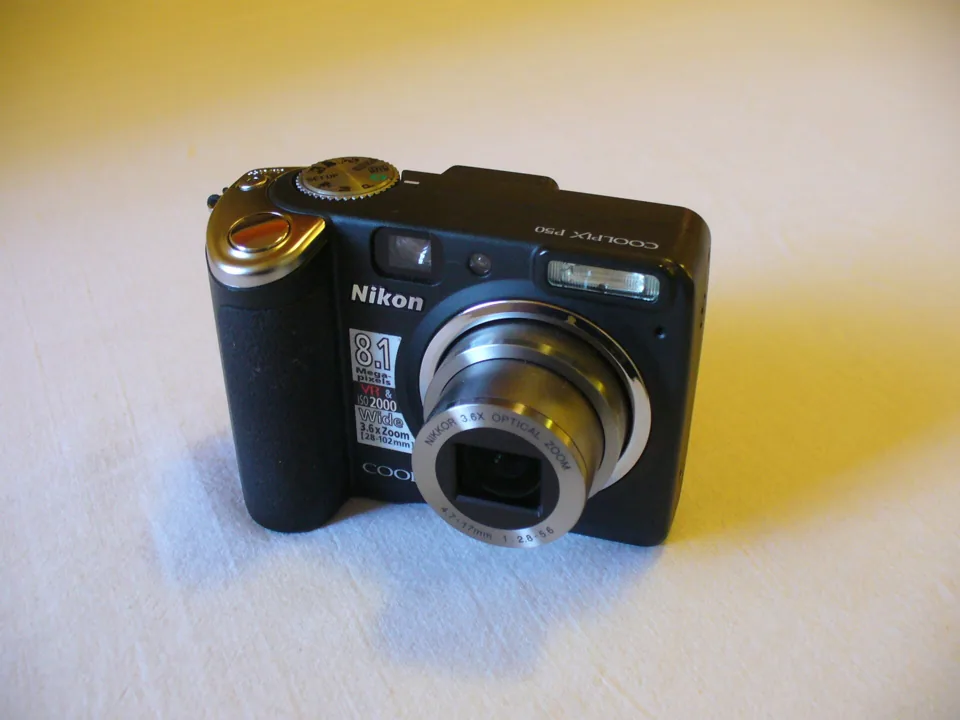

In 2007 Nikon sold a squared-off, wide-angle compact with an optical viewfinder, manual exposure and two AA batteries for $229.95. Reviewers called it good value, then disagreed about its speed, its noise and whether the pictures were too soft or too sharp.
- Launched
- August 2007
- Sensor
- 8.1 MP CCD
- Lens
- 28–102 mm, 3.6×
- Card
- SD, SDHC
- Battery
- AA
Nikon Coolpix P50 specs: sensor, lens, battery, memory card and cable
Launched in August 2007 at $229.95, the Nikon Coolpix P50 is an 8.1 MP CCD compact with a 28–102 mm (35 mm equivalent) 3.6× zoom lens. Inside: it takes SD and SDHC cards and runs on AA batteries. Sources
Meet the camera
It is a square, grippy camera,5 sold in black or silver,45 that Trusted Reviews called physically quite large for a compact: PhotographyBLOG's specification list gives about 94.5 by 66 by 44 millimetres and 160 grams without battery and card,4 and Trusted Reviews gave 210 grams including alkaline cells and warned that it would take up a lot of room in a pocket.5 Trusted Reviews called the body plastic and a little flimsy, with a top panel that flexed and creaked when squeezed.5 PhotographyBLOG's verdict on the look was that it appears more expensive than it is.4
Nikon announced it on 30 August 2007, together with the 12-megapixel P5100, at a US suggested price of $229.95 and with availability in October.1 PhotographyBLOG's announcement gave £199.99 or €300 with sales from October,3 while DPReview's summary of the same Nikon UK release says UK sales from September 2007 at £199.99 and the release text it reproduces says autumn 2007.2 UK prices then drift: by its December 2007 review PhotographyBLOG saw it for under £150 against an official £199,4 Trusted Reviews quoted a list price of £149.99 and a street price under £130,5 and Popular Photography, in December 2008, said about $160 in the shops.6
Why this one was interesting
A 28 mm lens and manual modes for snapshot money
The lens starts at a 28 millimetre equivalent, as Nikon UK's announcement put it,3 and Nikon USA's release lists program and manual exposure and Face-Priority AF that can find up to 12 faces.1 Trusted Reviews said the manual option set the camera apart from many compacts, and compared it with Canon's A580, which had a near-identical specification and a 4x zoom.5 PhotographyBLOG's conclusion praised the wide angle and a broader focal range than the average compact.4 Our Canon PowerShot A590 IS retrospective covers a Canon camera of 2008 built on the same recipe: two AA batteries, an optical viewfinder and a 4x zoom starting at 35 mm.8
The cheaper partner of the P5100
Nikon's release laid out the split. The P5100 had 12.1 megapixels, a 3.5x zoom with optical VR, ISO 3200, a magnesium-alloy body, an accessory shoe, a 2.5-inch screen, a Li-ion battery and $399.95 on the ticket. The P50 had 8.1 megapixels, electronic VR, ISO 2000, a 2.4-inch screen, AA batteries, program and manual modes only and $229.95.1 Trusted Reviews set it in context: the P5000, launched in February 2007, was the first Nikon compact in nearly three years aimed at more than the snapshot market, and the P50 was the base model of the series.5 The P name carried on in our Coolpix P7000 (2010) and Coolpix P340 (2014) retrospectives.8
Ordinary batteries
Popular Photography said Nikon had simplified the power source to two standard AA cells, and called the CIPA rating of about 140 shots respectable for two cells; it added that real-life evaluations, which it did not describe, ran at 200 to 230 shots with fresh batteries.6 Nikon listed optional EN-MH1 rechargeable cells and an MH-71 charger.4
What was lost
The stabiliser is the obvious gap. Popular Photography explained that the P50 reads shake with an angular velocity sensor but corrects it in the image processor instead of moving a lens element, which it said would not match optical VR, though it thought the system worked well in its samples.6 PhotographyBLOG was less impressed: in low light at full telephoto it saw camera shake anyway, and said the electronic system seemed only to add noise, giving pictures both blurred and noisy; its conclusion lists the lack of true VR as a drawback.4 Popular Photography also noted there is no raw capture.6 Trusted Reviews found the manual mode narrow: only the minimum and maximum aperture can be chosen, shutter speeds run from eight seconds to 1/1000 second in whole stops, and there is no aperture or shutter priority.5
The dark: its weak point
The three full reviews disagreed about noise. PhotographyBLOG saw noise from ISO 400 upward and called ISO 1600 and 2000 appallingly noisy on the rear screen, though on a computer it thought both usable at a push.4 Trusted Reviews noted some colour distortion in dark areas at ISO 200 and called ISO 400 good, ISO 800 usable and anything higher severely noisy.5 Popular Photography, by contrast, said it had to zoom to 200 per cent in Photoshop before it saw the usual point-and-shoot noise and artefacts, and credited Nikon's EXPEED processor; it did not say at which ISO.6
Night work was limited. PhotographyBLOG found the longest shutter speed in night scene mode, four seconds, fairly disappointing for serious night photography.4 Trusted Reviews said the autofocus slows as light falls and that the assist lamp reaches only a couple of metres.5 The photographs below were taken with real P50s, with the ISO and shutter speed read from each file's own EXIF data.


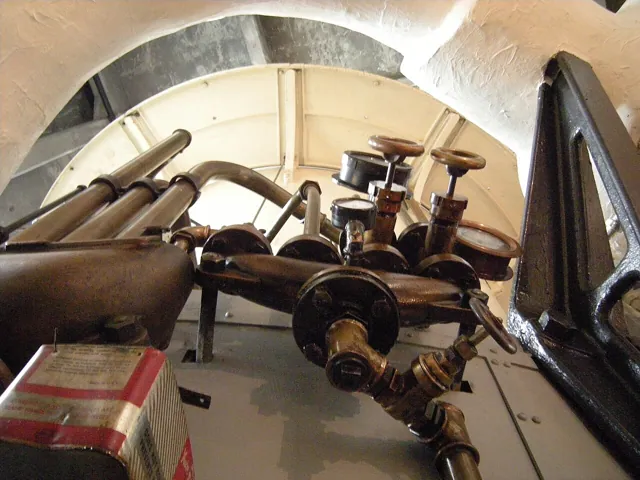





Real photographs taken with this camera. The sensitivity and shutter speed shown are recorded in each file's own EXIF data. These four frames were shot at ISO 407 to 800, well below the 1600 and 2000 settings the reviewers disliked most, and the basilica, at ISO 407, is a modest setting, so the strip shows ordinary indoor sensitivities rather than the worst case.
Like the sound of it? See recent eBay sold listings for this camera ↗
On eBay right now
Live listings for this camera, supplied by eBay and updated automatically. We earn a commission if you buy through them.
The little wins
A real wide angle
PhotographyBLOG's conclusion called the wide-angle lens an advantage, and Trusted Reviews called the 28 mm end useful for wide panoramic shots, adding that the 102 mm long end was no better than most 3x zoom compacts.45
Zoom while filming
Popular Photography found that the lens zoomed during video recording, silently and smoothly, which it said many cameras at this price did not allow.6
Handling tricky light
PhotographyBLOG said it handled tricky exposures better than expected, with even results from its multi-segment metering and vivid reds, greens and blues at default settings.4 Trusted Reviews found dynamic range pretty good, with good shadow detail but some burned-out highlights, and liked the playback D-Lighting that brightens shadows.5
How it drew the picture
PhotographyBLOG scored image quality 3.5 out of 5 on 8-megapixel JPEGs of about 2.5 MB, and found them soft at the default sharpening and better for sharpening on a computer.4 Trusted Reviews said the opposite about the same setting: the default sharpening is severe and detailed images look over-processed.5 It added significant barrel distortion at the wide end, slight pincushion at the long end and detail no better than most other 8-megapixel compacts, which it put down to an identical 1/2.5-inch sensor.5 The nine daylight photographs below come from several Commons contributors, so they show subjects and light more than the camera's range.
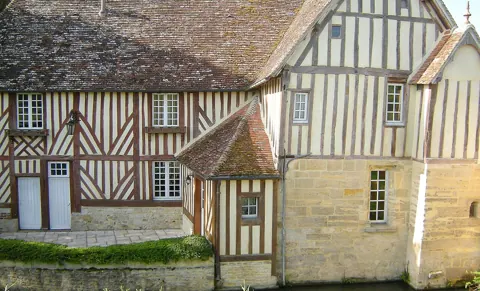

















Photos taken with this camera, from Wikimedia Commons, credited under each picture.
Where it let you down
The optical viewfinder, which Popular Photography noted many cameras at this price lack, drew some of the harshest criticism. Trusted Reviews put frame coverage at about 75 per cent, very bad parallax and no framing lines, and called it virtually useless for composing a shot.5 Popular Photography put coverage at 80 per cent, added that there is no dioptre adjustment and that an index finger can intrude, and told readers to frame with the screen.6 PhotographyBLOG found it small enough for the reviewer's nose to touch and smear the screen.4 The screen itself, at 115,000 dots, drew a verdict of reasonable but hazy from PhotographyBLOG,4 a glossy finish Trusted Reviews called so shiny you could shave in it, and glare that Popular Photography found extreme with the sun behind the photographer.56
Speed depends on whose camera you believe. PhotographyBLOG put start-up at about two seconds and found little shutter lag but two to three seconds to save a full-resolution JPEG.4 Trusted Reviews found nearly 3.5 seconds to start, about 2.5 seconds between single shots and autofocus that hunted at telephoto.5 Popular Photography called focus quick and snappy and counted six frames in five seconds, 18 images before the buffer filled.6 Close focus was weak: Popular Photography noted a 5 centimetre limit against 1 centimetre on some Canon, Fuji and Olympus rivals.6
Battery life is a three-way conflict: about 140 shots by the CIPA standard,4 200 to 230 shots in the real-life evaluations Popular Photography cited, with fresh cells,6 and just over 100 shots before PhotographyBLOG's AA cells were almost spent.4
What the reviewers said
| Outlet | Date | Verdict |
|---|---|---|
| PhotographyBLOG | 17 Dec 2007 | Design 4, features 4, ease of use 4, image quality 3.5 and value 5 out of 5; cannot deliver miracles at the price but is easy and reliable in most conditions, with no true VR.4 |
| Trusted Reviews | 5 Feb 2008 | A simple compact dressed up as an enthusiast's camera; not bad value at £130, but limited features, average performance and a build it listed as poor; it listed 8 for value and 7 for image quality.5 |
| Popular Photography | 17 Dec 2008 | No score; an excellent performer and a really excellent deal for under $200, with weak macro and a cramped viewfinder.6 |
| Imaging Resource | Undated | Overview only, with no verdict: the economy sibling of the P5100, noting that optical viewfinders are increasingly rare.7 |
The timeline
- 30 August 2007Nikon announces the P50 and P5100; DPReview posts the specifications.12
- October 2007US availability; Imaging Resource's table lists 30 October.17
- 17 December 2007PhotographyBLOG publishes its review.4
- 17 December 2008Popular Photography publishes its review.6
Should you buy one now?
Buy one if you want a simple CCD compact with a 28 mm wide end that runs on ordinary AA cells, you will shoot mostly in daylight at ISO 64 to 200, and you will frame on the screen rather than the viewfinder. It launched at $229.95;1 what it sells for now is a question for the sold listings, not for us. Before you bid, check these:
- The batteries. It takes two AA cells; reviewers reported anything from just over 100 to 230 shots.46 Rechargeable AAs are on Amazon ↗.
- The card. It takes SD and SDHC cards and has about 52 MB built in;14 see our memory card guide.
- The cable. PhotographyBLOG's specification page lists a UC-E6 USB cable among the supplied accessories;4 see our UC-E6 cable page.
- The screen and viewfinder. Check the glossy screen for scratches and that the viewfinder is clear; reviewers disliked both even when new.56
- The lens. Check that it extends and retracts cleanly.
If you are wondering why cameras like this are being hunted down again, we tell that story once, in Pictures that never left the card; for the vocabulary, see our glossary.
See recent sold prices on eBay ↗Shop on eBay ↗AA rechargeable batteries ↗
Sources
- Nikon USA press room, Nikon's new P-series cameras (30 Aug 2007: P50 at $229.95, P5100 at $399.95, P50 available October 2007)
- DPReview, Nikon Coolpix P50 announcement and specification table (30 Aug 2007; the table is marked as not final in places)
- PhotographyBLOG, Nikon P50 announcement by Mark Goldstein (31 Aug 2007: £199.99 / €300, sales from October)
- PhotographyBLOG, Nikon Coolpix P50 review by Gavin Stoker (17 Dec 2007; six pages, including its specification list and ratings)
- Trusted Reviews, Nikon CoolPix P50 review by Cliff Smith (5 Feb 2008)
- Popular Photography, Camera Review: Nikon Coolpix P50 by Mark Lent (17 Dec 2008)
- Imaging Resource, Nikon P50 overview and specifications (undated; availability 30 Oct 2007; no lab results on the page we read)
- Digicam Atlas, our own Canon PowerShot A590 IS, Nikon Coolpix P7000 and Nikon Coolpix P340 retrospectives (their data files cite the reviews listed there)
The camera photograph is by Leandro Ciuffo (CC BY 2.0); sample photographs are credited under each one, all via Wikimedia Commons. Links to eBay and Amazon are affiliate links.