Canon PowerShot ELPH · on sale October 2006
The Canon PowerShot SD900 (Digital IXUS 900 Ti): the titanium ELPH, and whether it was worth the money
Sold in Europe as the Digital IXUS 900 Ti and in Japan as the IXY Digital 1000.
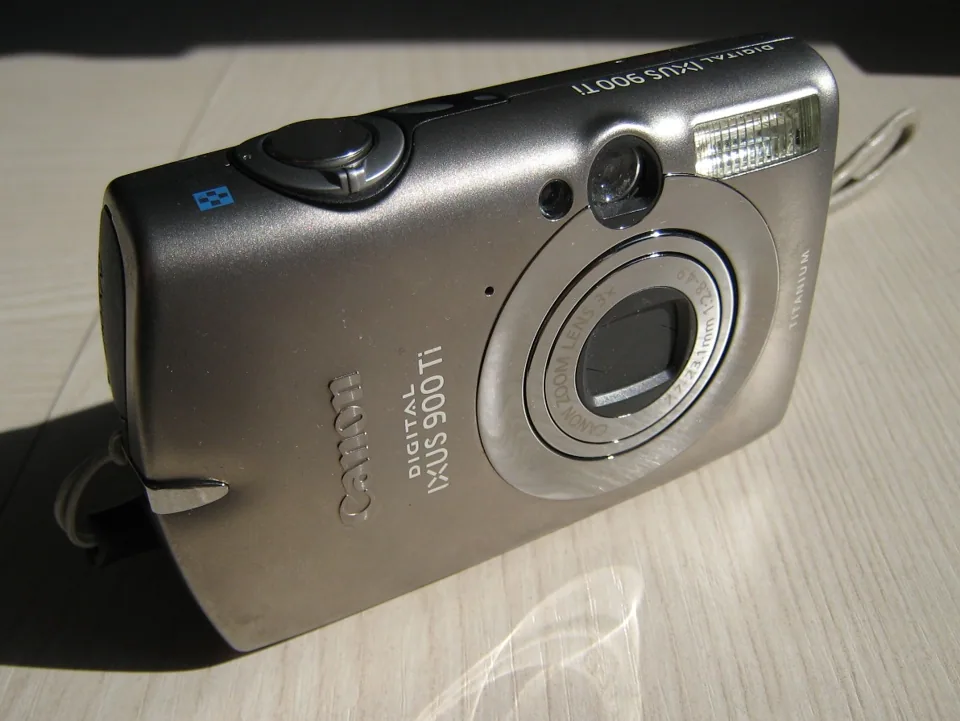

In 2006 Canon cast its flagship pocket camera in titanium and gave it a 10-megapixel sensor. Reviewers admired how it was made and how it drew, then split on whether anyone needed to pay that much for it.
- Launched
- October 2006
- Sensor
- 10 MP CCD
- Lens
- 37–111 mm, 3×
- Card
- SD, SDHC, MultiMediaCard
- Battery
- NB-5L
Canon PowerShot SD900 specs: sensor, lens, battery, memory card and cable
The Canon PowerShot SD900 (also sold as the Digital IXUS 900 Ti and IXY Digital 1000) came out in October 2006 as a 10 MP CCD compact with a 37–111 mm (35 mm equivalent) 3× zoom lens. It runs on the NB-5L battery. Sources
- Sensor
- CCD, 1/1.8", 10 MP source
- Lens
- 37–111 mm equivalent, 3× zoom source
- Memory card
- SD, SDHC, MultiMediaCard source
- Battery
- NB-5L source
- Also sold as
- Digital IXUS 900 Ti · IXY Digital 1000
- USB / A/V cable
- IFC-400PCU, AVC-DC300 Partly confirmed · all Canon cables
Meet the camera
Canon's museum page presents it as the best-quality model of the IXY line and the successor to the IXY 700 of September 2005: a 10.0-megapixel CCD and the DIGIC III processor also found in the PowerShot G7, in a body of pure titanium that the company called light, durable and resistant to rust and dirt.1 Canon's US announcement added that it was the first time the Digital ELPH's curved design had been rendered in titanium, and likened its size to a deck of playing cards.2 Its weight is listed as about 165 grams for the body alone;1 DPReview put it at around 194 grams fully loaded, enough to feel solid without feeling heavy.3
It had three names. Canon sold it as the PowerShot SD900 Digital ELPH in North America, the Digital IXUS 900 Ti in Europe and the IXY Digital 1000 in Japan.1 Canon announced the SD900 on 14 September 2006 alongside the SD800 IS and the SD40, and Canon's museum lists October 2006 as the marketing date.21 The launch price is a matter of which source you read, so here they are side by side:
| Source | Price |
|---|---|
| Canon US announcement, 14 Sep 2006 | Estimated selling price $499.99.2 |
| Imaging Resource spec sheet | MSRP $500, availability 10/2006.4 |
| DPReview, Jan 2007 | Street price $399 in the US and £298 in the UK; the text calls it a $450 compact.3 |
| PhotographyBLOG, Feb 2007 | A penny shy of £400 in the UK.5 |
| Popular Photography test page | $425.6 |
- Sensor
- 10.0 MP CCD, 1/1.8"1
- Screen
- 2.5", about 230,000 dots, plus an optical viewfinder1
- Video
- 1024 × 768 at 15 fps, or 640 × 480 at 30 fps, Motion JPEG1
- Card
- SD / SDHC / MMC; the boxed card is 16 MB in Canon's museum spec, 32 MB in the US announcement sheet and in three reviews124356
- Size
- 91.2 × 59.6 × 28.2 mm, about 165 g body only1
Why this one was interesting
A metal body as the main feature
DPReview said the SD900 was functionally pretty much indistinguishable from its stable mates, and that the titanium case was more a talking point than a practical advantage unless you expose the camera to corrosives or leave it in the bottom of a bag with your keys; it still called it more durable than other ELPHs.3 Popular Photography found it solid and very well built, and PhotographyBLOG likened it to the Porsche 911 of digital compacts.65 Imaging Resource said it looks bulky but fits the palm comfortably, with a slight bulge at the front and a sculpted mode dial that give it a grip you feel rather than see.4
Face detection, three verdicts
Canon's announcement presented face detection as new with this generation, and reviewers did not agree on it.2 Imaging Resource called it probably the most reliable focusing it had used: half-press and the camera marks the nearest face, ignoring the wall behind.4 PhotographyBLOG found it made little difference in practice, since users tend to focus on the subject before pressing the shutter anyway.5 DPReview called face detection a bit of a novelty that works most of the time but focuses more slowly than normal, and separately listed the AiAF focus mode as a bit unpredictable, advising you to turn it off.3
ISO 1600, and a trick for ISO 3200
Canon pitched its new ISO 3200 scene mode as a way to shoot where a tripod or flash had been needed before, and PhotographyBLOG repeated Canon's billing of ISO 1600 for flash-free low-light shooting.25 Imaging Resource explained the ISO 3200 scene mode: it cuts the picture to 1600 × 1200 pixels, which it called good enough for an 8 by 10 inch print at 150 dpi, and it said the mode kept very rich colour, with noise that looked more like an artefact of averaging than the usual grain.4 PhotographyBLOG likewise found it less noisy than ISO 1600, curiously, because a lot of detail gets smoothed out.5
A viewfinder nobody loved
Imaging Resource called an optical viewfinder alongside a big screen a rare pairing, useful in bright sun or in a dark hall, though it quoted its test photographer calling this one truly awful, and said it shows about 80 percent of the frame.4 PhotographyBLOG found it slightly superfluous given a screen that stays clear in sun and shade, and noted that your nose smears the screen when you use it.5 The payoff is battery life: Canon's figure of 230 shots rises to about 700 with the screen off, said Imaging Resource and DPReview.43 Popular Photography noted it was the only camera in its five-camera test with an optical finder.6
For the cameras around it, see our reviews of the SD750, the SD800 IS announced the same day, and the later SD870 IS.
How it drew the picture
DPReview called resolution excellent and a big leap over the 7-megapixel ELPHs, and measured 1700 lines per picture height (absolute) and 2100 (extinction) horizontally, with barrel distortion of 0.9 percent at wide angle and 0.1 percent at telephoto; it also saw some corner softness, clipped highlights and occasional purple fringing.3 Popular Photography's lab rated resolution excellent, at 1955 at ISO 64 and 1820 at ISO 400, against 1130 at ISO 1600, and measured visible barrel distortion of 0.38 percent at the wide end, a different method from DPReview's, so the two figures should not be compared.6 PhotographyBLOG found default output a little soft, colours naturalistic bordering on warm, metering pretty much spot on and, despite no stabiliser, surprisingly few blurred shots even at night.5 Imaging Resource found it easy to blow out highlights, because exposure compensation is not available in Auto.4

















Photos taken with this camera (the file data names it as a Digital IXUS 900Ti), from Wikimedia Commons, credited under each picture. We found no verified high-ISO or low-light samples for this camera, so this page has no low-light strip.
Where the noise line fell
The disagreement is at ISO 800, and DPReview disagreed with itself. Its studio comparison called ISO 800 surprisingly usable thanks to light noise reduction, better than a lot of competitors manage at ISO 400, and ISO 1600 a stop too far; but its noise section called ISO 800 and 1600 noisy, with ISO 1600 useless except in emergencies, and its cons list read "ISO 800 and 1600 of limited use".3 PhotographyBLOG said noise creeps in at ISO 800 and ISO 1600 gets an impressionistic look, so steer clear.5 Popular Photography's scale put noise at 2.2 at ISO 400 and called it unacceptable at ISO 800 (3.5) and ISO 1600 (3.7).6
Like what it can do? See recent eBay sold listings for this camera ↗
On eBay right now
Live listings for this camera, supplied by eBay and updated automatically. We earn a commission if you buy through them.
The little wins
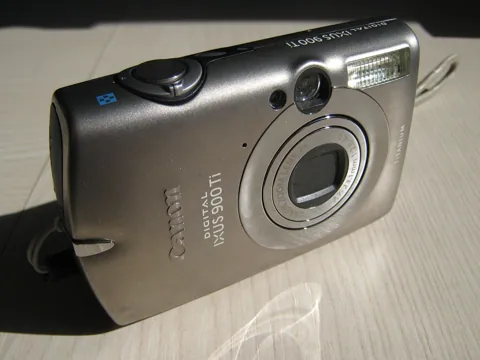 The SD900 with its titanium front plate. · Tobias Abel · CC BY-SA 3.0 · Commons
A dial you touch first
Brush the touch control dial and a larger copy of its icons appears on the screen, which Imaging Resource said magnifies whatever your thumb is on, though you still have to click to choose.4 PhotographyBLOG described the same virtual dial.5
A screen you can tilt your head at
Imaging Resource said the 2.5-inch screen stays readable at angles approaching 180 degrees, so you can hold the camera over your head or low down.4
Sorting in the camera
The My Category feature tags pictures as People, Scenery, Events or a to-do item, and Imaging Resource said it pays off in playback, slide shows and printing, because you can sort before you reach a computer.4
How fast it was
Imaging Resource's lab measured 1.2 seconds from power-on to first shot, shutter lag of 0.60 seconds at wide angle and 0.82 at telephoto with full autofocus, 0.071 seconds when prefocused, 1.98 seconds between full-size shots, and 6 seconds for the flash to recycle after a full-power shot.4 It called performance generally above average, and the camera responsive enough for family photographs, particularly at wide angle.4 Continuous shooting is a place where sources conflict: Canon's museum page lists about 2.1 frames per second (Large/Fine, screen off), Imaging Resource measured one shot per second, and DPReview put it at around 0.9 frames per second.143
Where it let you down
Two reviewers named the same gap: image stabilisation. PhotographyBLOG said the missing stabiliser was what kept it from a fifth star, and DPReview pointed out that the SD800 IS cost roughly the same and offered a true wide-angle zoom and stabilisation.53 Both also found the 3x zoom unremarkable.53 Popular Photography said the buttons carry several jobs each, and in its test a press meant for exposure compensation changed the AF mode instead.6 PhotographyBLOG noted that the card and battery share a compartment on the base, so you cannot change the card while the camera sits on a tripod.5 Imaging Resource's cons were a wobbly mode dial, no manual control over aperture or shutter speed, ISO 3200 only at low resolution and a camera a little bulky next to rivals.4 It also said the shake warning showed constantly at 1/30 second in rain, and that 1/60 second was the best it could manage.4
What the reviewers said in 2007
| Outlet | Date | Verdict |
|---|---|---|
| Imaging Resource | Full review 15 Jan 2007 | 4.5 out of 5 and a Dave's Pick: a good take-anywhere camera with good colour, quick and dependable, with face detection that works.4 |
| DPReview | 29 Jan 2007 | Image quality 8.5 out of 10 and build 9.5, value 6.5; it missed a Highly Recommended award by a whisker, and the reviewer suspected it had priced itself out of the running.3 |
| PhotographyBLOG | 13 Feb 2007 | 4.5 out of 5 for design, ease of use and image quality, 4 for features and value: nearly the perfect general-use compact, held back by no stabiliser and a high-ish premium for the titanium.5 |
| Popular Photography | Page dated 17 Dec 2008 (original test date not found) | Stylish and solid, with serious image quality issues at ISO 800 and above, and the most expensive of the five cameras in its test.6 |
The timeline
- 14 September 2006Canon announces the SD900, SD800 IS and SD40 at an estimated $499.99 for the SD900.2
- October 2006Canon's museum lists the camera as marketed.1
- 26 November 2006Imaging Resource publishes its hands-on preview.4
- 15 January 2007Imaging Resource's full review is posted.4
- 29 January 2007DPReview publishes its review.3
- 13 February 2007PhotographyBLOG publishes its review.5
- 17 December 2008The date shown on Popular Photography's test page.6
Should you buy one now?
Buy one if you want a small, well-made 2006 compact with a 10-megapixel sensor, an optical viewfinder and a pleasant touch dial, and you can live with no stabiliser and noise above ISO 400. The launch price depends on the source, from $499.99 in Canon's announcement to a street price of $399 in DPReview's review;23 what it sells for now is a question for the sold listings, not for us. Before you bid, check these:
- The name. It was the Digital IXUS 900 Ti in Europe and the IXY Digital 1000 in Japan, so search all three.1
- The battery. It uses an NB-5L, rated about 230 shots;1 a fresh one is on Amazon ↗.
- The card. It takes SD, SDHC and MMC cards, per Canon, and the boxed card was only 16 or 32 MB depending on the source, so you will want your own; see our memory card guide.142
- The touch dial and mode dial. Imaging Resource found the mode dial a little wobbly, so check both feel right.4
- The screen. PhotographyBLOG saw noses smear it through the viewfinder, so look for marks.5
- The lens. Check that it extends and retracts cleanly and that photos are not hazy.
If you are wondering why cameras like this are being hunted down again, we tell that story once, in Pictures that never left the card.
See recent sold prices on eBay ↗Shop on eBay ↗NB-5L battery ↗
Sources
- Canon Camera Museum: PowerShot SD900 DIGITAL ELPH / IXY DIGITAL 1000 / Digital IXUS 900 Ti (names, October 2006, launch text, specifications)
- Imaging Resource news, Canon: Three new Digital ELPHs, by Mike Tomkins (14 September 2006), carrying Canon's US announcement
- DPReview, Canon SD900 Digital ELPH (IXUS 900 Ti) Concise Review by Simon Joinson (29 January 2007)
- Imaging Resource, Canon PowerShot SD900 Digital ELPH review by Mike Pasini (hands-on 26 Nov 2006, full review 15 Jan 2007), with the lab timing page
- PhotographyBLOG, Canon Digital IXUS 900 Ti review by Gavin Stoker (13 February 2007)
- Popular Photography, Test: Canon PowerShot SD900 Digital Elph, by Jack Howard (page dated 17 December 2008)
Camera photo by Tobias Abel (CC BY-SA 3.0); sample photographs are credited under each one, all via Wikimedia Commons. Links to eBay and Amazon are affiliate links.