Canon PowerShot ELPH / IXUS · 2008
The Canon PowerShot SD990 IS (Digital IXUS 980 IS): the flagship ELPH with a manual mode and a viewfinder
Sold in Europe as the Digital IXUS 980 IS and in Japan as the IXY Digital 3000 IS.
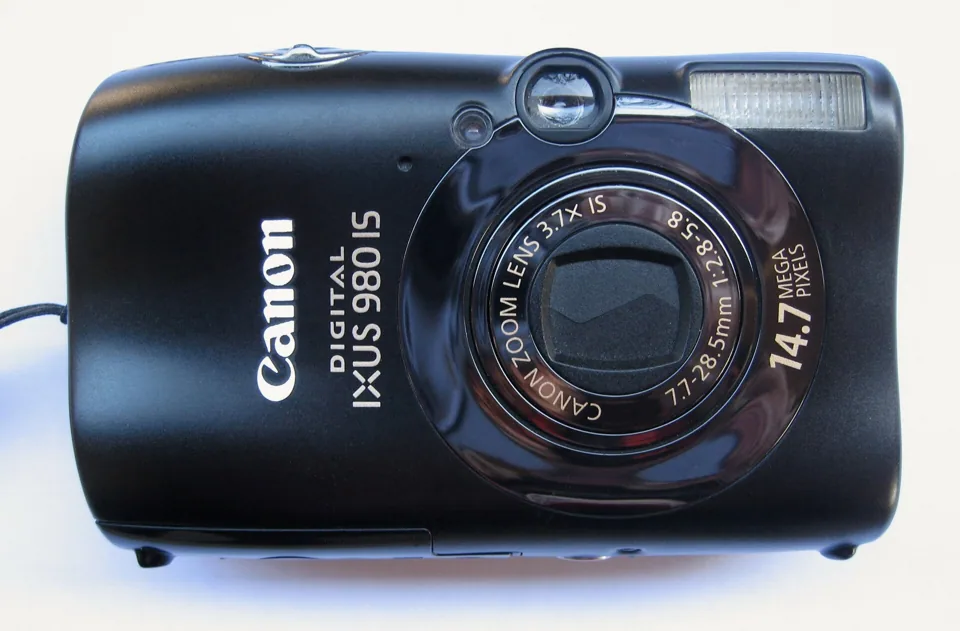

In September 2008 Canon put a 14.7-megapixel sensor, larger than most pocket cameras carried, into its top ELPH, gave it an optical viewfinder, and added a manual exposure mode that PhotographyBLOG called a first for the family. Four reviewers praised the build. They split on the pictures: one called the quality outstanding, another found it caught barely more real detail than a good 12-megapixel compact.
- Launched
- September 2008
- Launch price
- $399.99 recommended3
- Sensor
- 14.7 MP CCD
- Lens
- 36–133 mm, 3.7×
- Card
- SDHC, SD, MultiMediaCard
- Battery
- NB-5L
Canon PowerShot SD990 IS specs: sensor, lens, battery, memory card and cable
The Canon PowerShot SD990 IS (also sold as the Digital IXUS 980 IS and IXY Digital 3000 IS) is a 14.7 MP CCD compact camera with a 36–133 mm (35 mm equivalent) 3.7× zoom lens, launched in September 2008 at $399.99. It runs on the NB-5L battery. Sources
- Sensor
- CCD, 1/1.7", 14.7 MP source
- Lens
- 36–133 mm equivalent, 3.7× zoom source
- Memory card
- SDHC, SD, MultiMediaCard source
- Battery
- NB-5L source
- Also sold as
- Digital IXUS 980 IS · IXY Digital 3000 IS
- USB / A/V cable
- IFC-400PCU, AVC-DC400 Confirmed · all Canon cables
Meet the camera
Canon's museum calls it the flagship of the IXY Digital line, the successor to the IXY Digital 2000 IS of September 2007, and lists what was new: the 14.7-megapixel CCD, a Manual Mode for shutter speed and aperture, and a Quick Mode that keeps adjusting focus and exposure.1 It also names a curved body with an alumite finish.1 PhotographyBLOG said the curves make it more comfortable than its dimensions suggest, and that the body is metal even where it does not look it, as on the black version.3 Trusted Reviews tested a matt black one, called it all metal with a strong hinge on the battery hatch, and set its easy grip against what it called the 980's immediate predecessor, the IXUS 970 IS, which it said handled like a well-worn bar of soap (Cameralabs, PhotographyBLOG and Imaging Resource name the predecessor as the IXUS 960 IS / SD950 IS).6432 Cameralabs described a dipped, figure-eight grip that felt odd for a moment and then comfortable.4 Imaging Resource was cooler: bulky for an ELPH, but pocketable, slick, and with no thumb rest.2
It had three names: PowerShot SD990 IS Digital ELPH in the Americas, Digital IXUS 980 IS in Europe, IXY Digital 3000 IS in Japan.1 PhotographyBLOG listed a recommended price of $399.99,3 Imaging Resource an MSRP of $400 with US shipping from October 2008,2 and Photo Review an Australian RRP of AUD $599.5 Trusted Reviews gave no figure but called it the most expensive camera in the IXUS range at the time of its May 2009 review, and said that if you want top quality you have to pay for it.6
- Sensor
- 14.7 MP CCD, 1/1.7"1
- Lens
- 3.7x, 36–133 mm equiv., f/2.8–5.8, lens-shift stabiliser, optical viewfinder1
- Screen
- 2.5", about 230,000 dots1
- Card and battery
- SD/SDHC (MMC and MMCplus also listed) · NB-5L, about 280 shots per charge (CIPA, screen on)1
- Size
- 96.7 × 62.2 × 27.9 mm, about 160 g body only1
- Launch price
- $399.99 recommended3
Why this one was interesting
A manual mode, with a catch
PhotographyBLOG called it the first IXUS/ELPH with a true manual mode, and counted 45 shutter speeds from 1/1600 s to 15 s.3 The catch is the aperture. Photo Review and Cameralabs both found only two choices at any zoom setting, f/2.8 or f/8 at the wide end and f/5.8 or f/16 at the long end, and Cameralabs saw little use in that for controlling depth of field, though the wider exposure range helped.54 PhotographyBLOG suspected a built-in neutral density filter rather than an iris, reasoning from identical depth of field at f/5.8 and f/16, and said that setting the values (press FUNC/SET, then use the wheel and the left and right buttons) was awkward enough to keep them out of Manual more than expected.3
A viewfinder in the flagship
Trusted Reviews pointed out that Canon was the only maker routinely putting an optical finder on an ultra-compact, and that some buyers would choose the camera for that alone; its own view was that the finder is small, dim, has no dioptre correction and covers about 80 percent of the frame, so it would rather use the screen.6 PhotographyBLOG found the finder tiny with obvious parallax, but useful for saving battery and bracing the camera against the forehead.3 Cameralabs agreed it was small and partial, and still saw it saving battery and helping in bright sun.4
The same sensor as the G10
Cameralabs noted that the sensor is shared with Canon's PowerShot G10, and that noise levels in the two are fairly similar.4 Trusted Reviews thought the larger 1/1.7-inch sensor kept noise better controlled than the 1/2.3-inch ones in most rivals, despite the pixel count.6 For the slimmer ELPH Canon marketed in February 2009, see our SD780 IS review, and for the August 2009 one with a 28 mm lens, the SD940 IS.
What was lost
The lens did not go wide. PhotographyBLOG wanted a wider zoom and said 36 mm is not enough these days; Cameralabs listed the missing wide angle and the missing HD video as the reasons it fell short of a top award.34 There is no HD or HDMI output, and Cameralabs said many buyers may prefer the SD780 IS, with its cheaper price, 720p video and 3x lens from 33 mm, or the SD880 IS, with a 28 mm start and a 3-inch screen.4 Photo Review thought the buttons small and the control dial too easy to turn by accident.5 Imaging Resource found the chrome ring that replaced the touch dial hard to control and sometimes disabled; Trusted Reviews, by contrast, thought it much more responsive than before.26
The dark: its weak point
Every reviewer put the camera's best work at low ISO. Opinions on the top of the range ran wide. Trusted Reviews saw no noise at ISO 80 and 100, a little at 200 and much the same at 400, more at 800 and fading detail at 1600 that was still printable, which it called impressive for a 14-megapixel camera.6 PhotographyBLOG found hardly any visible noise at 80 and 100 but a smudged look from heavy noise reduction, good big prints at 200, a watercolour texture by 800, and advised keeping to ISO 200 or below for poster prints.3 Imaging Resource saw detail already slightly smudgy at 80, noticeably softer from 200 and very soft from 400, yet usable prints at 11 by 14 inches at 400 and 8 by 10 at 800 and 1600.2 Photo Review put the fall in resolution at ISO 400.5 Cameralabs compared it with the Fujifilm F60fd and found no resolution advantage for 14.7 megapixels from ISO 400 upward, with the Fujifilm keeping more detail at 800 and 1600.4 The ISO 3200 setting is limited to 2 megapixels; Imaging Resource called it soft but good for a sharpened 4 by 6 print.23
The two photographs below were taken with this camera at ISO 800 and ISO 1600, according to each file's own EXIF data, and are shown as uploaded; the photographers' processing is unknown.


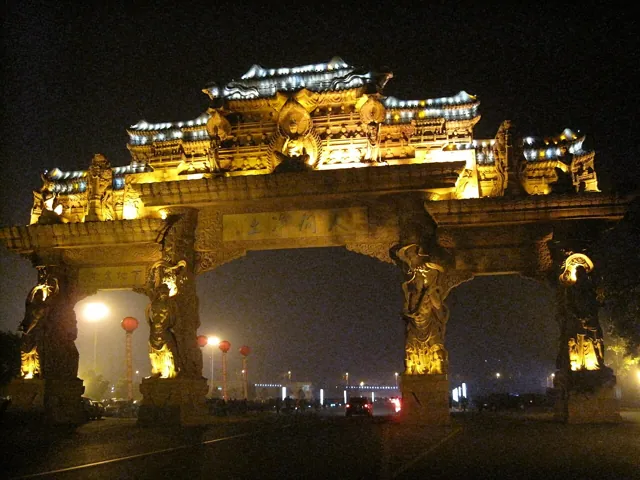

Trusted Reviews also found the dynamic range poor: the meter protects the highlights and gives up almost all the shadow detail, a problem it called common to over-powered compact sensors; Photo Review likewise saw blown highlights and blocked shadows in contrasty scenes.65
Like what you read? See recent eBay sold listings for this camera ↗
On eBay right now
Live listings for this camera, supplied by eBay and updated automatically. We earn a commission if you buy through them.
The little wins
Quick Shot
The screen turns into a status display, you frame through the viewfinder, and continuous autofocus runs. Imaging Resource timed a 0.22 s shutter lag in it, which it said was hard to test, against 0.50 s at wide angle in normal use, and noted Canon's rating of about 180 shots per charge in the mode; PhotographyBLOG found it worked better than expected in bright light.23
A live histogram
PhotographyBLOG said an optional live histogram, which it thought should be standard on compacts, made exposure easier to judge.3
Stitch Assist
PhotographyBLOG called the panorama aid highly useful, partly making up for the lack of a wide lens.3
An underwater option
Cameralabs mentioned an optional WP-DC27 housing that makes the camera waterproof to 40 m.4
How it drew the picture
The reviewers disagree here, about the lens as much as the noise. Cameralabs judged that the 14.7 megapixels caught not much more real detail than a good 12-megapixel compact, found the wide-end corners soft and the lens weaker than the G10's, and also noted that Canon applied less sharpening and contrast than the Fujifilm, leaving a restrained look that can be raised in the menus.4 Imaging Resource found centre sharpness good but wide-angle corners blurred, worst at upper left, barrel distortion of about 0.8 percent at wide, high chromatic aberration at wide, and lens flare that was its main weakness.2 PhotographyBLOG said the lens largely fails to keep up with the resolution at the wide end, with strong blurring outside the centre and barrel distortion on the high side, but at the telephoto end saw a jaw-dropping amount of detail, and scored image quality 4 out of 5.3 Trusted Reviews went the other way, calling the edge-to-edge sharpness excellent, the distortion minimal and the blurring confined to the far corners.6 Photo Review scored image quality 8.5 out of 10, found colour fair with raised saturation in reds and blues, and saw colour fringing at 100 percent.5 Imaging Resource, PhotographyBLOG and Cameralabs each ended up with the same working rule: the long end of the zoom is sharper than the wide end.234
















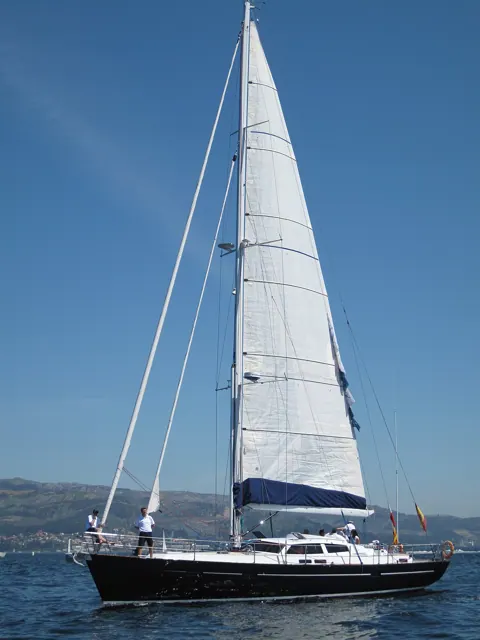

Photos taken with this camera (the camera model in each file's EXIF data reads IXUS 980 IS or SD990 IS), from Wikimedia Commons, credited under each picture.
Where it let you down
Speed is where the verdicts differ. Imaging Resource called its 2.0 s cycle time slightly slow, while Trusted Reviews called 1.6 s shot to shot very fast.26 Imaging Resource timed autofocus shutter lag at 0.50 s at wide and 0.60 s at telephoto, 0.085 s prefocused, a single-shot cycle of 2.0 s and 1.37 frames per second in bursts.2 Photo Review recorded a 0.4 s capture lag and 1.8 s shot to shot without flash;5 Trusted Reviews reported 1.6 s shot to shot, 1.4 frames per second in bursts, and a start-up of about 1.5 s;6 Cameralabs measured 1.25 frames per second with an 8 GB SDHC card.4 Canon rates the burst at about 1.3 frames per second.1 Cameralabs still listed that burst rate among the bad points.4 The video is VGA at 30 fps with no optical zoom while recording and clips ending at 4 GB or about an hour.145 Photo Review said the autofocus often picked the wrong target; Trusted Reviews blamed the nine-zone mode for having a mind of its own and called the centre zone quicker and more reliable.56 Imaging Resource found the power button hard to press and the camera awkward to stand on its side.2 White balance split the reviewers as well: PhotographyBLOG called automatic white balance well above average and nearly flawless under fluorescent light, while Imaging Resource found Auto and Manual white balance good under tungsten light but its Incandescent preset too pink, and Photo Review found that Auto left an orange cast under incandescent light while the presets gave neutral colours.325 Battery life was the exception: Cameralabs listed great battery life with the viewfinder among the good points, and Canon's own rating is about 700 shots with the screen off.41
What the reviewers said in 2008 and 2009
| Outlet | Date | Verdict |
|---|---|---|
| PhotographyBLOG | 15 Dec 2008 | Design 4.5, features 4.5, ease of use 4, image quality 4, value 4 out of 5. Recommended to DSLR owners wanting a second camera and to beginners who want room to grow; best used at the long end of the zoom.3 |
| Trusted Reviews | 13 May 2009 | 4.5 stars overall; build quality 10, image quality 9, value 8 out of 10. A superb camera built to a standard; the one clear drawback is that it is very expensive.6 |
| Imaging Resource | 26 Jun 2009 | 4.5 out of 5 and a Dave's Pick; the reviewer called it the best ELPH they had used. Real manual control; held back by flare, soft wide-angle corners and softness from ISO 200.2 |
| Cameralabs | 30 Nov 2009 | 82 percent and Recommended. Strong on resolution, screen, battery with the viewfinder and manual control; marked down for the missing wide angle and HD video, and value scored lowest at 15 out of 20.4 |
| Photo Review | No date shown | Overall 8.8 out of 10 (build 9, ease of use 9, image quality 8.5). An elegant, high-resolution camera with more adjustable controls than usual.5 |
The timeline
- September 2007The IXY Digital 2000 IS, the camera the 3000 IS succeeds, is marketed.1
- September 2008Canon's museum lists the IXY Digital 3000 IS (SD990 IS, IXUS 980 IS) as marketed.1
- October 2008US shipping begins, at an MSRP of $400.2
- 15 December 2008PhotographyBLOG publishes its review.3
- 13 May 2009Trusted Reviews publishes its review.6
- 26 June 2009Imaging Resource publishes its express review.2
- 30 November 2009Cameralabs publishes its review.4
Should you buy one now?
Buy one if you want a metal ELPH with real manual exposure, a viewfinder and a big-sensor CCD, and you can live with a 36 mm wide end and VGA video. It launched at $399.99;3 what it sells for now is a question for the sold listings, not for us. Before you bid, check these:
- The name. It is the PowerShot SD990 IS in the Americas, the Digital IXUS 980 IS in Europe and the IXY Digital 3000 IS in Japan, so search all three.1 The IXUS 990 IS (SD970 IS) is a different camera, with a 5x zoom and a 3-inch screen.4
- The battery. It uses an NB-5L, rated at about 280 shots; a fresh one is on Amazon ↗.1
- The card. It takes SD and SDHC cards;1 see our memory card guide.
- The controls. Press the power button and turn the control ring: Imaging Resource found the power button hard to press, and Photo Review found the control dial moved too easily on its unit.25
- The lens. Check that it extends and retracts cleanly and that wide-angle photos are not hazier than the reviews describe.
If you are wondering why cameras like this are being hunted down again, we tell that story once, in Pictures that never left the card.
See recent sold prices on eBay ↗Shop on eBay ↗NB-5L battery ↗
Sources
- Canon Camera Museum: IXY DIGITAL 3000 IS / PowerShot SD990 IS DIGITAL ELPH / Digital IXUS 980 IS (names, September 2008, specifications)
- Imaging Resource, Canon SD990 IS express review by Mike Pasini and Stephanie Boozer (26 June 2009; MSRP $400, shipping from October 2008)
- PhotographyBLOG, Canon Digital IXUS 980 IS review by Zoltan Arva-Toth (15 December 2008; pages 1, 2 and 6 read)
- Cameralabs, Canon Digital IXUS 980 IS / PowerShot SD990 IS review by Gordon Laing (30 November 2009; pages 1, 2, 3 and 5)
- Photo Review (Australia), Canon Digital IXUS 980 IS review (no author or date shown; RRP AUD $599)
- Trusted Reviews, Canon IXUS 980 IS review by Cliff Smith (13 May 2009)
Camera photo by Asio otus (CC BY-SA 3.0); other photographs are credited under each one, all via Wikimedia Commons. Links to eBay and Amazon are affiliate links.