Nikon Coolpix S · announced February 2011
The Nikon Coolpix S9100: an 18x zoom in a shirt pocket
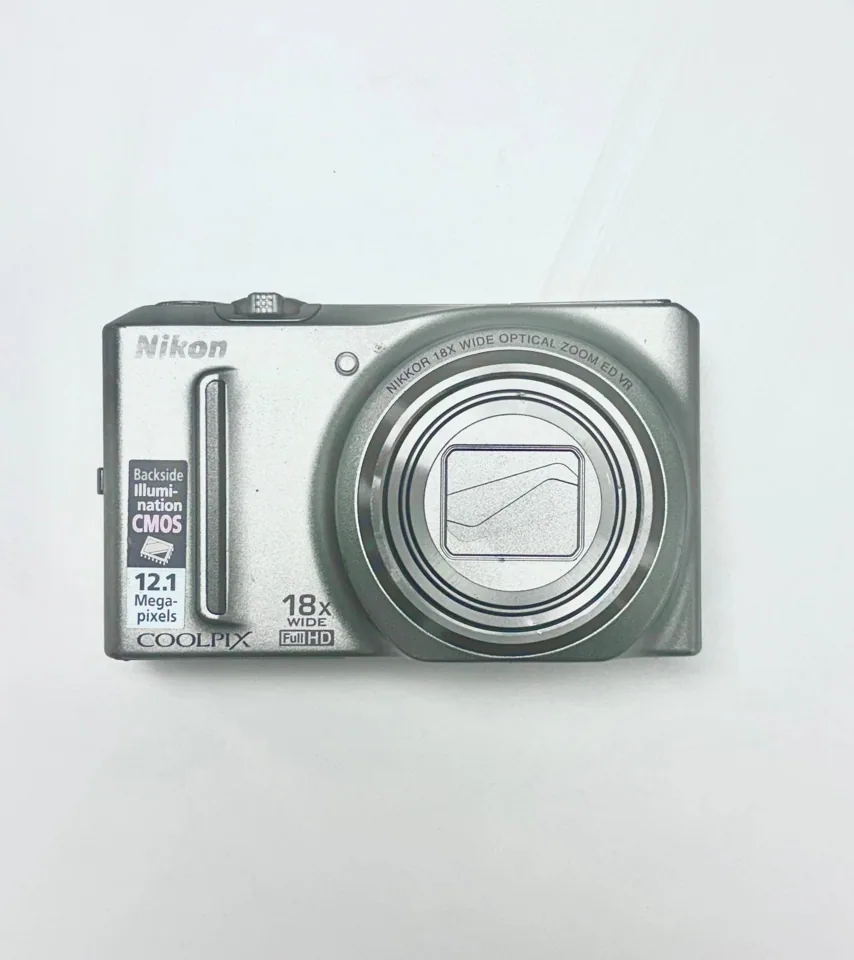
In February 2011 Nikon fitted a 25–450 mm lens and a back-illuminated sensor into a body 35 millimetres thick and priced it at about $330. Reviewers praised how it held up as the light dropped, and three of the four we read caught its autofocus losing the subject.
- Launched
- February 2011
- Launch price
- $329.95 · £299.993
- Sensor
- 12.1 MP CMOS
- Lens
- 25–450 mm, 18×
- Card
- SD, SDHC, SDXC
- Battery
- EN-EL12
Nikon Coolpix S9100 specs: sensor, lens, battery, memory card and cable
The Nikon Coolpix S9100 is a 12.1 MP CMOS compact camera with a 25–450 mm (35 mm equivalent) 18× zoom lens, launched in February 2011 at $329.95. It takes SD, SDHC and SDXC cards and runs on the EN-EL12 battery. Sources
Meet the camera
PhotographyBLOG gave its official dimensions as 104.8 by 62.0 by 34.6 millimetres and its weight as about 214 grams with battery and card.3 TechRadar described a metal body in two-tone finish with a gun-metal front on the silver unit it tested, and felt it was well built without being heavy.5 Imaging Resource liked the soft rubber on the front panel and a raised bar that made a slick little camera easy to hold, and said it fits a shirt pocket, though at 1.4 inches thick it is no ultracompact.2 The lens is a Nikkor of 12 elements in 11 groups, f/3.5 at the wide end and f/5.9 at the long end.3
All five of our sources call it the Coolpix S9100, and we found no other regional name. Imaging Resource reported it on 8 February 2011 alongside the L120, shipping from March at $330.12 PhotographyBLOG listed £299.99, €348.00 and $329.95 (Imaging Resource rounds it to $330) and a street price near £250;3 Expert Reviews gave a reviewed price of £240 in June,4 and TechRadar put it at about £220.5
Why this one was interesting
A sensor that kept its head at ISO 400
Expert Reviews explained the trade: a back-illuminated sensor is less noisy at a given ISO but starts higher, here at 160 where most compacts start at 80 or 100. Its tester found a small edge over Panasonic's TZ20 in bright light and a large one from ISO 400 up, where the Panasonic smeared away detail with noise reduction and the Nikon kept it.4 The same review named one rival that matched it in low light, Canon's IXUS 1000 HS, and said it would still pay more for the Nikon's longer zoom, better screen and longer battery life.4
Eighteen times, from 25 millimetres
Expert Reviews called it the longest zoom yet fitted to a compact-shaped camera.4 TechRadar traced the form to Panasonic's TZ series, with the lens to one side and a big screen filling the back, and called the S9100's design very similar.5 Imaging Resource noted that a zoom this long used to come only on bulky dSLR-style superzooms, and that the 25 mm wide end took in more of a room than most digicams.2 Two years earlier our Lumix DMC-ZS3 stopped at 12x.
Slow motion on a point-and-shoot
Imaging Resource lists high-speed modes of 240 frames per second at 320 by 240 pixels, 120 at 640 by 480 and 60 at 1280 by 720, limited to 10, 10 and 30 seconds of recording. In them sound is off and zoom and focus lock when recording starts.2 Expert Reviews praised the way the slow-motion options trade frame rate against resolution.4
The dark: its weak point
The four reviewers drew the same slope with different numbers. PhotographyBLOG found softening from ISO 800 up, a sandy look to shadow detail at 1600 when enlarged and obvious smoothing at 3200, and still judged the results very respectable for a camera under £300.3 TechRadar saw few signs of noise reduction up to ISO 400, a slight softening at 800 that needed a close look, and an ISO 3200 that was still impressive for a compact and good for 9 by 6 inch prints if well exposed.5 Imaging Resource found detail already a little soft at ISO 160, luminance noise overt at 800 and blurry, faded results at 1600 and 3200.2 Its print guide: ISO 160 good to 16 by 20 inches, 400 to 11 by 14, 800 best at 8 by 10, 1600 soft at 8 by 10, and 3200 pretty good at 5 by 7.2
TechRadar's resolution chart scores, in line widths per picture height times 100, fell from 20 at ISO 160 and 200 to 18 at 400, 16 at both 800 and 1600, and 12 at 3200.5 Its DxO-based noise graph gave the S9100 a good signal-to-noise ratio against the Panasonic TZ20, Canon IXUS 220 HS and a Fujifilm EXR compact, beating all but the Canon at ISO 800, while its dynamic range was at least 0.5 EV lower than all three up to ISO 800.5 The Canon is the IXUS 220 HS, which we review as the ELPH 300 HS. We found no free low-light photographs from this camera with the ISO recorded in the file, so we show none.
Like that look? See recent eBay sold listings for this camera ↗
On eBay right now
Live listings for this camera, supplied by eBay and updated automatically. We earn a commission if you buy through them.
The little wins
A flash that waits to be asked
The pop-up flash sits in the top panel and rises only when you slide a catch on the left side. Expert Reviews singled this out as a favourite; Imaging Resource found no red-eye even zoomed in at arm's length.42
Bursts at full resolution
Imaging Resource rated full-resolution Continuous H at 9.5 frames per second for five frames, and used it on a pitcher's warm-up at a ball game;2 Expert Reviews gave 10 fps for five.4
Night shots from a handheld stack
In handheld Night Landscape mode the camera combines a series of exposures to reduce noise, and Backlighting has an HDR option, Imaging Resource explained.2
A screen you could read outdoors
TechRadar praised the anti-reflective coating on the 3-inch screen and called it very sharp;5 Imaging Resource called it gorgeous and noted most digicams then used 230,000 dots.2
Quick to the first shot
Start-up plus first capture took about 1.5 seconds for Imaging Resource and about 1.6 for Expert Reviews (TechRadar said around two seconds before it was ready to shoot, PhotographyBLOG just over a second to power up). Imaging Resource measured full-autofocus shutter lag at 0.22 second and prefocused lag at 0.011 second.2453
How it drew the picture
PhotographyBLOG found handheld shots at 450 mm generally sharp, better than many travel zooms, with natural-looking colour, slight softening in the corners at 25 mm and purple fringing in high-contrast scenes; it also noted soft default sharpening that cannot be changed in the camera.3 Expert Reviews saw sharpness across the range with some corner softness at medium and long focal lengths.4 Imaging Resource's lab chart resolved 1,800 lines per picture height, called colour bright and vibrant with bright greens, reds and blues oversaturated, and saw strong corner blur on the right side at both ends of the zoom.2
On distortion the reviewers disagree. TechRadar saw strong barrel distortion at the wide end;5 Imaging Resource measured about one pixel (0.03 percent) in stills and credited in-camera processing, which it says is not applied to video.2 We cannot reconcile the two from the pages alone.
















Photos taken with this camera, from Wikimedia Commons, credited under each picture.
Where it let you down
Autofocus drew the most complaints. TechRadar said it struggled to focus accurately at the long end, so fast or erratic subjects were often missed.5 Expert Reviews found it less reliable on moving subjects than is usual for a superzoom,4 and Imaging Resource, which also rated it very fast, watched it hunt on a glass figurine in good light until the reviewer stepped back and zoomed in.2 TechRadar added that a sharp handheld shot at full zoom could occasionally be hard to get even outdoors in moderately good light.5
There is no manual exposure mode and no raw files (Imaging Resource), and there is no quick access to ISO or white balance (Expert Reviews).24 The lens uses a 2-stop neutral-density filter instead of an iris, so each focal length offers only two apertures.2 Imaging Resource's automatic white balance went red under tungsten light.2 In video, Expert Reviews found handheld footage at full zoom wobbly because the stabiliser is electronic, and the 15 Mbit/s bit rate blocky in fast action, while clips run up to 29 minutes.4 Digital zoom is very slow once you pass the optical range, Imaging Resource complained.2
Imaging Resource found the controls comfortable, the mode dial firm and the scroll wheel excellent, but the movie button hard to find and the USB port on the underside, so you must lay the camera down to plug in.2 TechRadar called the rear dial small and fiddly and said the centre button is easy to press while nudging the dial;5 PhotographyBLOG said the wheel is easy to overshoot.3 Battery life of about 270 shots was par for the class, PhotographyBLOG said, against roughly 1,000 quoted for two Casio rivals, and the camera has no GPS, unlike three others it named.3
What the reviewers said in 2011
| Outlet | Date | Verdict |
|---|---|---|
| PhotographyBLOG | 18 Apr 2011 | 4.5 out of 5 overall (design 4.5, features 4.5, ease of use 4, image quality 4, value 4.5): one of the best pocket do-everything travel zooms, but for casual users, not for manual control.3 |
| Expert Reviews | 11 Jun 2011 | A best-buy badge; a compact ultra-zoom that copes in low light, which it said comes very close to getting everything right; autofocus on moving subjects was the main complaint.4 |
| Imaging Resource | 18 Jul 2011 | 4.0 out of 5, a Dave's Pick and fourth in its 2011 travel-zoom shootout: very attractive and a nice travel camera if you do not need GPS; focus trouble and slow digital zoom were minor.2 |
| TechRadar | Undated | Ideal for frequent travellers who will use the zoom; good high-ISO results, fiddly dial, unreliable long-end autofocus and barrel distortion.5 |
The timeline
- 8 February 2011Announced with the Coolpix L120 at $330, shipping from March.1
- March 2011Starts shipping in the US.2
- 18 April 2011PhotographyBLOG publishes its review.3
- 11 June 2011Expert Reviews publishes its review.4
- 18 July 2011Imaging Resource posts its user report.2
Should you buy one now?
Buy one if you want a pocketable zoom that reaches 450 mm and still gives usable pictures indoors, and you can live with point-and-shoot control. If you want manual exposure, PhotographyBLOG pointed to Nikon's Coolpix P300 or P7000;3 we have a review of the P7000, and of the cheaper Coolpix S3300 for comparison. It launched at about $330;1 what it sells for now is a question for the sold listings, not for us. Before you bid, check these:
- Autofocus at full zoom. Zoom to 450 mm on something distant and see whether it locks, since three reviewers flagged this.542
- The battery. It uses an EN-EL12 and charges inside the camera over USB;32 a fresh one is on Amazon ↗. Sources disagree on the box: the text of the PhotographyBLOG review says Nikon included no standard mains charger, yet its own specification list and Imaging Resource both give a Charging AC Adapter EH-69P and a UC-E6 USB cable as supplied.32
- The card. SD, SDHC and SDXC work and MMC does not;3 Nikon recommends Class 6 or faster for HD video.2 See our memory card guide.
- The flash. It rises only when you slide the catch on the left side, so check that it opens and closes.24
- The lens. Check that it extends and retracts smoothly through the whole range.
If you are wondering why cameras like this are being hunted down again, we tell that story once, in Pictures that never left the card.
See recent sold prices on eBay ↗Shop on eBay ↗EN-EL12 battery ↗
Sources
- Imaging Resource, Nikon S9100, L120: Two new long-zoom Coolpixes, by Mike Tomkins (8 Feb 2011)
- Imaging Resource, Nikon Coolpix S9100 review by Mike Pasini and Stephanie Boozer (user report posted 18 Jul 2011; specification table; 4.0 out of 5, Dave's Pick)
- PhotographyBLOG, Nikon Coolpix S9100 review by Gavin Stoker (18 Apr 2011)
- Expert Reviews, Nikon Coolpix S9100 review by Ben Pitt (11 Jun 2011)
- TechRadar, Nikon Coolpix S9100 review by Gary Wolstenholme (undated page, seven pages)
Sample photographs are credited under each one, all via Wikimedia Commons. Links to eBay and Amazon are affiliate links.