Fujifilm FinePix F series · on sale March 2008 · a retrospective
The Fujifilm FinePix F100fd: a 28 mm wide F series that argued with itself about the dark
Twelve megapixels, a 28 to 140 mm lens and a stabilised sensor in a pocket body, from Fujifilm's F series. Here is what the 2008 reviewers found, where they disagreed, and what to check before you buy one.
Release date and launch price: launched March 2008; launch price $379.95 planned US retail1.
Quick answers
- Sensor
- CCD, 1/1.6", 12 MP source
- Lens
- 28–140 mm equivalent, 5× zoom source
- Memory card
- xD-Picture Card, SD, SDHC source
- Battery
- NP-50 source
- USB / A/V cable
- See our Fujifilm cable page
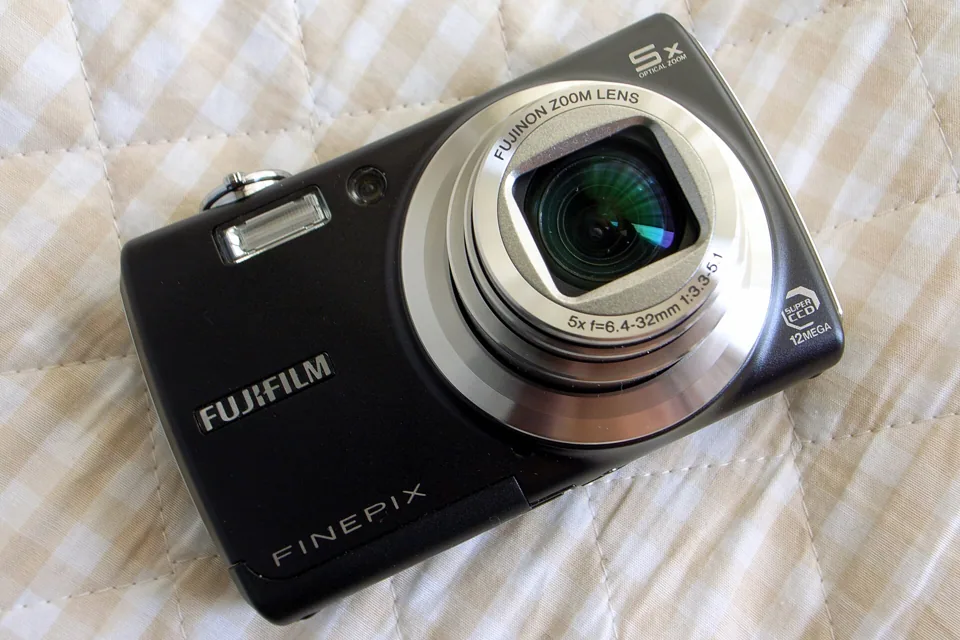
Meet the camera
The F100fd is what a successful line looks like when it tries to grow up. Fujifilm's F series had a following among serious photographers, and in January 2008 the company announced a new top model: a 12-megapixel sensor, a 5x zoom that started at 28 mm, and a screen-only body of 97.7 by 58.9 by 23.4 millimetres.12 PhotographyBLOG's reviewer called it the successor to the F50fd and the new top of the series, very much like its predecessor.2
Imaging Resource reported the announcement on 24 January 2008, with sales due to begin in March at a planned retail price of $379.95.1 The photograph above shows the camera in a dark finish with a bright metal ring around the lens; PhotographyBLOG says it came in champagne or black, and called the colour scheme stylish and said it fits a trouser pocket.2 This is the only free photograph of the camera itself we found; the rest of the pictures are samples taken with it.
We have also written up the earlier F30 and F31fd, older cameras; PhotographyBLOG says the F31fd has half the F100fd's resolution, and the reviews below ask what the extra pixels cost.5
Why this one was interesting
The F100fd put its weight on pixels and range: 12 megapixels, a wider lens, stabilisation that moved the sensor, and a dynamic range control borrowed, according to PhotographyBLOG, from the company's FinePix S5 Pro.2 All of it fitted a body PhotographyBLOG called compact enough for a trouser pocket.2 Imaging Resource called it a pretty good choice for the enthusiast.6
PhotographyBLOG's verdict was that image quality improved on the F50fd, with the new camera's ISO 800 matching that older camera's ISO 400, and that the 5x zoom with its 28 mm wide end made it a versatile camera.5 The same review set against that a more guarded line: with the aperture-priority, shutter-priority and manual modes removed, the reviewer called it a fairly run-of-the-mill compact and no longer the top pocket choice for aspiring photographers.5
The sensor and the lens
PhotographyBLOG describes an 8th-generation Super CCD HR with 12 megapixels, and Imaging Resource's announcement gives the same family at 1/1.6 inch.21 Neocamera's spec list writes it as a Super CCD SR, which conflicts with those two, so we follow them.7 The Fujinon zoom is 5x, with real focal lengths of 6.5 to 31.6 mm and apertures of f/3.3 at wide and f/5.1 at telephoto.1 Imaging Resource listed excellent corner sharpness among its strengths,6 and PhotographyBLOG saw cyan and purple fringing only in high-contrast scenes at the telephoto end, which it rated very good handling.3
The dark: the reviewers disagreed
On noise, they roughly agree. Neocamera found noise barely perceptible from ISO 100 to 400, and good medium prints at ISO 800 and 1600.9 PhotographyBLOG called ISO 100 to 400 noise-free, saw noise start at ISO 800, found ISO 1600 quite visibly noisy with desaturated colour, and said ISO 3200 was still usable for small prints.3 Imaging Resource saw noise suppression softening hair and fine detail and recommended staying at ISO 800 or below.6 ISO 6400 and 12800 are limited to a reduced image size; Imaging Resource found a 4x6 print at 12800 painterly with faded colour, and PhotographyBLOG called 12800 frankly unnecessary.63
On the question of whether it was good in low light, they split. Neocamera said it replaced the F50 as the best performing ultra-compact, with exceptionally low noise and excellent dynamic range, and said focusing stayed quick down to very low light.9 Imaging Resource listed poor low-light performance as its first weakness: in normal modes, pictures stayed dark until ISO 800, and it advised using flash in low light.6 PhotographyBLOG reached the same place from a different direction: against the older F31fd, the F100fd still lacked that camera's low-light performance, in exchange for twice the resolution.5
Part of the disagreement is about shutter speed rather than noise. PhotographyBLOG found a longest exposure of 4 seconds and called that its biggest disappointment for after-dark shooting.3 Imaging Resource found 1/4 second the longest outside Night mode, with Night mode reaching 8 seconds at ISO 100 but showing hot pixels.6 Neocamera noted that ISO is limited to 100 for shutter speeds slower than one second.7 The three descriptions do not fully match, so treat the exact figures with care.








Real photographs taken with this camera. Museum and church interiors; the sensitivity is read from each file's own data. We picked them for ISO and subject, not as a test.
Curious what the dark looks like? See what F100fds have recently sold for on eBay ↗
The little wins
Around the headline numbers, reviewers noticed smaller things that made the F100fd pleasant to carry.
 The F100fd, lens in front. · yoppy from Kawasaki, Kanagawa, · CC BY 2.0 · Commons

A 28 mm wide end
Imaging Resource listed the wide 28 mm equivalent 5x zoom among its strengths, and PhotographyBLOG called the 5x, 28 mm lens versatile.65
A stabiliser that moved the sensor
The Dual IS system combined a CCD-shift mechanism with higher ISO.2 PhotographyBLOG's handheld tests at 1/13 second at 28 mm and 1/6 second at 140 mm came out sharper with anti-shake on, and the reviewer said it really did seem to make a difference.3
Dynamic range you could dial
The camera offered Auto, 100, 200 and 400 percent dynamic range. PhotographyBLOG saw a slightly wider tonal range in its histograms, nothing too obvious.3 Imaging Resource found the 200 and 400 settings require raising ISO to 200 or 400, and at 400 percent detail was marred by noise.6
How it drew the picture
In good light the F100fd drew what the reviewers called good pictures. Imaging Resource rated colour very good, with some red and blue tones slightly oversaturated and skin tones a little pinkish but still believable,6 and called good 13 by 19 inch prints possible up to ISO 400.6 Neocamera praised its colours, white balance and sharpness.9 PhotographyBLOG found files a little soft straight from the camera and said sharpening cannot be changed in-camera, though another passage called the default output fine.3















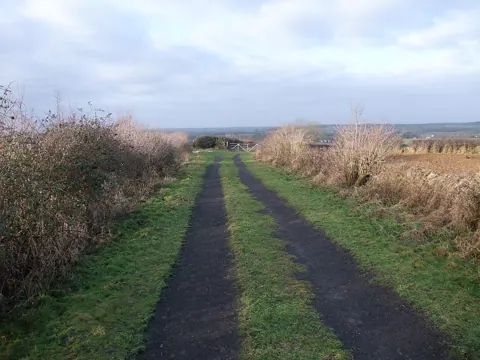

Photos taken with this camera, from Wikimedia Commons, credited under each picture.
Where it let you down
The complaints cluster around speed and control. Imaging Resource measured 3.5 seconds from power-on to first shot, 3.27 seconds between large fine JPEGs and 7.8 seconds of flash recycle.6 PhotographyBLOG, by contrast, put start-up at about a second and the zoom at about 1.5 seconds end to end,2 so the two do not agree on how quick the camera felt. The battery, rated at 230 shots, was called slightly below average by Imaging Resource and clearly below average by Neocamera.69 Imaging Resource also found the flash range limited at telephoto.6 Neocamera's list of faults was about handling: no grip beyond a thumb rest, and exposure compensation and white balance buried behind a menu that opens after a two-second hold.8
What the reviewers said in 2008
| Outlet | Date | Verdict |
|---|---|---|
| Neocamera | May 2008 | Rated Excellent. Excellent low noise, dynamic range, colour and white balance, called best in its class of ultra-compacts. Faults: a frustrating, overloaded menu button, no grip and below-average battery life.98 |
| Imaging Resource | 24 Jun 2008 | 4 out of 5 and a Dave's Pick, with the qualifier to use flash in low light. Praised corner sharpness, the 28 mm lens and colour; faulted low-light performance, no priority modes and slow start-up.6 |
| PhotographyBLOG | 18 Sep 2008 | Design 4, features 4, ease of use 4.5, image quality 4, value 4 (out of 5). Better image quality than the F50fd and a versatile lens, but the creative modes were gone and it was no longer the top pocket choice for aspiring photographers.5 |
We drew on three full reviews; other outlets also reviewed the F100fd, and we have not used them.
The timeline
- 24 January 2008Fujifilm announces the F100fd at a planned $379.95, with sales due from March.1
- March 2008The camera goes on sale; Imaging Resource lists its availability date as 30 March.16
- May 2008Neocamera publishes its review.7
- 24 June 2008Imaging Resource publishes its review and names it a Dave's Pick.6
- 18 September 2008PhotographyBLOG publishes its review.2
Should you buy one now?
Buy one if you want a wide-angle pocket zoom with sensor-shift stabilisation and decent daylight pictures, and you accept that its low-light reputation is mixed. Its launch price was a planned $379.95;1 what it sells for now is a question for the sold listings, not for us. Before you bid, check these:
- Which card will you use? No card came in the box.6 The slot takes xD-Picture Cards, SD and SDHC, and Neocamera recommended SD as cheaper, faster and larger.18 PhotographyBLOG's spec page lists SD cards without mentioning SDHC, so test the card you plan to use.4 The camera also has about 57 MB of its own memory.1
- The battery. The NP-50 was rated at only 230 shots when new;6 a used battery will do worse. A fresh one is available on Amazon ↗.
- The screen. It is the only way to frame a picture, so look for scratches and check it in daylight.2
- Low light. Expect to use flash or a higher ISO indoors, and remember that ISO 6400 and 12800 are reduced-size modes.67
- The controls. Mode selection runs through an on-screen dial opened with the centre button, so check that button works.8
If low light is the priority, PhotographyBLOG's comparison suggests the older F31fd was better in the dark; see our F31fd and F30 reviews.5
If you are wondering why cameras like this are being hunted down again, we tell that story once, in Pictures that never left the card.
See recent sold prices on eBay ↗Shop on eBay ↗NP-50 battery ↗
New to the jargon (CCD, ISO, xD cards, IXUS vs ELPH)? Read our plain-English digicam glossary.
Sources
- Imaging Resource, FinePix F100fd announcement (24 Jan 2008): price, ship date, specifications
- PhotographyBLOG, Fujifilm FinePix F100fd review by Mark Goldstein (18 Sep 2008), introduction, features, handling
- PhotographyBLOG, F100fd review, image quality page
- PhotographyBLOG, F100fd review, specifications page
- PhotographyBLOG, F100fd review, conclusion
- Imaging Resource, Fujifilm FinePix F100fd review by Stephanie Boozer (24 Jun 2008)
- Neocamera, Fujifilm FinePix F100fd review, capability page (May 2008)
- Neocamera, F100fd review, usability page
- Neocamera, F100fd review, performance page
Camera photo by yoppy from Kawasaki (CC BY 2.0); other photographs are credited under each one, all via Wikimedia Commons. Links to eBay and Amazon are affiliate links.