Canon PowerShot SX · announced August 2011
The Canon PowerShot SX150 IS: a 12x CCD zoom with manual modes, held back by two AA batteries
We found no other regional name: Canon's museum page lists PowerShot SX150 IS for Japan, the Americas and Europe, Asia and Oceania.1
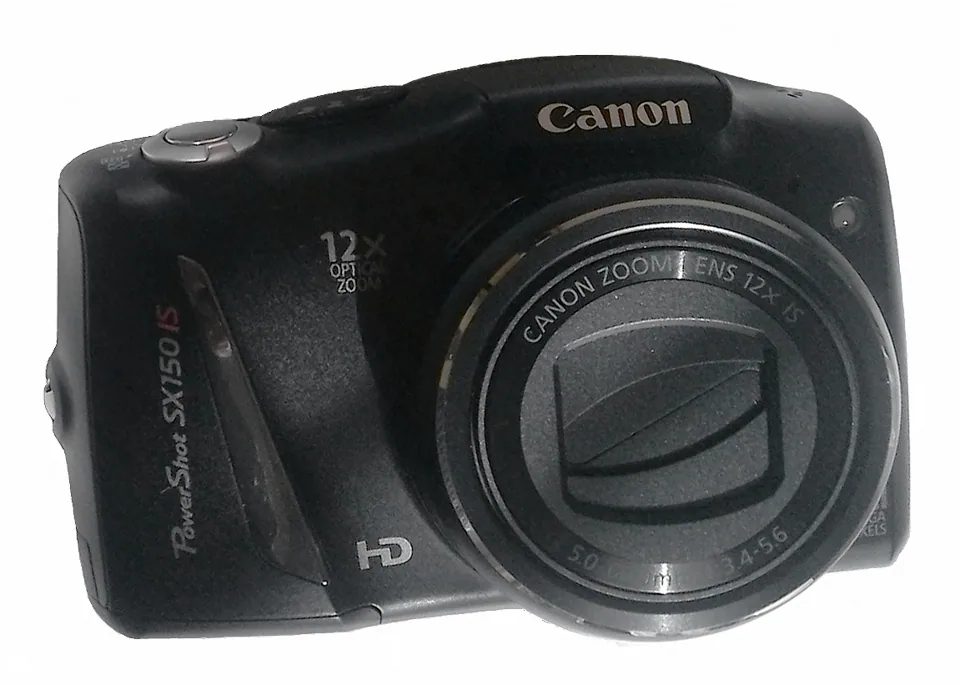

Canon's entry-level long zoom of 2011 gained two megapixels, a smarter stabiliser and a red movie button over the SX130 IS, and kept the SX130's lens, screen and pair of AA cells. Reviewers liked the zoom and the manual controls; most found the price keen, though one called it a false economy. All six reviews we read faulted the battery life or the AA format.
- Launched
- September 2011
- Launch price
- $249.99 · £199 · €2292
- Sensor
- 14.1 MP CCD
- Lens
- 28–336 mm, 12×
- Card
- SD, SDHC, SDXC
- Battery
- AA
Canon PowerShot SX150 IS specs: sensor, lens, battery, memory card and cable
The Canon PowerShot SX150 IS is a 14.1 MP CCD compact camera with a 28–336 mm (35 mm equivalent) 12× zoom lens, launched in September 2011 at $249.99. It takes SD, SDHC and SDXC cards and runs on AA batteries. Sources
- Sensor
- CCD, 1/2.3", 14.1 MP source
- Lens
- 28–336 mm equivalent, 12× zoom source
- Memory card
- SD, SDHC, SDXC source
- Battery
- AA source
- USB / A/V cable
- IFC-400PCU, STV-250N Confirmed · all Canon cables
Meet the camera
Reviewers could not agree whether it fits a pocket. TechRadar called it a mini bridge camera, too bulky for trousers but happy in a coat pocket;5 Cameralabs said it would not go unnoticed in jeans;8 Imaging Resource, setting it against Canon's much bigger SX40 HS, thought it very pocketable once the lens had retracted.7 Canon lists it at 113.3 by 73.2 by 45.8 millimetres and about 306 grams with batteries and card.1
Canon UK announced it on 23 August 2011 at £199 and €229, and in the US at $249.99 from the beginning of September.2 Reviewed said it replaced the SX130 IS at a US list price of $249.3 Imaging Resource saw a US street price of about $179, with $149 turning up here and there,7 and Expert Reviews recorded £153 in February 2012.6 Canon's museum dates the marketing to September 2011.1
Why this one was interesting
An exposure dial at a compact-camera price
Imaging Resource called Manual, aperture-priority and shutter-priority modes unusual at this price: very few cameras at the low end offered that much control, and here shutter priority ran from 15 seconds to 1/2500 with focus settable by hand.7 Expert Reviews said impoverished enthusiasts would value the manual controls,6 and Cameralabs, setting it beside the CMOS-sensor ELPH 300 HS and ELPH 310 HS, said the SX150 had a personality that encouraged you to engage with it.8
What changed from the SX130 IS
PhotographyBLOG called it a minor upgrade: two more megapixels, a better stabiliser, creative filters and a one-touch movie button on an otherwise identical camera.4 Cameralabs said the stabiliser hardware is unchanged and that 'Intelligent IS' now chooses panning, macro or tripod behaviour itself.8 TechRadar put the stabiliser at four stops, one more than before.5 The movie button took the place of the face-detection button.68 Expert Reviews regularly started recording by accident because of where it sat;6 TechRadar liked that filming no longer needs a trip to the mode dial.5 The earlier PowerShot SX130 IS had 12.1 megapixels and the same lens and AAs.10
What it was up against
Cameralabs compared it with two other 2011 Canons, the similarly priced ELPH 300 HS (IXUS 220 HS) and the slightly dearer ELPH 310 HS (IXUS 230 HS), and found both better on noise, burst speed and HD video, with a 12.1-megapixel CMOS sensor in smaller, lighter bodies. The SX150 answered with 12x zoom against 5x or 8x and exposure modes the others lacked.8 Expert Reviews thought the Canon SX230 HS and Fujifilm F600EXR, at about £190 with lithium-ion batteries and GPS, were in a different league, and called the SX150's lower price a false economy.6
The two AA batteries
Canon rates the camera at about 110 shots on alkaline cells and 320 on NiMH, and the box held alkalines.17 Imaging Resource tried Rayovac, Panasonic and Duracell cells, saw no difference between them, did not get close to 110 shots, and called it the worst power system the reviewer had seen in years.7 TechRadar said real-world life on alkalines fell short of Canon's figure and that you need NiMH to reach 320;5 PhotographyBLOG said it tends to empty a set of alkalines in a couple of afternoons;4 Cameralabs expected most owners to switch to rechargeables once the first pair ran out.8
Expert Reviews' list was longer. The low-battery warning came long before the cells were flat, with alkaline or NiMH.6 The camera often died during video while holding enough charge for dozens more photos, and its date and time reset although the cells had not run out. With the flash at full power it needed 13 seconds between shots, which the reviewer said seemed an inevitable downside of two AAs.6 Imaging Resource measured 13.6 seconds for flash recycling with year-old NiMH cells and 9.1 with new Sanyo Eneloops, and noted that a decent NiMH set and charger would push the total above the $179 street price.7
The format had one defence: TechRadar pointed out that AAs are on sale almost everywhere.5 Canon's next model in the line, the SX160 IS of September 2012, still took two AAs;11 the SX170 IS of August 2013 moved to a lithium-ion pack.12 Our SX170 IS review covers that one, and our guide to AA-powered digicams follows the format across brands.
The dark: its weak point
Reviewers agreed that quality falls as sensitivity rises and drew the line in slightly different places. Cameralabs called ISO 400 the top end of what it would accept at any size, with a green cast creeping in at 1600.8 TechRadar found ISO 800 lacking bite and 1600 short of detail, and its lab resolution scores, in line widths per picture height ×100, were 22 from ISO 80 to 400, 20 at 800 and 18 at 1600.5 Imaging Resource turned sensitivity into print size: ISO 80 printed well at 16 by 20 inches, ISO 400 was best at 8 by 10, ISO 800 was usable at 8 by 10 but much better at 5 by 7, and ISO 1600 was acceptable at 5 by 7.7 What Digital Camera was the outlier, calling high-ISO noise well controlled.9
Low Light mode was the escape hatch, and the two reviewers who judged it were unimpressed. It drops the picture to 2 megapixels;47 Imaging Resource found the results rough even at 4 by 6 inches,7 and Cameralabs saw much better detail and less noise from the ELPH 300 HS's 3-megapixel version.8 At the other extreme, PhotographyBLOG called a 15-second night exposure at ISO 80 very good.4








Real photographs taken with this camera. The sensitivity shown is recorded in each file's own EXIF data, and the camera's own EXIF model name matches. Not all were shot in dim light: the temple and platform pictures were exposed at 1/2500 and 1/1250 second.
Curious what one sells for? See recent eBay sold listings for this camera ↗
On eBay right now
Live listings for this camera, supplied by eBay and updated automatically. We earn a commission if you buy through them.
The little wins
A stabiliser you could trust
Cameralabs could hand-hold at 1/20 of a second at full zoom with stabilisation on and put the gain near four stops.8 Imaging Resource's reviewer shot similar frames with a Nikon 1 J1 and judged the sub-$200 Canon's the better ones.7
Clean geometry
Imaging Resource's lab measured barrel distortion of 0.5 percent at wide angle and pincushion of 0.2 percent at telephoto, better than average for a long zoom.7 TechRadar found barrel distortion well handled and sharpness holding across the frame, though Imaging Resource's lab saw softer corners at wide angle.57
How it drew the picture
The lens drew the widest range of opinions. TechRadar called fringing minimal, with a hint of green haloing, while Imaging Resource's lab measured moderately high chromatic aberration and soft corners at wide angle, Cameralabs found it noticeable in a bright test scene, and Expert Reviews saw coloured halos on high-contrast edges.5786 PhotographyBLOG found pictures a little soft out of the camera at the default sharpening, which it suggested raising.4 On colour, Imaging Resource found it accurate but short of the pop of Canon's CMOS cameras;7 TechRadar called the colours bright and the auto white balance a little warm.5


















Photos taken with this camera, from Wikimedia Commons, credited under each picture. We checked the Commons category on 29 October 2026: it holds 18,869 files, but just over half of a random sample of 1,500 came from two uploaders (one of them an upload bot), so we picked from others.
Where it let you down
It is slow, and the reviewers put numbers on it. Imaging Resource's lab clocked 2.9 seconds from switch-on to the first shot, 0.74 second of autofocus shutter lag, 2.64 seconds per frame and a burst of under one frame a second; with focus pre-set the lag fell to 0.07 second.7 Expert Reviews timed three seconds between shots.6 PhotographyBLOG, by contrast, called focus and exposure lightning-fast with no noticeable lag,4 and What Digital Camera called shot-to-shot speed generally good.9
Video stopped at 720p, and the lens motor was audible on the soundtrack;75 TechRadar said the zoom slows to over 10 seconds while you film.5 Imaging Resource missed an HDMI output and found the screen usable in sunlight despite its 230,000 dots, while PhotographyBLOG thought that resolution under-specified for 2011.74 The flash must be lifted by hand,75 and PhotographyBLOG found the battery door awkward to close, because you have to press down on the AAs as you slide it.4
What the reviewers said
| Outlet | Date | Verdict |
|---|---|---|
| TechRadar | 15 Oct 2011 (page markup) | 4 out of 5 in the page's review markup. A blend of automatic and manual features with sharp, natural pictures; held back by noise from ISO 800, sluggish shot-to-shot times, no Full HD and alkaline AAs.5 |
| PhotographyBLOG | 7 Dec 2011 | Recommended. Design 3.5, features 4, ease of use 4.5, image quality 4 and value 3.5 out of 5. Noisy above ISO 400 and hard on alkalines.4 |
| Expert Reviews | 10 Feb 2012 | 2 (rating value in the page's review markup). A generous zoom and accessible manual controls, but image and video quality described as nothing special, battery oddities and a 13-second flash cycle; called a false economy next to the SX230 HS.6 |
| Imaging Resource | 18 May 2012 (page markup) | 3.5 out of 5. A good deal at about $179 and a bargain at around $150, undermined by slow response, poor alkaline life and no HDMI.7 |
| Cameralabs | undated | 84 percent (build 17, image quality 16, handling 17, specification 16, value 18, each out of 20). Hard not to like, but weak on noise and burst speed, and poor on alkalines.8 |
| What Digital Camera | 30 Jan 2012 (page markup; byline shows 29 Oct 2014) | A sensible purchase with full manual control; the bulk and the AA power counted against it. No numeric score in the text we read.9 |
Where sources disagree: Imaging Resource's text gives 113.3 × 73.2 × 48.5 mm and 312 g, and its spec table 113 × 73 × 46 mm,7 while Canon and PhotographyBLOG's specification list give 113.3 × 73.2 × 45.8 mm and 306 g;14 we use Canon's. On corners, Imaging Resource's text says sharpness was good at wide angle, while its lens-test section describes blurring in the corners there.7 Flash recycling: Cameralabs said up to six seconds, Expert Reviews 13 seconds at full power, Imaging Resource 13.6 or 9.1 with fresh cells.867 On the screen, PhotographyBLOG called 230,000 dots disappointing, Imaging Resource decent and Cameralabs bright and punchy.478
The timeline
- August 2010Canon markets the SX130 IS, with two AA cells.10
- 23 August 2011Canon announces the SX150 IS; PhotographyBLOG and Reviewed post the news.23
- September 2011US shipping and Canon's marketing month.71
- 15 October 2011TechRadar's review, as dated in its page markup.5
- 7 December 2011PhotographyBLOG publishes its review.4
- 30 January 2012What Digital Camera's review, as dated in its page markup.9
- 10 February 2012Expert Reviews publishes its review.6
- September 2012The SX160 IS follows, still on two AA cells.11
- August 2013The SX170 IS brings a lithium-ion battery.12
Should you buy one now?
Buy one if you want a big, simple zoom with real exposure modes for daylight pictures, you can live with slow handling and weak low-light files, and you will budget for NiMH cells and a charger. It launched at $249.99;2 what it sells for now is a question for the sold listings, not for us. We have not tested a unit. Before you bid, check these:
- The name. Search the Canon PowerShot SX150 IS; Canon's museum page shows no other name.1 It is not the SX130 IS (12.1 MP, 2010) or the SX160 IS (about 16 MP, 2012).1011
- The batteries. It takes two AA cells, and the box held alkalines.17 Plan on NiMH; cells and a charger on Amazon ↗.
- The clock and the battery door. Expert Reviews saw the date reset with cells that were not empty, and PhotographyBLOG found the door awkward to close; set the clock, swap the cells and see that it holds and latches.64
- The card. It takes SD, SDHC and SDXC cards;1 Imaging Resource suggested a Class 6 or faster card for 720p video.7 See our memory card guide and glossary.
- The cable. Imaging Resource lists the IFC-400PCU USB cable in the box, and PhotographyBLOG's specification list describes a dedicated connector that is mini-B compatible;74 see our IFC-400PCU page.
- The flash. It must be raised by hand, so check that it lifts and stays up.75
- The lens. Check that it extends and retracts cleanly and that the glass is free of scratches.
If you are wondering why cameras like this are being hunted down again, we tell that story once, in Pictures that never left the card.
See recent sold prices on eBay ↗Shop on eBay ↗NiMH AA cells ↗
Sources
- Canon Camera Museum, PowerShot SX150 IS (marketed September 2011; same name in Japan, the Americas and Europe/Asia/Oceania; battery life, dimensions, weight, apertures)
- PhotographyBLOG, Canon PowerShot SX150 IS announcement by Mark Goldstein (23 Aug 2011), quoting Canon UK's press release
- Reviewed, Canon announces SX150 IS and two pocket cameras, by Christopher Snow (23 Aug 2011)
- PhotographyBLOG, Canon PowerShot SX150 IS review by Mark Goldstein (7 Dec 2011), including Canon's specification list
- TechRadar, Canon PowerShot SX150 IS review by Marcus Hawkins (page markup dated 15 Oct 2011; seven pages)
- Expert Reviews, Canon PowerShot SX150 IS review by Ben Pitt (10 Feb 2012)
- Imaging Resource, Canon SX150 IS review with lab tests (the page's markup names David Elrich and dates it 18 May 2012)
- Cameralabs, Canon PowerShot SX150 IS review (four pages; no author or date printed on the pages we read, announcement referred to as August 2011)
- What Digital Camera, Canon PowerShot SX150 IS review by Paul Nuttall (the byline of the copy we read shows 29 Oct 2014; the page markup gives 30 Jan 2012 as the date first published; pages 1 and 2 of 2)
- Canon Camera Museum, PowerShot SX130 IS (marketed August 2010; 12.1 million pixels; 12x lens; two AA batteries)
- Canon Camera Museum, PowerShot SX160 IS (marketed September 2012; about 16 million pixels; two AA batteries)
- Canon Camera Museum, PowerShot SX170 IS (marketed August 2013; lithium-ion battery pack)
Camera photo by Clive Darra (CC BY-SA 2.0); other photographs are credited under each one, all via Wikimedia Commons. Links to eBay and Amazon are affiliate links.