Canon PowerShot S · June 2004
The Canon PowerShot S60: a slim compact that learned to go wide
Canon's museum lists the same name for Japan, the Americas and Europe.1
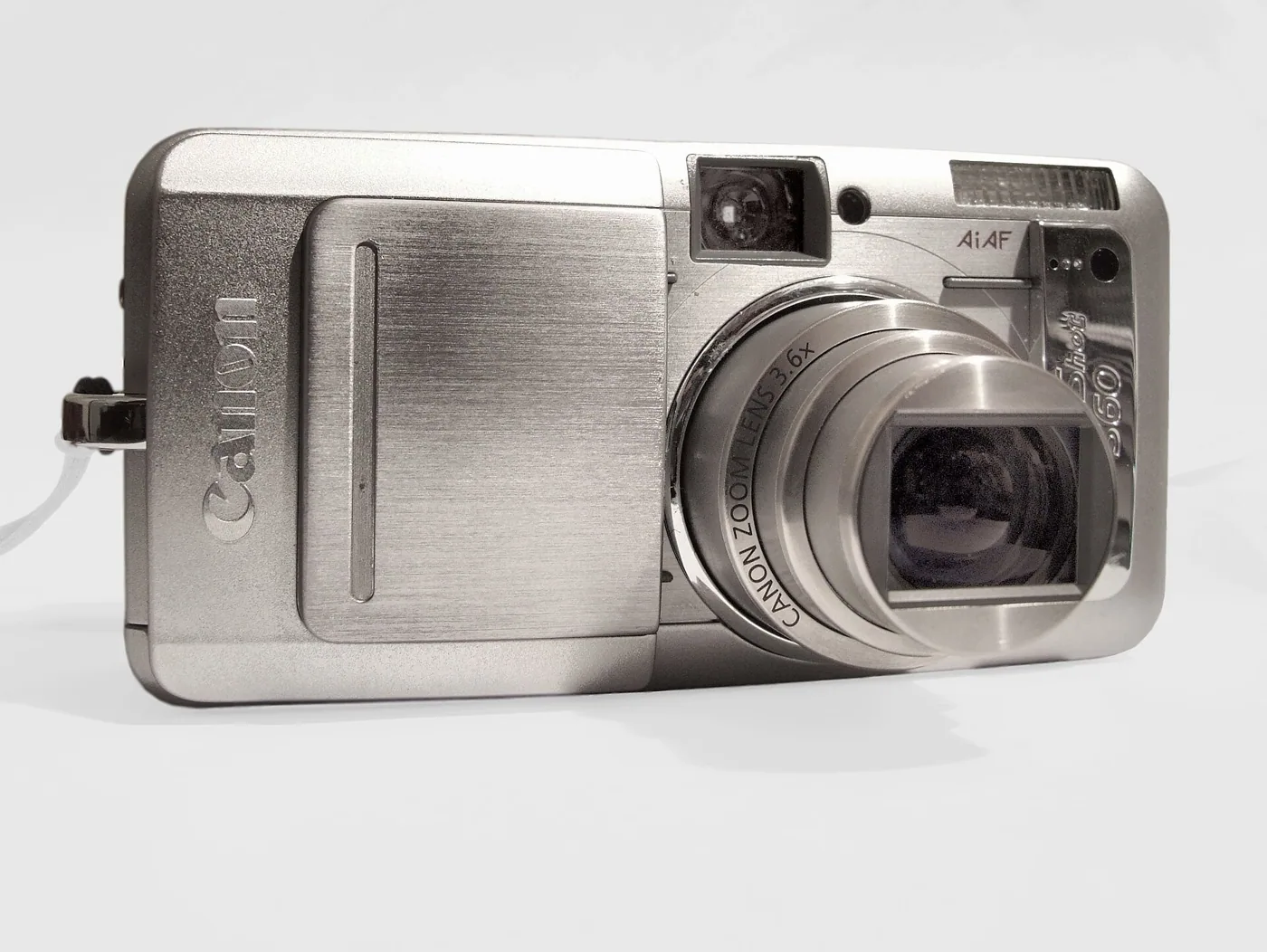

Canon kept the S50's five-megapixel sensor, put a 28 mm wide-angle lens in front of it and slimmed the body. The full reviews we read liked the pictures and the lens. The sources split on how solid it felt and how bright the screen was in sun.
- Launched
- June 2004
- Sensor
- 5 MP CCD
- Lens
- 28–100 mm, 3.6×
- Card
- CompactFlash
- Battery
- NB-2L, NB-2LH
Canon PowerShot S60 specs: sensor, lens, battery, memory card and cable
The Canon PowerShot S60 came out in June 2004 at $499 as a 5 MP CCD compact with a 28–100 mm (35 mm equivalent) 3.6× zoom lens. It takes CompactFlash cards and runs on the NB-2L or NB-2LH battery. Sources
- Sensor
- CCD, 1/1.8", 5 MP source
- Lens
- 28–100 mm equivalent, 3.6× zoom source
- Memory card
- CompactFlash source
- Battery
- NB-2L, NB-2LH source
- USB / A/V cable
- IFC-400PCU, AVC-DC300 Confirmed · all Canon cables
Meet the camera
The lens cover is the power switch. DPReview wrote that the camera starts when the cover reaches the end of its travel, and that you can reach playback with the cover shut by holding the play button.3 Imaging Resource added that the cover stops just short of the barrel until the lens has retracted, so the lens has time to retract before the cover closes completely.2 It described a polycarbonate frame wrapped in brushed, anodised aluminium panels; Canon calls the body an aluminium-magnesium alloy.21 In the hand DPReview found it comfortable: a small moulded thumb grip on the back, and a strap eyelet that doubles as a finger hook.3
Canon's museum puts the S60 on sale in June 2004 and dates the S50 it replaced to March 2003.13 MacTech's report of 10 May 2004 gave an expected June release and an estimated US street price of $499, with a battery pack, charger, USB cable and 32 MB CompactFlash card in the box.4 Macworld's note, dated 9 May, gave the same price and month, and said an underwater housing would cost $240.5 Imaging Resource called $499 a full $100 below the S50's introductory price;2 DPReview listed £399 in the UK.3 In Japan, PC Watch reported on 3 June that it would go on sale in mid-June at an open price, with a shop price estimated at around 60,000 yen.6 Two details do not match. DPReview says Canon announced the camera on 19 May, where MacTech's announcement report is dated 10 May (Macworld's is dated 9 May) and Imaging Resource first posted its review on 10 May.3452 And Imaging Resource's data sheet lists a retail price of $999, which no other source supports, so we do not use it.7
- Sensor
- 5.0 MP CCD, 1/1.8"1
- ISO
- Auto, 50, 100, 200, 4001
- Screen
- 1.8" TFT, about 118,000 dots, plus an optical viewfinder1
- Files
- JPEG or RAW, up to 2592 × 1944; shutter 15 s to 1/2000 s (1/2000 only at f/4 or smaller, per Imaging Resource)12
- Flash
- Built-in, 55 cm to 4.2 m at wide angle, to 2.0 m at telephoto (at ISO 100)1
Why this one was interesting
28 mm, in a case that stayed thin
DPReview wrote that Canon kept the telephoto end at 100 mm and moved the wide end to a 28 mm view, with a maximum aperture of f/2.8 at wide angle and f/5.3 at telephoto, which it called a little slow but unsurprising given the size of the lens elements.3 Canon's museum calls the lens the first glass-molded ultra-high-refractive-index aspheric (UA) design in the world, and credits it for the slim barrel.1 PC Watch listed eight elements in seven groups, two of them aspheric.6 Imaging Resource relayed Canon's own claim that it was a year or more ahead of other lens makers in producing such optics in volume.2 That is the maker's claim, not a finding.
What the reviewers found was more modest. DPReview measured 0.9 percent barrel distortion at wide angle, which it said was less than most compacts show at 35 mm, and called the lens sharp across the frame, with purple fringing as the one issue.3 Imaging Resource measured the same 0.9 percent, saw a fair amount of chromatic aberration at the widest setting, and judged that the new glass gave a wider and more compact lens without beating the optical quality of larger lenses of similar range.2 From normal focal lengths to telephoto it found the lens very sharp corner to corner.2 A wide view was the point for the people who wrote about it: DCResource (second-hand) noted that most compacts start at 35 to 39 mm and called 28 mm great for indoor shots, and PCMagazine (second-hand) said it liked the wide-angle ability.89
A control layout that finally behaved
DPReview did not hide its dislike of the multi-function controller on the S40, S45 and S50, and welcomed an ordinary four-way pad with a separate SET button and a dedicated zoom lever on the back.3 Imaging Resource called the new pad one of the better ones it had seen, with no confusion about which direction it was pressing.2 The FUNC menu now lists every option at once, resolution and quality included, so one trip to the list replaces cycling through screens.2 A Print/Share button glows blue when the camera is ready to print to a PictBridge printer or send pictures to a computer.21
Same sensor, new name
The name invited a wrong guess. DPReview opened by warning that the '60' would lead buyers to assume six megapixels, when the S60 had the S50's five-megapixel CCD.3 Imaging Resource noted that earlier S-series numbers had matched the megapixel count (S30 at 3.3, S40 and S45 at 4, S50 at 5) and thought the S55 would have been a better name.2 DPReview's chart test then found the S60's resolution identical to the S50's and close to a six-megapixel Casio EX-P600's, 1,450 lines per picture height horizontally against 1,500, and guessed that this was why Canon chose the number: the camera lost nothing to the new six-megapixel compacts.3
A compact G5
Both reviewers set it beside Canon's bigger G series. Imaging Resource said that apart from the rotating screen and the external hot shoe the S60 had almost all the advanced features of the G5, with a longer zoom.2 DPReview called it a compact G5, with a lens slower than the G5's f/2.0 to f/3.0.3 It shoots RAW, and Imaging Resource found it buffers two RAW frames, which it called unusual in a compact.2 See our PowerShot G5 retrospective, and, for the same line a generation earlier, the PowerShot S45.
The dark, and the noise
This is a camera for good light. Imaging Resource found noise for the most part invisible at ISO 50 and 100, visible at 200 and objectionable at 400, where it said it would not call the camera usable, and thought the noise slightly higher than the S50's.2 DPReview said the images were clean at ISO 50 and noisier from there up; in its studio comparison at ISO 400 the S60 kept its detail but at the expense of a sharp-looking noise pattern, while the Samsung Digimax V50's noise was more noticeable.3 Imaging Resource tested very dim light and found clear, usable pictures down to 1/16 of a foot-candle (0.67 lux) at ISO 100, 200 and 400; ISO 50 was bright only down to 1/8 foot-candle.2 It also reported that the camera focused in the dark, at close range, thanks to a bright assist lamp.2
The flash drew two readings. DPReview found it metered fairly well, perhaps slightly underexposed, with good colour and no cast.3 Imaging Resource found it lit its test target out to 14 feet, but judged from the noise in the 10- to 14-foot shots that the camera quietly raises the sensitivity, although Canon's software still reported ISO 50.2






Only the first file records an ISO in its data; the other two give the exposure time and aperture the camera wrote.
Like that look? See recent eBay sold listings for this camera ↗
On eBay right now
Live listings for this camera, supplied by eBay and updated automatically. We earn a commission if you buy through them.
The little wins
Blinking highlights and a 10x zoom
In playback the S60 shows a histogram, and Imaging Resource liked even better that blown-out highlights blink between white and black, so you see exactly where detail is lost. It could enlarge a frame to about ten times, enough in its view to judge focus.2
A tripod mount off to one side
Imaging Resource noticed the mount sits well off centre, so the battery and card door can be opened while a small tripod is attached.2
Exposure locked apart from focus
Half-pressing the shutter sets both, and pressing the metering button afterwards resets only the exposure, a high-end feature Imaging Resource said came over from the G series. It works for flash exposure too, which the reviewer called very slick.2
How it drew the picture
In good light the verdicts were warm. DPReview called the pictures high in resolution, sharp, with good metering, a pleasant tonal balance that lifts shadow detail, vivid colour and few processing artefacts.3 Imaging Resource said it saw very good to excellent colour, accurate exposure, and strong detail out to at least 1,200 lines, its more conservative threshold, with artefacts starting around 1,000 and extinction near 1,600.2 Both found automatic white balance poor under incandescent light: DPReview's test gave a strong orange cast, and in Imaging Resource's indoor portrait the manual and incandescent settings coped where automatic did not.32


















Photos taken with this camera, from Wikimedia Commons, credited under each picture. Each file's recorded camera model is the Canon PowerShot S60. In the files' data, five of the nine daylight pictures sit at the lens's 5.8 mm wide end, two at its 20.7 mm telephoto end and two in between (our reading of the metadata).
Where it let you down
It was not quick. DPReview said the S60 was ready to shoot over half a second sooner than the S50, but that focus speed and lag were about the same as before and nothing to boast about. It measured 3.2 seconds from off to record and 2.0 seconds shot to shot, and disliked a 1.3-second delay when browsing pictures.3 Imaging Resource also measured 3.2 seconds to the first shot, with autofocus lag of 0.77 seconds at wide angle and 0.99 at telephoto and a prefocused lag of 0.084 seconds, which it called very fast. Its overall rating was a bit better than average.2 Large, fine files came at about 2.4 seconds apiece for five frames, then slowed to roughly 5.6 seconds a shot.2
The top shutter speed carries a condition: Imaging Resource found speeds faster than 1/1,250 second available only at f/4 and smaller.2 DPReview also listed, among its cons, that the nine-point autofocus is not available in the P, Tv, Av and M modes.3 The optical viewfinder shows about 82 percent of the frame at every zoom setting, with a high eyepoint that Imaging Resource said suits spectacle wearers, and has no dioptre adjustment.23
Macro drew two different readings. Canon's museum gives a closest focus of 4 cm.1 Imaging Resource measured a minimum area of 58 by 43 mm and called it impressive, though the flash overexposed at that range and the corners went soft.2 DPReview measured 73 by 54 mm at wide angle with high distortion, and rated the macro as average, if better than the S50's.3 On battery, Canon quotes about 240 shots with the screen on and 550 with it off,1 and Imaging Resource's worst-case run-down, screen on, lasted 132 minutes, which it called very respectable, though it advised buying a second battery.2
Where the sources disagree
| Point | One source | Another |
|---|---|---|
| How solid it felt | DPReview listed solid build quality and a nice metallic finish among its pros.3 | Digital Camera Magazine (second-hand) found it much more plasticky than the S50, though not bad in absolute terms, and a step back from previous Canon build standards; DCResource (second-hand) rated build quality good for the most part but disliked the plastic battery and card cover.108 |
| The screen in sunlight | Imaging Resource: better-than-average visibility in sun, with two brightness levels.2 | DPReview: sharp and bright, but with no anti-reflective coating, so harder to use in bright sun; PCMagazine (second-hand): not particularly bright and washed out by direct light.39 |
| Normal focus, nearest | Canon: 44 cm; Imaging Resource: 44 cm.12 | DPReview's specification table: 50 cm.3 |
| Slimmer than the S50 | Canon: 3.2 mm slimmer and 30 g lighter.1 | DPReview: 5 mm thinner. Imaging Resource: a little slimmer, and almost three ounces lighter.32 |
| Custom white balance | Imaging Resource: two can be saved.2 | Canon's museum: one custom position.1 |
What the reviewers said in 2004
| Outlet | Date | Verdict |
|---|---|---|
| Imaging Resource | 10 May 2004 (updated 28 Jun) | A Dave's Pick: a significant upgrade to the S50 with a wider lens and better controls. Its one down-note was noise slightly higher than the S50's.2 |
| DCResource (second-hand) | 26 Jun 2004 (news item) | A nice camera for a high-resolution compact with a wide lens, full manual controls and a fairly compact body.8 |
| DPReview | 13 Aug 2004 | Highly Recommended, one of the best five-megapixel compacts; among its cons were purple fringing, a slow telephoto, autofocus speed and lag no better than the S50's, and poor automatic white balance in incandescent light.3 |
| PCMagazine (second-hand) | 17 Sep 2004 (news item) | Liked the smooth zoom and the 28 mm view; found the screen not bright enough in direct light.9 |
| Digital Camera Magazine (second-hand) | 12 Oct 2004 (news item) | Found the body much more plasticky than the S50's and a step back from previous Canon build standards.10 |
The timeline
- March 2003Canon's museum dates the S50 here.1
- 10 May 2004MacTech reports the S60's announcement; Imaging Resource's review is first posted the same day.42
- June 2004Canon's museum lists the camera as marketed; PC Watch says mid-June in Japan.16
- 13 August 2004DPReview publishes its review.3
- September 2004The PowerShot S70 appears, one rank above, with the same lens and a 7.1-megapixel sensor.11
Should you buy one now?
Buy one if you want a compact with a 28 mm wide end, RAW files and plenty of manual control, and you shoot mostly in good light at ISO 200 or below. It was introduced at an estimated $499;42 what it sells for now is a question for the sold listings, not for us. Before you bid, check these:
- The name. It is PowerShot S60 everywhere, so one search covers it.1 The S50 is a different camera with the same sensor, so check the model name in the listing.
- The battery. Canon lists NB-2LH or NB-2L;1 DPReview gives the NB-2LH as 720 mAh.3 Check the pack and charger are included. Amazon ↗
- The card. It takes CompactFlash Type I and II;1 DPReview says it supports cards over 2 GB, which need the FAT32 format.3 See our CompactFlash guide.
- The cover. It is the power switch, so slide it fully open and shut a few times and watch the lens go out and back.32
- The battery and card door. DCResource (second-hand) disliked the plastic cover;8 check that it latches properly.
- The screen. Look for scratches; it has no anti-reflective coating.3
- The cables. Canon lists a USB mini-B jack and PAL/NTSC video out;1 DPReview and Imaging Resource say the USB is version 1.1, and Imaging Resource measured about 508 KB per second, fast enough in its view not to need a card reader.32
If you are wondering why cameras like this are being hunted down again, we tell that story once, in Pictures that never left the card.
See recent sold prices on eBay ↗Shop on eBay ↗NB-2LH battery ↗
Sources
- Canon Camera Museum: PowerShot S60 (outline and specifications: marketed June 2004, S50 released March 2003, UA lens, body, focus range, flash range, shots per charge, interfaces)
- Imaging Resource, Canon PowerShot S60 review, twelve pages (first posted 10 May 2004, updated 28 Jun 2004; lab timings, resolution, noise and low-light tests)
- DPReview, Canon PowerShot S60 review by Phil Askey (published 13 Aug 2004; read in full, including specification table, design, timings, white balance, studio comparisons with the Samsung Digimax V50, resolution chart, conclusion)
- MacTech, “Canon introduces slimline 5mp PowerShot S60” (10 May 2004; expected in June, estimated street price US$499, box contents)
- Macworld, “Canon introduces wide-angle PowerShot S60” (dated 9 May 2004; June, $499, underwater housing $240)
- PC Watch (Impress), Canon PowerShot S60 announcement, in Japanese (3 Jun 2004; mid-June release, open price, lens construction)
- Imaging Resource data sheet, Canon PowerShot S60 (retail price field $999.00, price updated 2007-02-27; cited only to record a figure no other source supports)
- PhotographyBLOG news item, DCResource Reviews Canon PowerShot S60 (26 Jun 2004; second-hand: a quoted excerpt, we could not open DCResource's own page)
- PhotographyBLOG news item, PCMagazine Reviews Canon PowerShot S60 (17 Sep 2004; second-hand excerpt)
- PhotographyBLOG news item, Digital Camera Magazine Reviews Canon PowerShot S60 (12 Oct 2004; second-hand excerpt)
- Canon Camera Museum: PowerShot S70 (marketed September 2004; one rank above the S60, same lens, 7.1-megapixel CCD)
Camera photo by Mohylek (CC BY-SA 4.0); other photographs are credited under each one, all via Wikimedia Commons. Links to eBay and Amazon are affiliate links.