Canon PowerShot A · March 2004
The Canon PowerShot A75: the A70's successor, $50 cheaper and still full of dials
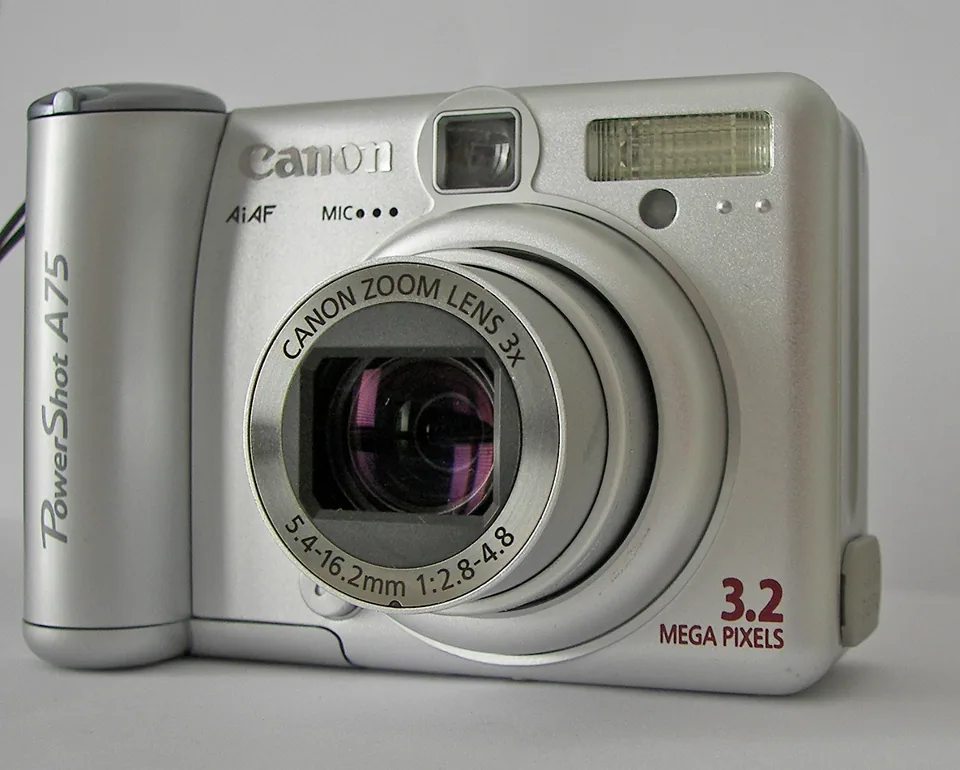
In spring 2004 Canon replaced the A70, which Imaging Resource said had topped Canon's sales the year before. The A75 kept the sensor and lens, added a larger screen, nine-point autofocus and a print button, and Imaging Resource gave a suggested price of $299 at introduction.14 Imaging Resource judged it about the same as the A70, and DCRP called it a nice improvement on an already excellent camera.45
- Launched
- March 2004
- Sensor
- 3.2 MP CCD
- Lens
- 35–105 mm, 3×
- Card
- CompactFlash
- Battery
- AA
Canon PowerShot A75 specs: sensor, lens, battery, memory card and cable
Launched in March 2004 at $299, the Canon PowerShot A75 is a 3.2 MP CCD compact with a 35–105 mm (35 mm equivalent) 3× zoom lens. Inside: it takes CompactFlash cards and runs on AA batteries. Sources
- Sensor
- CCD, 1/2.7", 3.2 MP source
- Lens
- 35–105 mm equivalent, 3× zoom source
- Memory card
- CompactFlash source
- Battery
- AA source
- USB / A/V cable
- IFC-400PCU, AVC-DC300 Confirmed · all Canon cables
A note on coverage: we read two full 2004 reviews from start to finish. DCRP says it reuses parts of its A70 review because the cameras are so similar, so some of its findings may come from the A70 and we cannot tell which. For Steve's Digicams and CNET only the first page survives in the web archive copies we could open, so we use them for a few facts and no verdicts. Canon's user guide and system map fill in some details.
Meet the camera
The A75 is a two-tone silver compact with a large grip formed by the battery compartment.4 Canon lists the body at 101 by 64 by 31.5 millimetres, excluding protrusions, and about 200 grams for the camera body only.1 Imaging Resource gave 327 grams with batteries and a CompactFlash card, and said it was too big for a shirt pocket but fine for a coat pocket or a purse.4 DCRP called it small, though not as small as a Digital ELPH.5
The sources disagree about what the shell is made of. Imaging Resource called it plastic with a metallic sheen, DCRP found a mix of metal and plastic that felt solid for a $300 camera, and Steve's feature list describes an aluminum-clad front. Canon's museum page names no material.4561
Canon marketed the A75 in March 2004 as the replacement for the A70, a model its museum page says was acclaimed worldwide for value after its March 2003 release.1 Imaging Resource gave a suggested price of $299 at introduction and April 2004 availability, $50 less than the A70; DCRP said it was available for $299, and CNET's page lists a release date of 15 April 2004.457
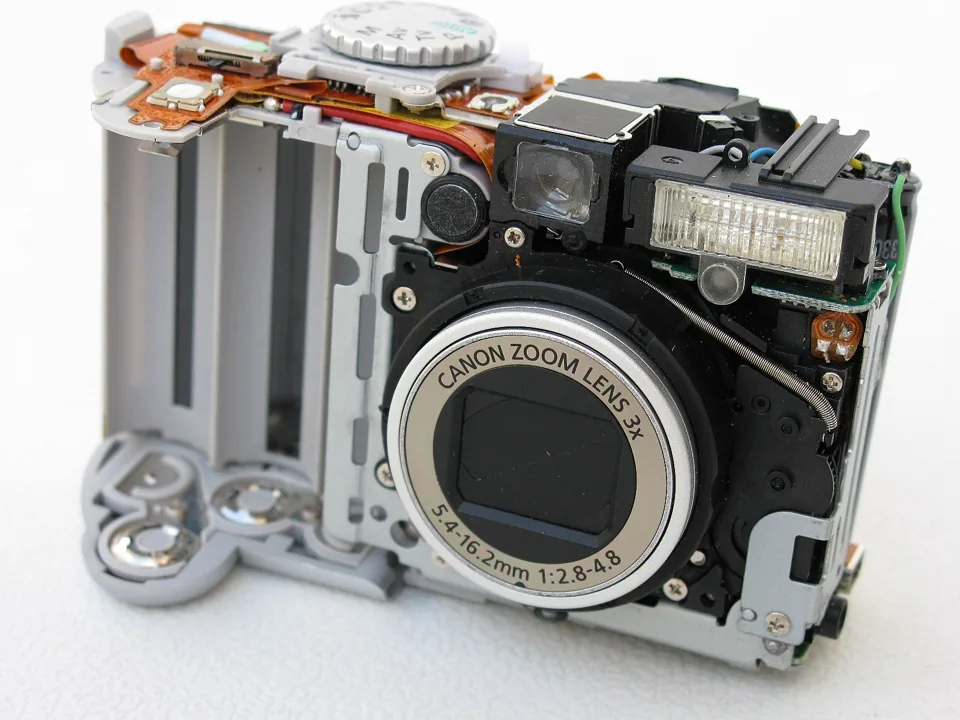
- Sensor
- 3.2 MP CCD, 1/2.7" (about 3.3 MP total)1
- ISO
- Auto, 50, 100, 200, 4001
- Screen
- 1.8"; Canon's museum lists about 110,000 dots, DCRP and Steve's 118,000 pixels. Optical viewfinder too156
- Video
- 640 × 480, 320 × 240 or 160 × 120, about 15 frames a second; Canon's user guide gives about 30 seconds a clip at 640 × 480 (sources differ, see below)148
- Size
- 101.0 × 64.0 × 31.5 mm excl. protrusions, about 200 g camera body only1
Why this one was interesting
The A70, revised
Canon's museum page says the A75 inherits the A70's sensor and lens and adds a new handgrip shape and an enlarged 1.8-inch screen, and says it offers a Print/Share button and six Special Scene modes.1 Imaging Resource called the changes evolutionary and added a faster, more efficient DIGIC processor to the list; DCRP's list had more focus points and data imprinting.45 The screen is where the sources part: Canon's museum pages put the A70's 1.5-inch screen at about 118,000 dots and the A75's at about 110,000, while DCRP counts 78,000 pixels on the old screen and 118,000 on the new one, and the spec table Steve's Digicams reproduces also says about 118,000 pixels for the A75.2156 We cannot reconcile the counting methods; the one point the sources share is that the new screen is bigger.
Manual control at an entry price
Imaging Resource called the A75 unusual: sold as entry level, yet with abilities that extended well beyond it.4 The mode dial carries program, shutter-priority, aperture-priority and full manual positions beside the scene modes, with shutter speeds from 15 seconds to 1/2000 and ISO 50 to 400.14 DCRP singled out the full manual controls as something rarely seen on an entry-level camera.5 Manual focus comes with a distance scale on the screen, though DCRP missed a focus-check zoom.45
Where it sat in the line
The PowerShot A70 arrived in March 2003 and the 4-megapixel PowerShot A80, with a swivelling screen and nine-point autofocus, in October 2003.23 So the A75, marketed five months after the A80, was the A70's successor and also a 3.2-megapixel sibling to the 4-megapixel A80. Imaging Resource suspected the A80 would take over the A70's popularity, and still wrote in its conclusion that the A75 looked poised to follow the A70 and A40.4 Later AA-powered A-series cameras we have reviewed include the PowerShot A640 and the PowerShot A700.
What was lost
Imaging Resource's lab chart gave the A75 about 1,000 lines per picture height, below the 1,100 it gave the A70, with artifacts from about 600 lines and extinction near 1,300. It then found distant outdoor shots as sharp as the A70's or sharper, and called the result "a bit of a puzzle."4 The optical viewfinder stayed tight, showing about 75 percent of the frame at wide angle and 77 percent at telephoto against nearly 100 percent on the screen, and DCRP noted it has no diopter control.45
Smaller faults: the flash could not throttle down for the macro range and overexposed the test shot, and DCRP noted there is no connection for an external flash.45 The screen's brightness is not adjustable.5 The battery door sits close to the tripod mount, so changing batteries on a tripod is awkward.4 DCRP called the CompactFlash cover somewhat flimsy.5
Like the look of 2004? See recent eBay sold listings for this camera ↗
In the dark
Imaging Resource found good low-light performance: bright, usable pictures down to its test limit of 0.67 lux at ISO 100, 200 and 400, and at ISO 50 down to 1.3 lux. Noise was low at ISO 50 and 100, moderate at ISO 200 and quite high at ISO 400.4 Its autofocus illuminator lets the camera focus in complete darkness, but only on nearby objects, a range Imaging Resource said grows as the light improves.4 DCRP called the lamp bright orange, found it helped focus in dim light, and called its 15-second night exposure slightly noisy with a fair amount of purple fringing, which a smaller aperture reduced.5
Canon lists the flash at 4.2 metres at wide angle and 2.5 metres at telephoto, with a recycle time of about 15 seconds or less.1
On eBay right now
Live listings for this camera, supplied by eBay and updated automatically. We earn a commission if you buy through them.
The little wins
Nine focus points
Imaging Resource explained that the camera judges focus across a nine-point area covering about 60 percent of the frame's centre, and focuses on whatever is closest to one of the points. You can switch it to the centre only.4 DCRP noted you cannot choose a point yourself.5 The A70 had five.245
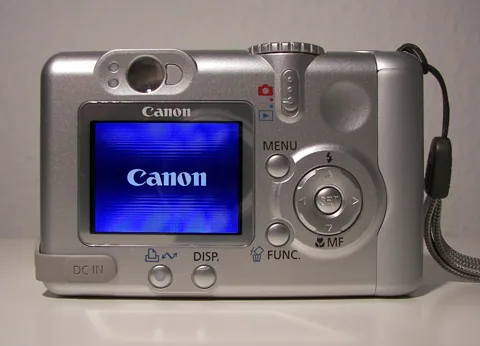 The back of the A75 with its screen showing the Canon start-up logo. · Solaris2006 · CC BY-SA 3.0 · Commons
A print button that glows
Canon says the Print/Share button also appeared on its new IXY Digital models.1 Imaging Resource saw it light bright blue when a PictBridge printer was connected, and one press prints the picture on screen.4 Connected to a Windows PC, the screen shows a Direct Transfer menu, and the options DCRP listed include a wallpaper setting.5
Three ways to count battery life
Canon's list gives about 250 shots with the screen on and 800 with it off on alkaline cells, and 550 and 1,200 on NiMH.1 Imaging Resource ran 1,600 mAh cells for three and a half hours in its worst case, and 16 hours with the screen off.4 DCRP quoted Canon at about 850 photos with 2,300 mAh cells and half-time screen use.5 The three measures differ, so the figures do not compare directly.
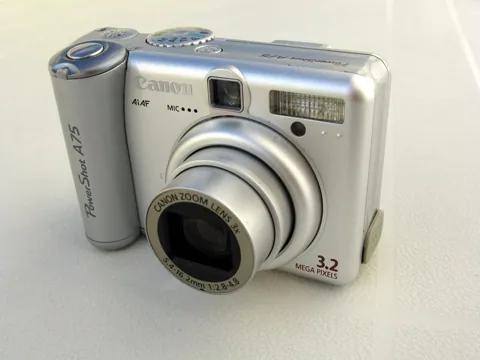 The A75 from the front with the lens extended. · Wassily · CC BY-SA 3.0 · Commons
Conversion lenses and a diving case
Press the small button beside the lens and the plastic ring comes off, ready for a lens adapter. DCRP listed a wide converter that takes the wide end to 26.6 mm, a tele converter that reaches 252 mm and a close-up lens, all needing a 19-dollar adapter that also takes 52 mm filters; its 2004 prices ran from $90 to $99 for the converters.45 An optional underwater case, the WP-DC30, was good to 40 metres, DCRP said.5
Six special scenes
The scene menu offers Foliage, Snow, Beach, Fireworks, Underwater and Indoor. Imaging Resource said Foliage boosts green and red, and Indoor tries to prevent shake and hold colour under fluorescent and tungsten light.14
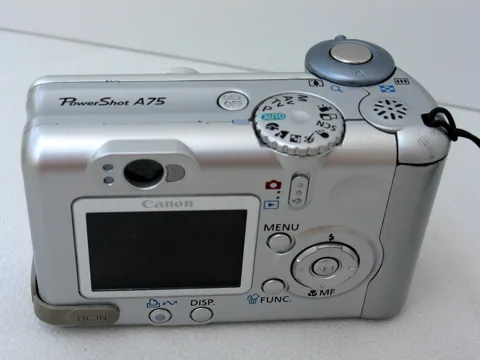 The back of the A75, with the mode dial and zoom lever on top. · Wassily · CC BY-SA 3.0 · Commons
A friendlier back
Imaging Resource said the larger screen and the new five-way pad improved the look of quality, and measured the screen at over 99 percent framing accuracy.4 DCRP called the redesigned controller much easier to use than the A70's, and noted two buttons below the screen instead of four.5
How it drew the picture
Imaging Resource called the colour very good to excellent, with an auto white balance that ran slightly warm and reddish, a manual setting that was cooler and more accurate, and skin tones a little pinkish.4 DCRP found colour and exposure accurate and pictures fairly sharp, with purple fringing now and then, and said 3.2 megapixels suits 8 by 10 prints.5 Imaging Resource measured barrel distortion of about 0.7 percent at wide angle and 0.2 percent at telephoto.4 At the largest size and best quality Canon lists a file of about 1.6 megabytes, which is 18 pictures on the 32 MB card in the box.1
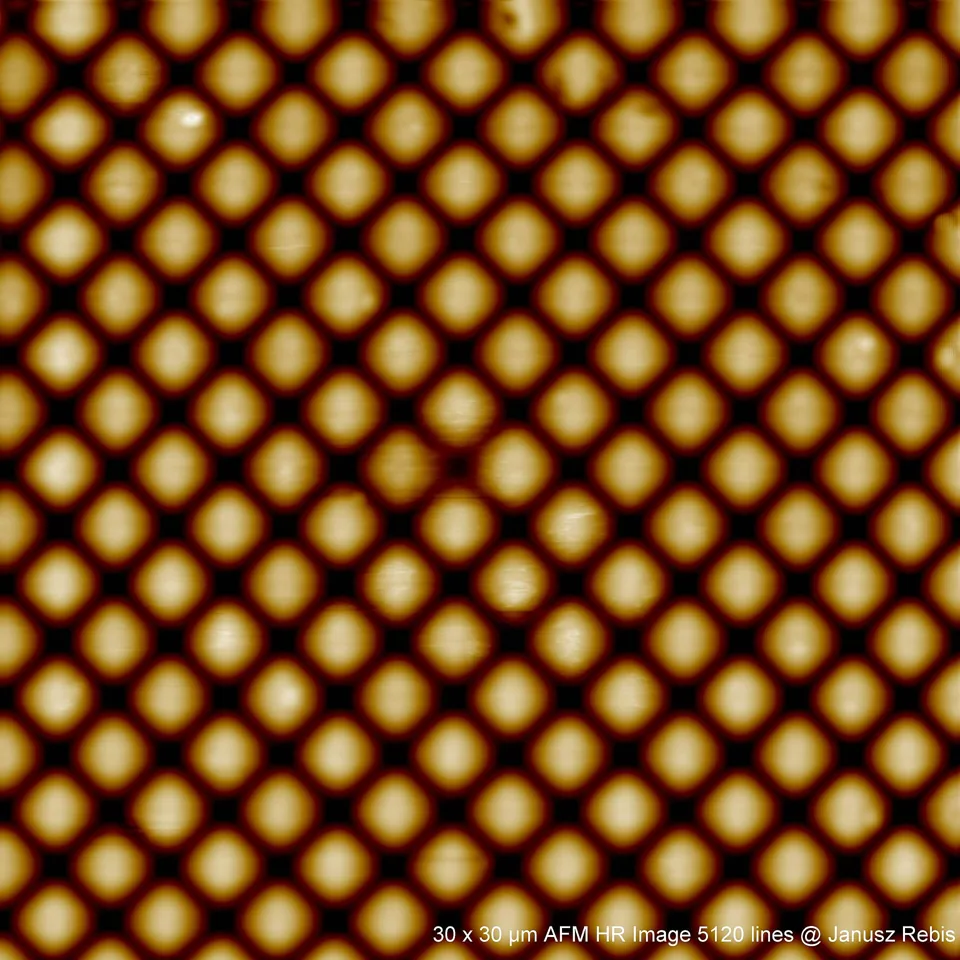
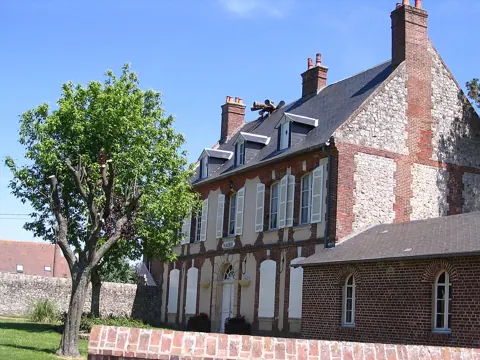










Photos taken with this camera, from Wikimedia Commons, credited under each picture. We chose them for variety, not to prove anything about quality; the aquarium shot is soft.
Where it let you down
Imaging Resource put full-autofocus shutter lag at 0.9 to 1.2 seconds, on the slow side of average, but called the lag after a half-press blazing.4 DCRP timed 2.5 seconds from switch-on to first shot, saw autofocus settle in under a second usually and shot-to-shot waits of 1.5 seconds, and clocked the zoom at 1.6 seconds from wide to telephoto at a single speed.5 Canon quotes a burst of about 2.2 frames a second; DCRP got eight frames at the best quality before it slowed, and CNET's summary says 11 frames in under six seconds.157
Video is the plain disagreement. Canon's museum table lists 30 seconds of 640 × 480 on a 32 MB card and 499 seconds on a 512 MB card, with each clip capped at three minutes. Canon's own user guide gives the maximum clip length as about 30 seconds at 640 × 480 and 3 minutes at the two smaller sizes, and says the 30-second figure was obtained with the supplied 32 MB card or the separately sold 256 MB or 512 MB Canon cards. DCRP says the same limits and adds that card size makes no difference; Steve's spec table repeats them. Imaging Resource simply says up to three minutes.18564 We take the user guide as the best guide to the camera, but we have not filmed with a unit. DCRP also said the movie mode was not hot for 2004, saved M-JPEG AVI files, and could not zoom while filming.5 The camera saves only JPEG, with no raw or TIFF.5
What the reviewers said in 2004
| Outlet | Date | Verdict |
|---|---|---|
| Steve's Digicams | 21 Mar 2004 | We read only the first page: features and specifications, no verdict.6 |
| DCRP | 3 Apr 2004, updated 28 Apr | Photo quality very good, performance robust; a great entry-level camera for beginners and amateurs, highly recommended. Dislikes: no diopter control, no rechargeable batteries in the box, an unremarkable movie mode. It reuses parts of its A70 review.5 |
| Imaging Resource | 15 May 2004 | About the same as the A70; a premier camera for the mid-level consumer market that is also a bargain, and a good all-round digicam.4 |
| CNET | 15 Jul 2004 | Editors' rating of 8.0 out of 10, Excellent; the summary praises the burst mode and says the A70's good qualities were kept.7 |
The timeline
- March 2003Canon markets the A70.2
- October 2003Canon markets the A80.3
- 21 March 2004Steve's Digicams posts its review.6
- March 2004Canon markets the A75.1
- 3 April 2004DCRP posts its review.5
- 15 April 2004CNET lists the release date.7
- 15 May 2004Imaging Resource dates its review.4
- 15 July 2004CNET dates its review.7
Should you buy one now?
Buy one if you want a 2004 CCD compact with real exposure control, AA batteries and a lens that takes converters, and you can live with a tight viewfinder and no raw. Its launch price was a suggested $299;4 what it sells for now is a question for the sold listings, not for us. Before you bid, check these:
- The card. It takes CompactFlash Type I only, so no Microdrive;5 see our CompactFlash guide and the glossary. The box held a 32 MB card, so plan on a bigger one.45
- The batteries. It takes four AA cells, alkaline or NiMH;14 both reviews suggest rechargeables, and a set with a charger ↗ is the usual pairing.45
- The cable. Canon lists a mini-B USB jack and a video-out jack,1 and its system map names the IFC-400PCU USB cable and the AVC-DC300 AV cable as supplied with the camera;9 our cable guide covers the connector.
- The lens and zoom. Check that it extends, retracts and zooms smoothly, and that the ring comes off if you want converters.4
- The card door. DCRP called the cover somewhat flimsy, so check that it still closes.5
- The date battery. Canon's user guide says a built-in rechargeable lithium battery keeps the date and time and is recharged by the AA cells in the camera, about four hours for a new camera; if the Date/Time menu appears at switch-on, the charge is low.8 Canon's museum power list names a coin-type secondary lithium battery, MS-614S.1 Ask whether the date holds.
If you are wondering why cameras like this are being hunted down again, we tell that story once, in Pictures that never left the card.
See recent sold prices on eBay ↗Shop on eBay ↗AA batteries and charger ↗
Sources
- Canon Camera Museum, PowerShot A75 (marketed March 2004; outline and full specifications)
- Canon Camera Museum, PowerShot A70 (marketed March 2003; 1.5-inch screen, about 118,000 dots)
- Canon Camera Museum, PowerShot A80 (marketed October 2003; 9-point AiAF, Vari-Angle screen)
- Imaging Resource, Canon PowerShot A75 review (review date 15 May 2004; $299 suggested price at introduction; availability April 2004)
- Digital Camera Resource Page (DCRP), Canon PowerShot A75 review (first posted 3 April 2004, updated 28 April 2004; archived copy of 31 December 2005)
- Steve's Digicams, Canon PowerShot A75 (review posted 21 March 2004; archived copy, only the first page read: introduction, features and specifications)
- CNET, Canon PowerShot A75 by David D. Busch (review date 15 July 2004; archived copy, only the summary page read: 8.0 of 10 and a release date of 15 April 2004)
- Canon, PowerShot A75 Camera User Guide (PDF hosted by Canon: movie clip lengths, date/time battery, specifications)
- Canon, PowerShot A75 System Map (PDF hosted by Canon: accessories and supplied cables)
Camera photos by Solaris2006, Wassily (both CC BY-SA 3.0) and Januszartur (CC BY-SA 3.0); other photographs are credited under each one, all via Wikimedia Commons. Links to eBay and Amazon are affiliate links.