Sony Cyber-shot W · on sale January 2010
The Sony Cyber-shot DSC-W350: the $200 slim camera that took both Memory Stick and SD cards
We found no other regional name for it; the announcements and reviews we read all use DSC-W350.124
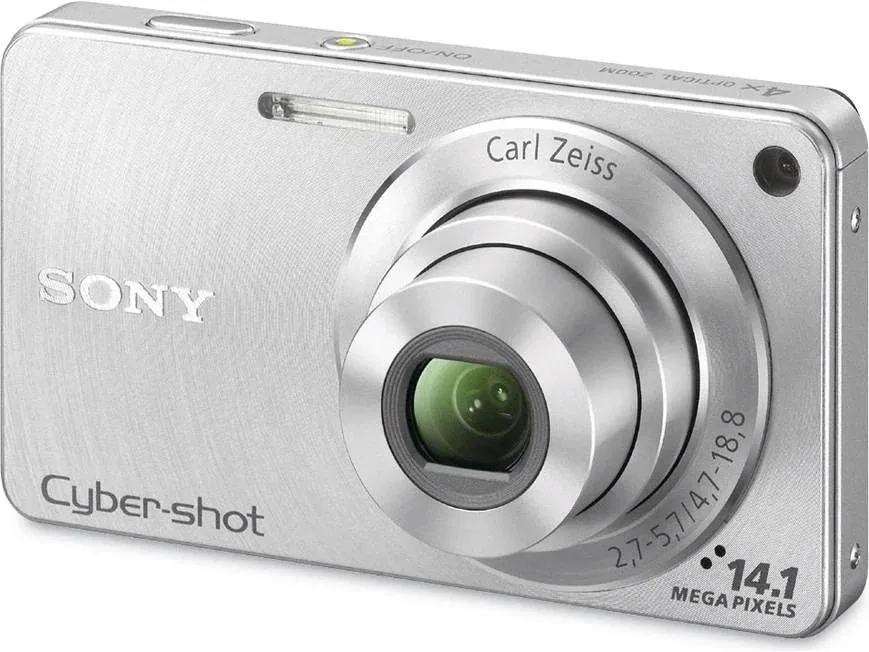
Sony announced it on 6 January 2010 as the cheaper of two Sweep Panorama compacts. Reviewers liked how small it was and how wide the lens went, and warned about noise, a dim screen and a proprietary cable. One of them said to buy the Canon next door if you could afford it.
- Launched
- January 2010
- Sensor
- 14.1 MP CCD
- Lens
- 26–105 mm, 4×
- Card
- Memory Stick Duo, Memory Stick PRO Duo, SD, SDHC
- Battery
- NP-BN1
Sony Cyber-shot DSC-W350 specs: sensor, lens, battery, memory card and cable
The Sony Cyber-shot DSC-W350 came out in January 2010 as a 14.1 MP CCD compact with a 26–105 mm (35 mm equivalent) 4× zoom lens. It runs on the NP-BN1 battery. Sources
- Sensor
- CCD, 1/2.3", 14.1 MP source
- Lens
- 26–105 mm equivalent, 4× zoom source
- Memory card
- Memory Stick Duo, Memory Stick PRO Duo, SD, SDHC source
- Battery
- NP-BN1 source
- USB / A/V cable
- See our Sony cable page
Meet the camera
The W350 is a flat, slim compact: Imaging Resource's table gives about 91 by 52 by 17 millimetres and 114 grams with battery and card,3 while Cameralabs measured 90.7 by 51.5 by 16.7 millimetres and 117 grams.5 Cameralabs listed a very slim and light body among its pros.7 It was announced on 6 January 2010 alongside the W370, and the W350 was listed at about $200 for January availability, against about $230 for the W370.12 Imaging Resource listed silver, black, pink and blue.1
The headline feature was Sweep Panorama: you press the shutter and sweep the camera, and it stitches the picture in the body. Imaging Resource said it was the first time Sweep Panorama appeared in a CCD-based Cyber-shot, and that the W350 recorded up to a 268-degree view.4 It also shot 720p video at 30 frames per second.3
- ISO
- 80 to 3200 (Auto limited to 80 to 800)4
Why this one was interesting
A wide lens in a very thin body
Cameralabs praised the 26 millimetre wide end as wider than average, and the body as easy to carry in most pockets.7 Imaging Resource liked the very low barrel distortion, about 0.1 percent at wide angle, and the fast autofocus in good light.4 Cameralabs said the optical stabiliser could not be switched off, and estimated about three stops of compensation.5
Panorama without a computer
Cameralabs said the camera assembles the panorama itself while the Canon rival needs software later.7 It produces pictures up to 7152 by 1080 pixels, though Cameralabs found its stitching less capable with moving subjects than the HX5's.5 Imaging Resource called the mode a great feature but said you need the proper light, and saw plenty of noise in its snowstorm shots.4
Smile and face tricks
Cameralabs liked a smile shutter with three sensitivity levels, and self-timer modes that fire when one or two new faces enter the frame.5 Imaging Resource listed face, Smile Shutter and Blink detection among its pros, though it was less enthusiastic about Smile Shutter itself.4
For other Sony compacts on this site, see our DSC-W830 and DSC-W200 reviews.
Which card does it take?
Both Memory Stick and SD. Imaging Resource's table lists Memory Stick Duo, Memory Stick PRO Duo (Mark 2 only), PRO Duo High Speed, PRO-HG Duo, SD and SDHC cards, with 45 megabytes of built-in memory.3 Cameralabs lists SD, SDHC and Memory Stick PRO Duo, and wrote that Sony claims SDXC compatibility;5 the Imaging Resource table and review do not list SDXC, Sony Japan's page only says Memory Stick Duo and SD cards,8 and we have not tested one. Treat SDXC as unconfirmed. Imaging Resource suggested 4 to 8 GB SD cards and a Class 4 or faster card for video.4 Cameralabs said it recorded about 29 minutes of the best 720p quality on a freshly formatted 2 GB card, at about 65 megabytes a minute.5 It also found the Memory Stick PRO Duo slot fiddly to load.5 Our memory card guide explains the formats.
What was lost
Next to its Canon rival this was the plainer camera. Cameralabs preferred the IXUS 130 / PowerShot SD1400 IS for its brighter, more colourful screen visible at more angles, playback histogram, mini HDMI port, 22 Intelligent Auto scenes (the Sony has eight) and a more comfortable, classier feel in the hand.57 The Sony has no manual exposure control and no histogram in shooting or playback, and its two apertures per focal length cannot be chosen.5 Imaging Resource listed few manual controls and a proprietary cable for HDTV output among the cons, with a component cable costing about $30 extra.4 See our Canon PowerShot SD1400 IS review for the other side of that comparison.
The dark: its weak point
Noise started early. Cameralabs listed image quality that deteriorates from ISO 200 among its cons and, in its low-light ladder, said the Canon was clearly better at ISO 100, still ahead at 200 and had a small edge at 400.76 Imaging Resource saw good definition at ISO 200 and 400 but noticeable noise suppression, luminance noise eroding fine detail by ISO 800, and detail all but gone at ISO 3200.4 At the top end Cameralabs said it preferred the Sony's look from ISO 800 and that ISO 3200 may be acceptable in an emergency, while Imaging Resource judged ISO 1600 surprisingly good at 5 by 7 inches but ISO 3200 too fuzzy even at 4 by 6.64
The flash and focus suffered too. Imaging Resource rated the flash at 12.5 feet at wide angle and 6.2 feet at telephoto, with the camera raising ISO to 640, a recycle time of 6.5 seconds, and autofocus that struggled in dim light, made worse by the assist lamp.4
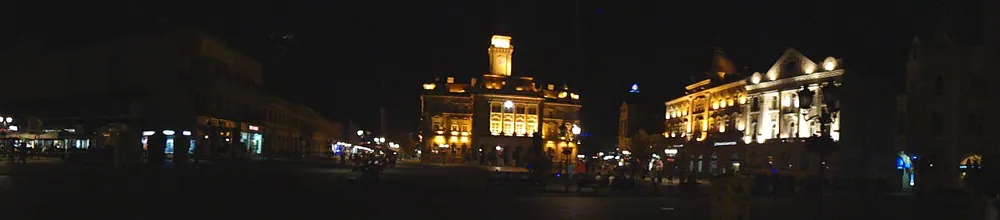
A night photograph taken with this camera; the ISO shown is the one recorded in the file's own data.
On eBay right now
Live listings for this camera, supplied by eBay and updated automatically. We earn a commission if you buy through them.
The little wins
Prefocused speed
Imaging Resource measured a prefocused shutter lag of 0.016 seconds, which it called zippy, and a start-up of about 2 seconds.4
Zoom while filming
Both reviewers noted the optical zoom works during video, although Cameralabs found the zoom too fast to be practical and the motor audible.457
Price against the Canon
At review time Cameralabs said it was available for around 20 percent less than the Canon, and still hard to beat on price.7
How it drew the picture
Cameralabs called real-life detail in decent light a draw with the Canon, with a punchier default look from stronger sharpening and contrast, and some watercolour smearing in foliage.6 It saw the extreme top-left corner turn visibly soft at one focal length near the wide end.6 Imaging Resource also found soft corners at wide angle, moderate red fringing there, and colour shifts: orange toward yellow and yellow toward green, and skin tones (darker skin leaned orange, lighter skin slightly yellow), with auto white balance too warm under incandescent light.4








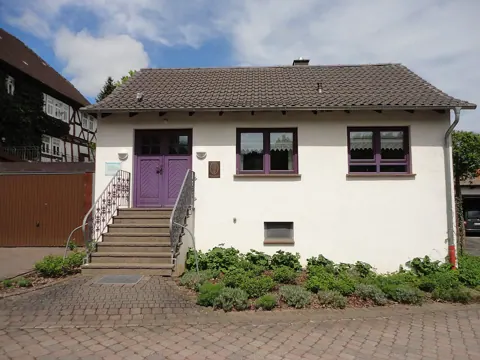







Photos taken with this camera, from Wikimedia Commons, credited under each picture.
Where it let you down
The slowest part was the wait between pictures: Imaging Resource timed 3.09 seconds per frame in single-shot mode, with zoom and focus locked out for about 3 seconds, which it called vexing.4 Cameralabs saw about 1.6 frames a second at first, but only four frames at that speed before one frame every 1.8 seconds.5 Autofocus lag was 0.34 seconds at wide angle and 0.39 at telephoto in Imaging Resource's test.4 Cameralabs found the screen hard to see at high or low angles, and Imaging Resource said it washed out in direct sunlight, though it worked very well under most circumstances.574 Battery life, rated at 240 shots, did not last nearly as long as stated in Imaging Resource's use, and it advised a spare.34 Video showed blocky noise on a 50-inch TV in Imaging Resource's test, and Cameralabs saw vertical streaks around bright highlights, a CCD habit.45 Cameralabs described a single proprietary port on the underside, with a bundled cable that ends in AV and USB.5 See our Sony cable page.
What the reviewers said
| Outlet | Date | Verdict |
|---|---|---|
| Imaging Resource | 5 Apr 2010 | 3 out of 5. Good in plenty of light with a strong panorama mode; weak in low light and slow between shots; confirm you can live with the trade-offs at about $200.4 |
| Cameralabs | Page dated Aug 2011 | 79 percent (build 18, value 17, handling 14, image quality 14, specification 16, each out of 20). Good value, but if you can afford the extra, Cameralabs thought the Canon IXUS 130 / SD1400 IS gave a superior overall experience.7 |
We found only these two full contemporary reviews. Cameralabs also compared its panorama stitching with Sony's HX5.5
The timeline
- 6 January 2010Sony announces the W350 and W370 at CES; the W350 is planned at $199 for January.12
- 5 April 2010Imaging Resource publishes its review.4
- August 2011The date on the Cameralabs review page.7
Should you buy one now?
Buy one if you want a tiny, light camera for daylight snapshots and panoramas and you do not mind soft, noisy low-light pictures. It launched at about $200;12 what it sells for now is a question for the sold listings, not for us. We have not tested a unit yet. Before you bid, check these:
- The name. Search the DSC-W350.1 The W370, announced the same day at about $230, is a different model.12
- The battery. It uses an NP-BN1;3 a fresh one is on Amazon ↗, and Imaging Resource listed below-average battery life among the cons.4
- The card. It takes Memory Stick Duo and PRO Duo cards and SD or SDHC.3 If you use Memory Stick, Imaging Resource's table says PRO Duo must be Mark 2.3 See our glossary entry and the memory card guide.
- The cable. The port is proprietary; the bundled cable carries AV and USB, and a component cable was an optional extra.54 Check that the cable is included.
- The screen and lens. Look for scratches on the screen, and check that the lens zooms cleanly and the corners are not smeared.
If you are wondering why cameras like this are being hunted down again, we tell that story once, in Pictures that never left the card.
See recent sold prices on eBay ↗Shop on eBay ↗NP-BN1 battery ↗
Sources
- Imaging Resource, Sony announces W370 and W350 (6 Jan 2010, from CES: specifications, $199 planned price, January availability)
- SlashGear, Sony introduces first digital cameras with HD video, Sweep Panorama on CCD Cyber-shots (6 Jan 2010)
- Imaging Resource, Sony DSC-W350 specification table (MSRP, memory cards, battery, size)
- Imaging Resource, Sony DSC-W350 review (user report by David Elrich, 5 Apr 2010, 3 out of 5)
- Cameralabs, Sony Cyber-shot DSC-W350 review by Gordon Laing (page dated Aug 2011, 79 percent, compared with the Canon IXUS 130 / SD1400 IS)
- Cameralabs, W350 review: image quality and noise pages (same review)
- Cameralabs, W350 review: verdict page
- Sony Japan, DSC-W350 archive product page (production ended; Memory Stick Duo and SD dual slot, NP-BN1, USB/AV cable in the box)
Photographs are credited under each one, all via Wikimedia Commons. Links to eBay and Amazon are affiliate links.