Sony Cyber-shot T · on sale spring 2009 · a retrospective
The Sony Cyber-shot DSC-T90: a credit-card camera that traded buttons for a touchscreen
In 2009 Sony claimed the world's thinnest optically stabilised camera, hid the lens behind a sliding cover and put almost the whole back under a 3-inch touchscreen. Reviewers admired the looks and argued about the price and the screen.
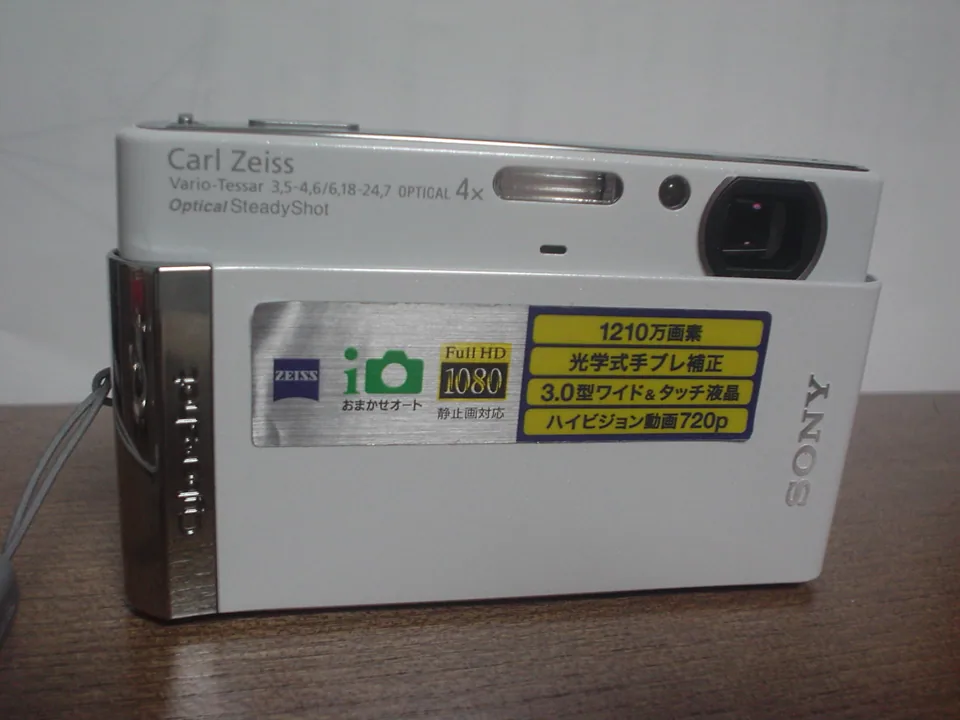
Meet the camera
Sony's Japanese launch announcement, dated 19 February 2009, called the T90 the thinnest optically stabilised digital still camera in the world, 13.9 mm at its thinnest point not counting the lens cover.1 Imaging Resource listed it at 94 by 57 by 15 millimetres.2 TechRadar noticed that two thirds of the front is a lens cover that you pull down to reveal the lens, which also switches the camera on.4 Photo Review called the metal body solidly made and the T90 a scaled-down version of the larger-screened T900.5
Sony announced both cameras together; the T900 had a 3.5-inch touchscreen and was a little thicker.1 Sony's Japanese release date for the T90 was 13 March 2009,1 and Imaging Resource gave an expected price of about $300 with US availability in April 2009.2 PhotographyBLOG's review priced it at £289,3 and Photo Review's at A$549.5 Colours were white, brown, pink, blue and black in Japan.1
Why this one was interesting
Almost no buttons
TechRadar noted that the 3-inch touchscreen means you will not find any function buttons on the back; icons run down either side of the screen to choose settings, and it found the screen more responsive than expected, effective and intuitive.4 Photo Review disagreed. It had never been a fan of touchscreens for camera controls and found the pressure needed frustrating: sometimes a setting activated at the brush of a fingertip, at other times it needed a solid poke.5 PhotographyBLOG said using the screen quickly becomes second nature with a bit of practice.3
Touch to focus
Photo Review noted that, as on previous touchscreen Cyber-shots, you could compose the shot and touch the point to focus on, moving the AF point several times before half-pressing the shutter.5
High-definition video, with a footnote
Sony's announcement promoted what it called high-definition video: 1280 by 720 at about 30 frames per second, in the MP4 format, about 82 minutes on a 4 GB Memory Stick Duo in standard mode.1 Photo Review and Imaging Resource both describe it as 720p, and Photo Review's "don't buy" list says to look elsewhere if you need Full HD.25 TechRadar's review praised "1080 HD recording" and its verdict page lists it as a reason to buy, which is a mistake against Sony's own figures.41
The same slim idea in an earlier form is told in our DSC-T9 retrospective.
The dark: how the sensor coped
Photo Review found resolution began to decline at ISO 800 and was very low at ISO 3200, where noise was also obvious, though the T90 kept full resolution even at the top setting.5 The camera tended to keep the ISO below 400 in its automatic modes; flash needed ISO 800 to light an average-size room, and image noise became visible in flash shots at ISO 800, though still printable at snapshot size.5 Sony's own description pointed to the BIONZ processor for noise reduction and a Dynamic Range Optimizer to balance light and dark.1
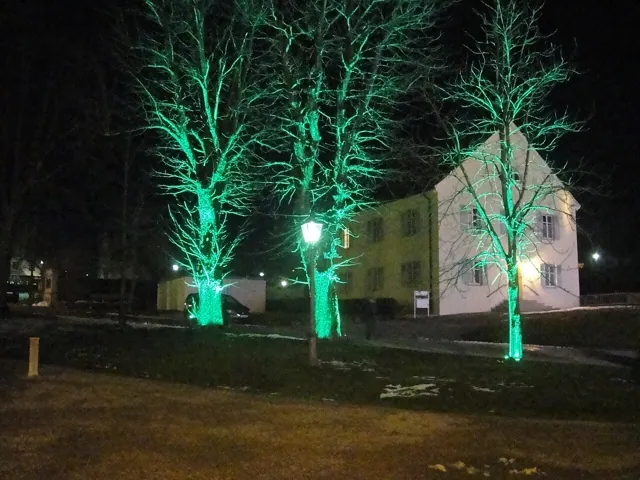

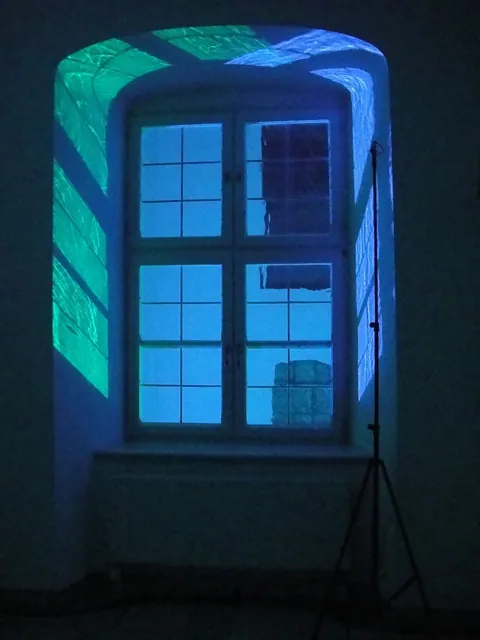





Real photographs taken with this camera, from Wikimedia Commons. The sensitivity shown is recorded in each file's own EXIF data.

Like that look? See recent eBay sold listings for this camera ↗
How it drew the picture
PhotographyBLOG rated image quality 3 out of 5.3 Photo Review found stills bright and colourful but slightly soft, with blown-out highlights typical of small sensors, edge softening and moderate chromatic aberration, and some barrel distortion at wide angles that had corrected itself by about mid-zoom.5 Its Magnifying Glass macro mode could take excellent ultra-close pictures, but the estimate was that roughly 60% of the shots were slightly unsharp because stabilisation was not always effective there.5
















Photos taken with this camera, from Wikimedia Commons, credited under each picture.
On eBay right now
Live listings for this camera, supplied by eBay and updated automatically. We earn a commission if you buy through them.
The little wins
A lens cover that is also the power switch
The slide-down front panel hides the lens, flash, microphone and lamp when stored, Photo Review said, and doubles as the on/off switch.5
Face and smile detection
Imaging Resource said it could tell children from adults, prioritise a stored face and detect a blink, with a dedicated Smile Shutter button.2
Advanced iAuto
In Advanced mode the camera took two shots with different settings for twilight, backlit and similar scenes, according to Photo Review.5
Where it let you down
Photo Review found the shiny front panel and screen constantly collect fingermarks, the sliding cover did not fit tightly enough to keep out dust and grit, and the casing was vulnerable to damage from sunscreen and similar chemicals.5 The controls on top, including the zoom lever, are tiny, and Photo Review warned they may be a problem for anyone with large fingers.5 There was no raw mode and no direct HDMI port, only an optional cable.5 TechRadar's one reason to avoid it was the price, and its review noted that images looked grainy on the screen indoors.4
What the reviewers said in 2009
| Outlet | Date | Verdict |
|---|---|---|
| PhotographyBLOG | 26 Jun 2009 | Design 4, features 4, ease of use 4, image quality 3, value 3 out of 5. Best viewed as a premium quality snapshot model, though not much of a bargain at £289.3 |
| TechRadar | 1 Jul 2009 | "An excellent and innovative camera, but you pay for it."4 |
| Photo Review | 2009 | 8.5 out of 10 overall: build 9, ease of use 9 for point-and-press but 7.5 using the controls, image quality 8.0 for stills and 7.0 for video.5 |
The timeline
- 19 February 2009Sony announces the T90 and T900 in Japan.1
- 13 March 2009Japanese release date for the T90.1
- April 2009Expected US availability, at about $300.2
- 26 June 2009PhotographyBLOG publishes its review.3
- 1 July 2009TechRadar publishes its review.4
Should you buy one now?
Buy one if you want one of the slimmest, best-looking pocket cameras of its era and you can live with a touchscreen, 720p video and a modest sensor. It launched at about $300;2 what it sells for now is a question for the sold listings, not for us. Before you bid, check these:
- The sliding cover. Photo Review found it let in dust, so check that it slides smoothly and the lens extends cleanly.5
- The touchscreen. Check that it responds evenly across the whole screen, because everything is operated from it.5
- The battery. It uses an NP-BD1, rated for about 220 shots;15 a fresh one is on Amazon ↗.
- The card. It uses Memory Stick Duo cards, and Memory Stick Pro Duo for 720p video.5
- The finish. Expect fingermarks and possibly chemical damage to the coating.5
If you are wondering why cameras like this are being hunted down again, we tell that story once, in Pictures that never left the card.
See recent sold prices on eBay ↗Shop on eBay ↗NP-BD1 battery ↗
New to the jargon (CCD, ISO, xD cards, IXUS vs ELPH)? Read our plain-English digicam glossary.
Sources
- Sony Japan press release, Cyber-shot DSC-T90 / DSC-T900 (19 Feb 2009; in Japanese)
- Imaging Resource, Sony DSC-T90 overview and specifications
- PhotographyBLOG, Sony Cyber-shot DSC-T90 review by Gavin Stoker (26 Jun 2009)
- TechRadar, Sony Cyber-shot DSC-T90 review by Michael Browne (1 Jul 2009)
- Photo Review (Australia), Sony Cyber-shot DSC-T90 review (2009)
Camera photo by Tunnel-mania (public domain); sample photographs are credited under each one, all via Wikimedia Commons. Links to eBay and Amazon are affiliate links.