Sony Cyber-shot W · announced early 2008
The Sony Cyber-shot DSC-W300: a titanium-coated 13.6-megapixel compact with a short zoom
We found no other regional name for it; the launch coverage and both reviews we read call it the DSC-W300.134
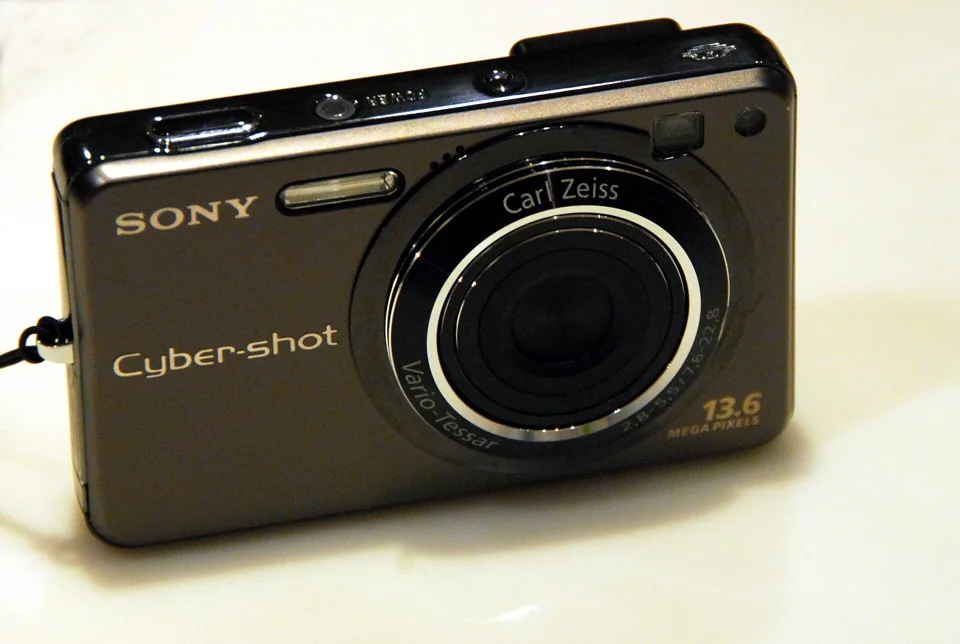

In 2008 Sony put a 13.6-megapixel sensor in its flagship W-series body, with a titanium coat and a 3x zoom. Imaging Resource praised the resolution, the shutter speed and the manual controls; it found the corners soft and the flash uneven, and both reviewers found the colour boosted.
- Launched
- January 2008
- Sensor
- 13.6 MP CCD
- Lens
- 35–105 mm, 3×
- Card
- Memory Stick Duo, Memory Stick PRO Duo
- Battery
- NP-BG1
Sony Cyber-shot DSC-W300 specs: sensor, lens, battery, memory card and cable
Launched in January 2008 at about $350, the Sony Cyber-shot DSC-W300 is a 13.6 MP CCD compact with a 35–105 mm (35 mm equivalent) 3× zoom lens. Inside: it takes Memory Stick Duo and Memory Stick PRO Duo cards and runs on the NP-BG1 battery. Sources
- Sensor
- CCD, 1/1.7", 13.6 MP source
- Lens
- 35–105 mm equivalent, 3× zoom source
- Memory card
- Memory Stick Duo, Memory Stick PRO Duo source
- Battery
- NP-BG1 source
- USB / A/V cable
- See our Sony cable page
Meet the camera
It is a pocket compact, 94 by 59 by 27 millimetres, finished in a single colour: titanium.53 Sony's pitch, as passed on by PhotographyBLOG from a Sony UK release, was a scratch-resistant titanium coating about five times tougher than anodised aluminium.3 Imaging Resource repeated that as Sony's claim, then handled the camera roughly in a camera bag and saw no scratches.4 PhotographyBLOG's loan unit came in a box that looked well travelled; it had a couple of minor scratches on the screen but a faceplate free of scuffs.6
Imaging Resource's report on the launch ran on 25 February 2008 and quoted a Sony release dated 23 January; DPReview's item of the same day gave the same release date, and PhotographyBLOG's followed on 26 February.123 Those sources put the price at about $350 and said it would ship in May, with Europe from early May;235 PhotographyBLOG's review gave a UK asking price of £248.99 and called that not cheap, but not unreasonable for the build.6 The weight is a small conflict: Imaging Resource gave 184 g with batteries, PhotographyBLOG 187 g with battery and an optional card, and 156 g for the body alone.57
Why this one was interesting
Thirteen megapixels, then a lot
PhotographyBLOG pointed out that 13.6 megapixels was more than most consumer SLRs offered, and PhotographyBLOG's launch item repeated Sony's line that the files would support A3-size enlargement and beyond.63 Imaging Resource's chart measured about 2,000 lines horizontally and 1,800 vertically and called that among the best for a compact;4 its verdict was that the picture quality set a new standard for the W-series.4 The catch was the lens: three times zoom, against the five times of the W170, which Imaging Resource named as one of two significant shortcomings.4
Quick when it counts
Imaging Resource timed prefocused shutter lag at 0.008 seconds and full-autofocus lag at 0.42 seconds wide and 0.54 seconds at telephoto; its combined figure of 0.48 seconds compares with 0.8 seconds for an average compact.4 A 3-megapixel burst mode ran at about five frames per second (4.96 measured), against 1.9 at full size.42
Faces, smiles and manual control
Smile Shutter and face detection were headline features: the camera fired when a subject smiled, tracked up to eight faces and told children from adults.36 Intelligent Scene Recognition chose among five scene types, and the D-Range Optimiser kept foreground and background detail without slowing the camera, according to PhotographyBLOG.6 The mode dial also offered manual exposure, with aperture and shutter-speed control, and Imaging Resource listed that among its pros.64 Our W170 review covers the 5x sibling; for the line's other cameras see the DSC-W55 and DSC-W120.
What was lost
Beyond the shorter zoom, Imaging Resource noted there was no HD movie mode and no zoom while filming, and that the HD-output claim came without a cable in the box: stills reached a television at 1080i only through an optional cable or cradle.41 PhotographyBLOG was sceptical of the marketing: a 1920 by 1080 picture is only about two megapixels, and the 16:9 playback conversion dropped resolution to two megapixels.6 Movies stopped at 640 by 480, and its best-quality setting needed a Memory Stick PRO Duo.7 The camera took Memory Stick Duo only, and Imaging Resource warned that a Duo adapter, needed for most card readers, was not supplied.47
The dark: its weak point
The reviewers did not agree about noise. Imaging Resource found it low to ISO 200, moderate at ISO 400 with some loss of detail, and stronger from ISO 800 with colour shifts, and said high ISO was usable to about 800.4 PhotographyBLOG called noise remarkably well controlled up to and including ISO 800, better than most at ISO 1600, with detail dropping at ISO 3200 though grain stayed minimal.6 Three noise-reduction levels were offered; Imaging Resource saw minimal impact on noise between them at ISO 3200.4 Its own user report and pros list were warmer, though: at ISO 3200 it said colour started to fade but detail stayed remarkably sharp, and it listed excellent low-light performance as a pro.4
The flash was the clearer problem. Imaging Resource found its coverage uneven at wide angle and dim at telephoto, with a nine-second recycle time and an indoor default that came out underexposed; slow-sync at +0.7 EV did better, with a pinkish cast.4 Sony's quoted ranges of 18.0 feet at wide angle and 9.2 feet at telephoto relied on the camera raising ISO to 800 and 640, which Imaging Resource thought far too much.4 PhotographyBLOG reported no obvious red-eye in its portrait tests.6






Real photographs taken with this camera at ISO 1600 and 3200. The sensitivity shown is recorded in each file's own EXIF data.
Like that look? See recent eBay sold listings for this camera ↗
On eBay right now
Live listings for this camera, supplied by eBay and updated automatically. We earn a commission if you buy through them.
The little wins
Prints
Imaging Resource found the resolution enough for good 13 by 19-inch prints, with 16 by 20 reasonable; ISO 800 shots were pretty good at 8 by 10, ISO 1600 not bad at that size unless examined closely, and ISO 3200 quite decent at 4 by 6.4
Little post-processing
PhotographyBLOG said the files needed little work straight from the camera, and liked the large, bright screen set against the 1.5-inch ones of a few years earlier.6
Titanium shell
Imaging Resource saw no scratches after rough treatment in a bag, though it said the glossy screen picked up fingerprints.4
Digital zoom that behaved
Imaging Resource found the 2x Precision Digital Zoom much better than average digital enlargement.4
Fast USB
Imaging Resource measured a USB 2.0 transfer of 9,619 KB/s and ranked it above average.4
How it drew the picture
PhotographyBLOG found colours realistic in isolation but more saturated than from Olympus, Nikon, Canon or Fuji compacts, even on default settings, and noted that a more neutral setting was available.6 Imaging Resource found strong reds and blues oversaturated, skin tones pink and warm, and indoor incandescent light too warm in Auto and Incandescent white balance; manual white balance was the accurate one.4 Outdoors it found exposure good and contrast a little high.4
On sharpness the two split, though Imaging Resource also called its images sharp overall, with good fine detail. PhotographyBLOG expected more from the Zeiss lens and the pixel count, saw no noticeable gain over an 8-megapixel model and found default files slightly soft, with some purple fringing only at extreme magnification.6 Imaging Resource found blurring in most corners and noticeable coma at 35 mm, a very soft lower-left corner at 105 mm, barrel distortion of 0.8 percent at wide angle and 0.3 percent pincushion at telephoto, and moderately high chromatic aberration.4 Macro focused to 5 cm according to PhotographyBLOG;6 Imaging Resource called it average in area but soft in the corners, with uneven flash.4


















Photos taken with this camera, from Wikimedia Commons, credited under each picture. Each file's EXIF names the DSC-W300, but we cannot check the uploader's settings, so treat them as a rough impression only.
Where it let you down
Imaging Resource called the Menu and Home buttons confusing, noted that horizontal menus did not wrap, found the buttons small (though easy to use) and the mode dial too loose, and said the tripod socket looked like an afterthought.4 It measured the optical viewfinder at about 86 percent coverage at wide angle and 81 percent at telephoto, against roughly 104 and 100 percent for the screen, and found the screen barely usable in direct sun.4 PhotographyBLOG called the viewfinder very small and warned that the camera would fire even without proper focus or with the subject too close.6
Startup is another small conflict. Imaging Resource timed 2.9 seconds from power-on to first shot, called that average in the text yet counted sluggish startup and shutdown among its cons; PhotographyBLOG put startup at about 1.5 seconds, with a slower shutdown.46 Imaging Resource also found mode switching slower than average, and PhotographyBLOG said a full-size shot took two to three seconds to write.46 The built-in 15 MB held about two or three full-resolution pictures.4
What the reviewers said in 2008
| Outlet | Date | Verdict |
|---|---|---|
| Imaging Resource | 15 Aug 2008 | 4 out of 5 and a Dave's Pick: Sony's best W-series camera of the moment, with excellent resolution, very low shutter lag, a titanium shell and manual exposure; the menus, short zoom, flash, wide-angle corners and the missing HD cable are the complaints.4 |
| PhotographyBLOG | 20 Aug 2008 | 4 out of 5 for design, image quality, ease of use and value, 3.5 for features: sturdy metal build and a large screen, good noise control, but image quality was the least impressive aspect, and the camera was as much style as substance, aimed at undemanding snappers.6 |
We read two full contemporary reviews. Cameralabs, DPReview and others may have reviewed it; we did not find or read one.
The timeline
- 23 January 2008The date on Sony's release, as quoted by Imaging Resource and DPReview a month later.12
- 25–26 February 2008Imaging Resource and DPReview publish the launch news; PhotographyBLOG follows on the 26th from Sony UK's release.123
- May 2008US shipping is planned for May, with Europe from early May, at about $350.235
- 15 August 2008Imaging Resource publishes its review.4
- 20 August 2008PhotographyBLOG publishes its review.6
Should you buy one now?
Buy one if you want a metal-bodied pocket compact with a big sensor, quick shutter and manual control, and can live with a short zoom, soft corners and a weak flash. It launched at about $350;15 what it sells for now is a question for the sold listings, not for us. Before you bid, check these:
- The name. Search the Cyber-shot DSC-W300.1 The W170 is the 5x sibling.4
- The lens. It extends on start-up, so check that it opens and retracts smoothly and that the glass is clean.6
- The battery. It uses an NP-BG1;5 a fresh one is on Amazon ↗.
- The card. It takes Memory Stick Duo and PRO Duo, with no adapter in the box originally;4 see our Memory Stick guide and the glossary.
- The cable. USB and AV came through a multi-connector cable supplied in the box;7 see our cable guide.
- The screen and shell. Look for fingerprint-smeared or scratched glass; the hard titanium coating was Sony's 2008 claim, so check the shell yourself.34
If you are wondering why cameras like this are being hunted down again, we tell that story once, in Pictures that never left the card.
See recent sold prices on eBay ↗Shop on eBay ↗NP-BG1 battery ↗
Sources
- Imaging Resource, 'Sony reveals Cyber-shot W300' by Mike Tomkins (25 Feb 2008; quotes Sony's release dated 23 Jan 2008)
- DPReview, 'Sony launches 13.6MP W300' by DPReview Staff (25 Feb 2008; Sony's release datelined 23 Jan 2008)
- PhotographyBLOG, 'Sony Cyber-shot W300' by Mark Goldstein, based on a Sony UK press release (26 Feb 2008)
- Imaging Resource, Sony DSC-W300 review by Mike Pasini, with shutter-lag testing by Rob Murray (15 Aug 2008; 4 out of 5, Dave's Pick)
- Imaging Resource, Sony DSC-W300 basic specifications (MSRP $350, shipped from May 2008)
- PhotographyBLOG, Sony Cyber-shot DSC-W300 review by Gavin Stoker (six pages: introduction, image quality, specifications, conclusion; 20 Aug 2008)
- PhotographyBLOG, Sony Cyber-shot DSC-W300 review, specifications page (page 5)
Photographs are credited under each one, all via Wikimedia Commons. Links to eBay and Amazon are affiliate links.