Sony Cyber-shot T · announced August 2008 · a retrospective
The Sony Cyber-shot DSC-T77: the slider with a touch screen where the buttons should be
We found no other regional name for it; Sony's press release, Imaging Resource and both UK reviews use DSC-T77.1345
In August 2008 Sony put a 4x Zeiss lens behind a sliding cover, a 3-inch touch screen on the whole back and a $300 price on the front. Reviewers praised the slim body and the smile detection, and split over whether the touch screen was a gift or a chore.
Release date and launch price: launched August 2008; launch price $300 · £209 (PhotographyBLOG also gives £189)34.
Quick answers
- Sensor
- CCD, 1/2.3", 10.1 MP source
- Lens
- 35–140 mm equivalent, 4× zoom source
- Memory card
- Memory Stick Duo, Memory Stick PRO Duo source
- Battery
- NP-BD1 source
- USB / A/V cable
- See our Sony cable page
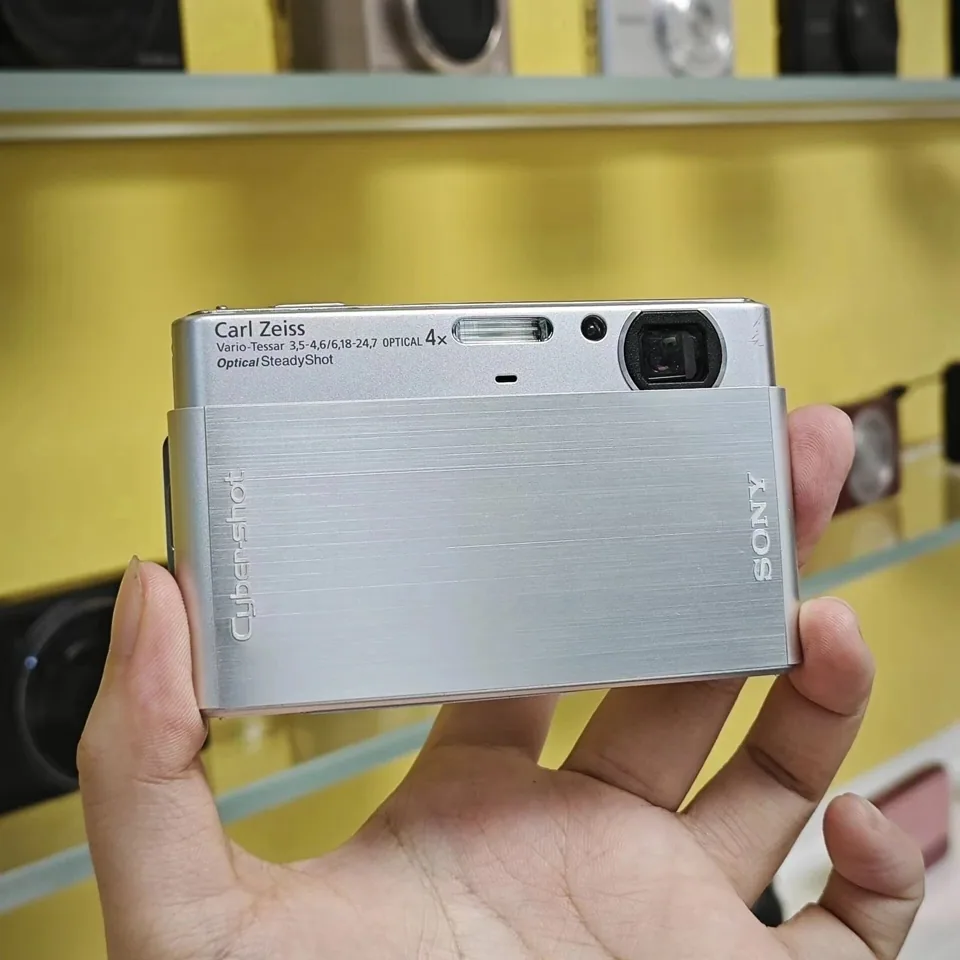
Meet the camera
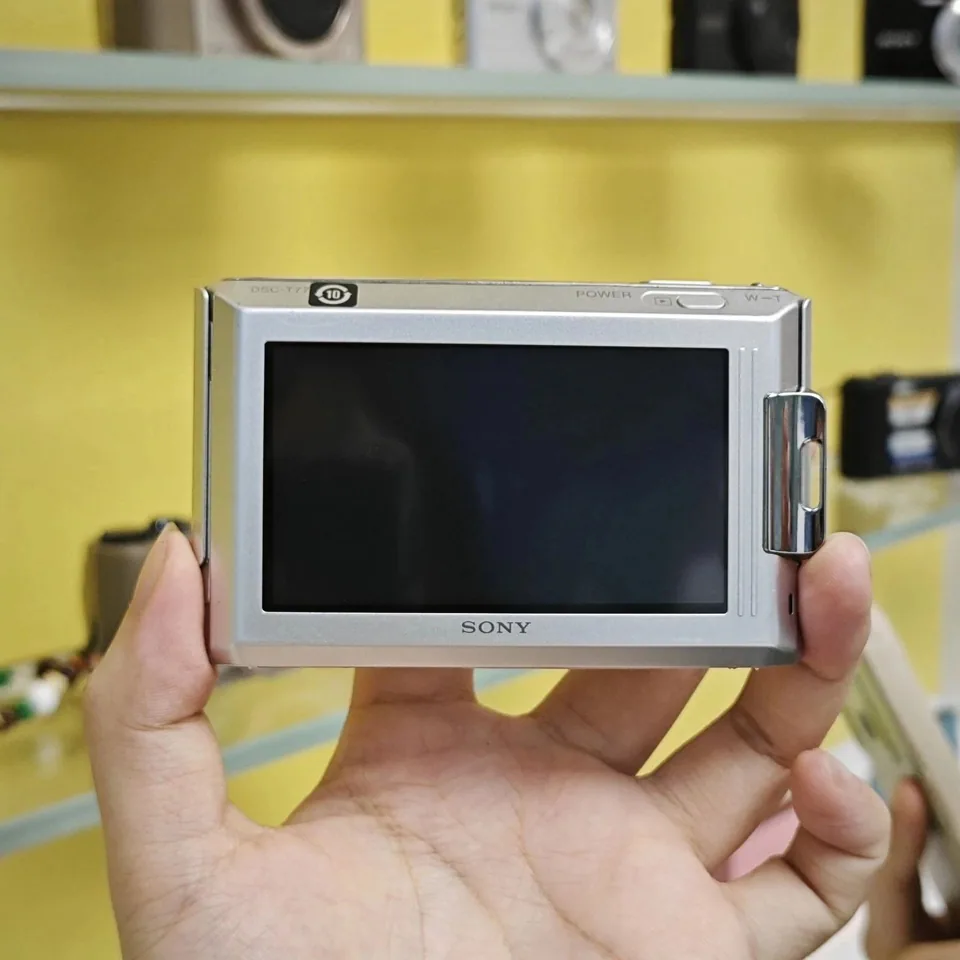
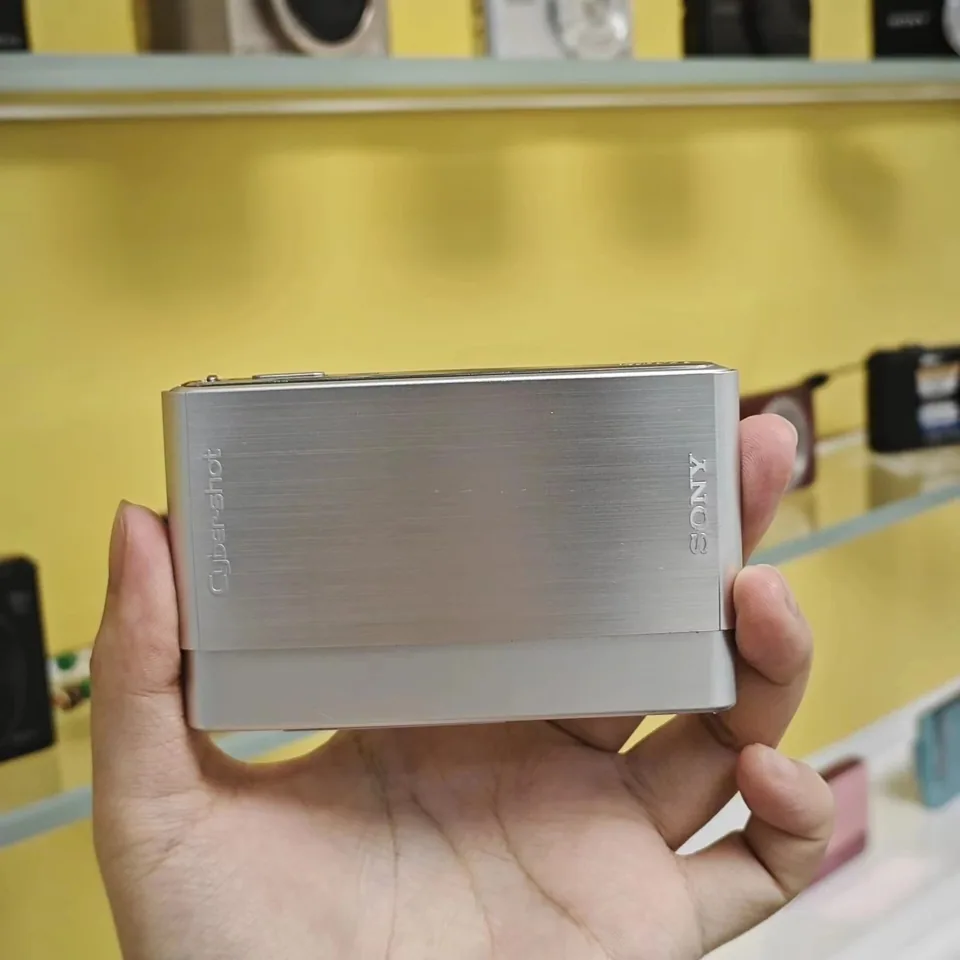
It is a thin metal slab: about 94 by 57 by 15 millimetres,13 and roughly 150 grams with battery in Imaging Resource's and Cameralabs' figures (PhotographyBLOG lists 126 g for the body and 151 g with accessories).354 Sony called it its thinnest model at the time.1 A panel slides down over the front to switch the camera on and uncover the lens, and slides up to switch it off; the folded optics stay inside the body, so no lens sticks out.24
The back is almost entirely screen: a 3-inch, 16:9, touch-sensitive panel with 230,400 dots (Sony's release rounds it to 230,000), which drives nearly every setting, with no viewfinder.315 The only physical controls Cameralabs found were power, shutter, playback and a small zoom lever.5 Sony announced it on 7 August 2008 as the replacement for the T70;1 Imaging Resource lists an MSRP of $300 and availability from 30 September 2008,3 and PhotographyBLOG gave £209 and $300 at the start of its review, and £189 in its conclusion.4
Why this one was interesting
A slim body with a lens that never moves
Cameralabs described it as the T70's successor, with a 4x zoom against the T70's 3x.5 Because the optics are folded inside, there is no lens to extend, and Imaging Resource called the sliding cover excellent.2 Cameralabs timed power-up at about 1.5 seconds,5 PhotographyBLOG at just under two,4 and Imaging Resource at 2.3 seconds, which it called average but faster than the T700.2
Smile Shutter, with a gauge
Smile Shutter waits for a clear smile before firing.5 Cameralabs liked a new on-screen scale showing how close the face is to triggering it, and rated the system more sophisticated than rivals from Pentax and Olympus.5 Face detection can favour children over adults.15 Imaging Resource said it tracks up to eight faces, adds an anti-blink mode that takes two frames and keeps the better one, and lets you filter playback by faces, smiles, children and infants.2
A camera that picks the scene
PhotographyBLOG called Intelligent Scene Recognition one of the more useful features for beginners,4 and Cameralabs said it switched sensibly between landscape, portrait and macro.5
Sony's own T-series of that era includes the older Cyber-shot DSC-T9, and the plainer DSC-W55 shows what a conventional zoom looked like.
What was lost
The wide end stayed at 35 millimetres; Cameralabs said it was no match for rivals starting at 28 mm.5 Its pick of rivals was the Canon IXUS 870 IS (starting at 28 mm, with a quicker interface) and the Panasonic Lumix FX35 (starting at 25 mm, with 720p video and faster burst, but thicker).5 There is no HD video: the best mode is standard definition.42 Imaging Resource found no HDTV cable in the box.2
The dark: its weak point
Reviewers disagreed on how early noise became a problem. PhotographyBLOG found ISO 80 to 800 respectably clean, softening at ISO 1600 and a watercolour look at ISO 3200 that it still called usable.4 Cameralabs, comparing it with the Canon and Panasonic, found that the Sony smears noise away at ISO 200 and 400 at the cost of fine detail, that noise reduction could not hide it at ISO 800, and that ISO 1600 and above were essentially unusable. Its advice was to stay at ISO 200 or below, or ISO 400 if you must.5 Imaging Resource found detail and colour poor at ISO 1600 and 3200, called low-light performance a con, and said the flash is weak with a short range, though it recycles fast.2 PhotographyBLOG added that Twilight mode tops out at a 2-second exposure.4








Dim-light photos from this camera at ISO 1600, as recorded in each file's own data, from Wikimedia Commons.
On eBay right now
Live listings for this camera, supplied by eBay and updated automatically. We earn a commission if you buy through them.
The little wins
Slide to shoot
Sliding the front cover down turns the camera on and uncovers the lens in one move, which Imaging Resource called elegant and functional.2
Silent zoom in video
Optical zoom works while filming and was inaudible, said Cameralabs.5
Tap to focus, tap to zoom
Cameralabs listed touch focus, face priority and tap-to-zoom in playback.5
Dynamic Range Optimizer
Imaging Resource found DRO often recovered highlights and shadows, and in its harsh-sunlight test the standard setting gave a usable image without exposure changes; once it also bloomed a bright hydrant into dark foliage.2
How it drew the picture
Imaging Resource found good colour and good print output at 13 by 19 inches, with corner blur not noticeable at 8 by 10, but also strong blurring in the corners in the lab test, moderate chromatic aberration and oversaturated reds and blues.2 PhotographyBLOG called pictures better than expected: warm and colourful with reasonable detail, but with lens flare, occasional exposure errors, barrel distortion at the widest setting and a slightly soft default sharpening.4 Cameralabs found resolution similar to the Canon and Panasonic but with obvious fringing in one crop, halos from aggressive sharpening, and heavier noise reduction than its rivals, so that pictures could look unnatural or electronic.5


















Photos taken with this camera, from Wikimedia Commons, credited under each picture. A thin selection from a few uploaders.
Where it let you down
Handling was the loudest complaint. Cameralabs said the slim body gives little grip and is hard to hold one-handed, that the touch controls often need several taps and sometimes miss the first one, and that stray fingers can drift in front of a lens set in the corner.5 PhotographyBLOG found the polished surfaces slippery, the physical controls small and fiddly, and the touch screen heavy on the battery; it also noted about a three-second wait after each shot and called operation more sluggish than the pricier T500.4 Imaging Resource, kinder, found the touch interface usable but inconsistent, noted that a touch screen turns one-handed shooting into a two-handed task, and rated battery life below average.2 Cameralabs measured stabilisation at about 2.5 stops, a little under average.5
What the reviewers said
| Outlet | Date | Verdict |
|---|---|---|
| Imaging Resource | 18 Dec 2008 | 4.0 out of 5 and a Dave's Picks award: pleasing pictures and what it called a great experience of shooting, despite corner softness, aberration, weak low light and below-average battery life. It is $100 cheaper than the T700.2 |
| PhotographyBLOG | 27 Feb 2009 | 3.5 out of 5 (design 3, features 4, ease of use 4, image quality 3, value 3.5): worth investigating for an unobtrusive camera and anyone who accepts touch-screen operation.4 |
| Cameralabs | 26 Jun 2009 | 77 percent (build 18/20, image 15, handling 10, specification 17, value 17): appealing to those who like the touch screen and smile detection, but it said most people would be better served by the Canon or Panasonic.5 |
The three verdicts are not a consensus: the one that rated it highest was the earliest, and Cameralabs, which scored handling lowest (10 out of 20), was the one that found the touch controls slow.5 We found no other full contemporary review.
The timeline
- 7 August 2008Sony announces the T77 and T700.1
- 30 September 2008Availability date in Imaging Resource's table, at $300.3
- 18 December 2008Imaging Resource publishes its review.2
- 27 February 2009PhotographyBLOG's review; it gives a lower price of £189 and says one high-street chain was selling it at £150.4
- 26 June 2009Cameralabs publishes its review.5
Should you buy one now?
Buy one if you want an ultra-slim 2008 pocket camera with a 35 to 140 mm zoom, a cover that doubles as the power switch, and Smile Shutter, and can live with standard-definition video, weak low light and a slow touch interface. It launched at $300;3 what it sells for now is a question for the sold listings, not for us. Before you bid, check these:
- The name. Search the Sony DSC-T77.3 Sony announced a pricier T700 alongside it.12
- The slide cover. It is the power switch, so check that it slides smoothly and snaps shut, and that the lens window behind it is clean.2
- The screen. Touch every corner: the corners act as the Home, Menu and Display controls.2
- The battery. It uses an NP-BD1 according to Imaging Resource and Cameralabs; Sony's press release names an NF-FD1 instead, so check the battery you are buying against the camera.351 A fresh one is on Amazon ↗. Rated life was about 220 shots, which PhotographyBLOG and Imaging Resource found short.42
- The card. It takes Memory Stick Duo and PRO Duo cards, and PhotographyBLOG lists the High Speed and PRO-HG Duo types as well; internal memory is only about 15 MB.4 See our memory card guide.
- The cable. Cameralabs said the only port is a proprietary connector on the underside, used with a combined TV and USB cable.5
If you are wondering why cameras like this are being hunted down again, we tell that story once, in Pictures that never left the card.
See recent sold prices on eBay ↗Shop on eBay ↗NP-BD1 battery ↗
Sources
- DPReview, Sony announces Cyber-shot DSC-T700 and DSC-T77 (press release, 7 Aug 2008)
- Imaging Resource, Sony DSC-T77 review by Mike Pasini and Stephanie Boozer (18 Dec 2008)
- Imaging Resource, Sony DSC-T77 specification table (MSRP $300, availability 30 Sep 2008)
- PhotographyBLOG, Sony Cyber-shot DSC-T77 review by Gavin Stoker (27 Feb 2009)
- Cameralabs, Sony Cyber-shot DSC-T77 review by Gordon Laing (26 Jun 2009; pages 1, 2, 3 and 5)
Photographs are credited under each one, all via Wikimedia Commons. Links to eBay and Amazon are affiliate links.