Sony Cyber-shot RX · on sale July 2012
The Sony Cyber-shot DSC-RX100: the 1-inch pocket camera that started a line
Not to be confused with its numbered successors (II, III and on).
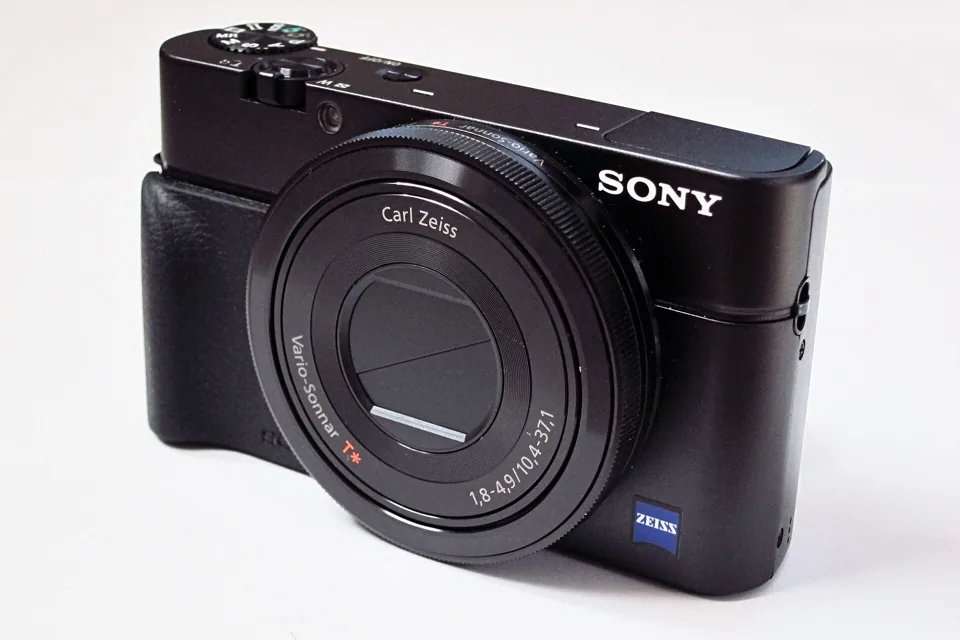
In 2012 Sony fitted a sensor with about four times the area of a usual compact’s into a 240-gram aluminium body for about $650. Reviewers praised the pictures and disagreed about the control ring.
- Launched
- June 2012
- Sensor
- 20.2 MP CMOS
- Lens
- 28–100 mm, 3.6×
- Card
- SD, SDHC, SDXC, Memory Stick PRO Duo
- Battery
- NP-BX1
Sony Cyber-shot DSC-RX100 specs: sensor, lens, battery, memory card and cable
Launched in June 2012 at $649.99, the Sony Cyber-shot DSC-RX100 is a 20.2 MP CMOS compact with a 28–100 mm (35 mm equivalent) 3.6× zoom lens. Inside: it runs on the NP-BX1 battery. Sources
- Sensor
- CMOS, 1.0", 20.2 MP source
- Lens
- 28–100 mm equivalent, 3.6× zoom source
- Memory card
- SD, SDHC, SDXC, Memory Stick PRO Duo source
- Battery
- NP-BX1 source
- USB / A/V cable
- See our Sony cable page
Meet the camera
The RX100 is a slab. Imaging Resource lists it at 102 by 58 by 36 millimetres and 240 grams with battery,3 and the Imaging Resource reviewer, a Canon S95 owner, said it felt right at home.2 Sony's release calls the body aluminium.1 Ming Thein found it slippery enough to wrap the grip in cloth tape, while DPReview found the rubber thumb rest on the back helped, and that a third-party grip improved things further.75 There is no viewfinder, and the screen is a 3-inch panel of 1,229k dots.41
What made the camera news sits behind the lens. Sony's release called it the world's first 1.0-inch type Exmor CMOS sensor and put its area at approximately four times that of the 1/2.3-type sensors in traditional point-and-shoot cameras.1 The sensor has 20.2 effective megapixels and measures 13.2 by 8.8 millimetres.3 The zoom is a Carl Zeiss-branded 28 to 100 mm equivalent, f/1.8 at the wide end and f/4.9 at the long end.4 It cost about $650 at launch: Sony gave that figure, Imaging Resource's table lists $649.99 with availability from 27 July 2012, and DPReview’s specification page lists $650, €650 and £550.135
Why this one was interesting
A sensor from another size class
Imaging Resource noted that the sensor is the same size as the ones in Nikon's 1 series, an interchangeable-lens system.2 DPReview's 2024 look back said the RX100 was the first to put a Type 1 sensor in a genuinely small, fixed-lens body, and put its sensor at about 2.7 times the size of the Type 1/1.7 sensors most rivals used.9 DPReview and Imaging Resource both set it against Canon's PowerShot S100. DPReview wrote that the Sony's larger sensor won on everything but price, which ran about 50 percent higher.5 Our reviews of the PowerShot S95 and S100 cover that Canon line.
Fast in the way that shows on a stopwatch
Sony claimed autofocus locking in as little as 0.13 seconds.1 Imaging Resource measured full-autofocus shutter lag of 0.153 seconds at wide angle and 0.266 at full zoom, against about 0.571 for the S100, and a prefocused lag of 0.013 seconds.2 Cameralabs was less impressed, calling the autofocus good but not especially fast and saying it could struggle in poor light.6 The same reviewers got 10 frames a second in a Speed Priority mode that fixes focus and exposure at the first frame, and 2.5 in the ordinary continuous mode.2 PhotographyBLOG described the autofocus as very quick and reliable and the shutter lag as barely noticeable.4
A ring around the lens, loved and disliked
Sony put a control ring around the lens for exposure, zoom and other functions.1 Cameralabs found it assignable to eight functions, among them ISO, white balance and exposure compensation, and thought the rear wheel wasted effort duplicating it.6 DPReview objected most strongly: a smooth ring suits focus and zoom, but a clickless dial is poor for stepping through discrete settings, and the review named it the main weakness.5 Ming Thein agreed that the ring has no detents.7
What was lost
The lists of absences ran long. There is no viewfinder.24 Cameralabs acknowledged a missing hot shoe and viewfinder, and noted the lack of an external microphone socket.6 DPReview noted that the lens has no built-in ND filter and no official way to fit filters, though third-party adapters exist.5 The battery charges only inside the camera, which DPReview said makes spares awkward, and Imaging Resource said the box holds no battery charger, only a small USB power supply and a micro USB cable.52 Cameralabs and Ming Thein both complained that no full manual came with their units (Cameralabs found only a short quick-start guide online), although Imaging Resource's in-the-box list includes an instruction manual.672
The dark: its weak point
Four reviewers drew the line for acceptable noise in different places. Imaging Resource found good results up to ISO 800, saw virtually no chroma noise, called noise levels a good two stops better than even high-end pocketable digicams, and gave print sizes of 20 by 30 inches at ISO 400, 11 by 14 at ISO 1600 and 5 by 7 at ISO 6400.2 DPReview called noise well controlled to ISO 1600, with heavy smoothing above that, and found raw files manageable to ISO 800.5 PhotographyBLOG saw noise becoming noticeable at ISO 1600 and said ISO 3200 and 6400 showed a little too much noise and smearing.4 Ming Thein put the edge of the useful range at ISO 3200.7 Against Canon's bigger G1 X, Imaging Resource saw the Canon do a little better at ISO 3200 and again at 6400, while the RX100 showed more detail than the S100 at ISO 3200.2




Real photographs taken with this camera, all by one Commons uploader. The sensitivity shown is recorded in each file's own EXIF data; we do not know how each file was processed after shooting.
Like that look? See recent eBay sold listings for this camera ↗
On eBay right now
Live listings for this camera, supplied by eBay and updated automatically. We earn a commission if you buy through them.
The little wins
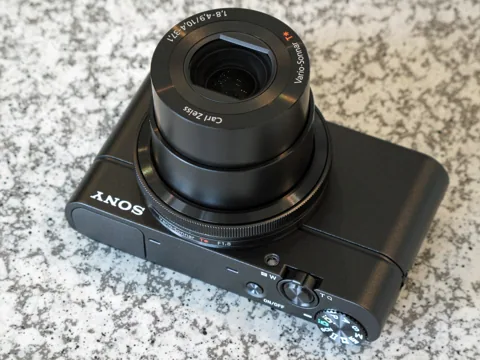 The RX100 from above, three-quarter view. · Hiroshi UZU from Saitama, Japa · CC BY 2.0 · Commons
Video that reviewers rated high
DPReview listed class-leading video features among its pros,5 and Cameralabs praised the picture while noting continuous autofocus worked well during filming.6 Imaging Resource called the 60p mode beautiful with few compression artefacts, though the files are very large.2
Panorama and HDR
Cameralabs called the automatic HDR very powerful and worthwhile and said the sweep panorama is one of the best.6 Looking back in 2024, DPReview's Richard Butler said the camera could shoot and stitch panoramas pretty effectively, but recalled that this meant disengaging raw capture.9


How it drew the picture
PhotographyBLOG scored image quality 5 out of 5 and found out-of-camera JPEGs slightly soft.4 DPReview scored JPEG 7.5 and raw 7.9 out of 10; it described exposure leaning bright, white balance a little cool, and reds that could overexpose and drift toward magenta.5 Imaging Resource listed poor rendering of yellows among its cons and found strong detail to about 2,300 lines per picture height in camera JPEGs.2 Imaging Resource rated one corner very soft at the wide end wide open and another very soft at full telephoto, with sharpness improving once stopped down; Ming Thein, who tested separately, found the corners pretty soft at f/1.8.27
















Photos taken with this camera, from Wikimedia Commons, credited under each picture.
Where it let you down
The flash drew complaints from several reviewers. Imaging Resource called it deficient even at six feet at the long end, though it rated the wide-angle range great, measured a 7.2-second recycle at full power, and its reviewer said they would shoot by available light instead; DPReview found the flash metering unpredictable, and PhotographyBLOG said it takes ages to recharge and is underpowered.254 The verdict was not unanimous: Cameralabs found fairly powerful, bright and even illumination in use, and said Sony's quoted 17.1 metres at wide angle (set against 8.5 for the Panasonic LX7) is flattering because it assumes auto ISO up to 3200, working out to about 12 metres at ISO 1600.6 DPReview gave about 3.4 metres at wide angle at ISO 125 and the same 17.1 metres in auto ISO.5 Ming Thein reported matrix metering that underexposed, sometimes by up to two stops, and a ‘?’ help button, which also deletes images, that cannot be reassigned.7 Imaging Resource saw flare when shooting wide open at night and listed slow continuous-autofocus lock among its cons.2 Cameralabs found that digital zoom cannot be switched off in movie mode and that its stabiliser was weaker than the Panasonic LX7's or the Canon G1 X's.6 Ming Thein compared it with a Leica D-Lux 5 and a Ricoh GR Digital III, noting that his comments on the Leica also apply to the Panasonic LX5, which our Lumix DMC-LX5 review covers.7
What the reviewers said in 2012
| Outlet | Date | Verdict |
|---|---|---|
| Imaging Resource | 6 Jun 2012 (first posted) | 5 out of 5 and a Dave's Pick: the most premium of pocket cameras; flash, corner softness and night flare held it back.2 |
| PhotographyBLOG | 23 Jul 2012 | 5 stars and its Essential award; design 5, features 5, ease of use 4.5, image quality 5, value 4. No viewfinder, hard to hold.4 |
| Photography Bay | 3 Aug 2012 | Hands-on after about a week, not a full review: fast, pocketable, and the price the only real drawback.8 |
| Ming Thein | 6 Aug 2012 | Called it the king of the hill among compacts and recommended it, with a long list of handling complaints.7 |
| DPReview | 28 Aug 2012 | 78 percent and a silver award: strong image quality and video, a vague control dial, no ND filter.5 |
| Cameralabs | 11 Oct 2012 | 88 percent overall, and the reviewer highly recommended it: large-sensor quality in a very small body, with no hot shoe, viewfinder or articulated screen.6 |
The timeline
- June 2012Sony announces the camera at about $650, for sale in July.1
- 6 June 2012Imaging Resource's review page shows this as its first-posted date.2
- 23 July 2012PhotographyBLOG publishes its review.4
- 27 July 2012Imaging Resource lists it as available.3
- 28 August 2012DPReview publishes its review.5
- 11 October 2012Cameralabs publishes its review.6
- 28 August 2024DPReview looks back, mentioning seven or so iterations of the RX100 line since.9
A 2024 look back
DPReview's 2024 retrospective called the original one of the most disruptive enthusiast compacts the site had seen, and still listed its flaws: few direct controls with little feel, a convoluted menu, JPEG colour less appealing than rivals' and an f/4.9 long end that blunted the low-light advantage.9 The later models, the piece says, added a brighter 24 to 70 mm f/1.8 to 2.8 lens, phase-detection autofocus, a pop-up viewfinder and newer sensors.9 It gave no sales figures, and we found none. Our PowerShot G7 X review covers a later Canon 1-inch compact.
Should you buy one now?
Buy one if you want a pocketable camera with a much larger sensor than a usual compact and can live without a viewfinder and with a clumsy dial. It launched at $649.99;3 what it sells for now is a question for the sold listings, not for us. Before you bid, check these:
- The model. It is the plain DSC-RX100; the numbered successors add other lenses and features,9 so make sure the listing says the original.
- The battery. It uses an NP-BX1;6 charging happens in the camera, so test that the USB port and charging light work, and consider a spare on Amazon ↗.52
- The card. It takes SD, SDHC, SDXC and Memory Stick PRO Duo, with no UHS support listed in Imaging Resource's spec table, although Cameralabs saw a small advantage from a UHS-I card;36 see our memory card guide.
- The lens ring and zoom. The ring is central to how it handles, so check that it turns smoothly and that the lens extends and retracts cleanly.5
- The grip. Reviewers found the body slippery,7 so ask for clear photos of the front and the thumb rest.
If you are wondering why cameras like this are being hunted down again, we tell that story once, in Pictures that never left the card.
See recent sold prices on eBay ↗Shop on eBay ↗NP-BX1 battery ↗
Sources
- Sony press release, “Sony’s New Advanced Cyber-shot RX100 Camera Packs Large Sensor and Bright Lens into Stylish, Pocket-Size Body” (5-6 Jun 2012)
- Imaging Resource, Sony RX100 review by Shawn Barnett, Mike Tomkins, Zig Weidelich and Dave Etchells (2012)
- Imaging Resource, Sony Cyber-shot DSC-RX100 specification table (MSRP $649.99, availability 27 Jul 2012)
- PhotographyBLOG, Sony Cyber-shot DSC-RX100 review by Mark Goldstein (23 Jul 2012)
- DPReview, Sony Cyber-shot DSC-RX100 in-depth review by Richard Butler (28 Aug 2012), conclusion page
- Cameralabs, Sony Cyber-shot RX100 review (11 Oct 2012)
- Ming Thein, “The Sony Cyber-shot DSC-RX100: a somewhat comparative review” (6 Aug 2012)
- Photography Bay, Sony RX100 hands-on review by Eric Reagan (3 Aug 2012; about a week of use, not a full review)
- DPReview, “On this day 2012: Sony Cyber-Shot DSC RX100 reviewed” by Richard Butler (28 Aug 2024)
Camera photos by Oilstreet (CC BY 2.5) and Hiroshi UZU from Saitama (CC BY 2.0); other photographs are credited under each one, all via Wikimedia Commons. Links to eBay and Amazon are affiliate links.