Fujifilm FinePix X · on sale spring 2011
The Fujifilm FinePix X100: the APS-C compact with a viewfinder that was two viewfinders
We found no other regional name for it: Fujifilm's US release and the UK reviews all call it the FinePix X100.123
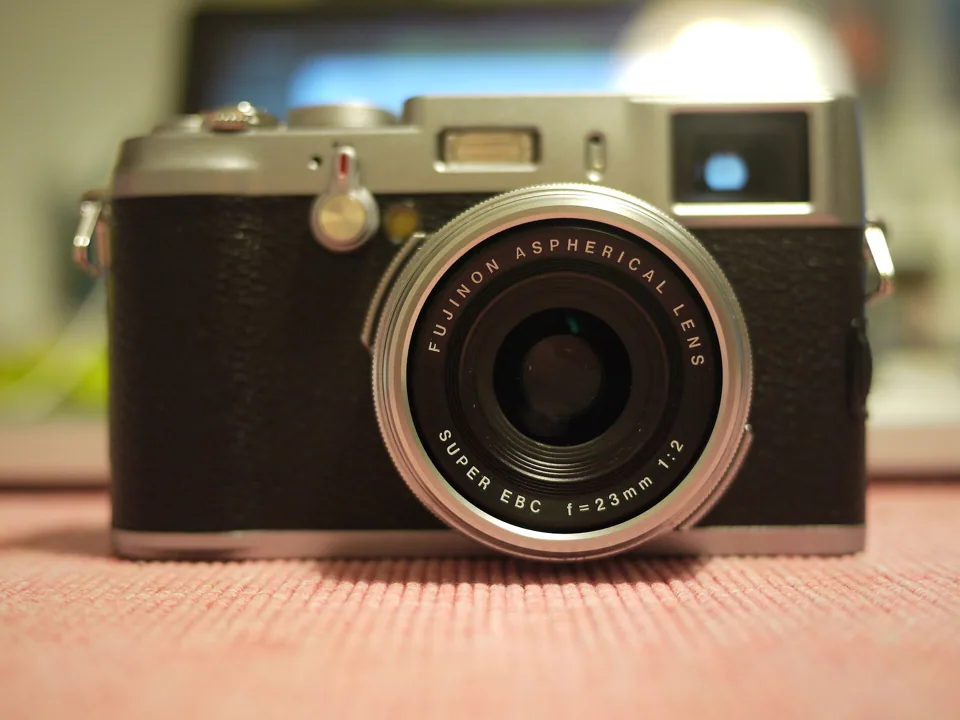

Fujifilm showed it at Photokina 2010 and put it on sale in the spring of 2011 for about $1,200. Reviewers loved the pictures and the finder, and spent many of their pages arguing with the firmware, the slow card writes and the loose dials.
- Launched
- March 2011
- Sensor
- 12.3 MP CMOS
- Lens
- fixed 35 mm
- Card
- SD, SDHC, SDXC
- Battery
- NP-95
Fujifilm FinePix X100 specs: sensor, lens, battery, memory card and cable
The Fujifilm FinePix X100 is a 12.3 MP CMOS compact camera with a fixed 35 mm (35 mm equivalent) lens, launched in March 2011 at $1,199.95. It takes SD, SDHC and SDXC cards and runs on the NP-95 battery. Sources
- Sensor
- CMOS, APS-C, 12.3 MP source
- Lens
- 35 mm equivalent, fixed (no zoom) source
- Memory card
- SD, SDHC, SDXC source
- Battery
- NP-95 source
- USB / A/V cable
- See our Fujifilm cable page
Meet the camera
Imaging Resource likened its looks to a rangefinder from 1962, and said it is smaller and flatter than an SLR but really isn't that little;5 PhotographyBLOG listed 126.5 by 74.4 by 53.9 millimetres and 445 grams with battery and card.2 Fujifilm's release says the top and bottom plates are die-cast magnesium alloy and the dials are milled from metal.1 The black covering only looks like leather, which Imaging Resource found disappointing, though it liked the grip.5 DPReview called it an utterly unexpected model that stole the show at Photokina 2010, and noted it was the company's first large-sensor APS-C camera for professionals and advanced amateurs since the S5 Pro DSLR of 2006.4
Fujifilm North America announced the US debut on 8 February 2011, with shipping in March and a price of $1,199.95.1 The reviews print slightly different prices: PhotographyBLOG listed £999 and $1,299,2 DPReview $1,200 and £1,000,4 and What Digital Camera later recalled a £1,000 launch price.6 TechRadar reported on 21 March that Fujifilm said high demand had pushed shipments back to April,3 while Imaging Resource's table gives availability on 30 March 2011;5 we do not know which date reached which shops.
- Size
- 126.5 × 74.4 × 53.9 mm, 445 g with battery and card2
Why this one was interesting
A big sensor in a small camera
PhotographyBLOG put the sensor at about ten times the size of those in most compacts, and said the X100 joined a very short list of compacts that use an APS-C one.2 Fujifilm's release says it optimised the angle of incidence together with the lens so light is gathered efficiently out to the edge of the sensor;1 TechRadar reports Fujifilm's claim that the microlens array was tailored to the lens to reduce corner shading, and Imaging Resource says the microlens positioning was fine-tuned to reduce vignetting.35
Two viewfinders in one
The optical finder is a reverse Galilean type, 0.5x, showing about 90 percent of the frame; the electronic one is a 0.47-inch, 1,440,000-dot display showing all of it.25 A lever on the front chooses, and an eye sensor swaps the finder and the rear screen.23 In the optical mode the bright frame shifts after focusing to correct for parallax.3 PhotographyBLOG used the optical finder about 90 percent of the time,2 while Imaging Resource's lab measured the frame lines at about 88 percent coverage before focusing and about 93 percent with the shutter half-pressed, and found the overlay dim in bright sun.5 TechRadar saw distortion in both finders, barrel-shaped in the optical one, and wondered whether its sample was misaligned.3
Dials where the menus used to be
The aperture ring runs from A through f/16 to f/2 and the shutter-speed dial has its own A position; set both to A for program mode.53 Both move in full stops, and third-stops come from the rear controls, the command control for aperture and the command dial for shutter speed.5 The exposure-compensation dial covers plus or minus 2 EV, and the shutter button is threaded for a mechanical cable release.32 A leaf shutter in the lens makes it close to silent; PhotographyBLOG listed a flash sync speed of up to 1/4000 second, DPReview up to 1/2000.24
A neutral-density filter in the lens
PhotographyBLOG had more trouble in bright sun than in the dark: the top speed at f/2 is 1/1000 second, and the built-in 3-stop filter is Fujifilm's remedy for keeping the aperture open outdoors.2 Imaging Resource added that the 1/4000 second maximum is reached only at f/8 and smaller.5
For another fixed-lens compact, see our Ricoh GR Digital; for a later large-sensor pocket camera, our Sony DSC-RX100.
What was lost
The lens is fixed, so you get one angle of view, that of a 35 mm lens on a full-frame camera. PhotographyBLOG thought that a worthwhile compromise for street work, where you move rather than zoom;2 Imaging Resource said the lack of a zoom kills it for most people, and that a pool-side clip showed why a parent would want one.5 The optical finder cannot focus closer than 80 centimetres; the electronic one reaches 35 centimetres, and macro mode 10.3 Macro mode forces the electronic finder, and Imaging Resource complained that the camera does not switch to macro by itself.25 DPReview added that it competed with the new mirrorless interchangeable-lens cameras, which tend to be friendlier to use, and that it was not cheap next to them.4
The dark: its strongest point, and its weakest
Reviewers largely agreed about high ISO. PhotographyBLOG found noise-free JPEGs from ISO 100 to 3200, a little noise at 6400 and more, with some desaturation, at 12800.2 TechRadar saw raw noise rising until about ISO 1600, then coloured speckle, banding at 12800 and black speckle in night pictures.3 Imaging Resource printed its test target at 24 by 36 inches for ISO 100 and 200, 16 by 20 at ISO 1600, 8 by 10 at ISO 6400, and called ISO 12800 good at 4 by 6.5 In its ISO 1600 and 3200 crops it judged the X100 better than a Canon T3, an Olympus E-PL2 and a Panasonic GF2, and ahead of a Nikon D5100 and a prototype Sony NEX-C3 at ISO 1600 and close to them at 3200, though in its detail comparison the two 16-megapixel bodies won.5








Real photographs taken with this camera. The settings shown are recorded in each file's own EXIF data.
The dark was also where it struggled. Imaging Resource listed autofocus in low light among its cons, and called the flare at f/2 against night lights dramatic, with repeating ghosts.5 DPReview described ghost images radiating from bright sources and picture detail degraded by light hitting the front element obliquely, and said a hood guards against that.4 The optional accessories on PhotographyBLOG's specification list include a lens hood, the LH-X100.2
Like that look? See recent eBay sold listings for this camera ↗
On eBay right now
Live listings for this camera, supplied by eBay and updated automatically. We earn a commission if you buy through them.
The little wins
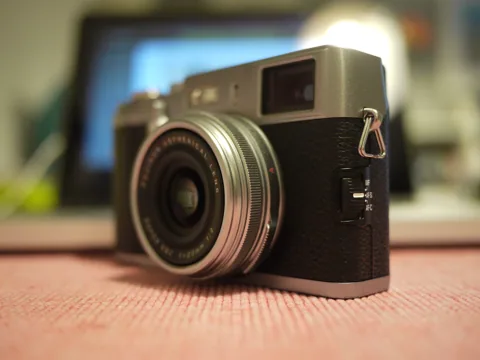 The aperture ring around the lens. · bfishadow from Beijing, China · CC BY 2.0 · Commons

A ring you can feel
TechRadar said the aperture ring turns well and stops positively at each aperture, one of the more pleasing things about the camera.3
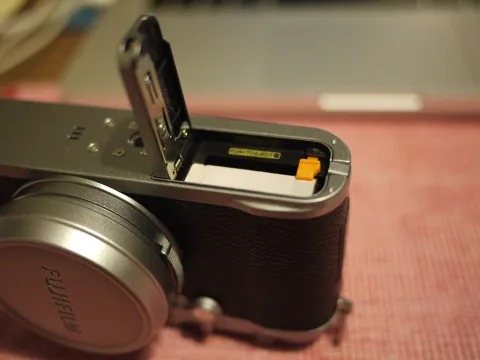 The battery and card door under the camera. · bfishadow from Beijing, China · CC BY 2.0 · Commons

Auto ISO you can set
PhotographyBLOG described a maximum sensitivity of up to ISO 3200 and a minimum shutter speed you can choose,2 and DPReview listed the flexible Auto ISO among its pros, though it also noted the setting is buried in the menus.4
How it drew the picture
PhotographyBLOG scored image quality 5 out of 5 and called files a little soft at default sharpening.2 TechRadar said JPEGs are good enough that for all but the most critical work they may suffice, and found a slight waviness at the frame edges that it blamed on the aspherical element.3 DPReview said the sensor may not be the latest generation but the pictures are almost impossible to criticise, and found the lens soft in the corners at f/2 and across the frame in macro at f/2.4 Imaging Resource's lab found strong detail to about 1,800 lines per picture height and horizontal distortion under 0.3 percent, with corner blur at f/2 that had eased by f/5.6.5

















Photos taken with this camera, from Wikimedia Commons, credited under each picture. The settings are read from each file's EXIF data.
Where it let you down
The speed of the card was the loudest complaint. DPReview said a raw file can take 7 seconds to write even with a decent Class 10 card, and that ISO, the finder switch and the focus point stay locked meanwhile;4 PhotographyBLOG reported about 6 seconds for a raw plus JPEG and 32 seconds to save a five-frame burst to a 15 MB/s card;2 Imaging Resource's lab needed 25 seconds to clear eight raw plus JPEG frames with a 30 MB/s card and 20 seconds with a faster one.5 Start-up times disagree: Fujifilm lists about 2.2 seconds, 0.7 in Quick Start mode;2 Imaging Resource measured 3.2 seconds to first shot;5 TechRadar called it just under a second or so.3
Manual focus is by wire. PhotographyBLOG said it takes many turns from 10 centimetres to infinity,2 DPReview called the ring unresponsive and said accurate focusing in the magnified view is often impossible because the lens stops down,4 and Imaging Resource called it unusable.5 The exposure-compensation dial moves too freely, according to Imaging Resource and TechRadar,53 TechRadar found the four-way pad slack with a small centre button, and Imaging Resource called the rear control cluster finicky because the centre button is easily mispressed.35 DPReview called the video mode half-hearted, and PhotographyBLOG called it merely average.42 Imaging Resource rated 300 shots per charge below average and advised a second battery, and its lab technician added that the card and battery cannot be changed while the camera is on a tripod.5 It also found that at portrait distances and f/2 to f/4 the camera often focused on some other part of a person and left the eyes soft.5
What the reviewers said in 2011
| Outlet | Date | Verdict |
|---|---|---|
| PhotographyBLOG | 17 Mar 2011 | Design 5, features 5, ease of use 4.5, image quality 5, value 4 out of 5, and its top award; a niche camera at an eye-watering price.2 |
| TechRadar | 21 Mar 2011 | A well-crafted camera with excellent image quality, let down by slow writing, minor operation issues and a price just under £1,000.3 |
| DPReview | 16 May 2011 | 75 percent overall (the score on its current page); too flawed to quite earn an outright recommendation, but easy to grow to love if you tolerate its foibles.4 |
| Imaging Resource | 13 Jul 2011 | 4 out of 5; excellent pictures, but a quirky interface and extreme flare kept it from the lab's highest recommendation.5 |
DPReview's page was later updated for firmware 1.10, released on 24 June 2011, and says Fujifilm fixed several complaints: it no longer set ISO and dynamic range separately for each exposure mode, third-stop apertures and shutter speeds were allowed in all modes, and holding the Fn button opened its menu. The lock-up while writing to the card remained.4 Imaging Resource, testing after the update, said the update fixed one of its chief gripes, the ISO changing with the mode.5
Six generations on: is the X100VI the same idea?
Our reading, in one sentence: the 2011 X100 and today's X100VI answer one brief (a fixed 23 mm f/2 lens, a hybrid viewfinder, dials on the top plate) and Fujifilm itself calls the new camera the sixth generation; almost everything behind the lens has changed, so what has lasted is the format, not the engine. We would be wrong if Fujifilm's current page gave a different focal length or viewfinder for the X100VI, or if Fujifilm drew no line between the two cameras.89
The numbers, like for like
| X100 (2011) | X100VI (2024) | |
|---|---|---|
| Lens | 23 mm, f/2, 35 mm equiv.; 8 elements in 6 groups, one aspherical1 | 23 mm, f/2, 35 mm equiv.; 8 elements in 6 groups, two aspherical9 |
| Aperture blades | 92 | 99 |
| Sensor | 12.3 MP APS-C CMOS, 23.6 × 15.8 mm2 | 40.2 MP APS-C X-Trans CMOS 5 HR, 23.5 × 15.7 mm9 |
| Optical finder | Reverse Galilean, 0.5x, about 90% coverage2 | Reverse Galilean, about 0.52x, about 95% coverage9 |
| Electronic finder | 0.47-inch, 1.44 million dots2 | 0.5-inch OLED, 3.69 million dots9 |
| Rear screen | 2.8 inches, 460,000 dots2 | 3.0 inches, 1.62 million dots, tilting touch screen9 |
| Stabilisation | None4 | 5-axis sensor shift, up to 6.0 stops (Fujifilm: with the LCD or EVF)98 |
| Standard ISO | 200 to 64002 | 125 to 128009 |
| Video | 720p, 24 fps2 | Up to 6.2K9 |
| Battery life (CIPA) | About 300 frames (finder not stated)25 | About 310 to 450 frames, depending on mode and finder9 |
| Weight with battery and card | About 445 g2 | About 521 g9 |
| Launch price, US | $1,199.951 | $1,599.95, per PetaPixel11 |
The sensor has about 3.3 times the pixels, and the nominal US launch price is about a third higher, with no allowance for inflation (our arithmetic). Fujifilm's X100VI page lists the viewfinder, lens and sensor in its own spec sheet; the X100 column rests on PhotographyBLOG's specification page and Fujifilm's 2011 release, because Fujifilm's own X100 page is marked discontinued and gave us no specifications.10
Who drew the line
Fujifilm did. Its page calls the X100VI the 6th-generation camera of the X100 series, built on a dial-based design passed down from model to model.8 Its US site now marks the X100 page as discontinued.10 We found no Fujifilm statement that compares the 2011 camera with the X100VI number for number.
An echo in demand, not a proven cause
In 2011 Imaging Resource heard of shortages and high demand,5 and TechRadar reported shipments pushed to April.3 In July 2024 Notebookcheck reported that Fujifilm said it was making about 15,000 X100VI a month, roughly twice its predecessor's rate, and that the camera was still sold out.12 We found no production or sales figures for the 2011 camera and make no claim that one shortage caused the other.
The strongest case against our reading
The X100VI is a different camera. Its sensor and processor are new, it is stabilised, it shoots 6.2K video and it weighs 76 grams more (our arithmetic).914 Even the lens is not the same recipe on paper: Fujifilm lists two aspherical elements where the 2011 release lists one, though DPReview calls the 2011 element double-sided.914 The faults the 2011 reviewers cared about, the slow card writes, the locked controls and the by-wire focus ring, were reported on the 2011 camera, and we have not read reviews of the X100VI to know which have gone.
Verdict: the thesis survives, narrowed. The brief is the same, and Fujifilm's page speaks of a design passed down from model to model.8 It fails if read as "the X100VI is the X100 with a newer sensor": the 2011 reviewers' complaints were about that camera's own firmware, card handling and lens, and we have no basis to say they carry over. This page does not review the X100VI, and what an X100 sells for today is a question for the sold listings.
The timeline
- Photokina 2010Fujifilm unveils the X100.4
- 8 February 2011Fujifilm North America announces the US debut: $1,199.95, shipping in March.1
- 24 June 2011Firmware 1.10 arrives and DPReview adds its addendum.4
- 27 October 2011An owner thread on DPReview's forums collects reports of sticking aperture blades.7
- 21 March 2012Firmware 1.20 adds a customisable raw button.4
- 19 February 2024Fujifilm announces the X100VI at $1,599.95, according to PetaPixel.11
Should you buy one now?
Buy one if you want a quiet camera with a large sensor, a real viewfinder and dials for aperture and shutter speed, and you will shoot with one angle of view. It launched at $1,199.95;1 what it sells for now is a question for the sold listings, not for us. Before you bid, check these:
- The name. Search the FinePix X100.1 Fujifilm's current page calls the newest model the X100VI, so check the listing says X100 and not a later one.8
- The firmware. Fujifilm shipped version 1.10 in June 2011 and 1.20 in March 2012, and DPReview mentions a 1.11 fix in between;4 ask the seller which is installed.
- The aperture. In October 2011 owners on a DPReview forum thread were reporting sticking aperture blades, and one poster relayed a reply they said came from Fuji support, saying the problem had been resolved and affected only a small batch, while another relayed a Fuji Australia reply saying Fujifilm Japan had advised of no manufacturing fault; we cannot verify either and found no Fujifilm advisory.7 Our suggestion: ask for sample pictures at f/8 or smaller.
- The dials. The exposure-compensation dial and the four-way pad were loose in 2011 reviews, so check that they hold.53
- The battery and charger. It uses an NP-95 rated at about 300 shots;25 a spare is on Amazon ↗. TechRadar said the battery does not quite fit the charger it came with, and that a small wedge of card fixed it.3
- The card. It takes SD, SDHC and SDXC;2 DPReview said you need the fastest cards you can get.4 See our memory card guide.
- The lens. Check the glass for scratches and look for a hood: DPReview said a hood guards against flare.4
If you are wondering why cameras like this are being hunted down again, we tell that story once, in Pictures that never left the card.
See recent sold prices on eBay ↗Shop on eBay ↗NP-95 battery ↗
Sources
- Fujifilm North America press release, 8 Feb 2011 (price, March shipping, specifications), reproduced in full by TechCrunch
- PhotographyBLOG, Fujifilm FinePix X100 review by Mark Goldstein (17 Mar 2011), with its specifications page
- TechRadar, Fujifilm FinePix X100 review by Matt Golowczynski (21 Mar 2011, eight pages)
- DPReview, Fujifilm FinePix X100 in-depth review by Andrew Westlake (16 May 2011, firmware 1.10 addendum of 24 Jun 2011)
- Imaging Resource, Fujifilm X100 review by Shawn Barnett with Luke Smith (13 Jul 2011), lab tests and specification block
- What Digital Camera, Fujifilm FinePix X100 review by Phil Hall, page 5 of 6, Value and Verdict (page shows 30 Oct 2014)
- DPReview Forums, thread 'Sticky Blades - what has Fuji tech support said?' (27 Oct 2011), owner posts
- Fujifilm, X100VI product page (US site, read 28 Oct 2026)
- Fujifilm, X100VI specifications (US site, read 28 Oct 2026)
- Fujifilm, X100 page on the US site (marked 'Discontinued', read 28 Oct 2026)
- PetaPixel, Fujifilm's X100VI Adds 5-Axis Image Stabilization and Jumps to 40MP, by Jaron Schneider (19 Feb 2024)
- Notebookcheck, Fujifilm denies planned shortage of the X100VI, by Hannes Brecher (4 Jul 2024)
Camera photos by bfishadow (CC BY 2.0) and Nienetwiler (CC BY-SA 3.0); other photographs are credited under each one, all via Wikimedia Commons. Links to eBay and Amazon are affiliate links.