Fujifilm FinePix F · on sale February 2009 · a retrospective
The Fujifilm FinePix F200EXR: the compact that let you trade pixels for noise or dynamic range
In 2009 Fujifilm put a new kind of sensor in a pocket camera with a 28–140 mm zoom. It could shoot 12 megapixels, or pool its pixels into a quieter 6-megapixel picture, or merge two exposures to rescue highlights. Reviewers loved the idea and split over how well it worked at full size.
Release date and launch price: launched February 2009; launch price $399.95 · £329.991.
Quick answers
- Sensor
- CCD, 1/1.6", 12 MP source
- Lens
- 28–140 mm equivalent, 5× zoom source
- Memory card
- xD-Picture Card, SD, SDHC source
- Battery
- NP-50 source
- USB / A/V cable
- See our Fujifilm cable page
Meet the camera
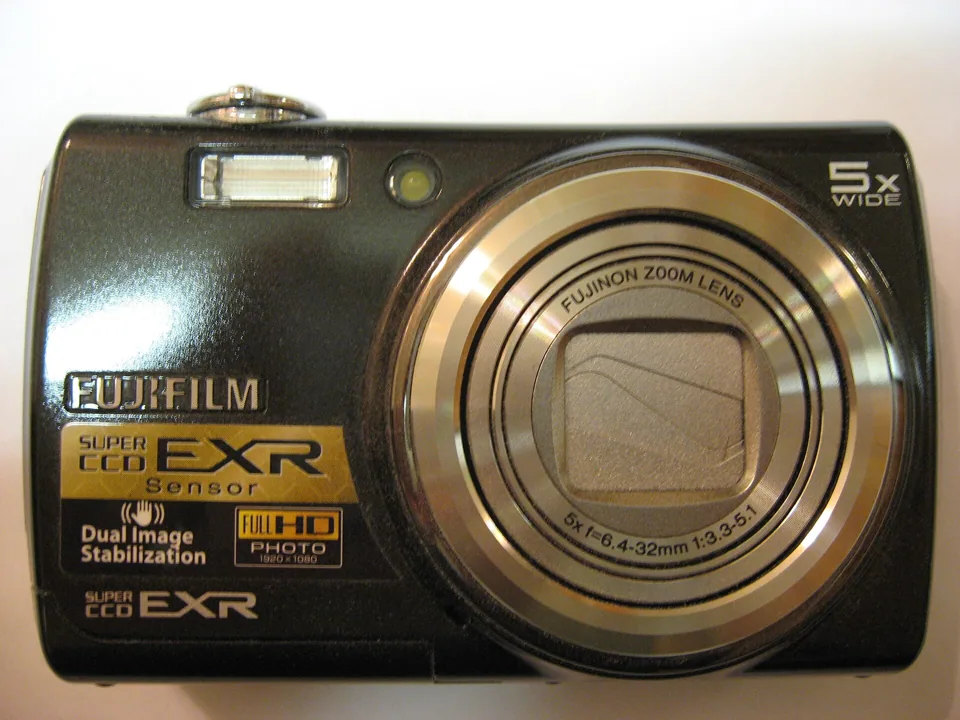
The F200EXR is described by Neocamera and What Digital Camera as the first camera to carry Fujifilm's Super CCD EXR sensor,35 a design Fujifilm first described at Photokina in 2008.2 The sensor is 1/1.6 inch and delivers 12 megapixels;1 PhotographyBLOG's review roundup quotes Photo Review (Australia) giving it as 8.08 by 6.01 mm, against 6.16 by 4.62 mm for a standard 1/2.3-inch chip.1 In front of it sits a 5x Fujinon zoom covering 28 to 140 mm on a 35 mm camera, opening to f/3.3 at the wide end and f/5.1 at the long end.1
It is a plastic-bodied compact5 of about 98 by 59 by 23 millimetres and 175 grams without battery or card, according to PhotographyBLOG, which called it externally very similar to the earlier F100fd, with the same 28–140 mm lens.1 Imaging Resource said it went on sale in February 2009 at an MSRP of about $400, with a street price nearer $350;2 PhotographyBLOG listed $399.95 and £329.99.1 What Digital Camera put it at around £290 when it reviewed it.5
Why this one was interesting
One sensor, three jobs
The sensor can capture at full 12-megapixel resolution, combine pixels for a lower-resolution file with less noise, or combine them for wider dynamic range.2 Fujifilm called the three settings Resolution Priority (HR), High ISO and Low Noise (SN) and D-Range Priority (DR), and an EXR Auto position picked one for you.1 PhotographyBLOG said Auto chose the mode its reviewer would personally have picked about 90 percent of the time.1 Neocamera counted the same three as 12 megapixels for detail, 6 for low noise and 6 for dynamic range.3
Dynamic range that was hard to find in a compact
In DR mode the camera takes two exposures and merges them into a 6-megapixel picture, with the range adjustable up to 800 percent, according to PhotographyBLOG, whose reviewer called it much more successful than the High ISO mode and said it far surpassed other compact cameras for keeping detail in highlights and shadows.1 Neocamera called it the most impressive of the EXR modes, good for up to three stops more highlight detail.3 DPReview called the highlight retention extremely impressive and said its tests suggested more than 10 EV of range in this mode, adding that the results should not be treated as absolute or comparable with other cameras.4
Manual control, of a sort
PhotographyBLOG noted that aperture-priority and manual modes returned on this model, but with only two apertures to choose from: f/3.3 and f/9 at the wide end.1 Imaging Resource also counted aperture priority and manual among the pros.2 Neocamera explained why the choice was so limited: the camera uses a built-in neutral-density filter in place of a variable aperture, so depth of field does not change, and there is no shutter priority.3
Fujifilm's earlier low-light CCD compacts are covered in our reviews of the FinePix F30 and the FinePix F31fd.
What was lost
Choosing a lower resolution meant giving up pixels. The two-exposure DR mode outputs 6 megapixels, and Neocamera noted that manual controls and shutter speeds slower than a quarter of a second are not available in it.3 Imaging Resource added that the 6-megapixel High ISO mode caps shutter speed at a quarter of a second and sensitivity at ISO 1600, which limits its use in dim light.2 There is no raw file, histogram or bracketing, as PhotographyBLOG listed.1
The dark: its weak point
The reviewers disagreed on where noise began at full resolution. PhotographyBLOG found ISO 100 and 200 noise-free, limited noise at 400 and fairly visible noise with some loss of fine detail at 800 (though still very usable), and called 6400 and 12800 not worth using.1 Neocamera found noise negligible up to ISO 400 and visible but not objectionable at 800.3 Imaging Resource saw noise-reduction artifacts from ISO 400 and detail dropping off quickly from 1600.2 What Digital Camera saw a watercolour-like texture from around ISO 400, still with good detail.5 DPReview measured less luminance noise than the Panasonic LX3 up to ISO 800 at full resolution, but in a visual comparison with the LX3 downsized to 6 megapixels it found the LX3 clearly better at ISO 800 and no obvious EXR advantage at 1600, and it listed noise-reduction smearing, especially at 12 megapixels, among its cons.4
The 6-megapixel mode was a smaller win than the idea suggested. PhotographyBLOG found it only slightly less noisy than full resolution, a smaller gap than it hoped for.1 DPReview agreed that the difference was subtle and too close to call visually, with the gain mostly in colour noise.4 Imaging Resource and Neocamera were warmer: the first estimated just under a stop of noise improvement with good detail up to ISO 800 (while noting that simply downsizing the 12-megapixel files came close), the second put it not quite a full stop ahead, with ISO 1600 usable for a medium-sized print.23




Real photographs taken with this camera. The sensitivity shown is recorded in each file's own EXIF data; which EXR mode was used is not.
Like that look? See recent eBay sold listings for this camera ↗
On eBay right now
Live listings for this camera, supplied by eBay and updated automatically. We earn a commission if you buy through them.
The little wins
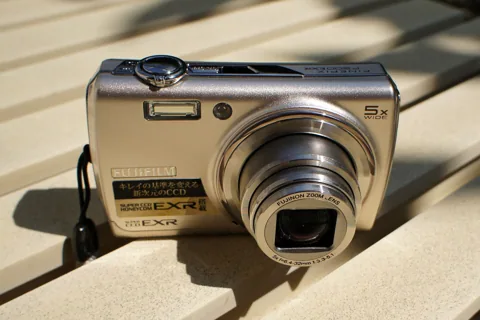


A wide-angle zoom in a thin body
Imaging Resource listed a wide-angle 5x zoom in a compact body among its pros,2 and Neocamera found the lens sharp from corner to corner, though Imaging Resource saw soft corners at wide angle.32
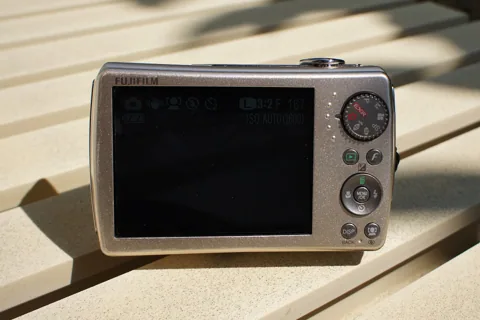 The back of the F200EXR. · 663highland · CC BY 2.5 · Commons

Face Detection 3.0
It finds up to ten faces and offers red-eye reduction, PhotographyBLOG noted;1 Neocamera added that it also works in playback.3
Speed
Neocamera called start-up, focusing, zooming and shutter lag fast,3 and PhotographyBLOG put start-up at around two seconds,1 though What Digital Camera found start-up hardly quick and DPReview called the camera not rapid.54 Imaging Resource measured a lag of about 0.5 seconds with full autofocus and 0.171 seconds prefocused.2
How it drew the picture
PhotographyBLOG scored image quality 5 out of 5, though it noted that out-of-camera files were soft and sharpening cannot be adjusted in the camera.1 Imaging Resource was harder on the full-resolution files, finding soft detail and demosaicing errors on horizontal and vertical lines, soft corners at wide angle and oversaturated reds with slightly pink skin and a warm automatic white balance.2 What Digital Camera called colour vibrant without being oversaturated and centre sharpness very good, with barrel distortion visible at 28 mm.5 Neocamera found artificial light left a noticeable cast with auto white balance, a step back from the F100fd.3


















Photos taken with this camera, from Wikimedia Commons, credited under each picture.
Where it let you down
PhotographyBLOG called the body awkward to hold, with no front grip and the thumb resting on the mode dial, which it knocked out of position in a pocket a couple of times; Neocamera also listed the mode dial changing by accident as a con.13 Battery life drew complaints from the reviewers: PhotographyBLOG gave about 150 shots per charge, Imaging Resource and DPReview quoted a CIPA rating of 230, Neocamera called it quite poor, and What Digital Camera found the battery loose in its compartment, once following the memory card out.12435 Imaging Resource found the flash weak, with a recycle time of about seven seconds (DPReview, by contrast, listed good flash performance as a pro), called the menus convoluted and the zoom control imprecise, and said movies were limited to 640 by 480 with no optical zoom.24 Neocamera added that the camera does not clearly show which EXR mode is active at lower resolutions.3
What the reviewers said in 2009
| Outlet | Date | Verdict |
|---|---|---|
| PhotographyBLOG | 18 Mar 2009 | Design 4, features 4.5, ease of use 4.5, image quality 5, value 4; 4.5 out of 5 overall. Recommended to anyone who wants the best straight-out-of-camera JPEGs.1 |
| Neocamera | 23 Apr 2009 | Rated Excellent: best image quality among ultra-compacts, but an awkward interface and poor battery life.3 |
| DPReview | 30 Apr 2009 | Highly Recommended. Less luminance noise than the LX3 in its measurements and dynamic range "amongst the best" it had seen; noise-reduction smearing at 12 MP, average battery life, no histogram, modest stabiliser benefit.4 |
| Imaging Resource | 15 Sep 2009 | 3 out of 5. Praised the 6-megapixel modes but found the 12-megapixel results and the interface hard to recommend to most buyers.2 |
| What Digital Camera | Page dated 31 Oct 2014 | Image quality and dynamic range praised; unlikely to threaten enthusiast compacts because of limited manual control.5 |
The timeline
- 2008Fujifilm first describes the Super CCD EXR sensor at Photokina.2
- February 2009The F200EXR goes on sale at an MSRP of about $400.2
- 18 March 2009PhotographyBLOG publishes its review.1
- 23 April 2009Neocamera publishes its review.3
- 15 September 2009Imaging Resource posts its review, with expanded 6-megapixel tests added on 26 September.2
Should you buy one now?
Buy one if you want a pocketable CCD compact with a real wide angle and a camera that thinks about dynamic range, and you are willing to accept a fussy interface. It launched at $399.95;1 what it sells for now is a question for the sold listings, not for us. Before you bid, check these:
- The name. PhotographyBLOG and Imaging Resource write FinePix F200EXR, while Neocamera and DPReview write F200 EXR, so search both spellings.1234
- The battery. It uses an NP-50;1 a fresh one is on Amazon ↗, and reviewers found the battery life short and the battery itself loose.15
- The card. The camera takes xD-Picture Cards and SD and SDHC cards;1 Neocamera recommends using SD, and Imaging Resource lists SD and SDHC cards up to 8 GB and xD up to 2 GB.32 See our memory card guide.
- The mode dial. Reviewers found it easy to knock out of place, so check that it stays where you put it.13
- The lens. Check that it extends and retracts cleanly.
If you are wondering why cameras like this are being hunted down again, we tell that story once, in Pictures that never left the card.
See recent sold prices on eBay ↗Shop on eBay ↗NP-50 battery ↗
Sources
- PhotographyBLOG, Fujifilm FinePix F200EXR review by Mark Goldstein (18 Mar 2009)
- Imaging Resource, Fujifilm F200EXR review by Mike Pasini and Zig Weidelich, overview by Mike Tomkins (posted 15 Sep 2009, updated 26 Sep 2009)
- Neocamera, Fujifilm FinePix F200 EXR review, with its performance and summary pages (23 Apr 2009)
- DPReview, Fujifilm FinePix F200 EXR review by Richard Butler (page dated 30 Apr 2009)
- What Digital Camera, Fujifilm FinePix F200EXR review by Matt Golowczynski (page dated 31 Oct 2014)
Camera photos by Chhe (public domain) and 663highland (CC BY 2.5); other photographs are credited under each one, all via Wikimedia Commons. Links to eBay and Amazon are affiliate links.