Ricoh Caplio R · announced September 2005
The Ricoh Caplio R3: a 28–200 mm zoom in a body 26 mm thick, and three reviewers who could not agree on the pictures
We found no other regional name for it: Ricoh's Tokyo release, the London release that DPReview printed and the 2005–06 reviews all call it the Caplio R3.13
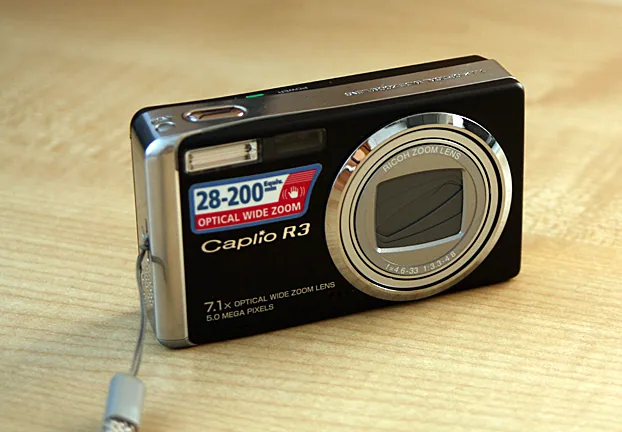

In September 2005 Ricoh fitted a 7.1x, 28–200 mm zoom and a stabiliser that moves the sensor into a pocket compact. Reviewers praised the speed, the one-centimetre macro mode and the stabiliser, split over the image quality, and three of them found something fragile.
Ricoh Caplio R3 specs: sensor, lens, battery, memory card and cable
The Ricoh Caplio R3 came out in September 2005 as a 5.13 MP CCD compact with a 28–200 mm (35 mm equivalent) 7.1× zoom lens. It takes SD and MMC cards and runs on the DB-60 battery. Sources
- Sensor
- CCD, 1/2.5", 5.13 MP source
- Lens
- 28–200 mm equivalent, 7.1× zoom source
- Memory card
- SD, MMC source
- Battery
- DB-60 source
- USB / A/V cable
- See our Ricoh cable page
Meet the camera
Ricoh lists it at 95 by 53 by 26 millimetres and about 135 grams without battery or strap, with about 30 grams more for the battery and strap.2 PhotographyBLOG called it light enough that you would not notice it in a trouser pocket, put that down to all-plastic construction and added that a metal band round the edge holds it together;5 DigiCamReview described a metal body and Trusted Reviews called it very solidly made.64 The lens is the point: f = 4.6–33 mm, equal to 28–200 mm, opening to f/3.3 at wide angle and f/4.8 at the long end.2 Ricoh called it the biggest zoom among digital cameras lighter than 150 grams as of 6 September 2005,1 and Trusted Reviews noted that most compacts stopped at 38 mm at the wide end.4
Ricoh announced it in Tokyo on 7 September 2005, and DPReview printed the London version of the release the same day.13 PhotographyBLOG gave the UK recommended price as £249.99;5 Trusted Reviews wrote of £219 in October and DigiCamReview of £230 in January;46 Engadget, summarising the Trusted Reviews piece, put the US street price at under $500.8
- Sensor
- 5.13 MP effective CCD, 1/2.5", up to 2592 × 19442
- Lens
- 7.1x, 28–200 mm equiv., f/3.3–4.8, CCD-shift stabiliser2
- ISO
- Auto and 64 to 8002
- Video
- 320 × 240 or 160 × 120, at 15 or 30 fps2
- Card and battery
- SD or MMC, 26 MB built in · DB-60, 310 shots by CIPA2
- Size
- 95 × 53 × 26 mm, about 135 g without battery2
Sources disagree on a few lines. Ricoh's R3 spec page lists the screen at about 114,000 dots, while PhotographyBLOG's review text and Ricoh's own R4 release call it 110,000 pixels.259 The London release as DPReview printed it says part of the lens protrudes from the body in storage; Ricoh's Tokyo release says the assembly retracts fully, and PhotographyBLOG saw it retract fully when switched off.315
Why this one was interesting
A zoom that folds twice
Ricoh's new Double Retracting Lens System stores the lens assembly inside the body, which is what let a 28–200 mm zoom fit into 26 millimetres; the R2, announced in February 2005, had a 28–135 mm lens.110 PhotographyBLOG measured over 7 centimetres of depth with the lens extended.5
A stabiliser that moves the sensor
Ricoh did not put the correction in the lens: the CCD shifts in the opposite direction to the shake, which Ricoh said left lens designers free to make the body slim.1 Trusted Reviews compared it with the method Konica Minolta used in some high-end cameras, and got sharp handheld pictures at 1/16 second at medium zoom and 1/50 second at full zoom.4 PhotographyBLOG shot the same subject at 200 mm and ISO 64, handheld, at 1/90 and 1/17 second with the stabiliser off and on, and found the pictures much sharper with it on.5 DigiCamReview ran a similar on and off test at 1/8 second, ISO 800, 200 mm, and also called it effective.6 PhotographyBLOG listed two modes, one always on and one that works only while the shutter is pressed.5
Macro from one centimetre, and some odd tricks
Ricoh's release promised macro from 1 cm, a zoom-macro setting and a skew correction mode that straightens pictures of blackboards, documents and timetables shot at an angle.1 Trusted Reviews called the macro mode extremely impressive and possibly the closest of any consumer camera;4 TechRadar said keen macro photographers would be impressed.7 Trusted Reviews called skew correction wonderfully clever; TechRadar called it clever but almost certainly of limited use.47
For Ricoh's enthusiast camera of the same year, see our GR Digital review.
What was lost
Reviewers made no comparison with the R2, so this is our reading of Ricoh's two spec pages. The R2 ran on its DB-50 battery or on two AA cells, and Ricoh rated it at 500 shots on the battery pack by the CIPA test; the R3's page lists only the DB-60 pack and an optional AC adaptor, rated at 310 shots.112 Those are Ricoh's figures for different batteries, not a test, and Ricoh's R3 pages do not say whether the stabiliser was on for the 310 figure, so the two numbers may not be like for like.29
The dark: its weak point
All three reviewers who tested noise saw it rise with sensitivity, and put the line in different places. PhotographyBLOG found none at ISO 64, some starting at ISO 100 (obvious in shadows, it said in its summary), obvious noise from ISO 200 and ISO 800 unusable, so it treated ISO 64 to 200 as the usable range.5 Trusted Reviews saw a clean picture at ISO 64, slight colour speckling but a printable picture at 100, noticeable colour noise and lost fine detail at 200, very noisy shadows at 400 and worse at 800.4 DigiCamReview found noise visible in dark areas even at ISO 64, only just acceptable at 200, high at 400 and very high at 800, and advised sticking to ISO 64 or 100 and avoiding Auto ISO.6 PhotographyBLOG's night shot, at the longest exposure of 8 seconds and ISO 64, lacked detail and was blurry.5








Real photographs taken with this camera. The sensitivity and shutter speed shown are recorded in each file's own EXIF data; the camera model recorded in each file is Caplio R3.
Like that look? See recent eBay sold listings for this camera ↗
On eBay right now
Live listings for this camera, supplied by eBay and updated automatically. We earn a commission if you buy through them.
The little wins
The stabiliser
All three reviewers who tried it said it worked.456 The catch, PhotographyBLOG argued: noise above ISO 200 means you leave the stabiliser on all the time, which it said negates much of the benefit; leaving it on did not hurt battery life.5
Quick on its feet
Ricoh claimed an average release lag of about 0.09 second and a start-up of 1.1 seconds.1 Trusted Reviews found the lag virtually non-existent;4 DigiCamReview put it at 0.1 to 0.2 second when pre-focused.6 PhotographyBLOG put start-up at about half a second where Trusted Reviews and DigiCamReview said just over a second.546
Macro from one centimetre
PhotographyBLOG called macro the stand-out highlight of the image quality while noting heavy lens distortion and shadowing that close.5 DigiCamReview found it very good, though noise removes detail at higher ISOs, and warned that the flash can wash out a very close subject.6
How it drew the picture
The three verdicts on picture quality were three different words. Trusted Reviews called it quite acceptable, with good exposure and colour and noise higher than it should be at high ISOs, and noted significant barrel distortion at the widest setting, plus vignetting in the top corners at full wide angle with the stabiliser off.4 DigiCamReview called it average: good colour, saturation, contrast and detail, but higher than average noise, purple fringing and softness, and it noticed neither vignetting nor barrel or pincushion distortion, which is not what Trusted Reviews saw.6 PhotographyBLOG called the image quality poor, citing noise from ISO 100, soft files at the default sharpening setting and purple fringing it said the camera handled badly, and gave the camera 3.5 stars out of 5 overall.5 TechRadar did not grade the pictures. None published lab measurements, so these are judgements from test shots.


Lapplaender · CC BY-SA 2.0 de · Commons


Siga · CC BY-SA 3.0 · Commons


たーなー · CC BY-SA 3.0 · Commons


Siga · Public domain · Commons


Lapplaender · CC BY-SA 3.0 de · Commons


Odorico · CC BY-SA 3.0 · Commons


Kryptonit (de.wikipedia), edits by Corni · Public domain · Commons


Vivimeri · CC BY-SA 3.0 · Commons

Photos taken with this camera, from Wikimedia Commons, credited under each picture. The camera model recorded in every file is Caplio R3.
Where it let you down
Three reviewers found something fragile. PhotographyBLOG's reviewer said the loose hinge on the battery and memory-card door was bad enough that they would have sent a personal camera back; DigiCamReview called the plastic battery cover fragile, with a single clip; TechRadar said the fins over the front element close badly, that both its review units developed the fault and that interference with the flaps as they close can make one come loose.567 PhotographyBLOG also found the USB and AV sockets uncovered, while DigiCamReview's tour lists a side compartment for them.56 The screen split opinion: PhotographyBLOG called its dot count completely inadequate and the picture grainy, TechRadar mediocre, DigiCamReview clear and easy to read.576 Focus was the other disagreement. Trusted Reviews found it struggled outside good light and said the camera lacks an AF illuminator, although Ricoh's spec page lists an AF auxiliary light;42 PhotographyBLOG found it mostly fine indoors with a focus-assist lamp that fires the flash twice, but sometimes struggling at 200 mm; DigiCamReview found it fine in low light but not always successful and slow in macro.56 PhotographyBLOG waited several seconds for the flash to recycle, where DigiCamReview called it quite quick and warned that it can overexpose.56 PhotographyBLOG pointed out that 26 MB of built-in memory holds 13 top-quality pictures.5
What the reviewers said in 2005–06
| Outlet | Date | Verdict |
|---|---|---|
| Trusted Reviews | 25 Oct 2005 | 8 out of 10. Attractively designed and well made, with outstanding performance and a reasonable price; the reviewer wrote that they had seen no other reviews of it.4 |
| PhotographyBLOG | 13 Dec 2005 | 3.5 stars out of 5. One of the most usable and best-designed cameras it had reviewed, with some of the worst pictures it had seen; only the macro mode and stabiliser worth having; hoped the next Ricoh would fix the image quality.5 |
| DigiCamReview | 16 Jan 2006 | “Above average”, 6 out of 10. Very good on features and speed, average on picture quality; best avoided if picture quality is your priority.6 |
| TechRadar | 1 Feb 2006 | No score on the page. A great zoom and some good features; build score hurt by the lens cover; whether it suits depends on how much you will compromise for the wider view.7 |
The timeline
- 28 February 2005Ricoh announces the Caplio R2, a 5-megapixel camera with a 4.8x, 28–135 mm lens.10
- 7 September 2005Ricoh announces the Caplio R3 in Tokyo; DPReview prints the London release.13
- 25 October 2005Trusted Reviews publishes its review.4
- 13 December 2005PhotographyBLOG publishes its review.5
- 16 January 2006DigiCamReview publishes its review.6
- 1 February 2006TechRadar publishes its review and mentions the R30, announced in January, with a 5.7x zoom.7
- 23 February 2006Ricoh announces the Caplio R4, which it says builds on the R3 with 6 megapixels, longer battery life and a higher-resolution LCD.9
Should you buy one now?
Buy one if you want a 28–200 mm zoom and a stabiliser in a pocket and will shoot mostly at ISO 64 or 100, the range DigiCamReview advised sticking to.6 PhotographyBLOG listed it at £249.99 in the UK in December 2005;5 what it sells for now is a question for the sold listings, not for us. Before you bid, check these:
- The name. Search the Caplio R3. TechRadar's R30 had a 5.7x lens,7 and the R4 has 6 megapixels where the front of the camera in our lead photo reads 5.0.9
- The lens flaps. TechRadar's units had flaps that would not close;7 switch the camera on and off and check that the lens retracts fully.5
- The battery door. PhotographyBLOG and DigiCamReview both had trouble with it, so check the hinge and clip.56
- The battery. It uses the DB-60, rated at 310 shots; PhotographyBLOG got over 250 in use.25 A fresh one is on Amazon ↗.
- The card. Ricoh lists SD cards from 32 MB to 1 GB and MMC, with 26 MB built in.2 We have not tested larger cards; see our memory card guide.
- The stabiliser. Find the button on the top plate and check that it switches on and off;4 DigiCamReview found it, like the power button, a little hard to press.6
- The ports and flash. Look at the side sockets for dirt or bent pins, and fire the flash once. We have not confirmed the connector type.
If you are wondering why cameras like this are being hunted down again, we tell that story once, in Pictures that never left the card.
See recent sold prices on eBay ↗Shop on eBay ↗DB-60 battery ↗
Sources
- Ricoh, “Caplio R3 press release” (Tokyo, 7 Sep 2005)
- Ricoh, Caplio R3 major specifications (page attached to the 2005 press release)
- DPReview, “Ricoh Caplio R3” (7 Sep 2005; prints Ricoh's London press release)
- Trusted Reviews, Ricoh Caplio R3 review by Cliff Smith (25 Oct 2005; read in the Internet Archive copy of 9 Dec 2015)
- PhotographyBLOG, Ricoh Caplio R3 review (13 Dec 2005; eight pages)
- DigiCamReview.co.uk, Ricoh Caplio R3 review (16 Jan 2006; read in the Internet Archive copy of 24 May 2006)
- TechRadar, Ricoh Caplio R3 review by Dan Grabham (published 1 Feb 2006)
- Engadget, “Ricoh Caplio R3 reviewed” by Marc Perton (26 Oct 2005)
- Ricoh, “Ricoh announces the Caplio R4” (press release, Tokyo, 23 Feb 2006)
- Ricoh, “Announcing the Release of the Caplio R2” (press release, Tokyo, 28 Feb 2005)
- Ricoh, Caplio R2 major specifications (page attached to the 2005 press release)
Camera photo by Colin Zhu (CC BY-SA 2.0); other photographs are credited under each one, all via Wikimedia Commons. Links to eBay and Amazon are affiliate links.