Casio Exilim Card · announced March 2003
The Casio Exilim EX-S3: the 11.7 mm camera with almost no shutter lag
We found no other regional name: Casio's US release and both full reviews call it the EX-S3 (we read no sources from other regions).123
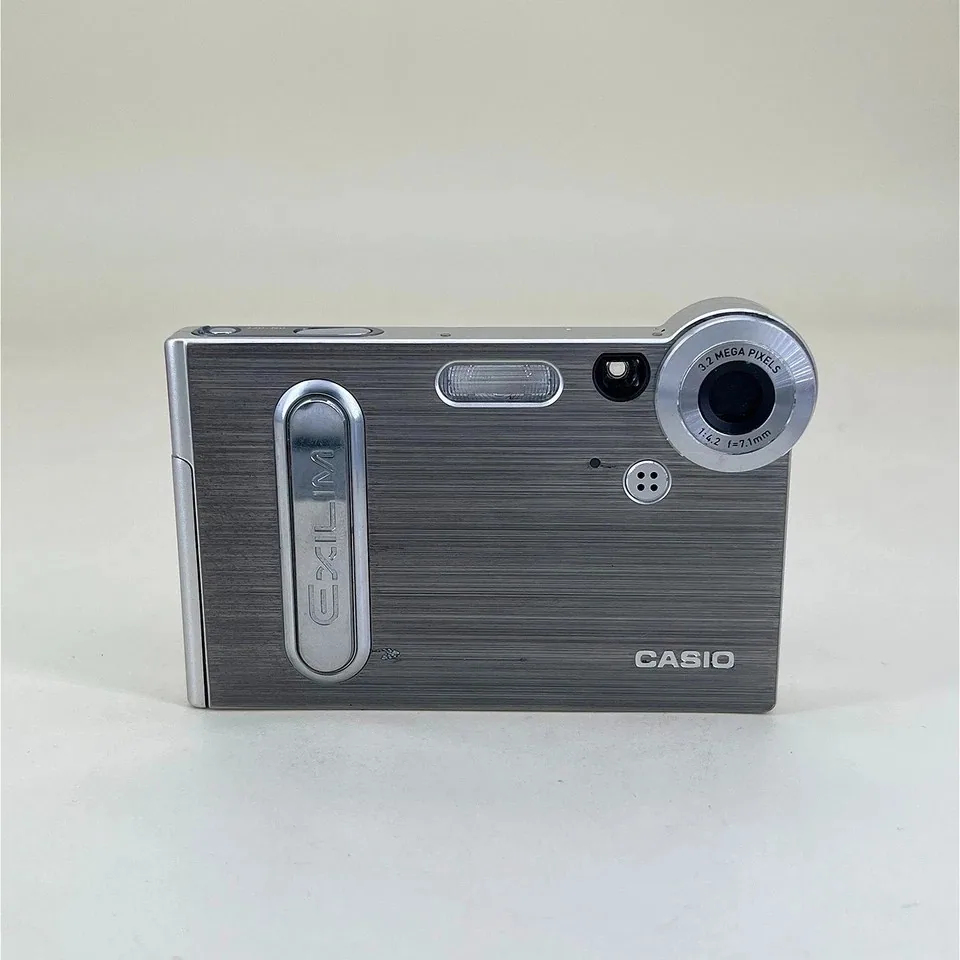
In March 2003 Casio announced a camera 11.7 millimetres thick with a fixed-focus lens and a 2-inch screen, for $349.99. Reviewers praised how quickly it shot and how it was built; the pictures drew the criticism.
- Launched
- March 2003
- Launch price
- $349.99 (suggested)1
- Sensor
- 3.2 MP CCD
- Lens
- fixed 35 mm
- Card
- SD, MMC
- Battery
- NP-20
Casio Exilim EX-S3 specs: sensor, lens, battery, memory card and cable
The Casio Exilim EX-S3 came out in March 2003 at $349.99 as a 3.2 MP CCD compact with a fixed 35 mm (35 mm equivalent) lens. It takes SD and MMC cards and runs on the NP-20 battery. Sources
- Sensor
- CCD, 1/1.8", 3.2 MP source
- Lens
- 35 mm equivalent, fixed (no zoom) source
- Memory card
- SD, MMC source
- Battery
- NP-20 source
- USB / A/V cable
- CA-22 Confirmed · all Casio cables
Meet the camera
Casio's release gave the size as 3.52 by 2.24 by 0.46 inches and the weight as 2.54 ounces without the battery;1 Steve's Digicams listed 89.5 by 57 by 11.7 millimetres and 72 grams.2 Casio called the case lightweight magnesium alloy and described the camera as card-sized;1 Digital Camera Resource called the body all metal and warned that it smudges and scratches easily.3 The sources do not quite agree on the metal: Steve's Digicams repeated Casio's magnesium-alloy line in its introduction but listed a "stainless steel" body in its feature list, and we cannot say which is right.2 The lens sits behind a barrier that opens and closes as the camera switches on and off, which Digital Camera Resource noted the older models lacked.13
The lens does not zoom, and it does not focus. Casio listed a fixed 7.1 mm lens equivalent to about 35 mm, f/4.2, with focus fixed from about 80 centimetres to infinity and a 4x digital zoom.1 Casio announced the camera on 2 March 2003 at the Photo Marketing Association show, with retail promised for April and a suggested price of $349.99.1 CNET's page, by contrast, lists a release date of 1 August 2003.4 We cannot tell from these sources which date matches a first shop sale.
- Sensor
- 3.2 MP effective (3.35 MP total) CCD, 1/1.8"1
- Lens
- Fixed, 35 mm equiv., f/4.2, focus 80 cm to infinity; 4x digital zoom1
- ISO
- Auto, 80, 160, 320, 6401
- Screen
- 2.0" TFT, 84,960 pixels (354 × 240); optical viewfinder1
- Video
- 320 × 240 with sound, up to 30 s per clip2
- Card and memory
- SD or MMC; 10 MB built in1
- Launch price
- $349.99 (suggested)1
Why this one was interesting
Nothing to focus, nothing to wait for
Casio claimed a release time lag of 0.01 second and a start-up of about one second with the splash screen off.1 Imaging Resource's editor noted in the announcement that such a figure must be for a prefocused shot and promised to test the real thing.1 With a fixed-focus lens there is nothing to prefocus: Digital Camera Resource found no real shutter lag, and the shutter button will not even half-press.3 Steve's Digicams said the camera has almost zero lag because of the fixed-focus lens and called it one of the fastest little cameras it had used.2 Digital Camera Resource found a start-up of under two seconds, and only with the start-up screen switched off.3
Thin on purpose
Casio's release (which gives the thickness as 0.46 inch; Steve's Digicams gives 11.7 millimetres) named two space-saving measures: a single module joining lens and CCD, and chips stacked vertically, a mounting it said needed 40 percent less chip area than the multi-chip module of the 2-megapixel EX-S2 and M2.12 Steve's Digicams photographed it beside a Minolta DiMAGE Xt, a Pentax Optio S and a standard CD to show the difference.2
A screen that finally mattered
The screen grew to 2.0 inches from the 1.6 inches on the older models, Digital Camera Resource said.3 The two full reviews disagreed about it: Steve's Digicams called it resolute and colourful and larger than the screens on most full-size cameras then, while Digital Camera Resource called it bright and fluid but low in resolution.23
Imaging Resource described it as a fixed-focal-length version of the zoom-equipped EX-Z3 shown in January, and Digital Camera Resource noted that this generation had no MP3-playing "M" twin.13 Later Exilims in our archive include the EX-Z75, which uses the same NP-20 battery code, the EX-Z1000 and the EX-ZR100.
What was lost
Each new Card Exilim, Digital Camera Resource observed, got a slower lens: f/4.2 here, against f/3.2 and f/2.5 on earlier models.3 The camera also has no macro mode, since it cannot focus nearer than 80 centimetres, and no tripod socket, which stopped Digital Camera Resource running its night and distortion tests.3 Its reviewer even wondered whether older models had 12 MB of built-in memory against 10 MB here, a figure we could not confirm.3 And Digital Camera Resource's closing advice was blunt: with 3x zoom compacts such as the EX-Z3 and the Pentax Optio S around, the non-zoom Exilims were no longer that appealing.3
The dark: its weak point
Digital Camera Resource found a lot of noise in its test photos, visible even at ISO 80 in its red-eye test shot, giving an "over-processed" look, plus noticeable vignetting, some softness at the edges and visible red-eye, though no purple fringing; it enlarged that shot and adjusted its levels to make the noise visible.3 Steve's Digicams was kinder: the lens showed a moderate amount of barrel distortion and was not the sharpest, but did a good job given how small it is.2 CNET's summary calls the image quality only average and lists the fixed-focus, fixed-focal-length lens without macro, and ergonomics that will not appeal to everyone, among the bad points.4
Casio listed a flash range of about 0.8 to 2 metres,1 which Digital Camera Resource called short.3 The two photos below are low-light shots from the free set: a floodlit stadium at night and a dimly lit restaurant interior. Neither file records its ISO, so we cannot say how high the camera went.


On eBay right now
Live listings for this camera, supplied by eBay and updated automatically. We earn a commission if you buy through them.
The little wins
Two people, one picture
Best Shot's Coupling Shot lets two people appear in one frame without a third; Pre Shot has a bystander press the button against a frozen background you composed.123
A web album in the camera
The camera builds an HTML photo album you can copy to a web site, from ten layouts in Digital Camera Resource's count, and a calendar view that shows a thumbnail on each day you shot.3
How it drew the picture
There is no lab test of this camera in what we read. Casio offered 2048 × 1536 stills at three quality levels, with a 10 MB memory holding five at the finest.13 The pictures below are from Wikimedia Commons, each recorded in its file data as taken with an EX-S3, and credited under each picture. They are a small, scattered sample: one is a sunrise haze, another a rabbit indoors, none is a test chart.








Photos taken with this camera, from Wikimedia Commons. Only about a hundred free files exist.
Where it let you down
Steve's Digicams noted that you have to keep your finger off the top left of the body or it appears in the picture, and that there is no video output;2 it also said movie clips play back silently because the camera has no speaker.2 Digital Camera Resource added that a picture cannot be deleted right after it is taken, that the full manual is only on the CD, that the bundled Photohands software was Windows-only, and that the dock connector did not seem to have a cover.3 The reviewers also disagreed about the viewfinder: Steve's Digicams called it large and bright and showing about 85 percent of the frame, Digital Camera Resource called it pretty small with no diopter adjustment.23 The camera's own file data, as recorded on each sample photo, gives f/4.2, so Steve's feature list that says F4.7 looks like a slip; his specification table, Casio's release and Digital Camera Resource all say f/4.2.213 Steve's Digicams said everything from a metre away is in focus, where Casio listed 80 centimetres.21 Digital Camera Resource waited about 2.5 seconds between shots at the finest quality,3 while Steve's Digicams put shot-to-shot at under two seconds with flash.2
What the reviewers said in 2003
| Outlet | Date | Verdict |
|---|---|---|
| Steve's Digicams | 13 Jun 2003 | No score. Called it as small and thin as cameras come, very fast and built like a tank; its lens not the sharpest but good for the size. Pointed buyers who want zoom to the EX-Z3.2 |
| Digital Camera Resource | 26–27 Jul 2003 | No score. A nice secondary camera you can take anywhere; skip it as a first camera because photo quality is very mediocre and you will miss a zoom lens.3 |
| CNET | 22 Dec 2003 | 7.2 out of 10 ("Very good"); readers 7.0 from 31 ratings when archived in 2005. Very small, stylish, almost no shutter lag, long battery life; the lens limits versatility and image quality is average.4 |
We read CNET's summary page, not the full review, so only its headline findings are reported. Steve's Digicams and Digital Camera Resource were read in full through Internet Archive copies.
The timeline
- 2 March 2003Casio announces the EX-S3 at the PMA show: $349.99, retail promised for April.1
- 13 June 2003Steve's Digicams posts its review.2
- 26 July 2003Digital Camera Resource posts its review.3
- 1 August 2003The release date CNET lists.4
- 22 December 2003CNET's review is dated.4
Should you buy one now?
Buy one if you want a very thin, very quick, plainly made snapshot camera and you accept noisy, soft pictures. It launched at $349.99;1 what it sells for now is a question for the sold listings, not for us. Before you bid, check these:
- The cradle. The camera has only contacts for a USB cradle and a DC input, no ordinary port, so check that the cradle and its adapter come with it.12 We found no source that describes another way to charge it.
- The battery. It takes the NP-20, a proprietary pack; a replacement is on Amazon ↗.23 An old pack may hold far less than the rated figure.
- The card slot. It takes SD and MMC cards and has 10 MB inside;1 the dummy card in the slot keeps dust out.3 Our memory card guide covers what old cameras accept. We have not tested a large card.
- The body. It is metal and marks easily,3 so check the lens barrier moves cleanly and the lens is not scratched.
- The screen and controller. The four-way controller does menus and zoom, so check every direction works.2
If you are wondering why cameras like this are being hunted down again, we tell that story once, in Pictures that never left the card.
See recent sold prices on eBay ↗Shop on eBay ↗NP-20 battery ↗
Sources
- Casio, Inc., EX-S3 launch release and specifications, 2 March 2003 (reproduced by Imaging Resource, with its editor's note)
- Steve's Digicams, Casio Exilim EX-S3 user review, posted 13 June 2003, four pages (Internet Archive copy, December 2004)
- Digital Camera Resource Page, Casio Exilim EX-S3 review by Jeff Keller, 26 July 2003, updated 27 July (Internet Archive copy, January 2008)
- CNET, Casio Exilim EX-S3 editors' review summary by David D. Busch, 22 December 2003 (Internet Archive copy, December 2005; the full review text could not be retrieved)
Photographs are credited under each one, all via Wikimedia Commons. Links to eBay and Amazon are affiliate links.