Panasonic Lumix FX series · on sale March 2006 · a retrospective
The Panasonic Lumix DMC-FX01: the smallest camera with a 28 mm lens
In 2006 Panasonic put a wide-angle Leica lens and image stabilisation into a camera barely bigger than a deck of cards. Reviewers called it a first for the ultra-compact class, and complained about the noise.
Meet the camera
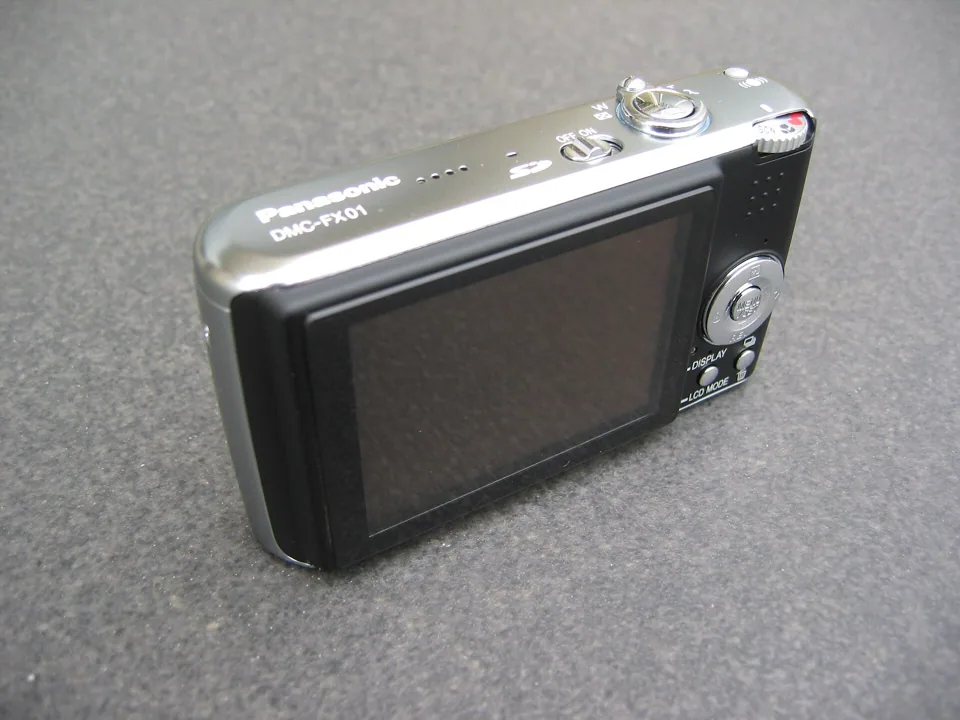
It is plain on purpose. Imaging Resource described the minimalist styling Panasonic was known for: a body almost completely smooth apart from the controls and a small oval trim piece on the front that also gave fingers a grip.2 A Leica DC Vario-Elmarit lens sat at one end, a big screen filled the back, and DPReview called the camera's construction high quality and its design lovely.3 It measures about 94 by 51 millimetres and 24 thick,1 and Photo Review gave its weight as 132 grams without battery and card.4
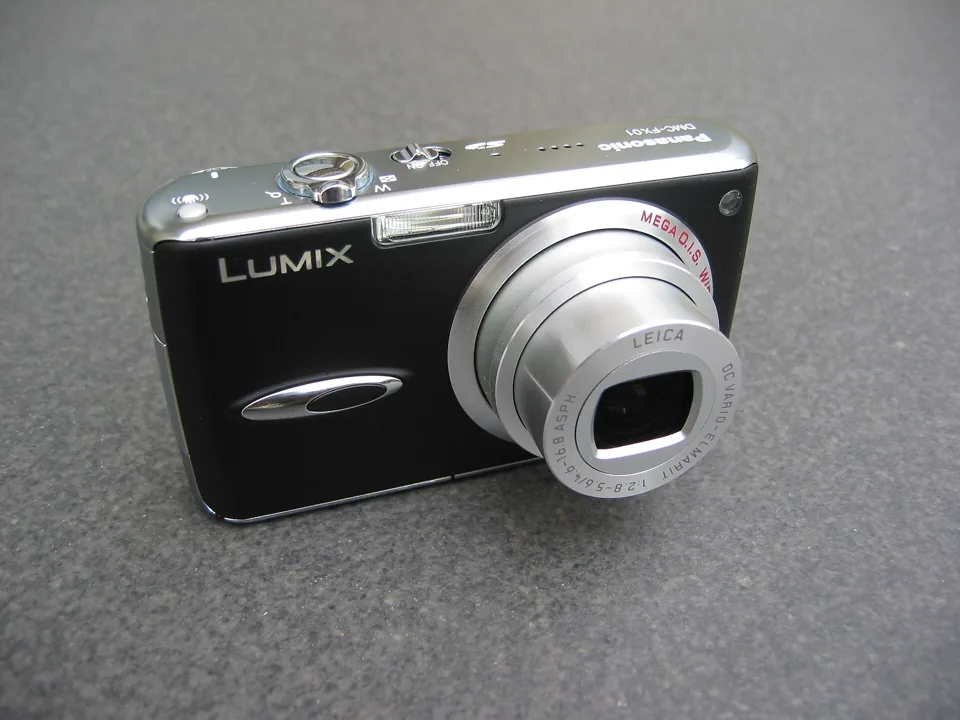
Panasonic announced it on February 14, 2006, with the camera due in March at $349.95.1 DPReview reviewed it on March 27, saying the FX line it belonged to had offered the first serious competition to Canon's Ixus range as the ultra-compact of choice for the style-conscious snapshooter.3 Photo Review found it almost identical to the Leica C-Lux 1, which cost roughly $150 more.4
Why this one was interesting
Wide, in a pocket
The lens was the news. It covered 28 to 102 mm, and DPReview called it highly versatile and said the camera was the smallest 28 mm camera in the world, bringing true wide-angle shooting to the ultra-compact class, something many more serious users had been crying out for.3 Most compacts then started around 35 mm. Wide angles let you fit a room, a group or a street into a pocket-sized camera.
Was it a new chip?
No: a 6-megapixel CCD with MEGA O.I.S. image stabilisation.1 DPReview said the stabilisation worked well and that the camera felt fast and responsive.3 It also praised excellent colour, vivid but natural.3
Panasonic's rise
DPReview's conclusion told a bigger story: in a few years Panasonic had gone from nowhere to a key player, not by marketing or aggressive pricing but by taking risks and filling gaps in the market, with the Leica lens tie-up paying off in image quality. The industry, it said, had stopped joking about microwave makers not being able to do cameras.3
Later Lumix cameras followed the same ideas: see our TZ3 retrospective for the travel-zoom and our LX3 retrospective for the enthusiast model.
The dark: not its strength
DPReview found the camera very noisy at ISO 200 to 400 in low light, noise reduction a bit strong even at lower ISOs, results a little soft at f/5.6 and above, and the ISO 800 and 1600 mode needlessly interpolated back up to 6 megapixels.3 The lens was f/2.8 at wide angle but f/5.6 at telephoto.1




Real photographs taken with this camera. The sensitivity shown is recorded in each file's own EXIF data.

Like that look? See what FX01s have recently sold for on eBay ↗
On eBay right now
Live listings for this camera, supplied by eBay and updated automatically. We earn a commission if you buy through them.
The little wins
A screen to look at
The 2.5-inch screen had 207,000 pixels and a 100 percent field of view, which Imaging Resource called higher than average resolution; DPReview called it big, bright and high resolution.13


.jpg)
How it drew the picture
DPReview found high resolution and clean images with excellent colour in good light, but occasional exposure problems and blown highlights in very bright light.3 Photo Review compared it with the Leica C-Lux 1 and found the Panasonic's resolution slightly better but its saturation less natural, with similar noise at high ISOs.4








Photos taken with this camera, from Wikimedia Commons, credited under each picture.
Where it let you down
There was no manual control of shutter speed or aperture, DPReview noted, and the flash was not very powerful, though fine for normal social shots. It was easy to press buttons by accident when shooting one-handed.3 Photo Review said the FX01 lacked key manual controls and an optical viewfinder.4
What the reviewers said in 2006
| Outlet | Date | Verdict |
|---|---|---|
| DPReview | 27 Mar 2006 | High quality, lovely design and a 28 mm lens in an ultra-compact, with excellent colour; very noisy at ISO 200 to 400 in low light and no manual control.3 |
| Photo Review | Undated | Rated 8.5: some good still and video features in a pocketable body, but missing key manual controls and a viewfinder.4 |
The timeline
- 14 February 2006Panasonic announces the FX01 at $349.95.1
- March 2006It goes on sale.1
- 27 March 2006DPReview publishes its review.3
Should you buy one now?
Buy one if you want a pocketable camera with a wide lens and a bright screen from the era of the first Leica-badged compacts, and you will keep ISO low. It launched at $349.95;1 what it sells for now is a question for the sold listings, not for us. Before you bid, check these:
- The lens. It must extend and retract cleanly; the lens is the point of the camera.
- The battery. It was rated for about 320 pictures when new;4 a fresh one is on Amazon ↗.
- The card. It takes SD and MMC cards.1
- The screen. It is the whole viewfinder; look for scratches.1
- The buttons. Easy to press by accident,3 so check they all work.
If you are wondering why cameras like this are being hunted down again, we tell that story once, in Pictures that never left the card.
See recent sold prices on eBay ↗Shop on eBay ↗Replacement battery ↗
New to the jargon (CCD, ISO, xD cards, IXUS vs ELPH)? Read our plain-English digicam glossary.
Sources
- Imaging Resource, “Panasonic Lumix DMC-FX01” announcement by Mike Tomkins (14 Feb 2006)
- Imaging Resource, Panasonic DMC-FX01 overview (updated 14 Feb 2006)
- DPReview, Panasonic Lumix DMC-FX01 review (27 Mar 2006)
- Photo Review (Australia), Panasonic Lumix DMC-FX01 review (undated; compared with the Leica C-Lux 1)
Camera photos by Magnus Manske (CC BY-SA 3.0); other photographs are credited under each one, all via Wikimedia Commons. Links to eBay and Amazon are affiliate links.